
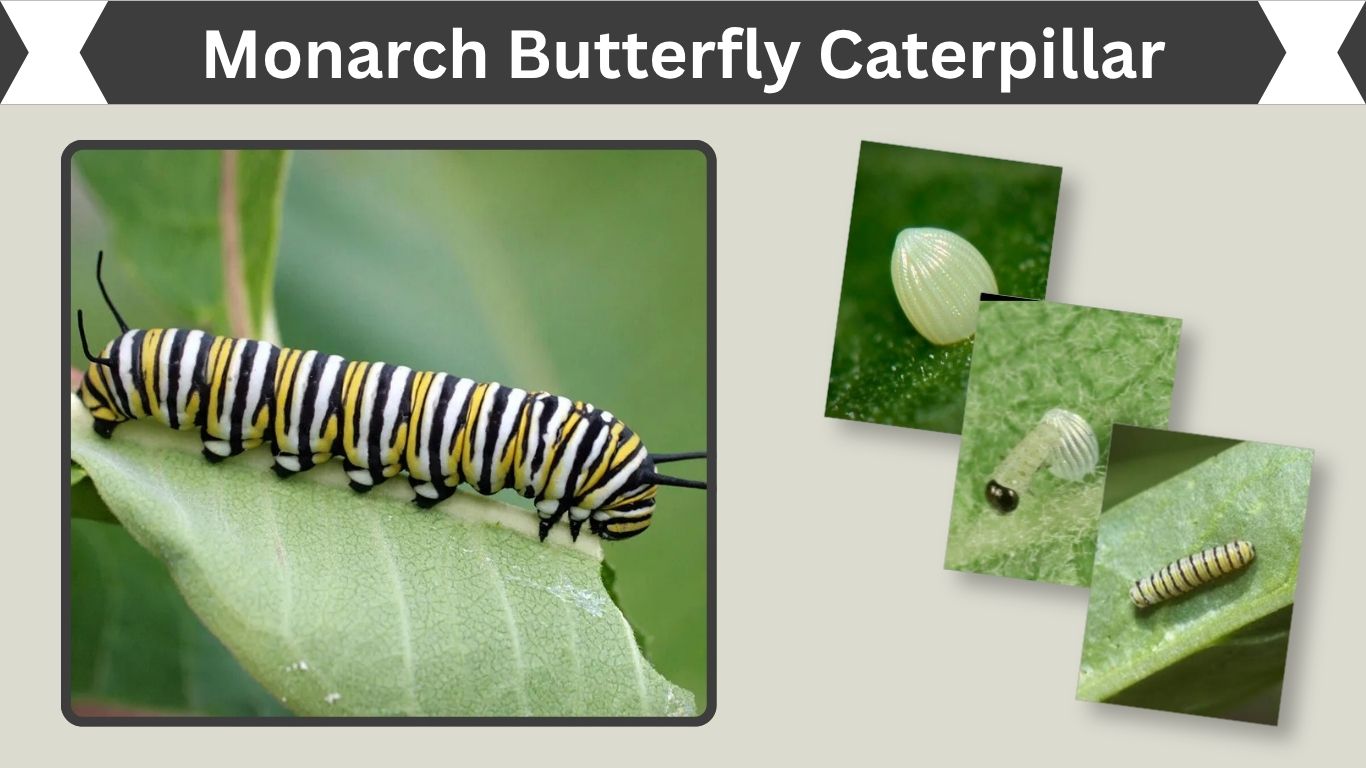
The monarch butterfly caterpillar is one of North America’s most recognizable larvae. Its bold black, white, and yellow bands make it easy to notice on milkweed plants, where it spends most of its growing period. During the caterpillar stage, it eats rapidly, molts several times, and eventually forms a green chrysalis before emerging as an orange-and-black monarch butterfly. Learning how to identify monarch caterpillars, eggs, food plants, growth stages, and common look-alikes can help gardeners protect these fascinating insects.
What Does a Monarch Butterfly Caterpillar Look Like?
A monarch butterfly caterpillar has a smooth, cylindrical body covered with alternating black, white, and yellow bands. The colors become brighter and more noticeable as the caterpillar grows.
Unlike many moth larvae, monarch caterpillars are not fuzzy or hairy. They also have flexible black filaments that resemble antennae but are not true antennae.
Monarch Caterpillar Identification
Important identification features include:
- Black, white, and yellow horizontal body bands
- Two pairs of long black filaments
- One pair of filaments near the head
- One shorter pair near the rear
- Smooth body without hairs or spines
- Black head with pale markings
- Usually found eating milkweed leaves
Young monarch caterpillars may look pale or mostly grayish before their striped pattern becomes fully visible.
How Big Does a Monarch Caterpillar Get?
A newly hatched monarch caterpillar is only a few millimeters long. By its final growth stage, it can reach approximately 1.5 to 2 inches in length.
Its size increases dramatically because the caterpillar spends most of its time eating. Before each growth stage, it sheds its old skin through a process called molting.
Monarch Butterfly Eggs and Hatching
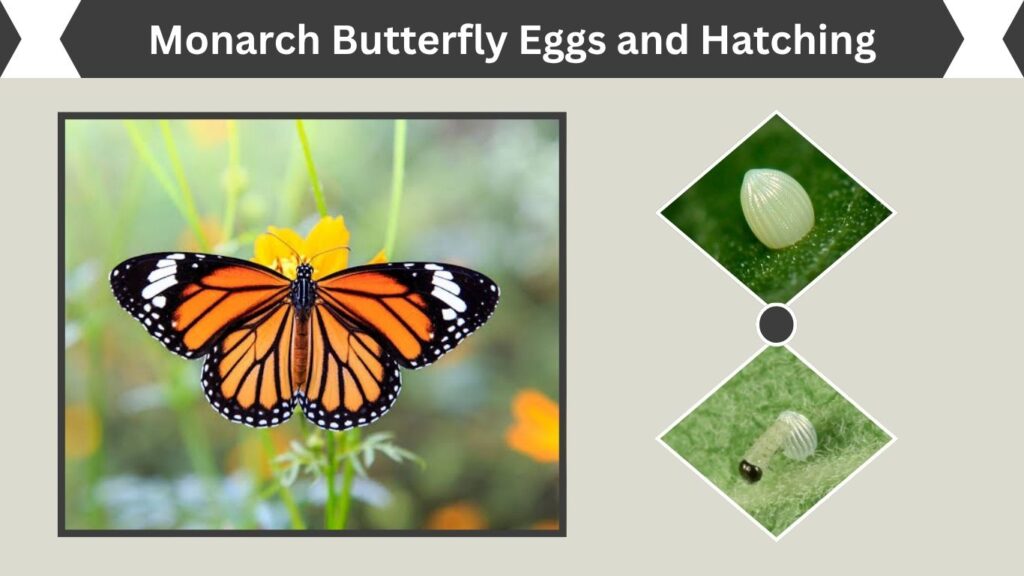
Female monarch butterflies normally lay their eggs individually on milkweed plants. Eggs are often placed on the underside of a leaf, although they may also appear on stems, flower buds, or the upper leaf surface.
What Do Monarch Butterfly Eggs Look Like?
Monarch eggs are:
- Creamy white or pale yellow
- Dome-shaped
- About the size of a pinhead
- Covered with fine vertical ridges
- Usually attached individually to milkweed
Monarch eggs can sometimes be confused with milkweed sap, aphids, or other insect eggs. A magnifying glass can make the egg’s ridged surface easier to see.
From Egg to Caterpillar
The egg normally hatches after several days, depending on temperature and environmental conditions. The tiny caterpillar often eats part or all of its eggshell before beginning to feed on the milkweed leaf.
Newly hatched caterpillars are extremely small and vulnerable to heat, rain, predators, pesticides, and accidental disturbance.
Monarch Butterfly Caterpillar Stages
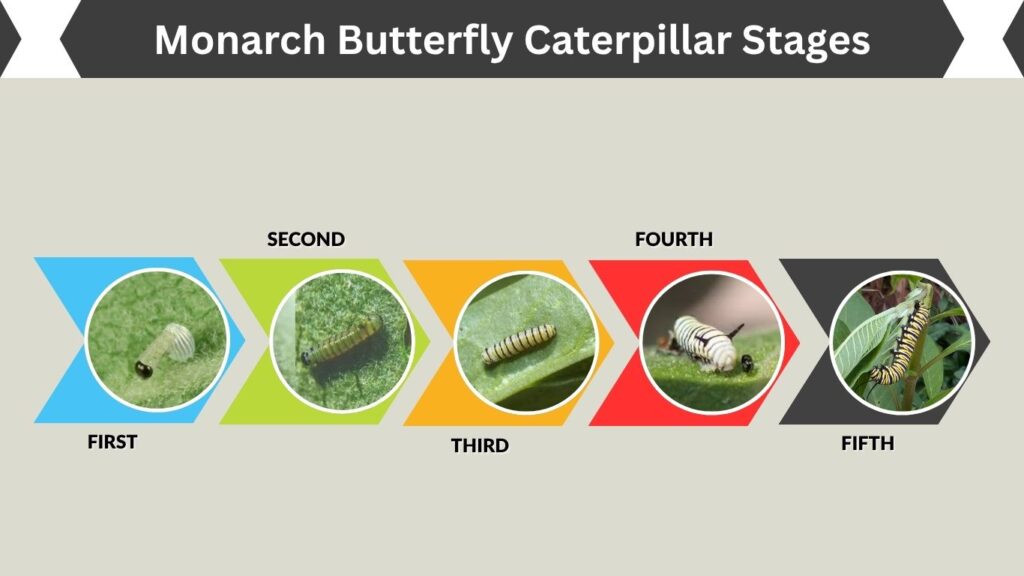
Monarch caterpillars pass through five larval stages called instars. During each instar, the caterpillar grows until its outer skin becomes too tight. It then molts and enters the next stage.
| Instar | General Appearance | Typical Development |
| First | Tiny, pale, faintly striped | Begins feeding on milkweed |
| Second | Clearer stripes and short filaments | Eats larger sections of leaves |
| Third | Bold bands become visible | Body and filaments grow quickly |
| Fourth | Larger, brightly patterned | Consumes substantial milkweed |
| Fifth | Thick body and long filaments | Prepares to form a chrysalis |
How Long Is the Caterpillar Stage?
A monarch generally remains a caterpillar for around 10 to 14 days in warm conditions. Cooler temperatures, food availability, and the caterpillar’s health can lengthen development.
During this short period, the larva grows from a nearly microscopic hatchling into a large, fully striped caterpillar.
Monarch Caterpillar to Chrysalis
When the caterpillar is fully grown, it leaves its feeding area and searches for a protected place. It attaches a silk pad to a branch, leaf, enclosure roof, or another suitable surface.
The caterpillar hangs upside down in a curved “J” shape. After approximately 12 to 24 hours, it sheds its striped skin and reveals a soft green chrysalis underneath.
Monarch Butterfly Chrysalis
The monarch chrysalis is jade green with small metallic-looking gold spots. Although many people call it a cocoon, monarch butterflies technically form a chrysalis. Cocoons are silk coverings commonly made by moth caterpillars.
Inside the chrysalis, the caterpillar undergoes metamorphosis. Its body is reorganized into the structures of an adult butterfly, including wings, antennae, compound eyes, and long legs.
How Long From Caterpillar to Monarch Butterfly?
The chrysalis stage commonly lasts around 8 to 15 days, although temperature can affect the timing. Shortly before emergence, the chrysalis becomes transparent, allowing the butterfly’s orange-and-black wings to become visible.
From egg to adult butterfly, the complete process often takes approximately three to five weeks under favorable conditions.
What Do Monarch Butterfly Caterpillars Eat?
Monarch caterpillars depend on milkweed plants. Milkweed is their primary host plant and provides both nutrition and chemical protection.
Milkweed and Monarch Caterpillars
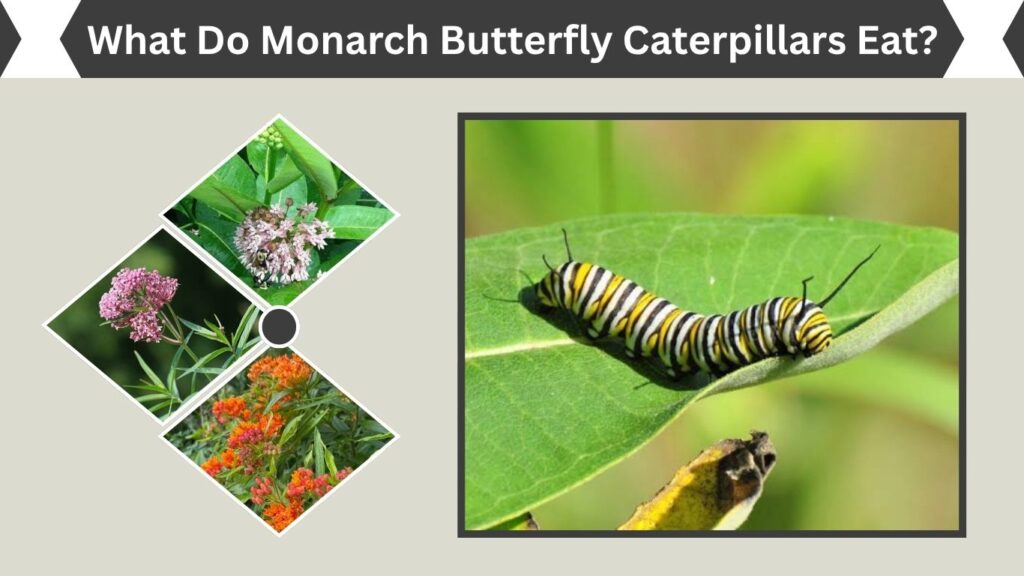
Milkweed contains compounds called cardenolides. Monarch caterpillars store some of these chemicals in their bodies, making them unpleasant or harmful to many potential predators.
Common milkweed species used by monarch caterpillars include:
- Common milkweed
- Swamp milkweed
- Butterfly weed
- Showy milkweed
- Tropical milkweed
- Antelope-horns milkweed
The milkweed species available depends on the region. Native milkweed is usually the best choice for supporting local monarch populations.
Do Monarch Caterpillars Eat Parsley?
Monarch caterpillars do not normally eat parsley, dill, fennel, or carrots. Caterpillars found on these plants are more likely to be black swallowtail larvae.
A caterpillar may crawl onto a nearby non-host plant while searching for a place to molt or form a chrysalis, but it still requires milkweed for regular feeding.
How to Care for a Monarch Butterfly Caterpillar
Monarch caterpillars are sometimes raised in protected enclosures for observation or education. However, they require clean conditions, adequate ventilation, and a steady supply of safe milkweed.
Basic Caterpillar Care
Provide fresh, pesticide-free milkweed every day. Wash and dry the leaves carefully before offering them, especially when their treatment history is unknown.
Keep the enclosure ventilated and out of direct afternoon sunlight. Excessive heat can quickly harm eggs, caterpillars, and chrysalises.
Remove old leaves and caterpillar waste, called frass, daily. Crowded or dirty enclosures can encourage disease and parasite transmission.
Avoid handling the caterpillars unnecessarily. Young larvae are delicate and can be injured easily during molting.
Signs of a Healthy Caterpillar
A healthy monarch caterpillar usually:
- Eats regularly
- Produces dark green or brown frass
- Grows noticeably between molts
- Grips leaves and stems firmly
- Becomes temporarily inactive before molting
- Forms a normal J shape before pupating
Temporary inactivity is not always a sign of illness. Caterpillars often stop eating and remain still while preparing to shed their skin.
Monarch Caterpillar Predators
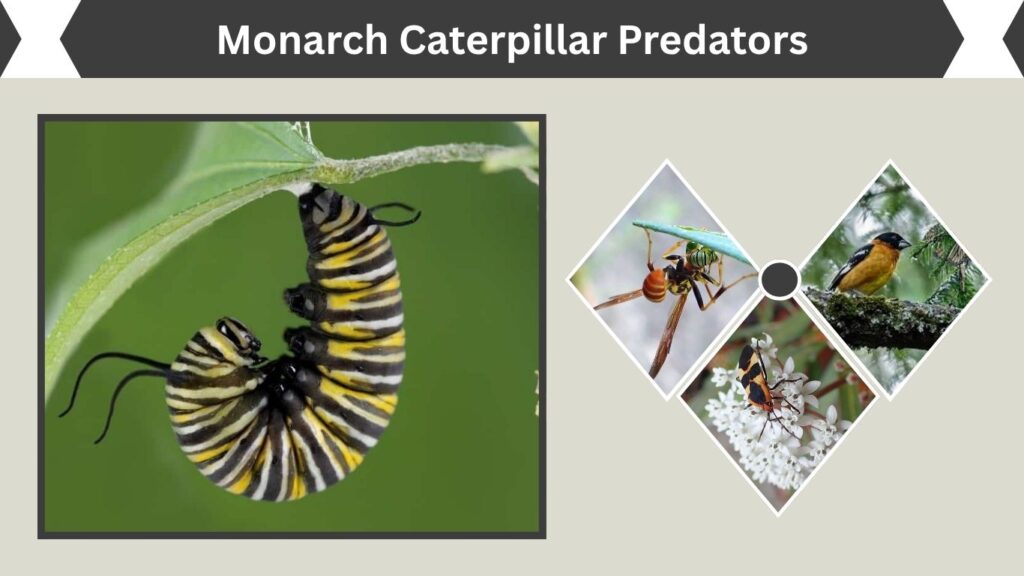
Milkweed chemicals provide some protection, but monarch caterpillars are not completely safe from predators.
Ants, spiders, wasps, assassin bugs, stink bugs, beetles, and other insects may attack eggs or caterpillars. Parasitic tachinid flies can also lay eggs on monarch larvae. The fly larvae later develop inside the caterpillar or chrysalis.
Heavy rain, extreme temperatures, pesticides, and a shortage of healthy milkweed can further reduce survival.
Monarch Butterfly Caterpillar Look-Alikes
Several striped caterpillars may be mistaken for monarch larvae.
Queen Butterfly Caterpillar vs. Monarch
Queen butterfly caterpillars have similar black, white, and yellow bands. However, queen caterpillars generally have three pairs of long filaments, while monarch caterpillars have two pairs.
Both species feed on milkweed, so they may occasionally appear in similar habitats.
Black Swallowtail Caterpillar
A mature black swallowtail caterpillar has green, black, and yellow markings. It usually feeds on parsley, dill, fennel, and plants in the carrot family rather than milkweed.
When disturbed, it may extend an orange, forked scent gland called an osmeterium.
Milkweed Tussock Moth Caterpillar
Milkweed tussock moth caterpillars also eat milkweed. Unlike smooth monarch caterpillars, they are covered with dense tufts of black, white, and orange hairs.
Are Monarch Caterpillars Poisonous?
Monarch caterpillars are not venomous and cannot sting. Their filaments are soft sensory structures rather than stingers.
However, the caterpillars absorb defensive chemicals from milkweed. These chemicals may make them toxic or unpleasant to animals that try to eat them. People should avoid intentionally consuming or placing caterpillars near the mouth and should wash their hands after handling milkweed.
FAQs
What Caterpillar Turns Into a Monarch Butterfly?
The black, white, and yellow striped larva of the monarch butterfly, scientifically known as Danaus plexippus, becomes an adult monarch. It has two pairs of black filaments and normally feeds exclusively on milkweed during its caterpillar stage.
How Long Does a Monarch Stay a Caterpillar?
A monarch usually remains in the caterpillar stage for approximately 10 to 14 days. Development may be faster in warm conditions or slower during cool weather. During this period, the caterpillar passes through five instars and molts between each one.
Is a Monarch Caterpillar Fuzzy?
No. Monarch caterpillars have smooth bodies with bold black, white, and yellow bands. A fuzzy caterpillar found on milkweed is more likely to be a milkweed tussock moth caterpillar or another moth larva.
Why Is My Monarch Caterpillar Not Moving?
A motionless caterpillar may be preparing to molt or form a chrysalis. It may stop eating and remain still for several hours. However, prolonged weakness, discoloration, fluid leakage, or failure to grip surfaces can indicate injury, disease, pesticide exposure, or parasitism.
Can Monarch Caterpillars Live Without Milkweed?
Monarch caterpillars cannot complete normal development without milkweed. It is their essential host plant and primary food source. Adult monarch butterflies drink nectar from many flowers, but their caterpillars rely on milkweed leaves, buds, flowers, and tender stems.
