
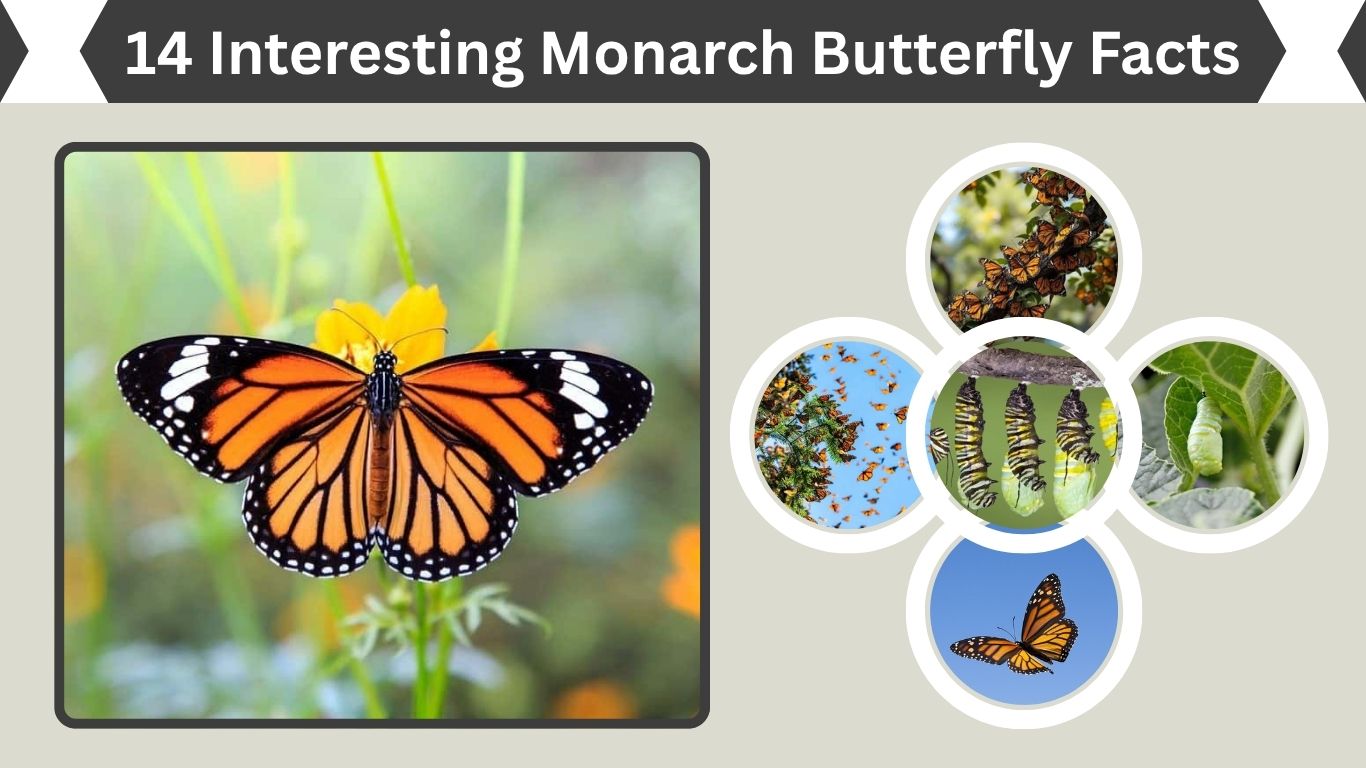
Monarch butterflies are famous for their orange-and-black wings, but their appearance is only one part of what makes them remarkable. These butterflies complete an extraordinary transformation, depend on milkweed plants, use an internal navigation system, and travel enormous distances during migration. Several generations participate in their annual journey, yet one special generation completes nearly the entire southward trip. The following interesting monarch butterfly facts explore their appearance, diet, life cycle, behavior, migration, and importance in the natural world.
Interesting Facts About Monarch Butterflies
Monarch butterflies have developed unusual adaptations that allow them to find food, discourage predators, survive changing seasons, and migrate across a continent. Here are 14 facts that demonstrate why the monarch is one of the world’s most fascinating butterflies.
1. Their Scientific Name Is Danaus plexippus
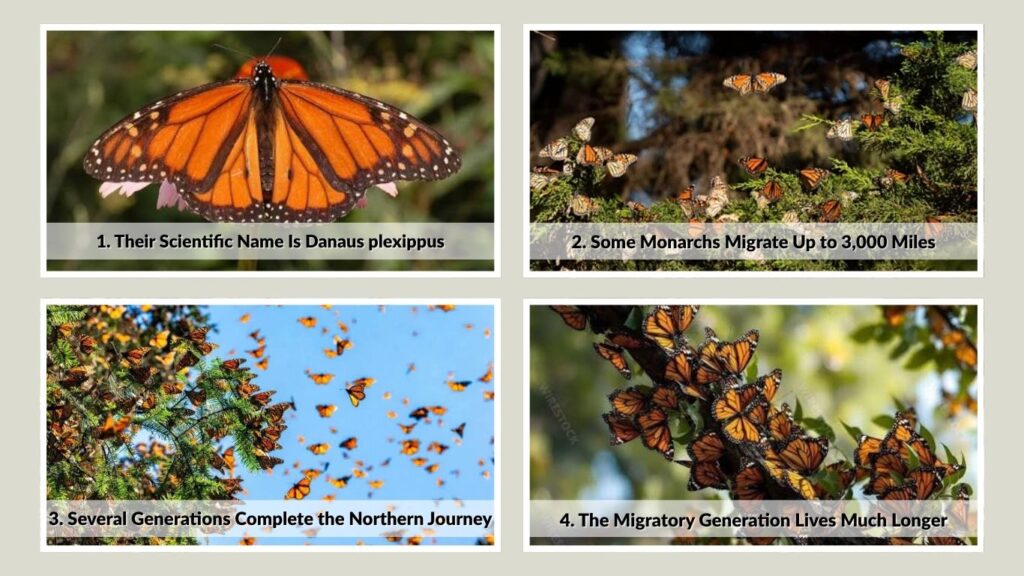
The monarch butterfly’s scientific name is Danaus plexippus. It belongs to the family Nymphalidae, a large group often called brush-footed butterflies.
Adult monarchs have brilliant orange wings divided by black veins. Black borders containing two rows of white spots surround the wings. Most adults have a wingspan of approximately 3.5 to 4 inches, making the monarch relatively large compared with many common garden butterflies.
2. Some Monarchs Migrate Up to 3,000 Miles
Eastern North American monarch butterflies undertake one of the longest known insect migrations. During fall, some fly up to 3,000 miles from southern Canada and the northern United States to overwintering forests in central Mexico.
Western monarchs generally travel shorter distances, migrating to coastal groves in California and northern Baja California. Monarchs conserve energy by gliding on favorable air currents instead of continuously flapping their wings.
3. Several Generations Complete the Northern Journey
The same butterfly does not normally make a complete round trip between Mexico and northern Canada. Monarchs leaving Mexico in spring travel north, reproduce, and die. Their offspring continue the journey.
It commonly takes three or four generations to reach the northern portion of the breeding range. However, the final generation of the year makes the long return flight south without help from later generations. These butterflies travel to forests they have never previously visited.
4. The Migratory Generation Lives Much Longer
Monarch butterflies born during spring and early summer generally live as adults for only about two to six weeks. They spend much of that time mating and laying eggs.
The late-summer migratory generation is different. Sometimes called the “super generation,” these butterflies may survive for six to nine months. They delay reproduction, store energy, migrate south, survive winter, and begin traveling north again in spring.
5. Monarchs Use the Sun to Navigate
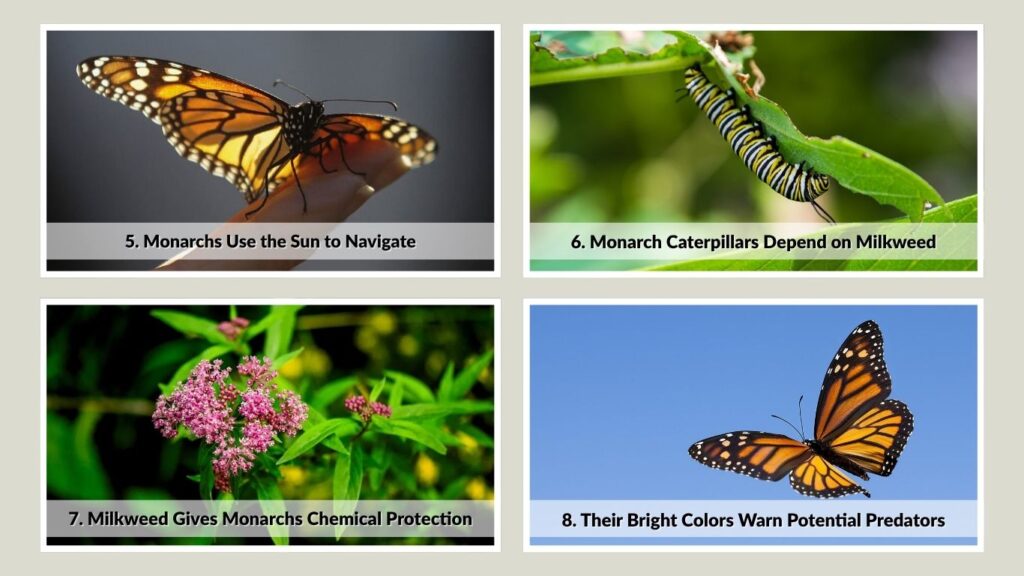
Migrating monarchs do not simply follow other butterflies. They possess a time-compensated sun compass that allows them to maintain the correct direction while the sun moves across the sky.
Their internal biological clock helps them adjust their direction according to the time of day. Research also shows that clocks located in their antennae play an important role in this navigation system. This allows monarchs that have never migrated before to travel toward the correct overwintering region.
6. Monarch Caterpillars Depend on Milkweed
Monarch caterpillars are specialized feeders that depend on plants in the milkweed family. Female monarchs search for milkweed and usually place their eggs individually on its leaves or stems.
After hatching, the tiny caterpillars consume milkweed leaves, flower buds, flowers, and tender plant tissue. Without milkweed across their breeding range, monarchs cannot produce the generations required to maintain their population and complete migration.
7. Milkweed Gives Monarchs Chemical Protection
Milkweed contains defensive chemicals called cardenolides. Monarch caterpillars have adaptations that allow them to consume milkweed and retain some of these chemicals in their bodies.
The compounds can make both caterpillars and adult butterflies distasteful or harmful to certain predators. However, milkweed does not make monarchs completely predator-proof. Spiders, wasps, ants, birds, parasitic flies, and other animals may still attack eggs, caterpillars, chrysalises, or adults.
8. Their Bright Colors Warn Potential Predators
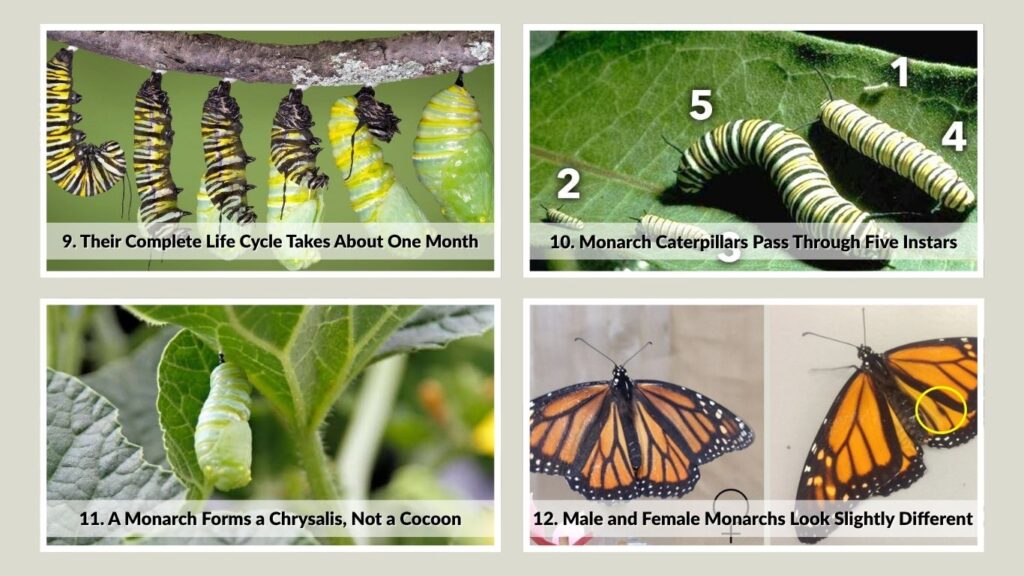
The monarch’s orange-and-black wings are more than decorative. Their bold coloration acts as a warning signal that tells potential predators the butterfly may be unpleasant to eat.
Monarch caterpillars also display noticeable black, white, and yellow bands. This type of warning coloration is known as aposematism. A predator that has an unpleasant experience after attacking a monarch may learn to avoid similarly colored butterflies in the future.
9. Their Complete Life Cycle Takes About One Month
Monarch butterflies undergo complete metamorphosis through four stages: egg, caterpillar, chrysalis, and adult.
The egg usually hatches within several days. The caterpillar then eats and grows for roughly two weeks before forming a chrysalis. The butterfly generally remains inside the chrysalis for about one to two weeks. Under suitable temperatures, the entire journey from egg to adult takes approximately one month.
10. Monarch Caterpillars Pass Through Five Instars
A monarch caterpillar’s skin cannot continuously expand as its body grows. It must shed its old outer covering several times.
The caterpillar completes five growth stages called instars. It becomes larger after every molt, and its black, white, and yellow pattern grows more noticeable. During its final instar, the caterpillar may reach approximately 2 inches long. It then stops eating, searches for a protected location, and prepares to form a chrysalis.
11. A Monarch Forms a Chrysalis, Not a Cocoon
People frequently call the monarch’s pupal covering a cocoon, but this is technically incorrect. Monarch butterflies form a chrysalis. Cocoons are protective silk coverings produced by many moth caterpillars around their pupae.
A monarch chrysalis is jade green with small gold-colored markings. Shortly before the adult emerges, the covering becomes transparent, revealing the butterfly’s dark body and folded orange-and-black wings.
12. Male and Female Monarchs Look Slightly Different
Male and female monarch butterflies have similar colors, but close observation reveals several differences. Males usually have thinner black veins running across their wings. They also possess a black scent-scale spot on each hindwing.
Females lack these distinct hindwing spots and generally have thicker black veins. Males are often slightly larger, although size alone is not always a reliable way to determine a monarch’s sex.
13. Monarchs Appear to Have Only Four Legs
Like other insects, monarch butterflies technically have six legs. However, the small front pair is reduced and held close to the body. Consequently, a monarch often appears to walk on only four legs.
This feature is common among members of the brush-footed butterfly family. The reduced front legs contain sensory structures and are not normally used for walking in the same way as the longer middle and hind legs.
14. Adult Monarchs Help Pollinate Wildflowers
Caterpillars depend on milkweed, but adult monarchs drink nectar from many different flowering plants. They use a long, tube-shaped mouthpart called a proboscis to reach liquid nectar.
While moving between flowers, monarchs may carry pollen and contribute to wildflower pollination. Nectar also provides the carbohydrates migrating monarchs need to build fat reserves and fuel their journey. Gardens containing native milkweed and season-long nectar flowers can provide important breeding and migration habitat.
Why Monarch Butterflies Need Protection
Although monarchs possess impressive survival adaptations, most individuals never reach adulthood. U.S. Fish and Wildlife Service material reports mortality exceeding 90% during the egg and larval stages. Eggs and young caterpillars are vulnerable to weather, predators, parasites, diseases, and pesticide exposure.
Monarch populations also depend on connected habitats across Canada, the United States, and Mexico. Loss of milkweed, limited nectar sources, severe weather, pesticide use, and damage to overwintering forests can disrupt different parts of their annual cycle.
Homeowners can help by planting locally native milkweed, growing nectar-producing flowers, avoiding unnecessary pesticide use, and allowing some natural vegetation to remain. Native milkweed that dies back seasonally may also reduce conditions that encourage the transmission of certain monarch parasites.
FAQs
How Long Does a Monarch Butterfly Live?
Most spring and summer monarch butterflies live for approximately two to six weeks as adults. The special migratory generation can survive for six to nine months because it delays reproduction and conserves energy while migrating and overwintering.
What Do Monarch Butterflies Eat?
Adult monarchs drink nectar from milkweed and many other flowers. Their caterpillars have a much more restricted diet and depend on milkweed plants. Milkweed provides the nutrition caterpillars require to grow and the defensive compounds that help discourage some predators.
Are Monarch Butterflies Poisonous?
Monarchs retain defensive chemicals obtained from milkweed, which can make them toxic or distasteful to some animals. However, they are not venomous, do not have stingers, and cannot inject poison. Their bright colors warn predators against eating them.
Where Do Monarch Butterflies Go During Winter?
Most eastern North American monarchs overwinter in mountain forests in central Mexico. Many western monarchs gather in sheltered tree groves along coastal California and northern Baja California. These locations provide the cool, protected conditions needed to conserve energy.
How Can You Attract Monarchs to a Garden?
Plant milkweed species native to your region so females have somewhere to lay eggs and caterpillars have food. Add several nectar-rich native flowers that bloom during different seasons. Avoid pesticides and provide a sunny, sheltered garden area where butterflies can feed and rest.
