
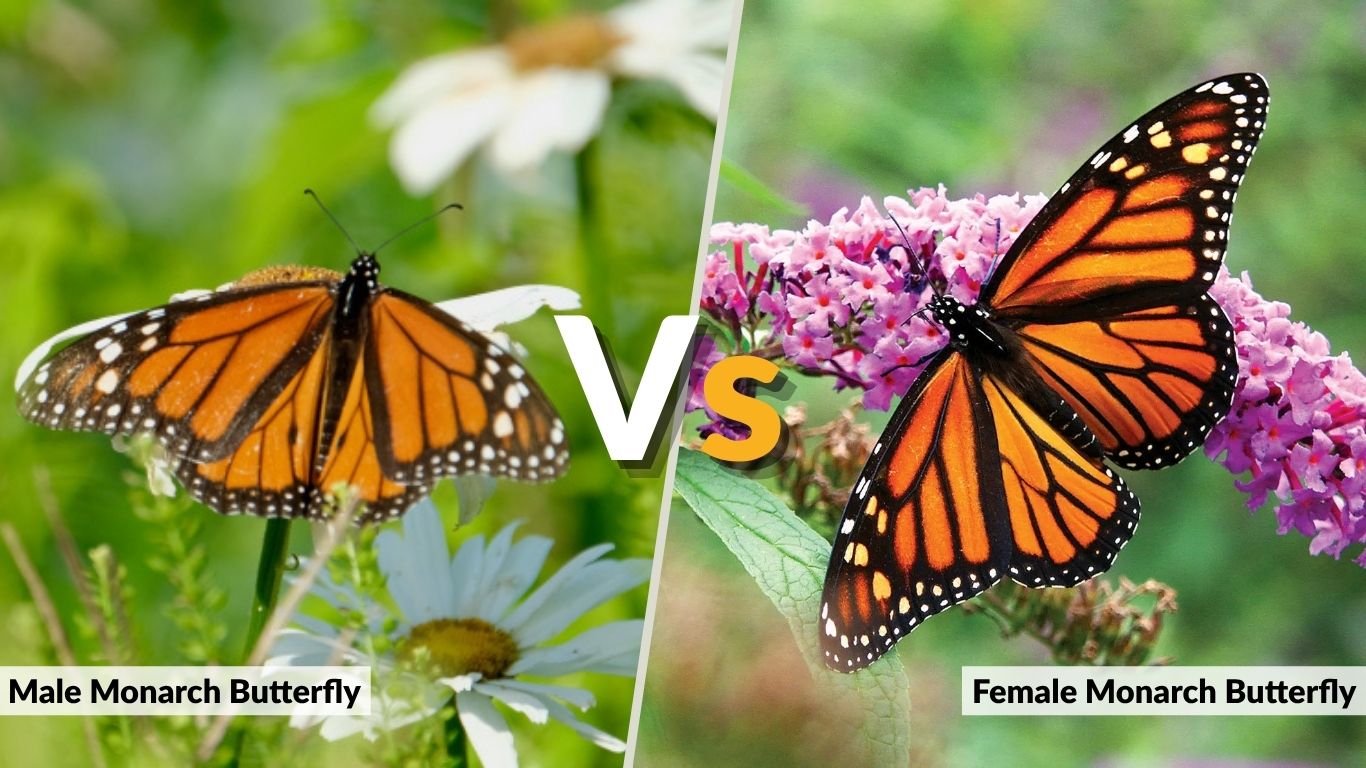
Male and female monarch butterflies look almost identical at first glance. Both have bright orange wings, black veins, dark borders, and rows of white spots. However, several physical features make them surprisingly easy to distinguish. Male monarchs have two noticeable black scent spots on their hindwings and usually possess thinner wing veins. Females lack these spots and generally have thicker, darker veins. Differences also occur in their abdomen shape, reproductive anatomy, and behavior. This guide explains how to identify a male vs. female monarch butterfly accurately in gardens, photographs, and the wild.
Male vs. Female Monarch Butterfly Comparison
The easiest way to determine a monarch’s sex is to examine the upper surface of its open hindwings. Black spots are the strongest sign of a male, while thick veins without these spots indicate a female.
| Feature | Male Monarch | Female Monarch |
| Black hindwing spots | Present | Absent |
| Wing veins | Usually thinner | Usually thicker |
| Overall color | Often brighter orange | Frequently darker |
| Average size | Often slightly larger | Often slightly smaller |
| Abdomen tip | Has reproductive claspers | Broader, without male claspers |
| Main reproductive role | Finds and mates with females | Finds milkweed and lays eggs |
How to Identify a Male Monarch Butterfly
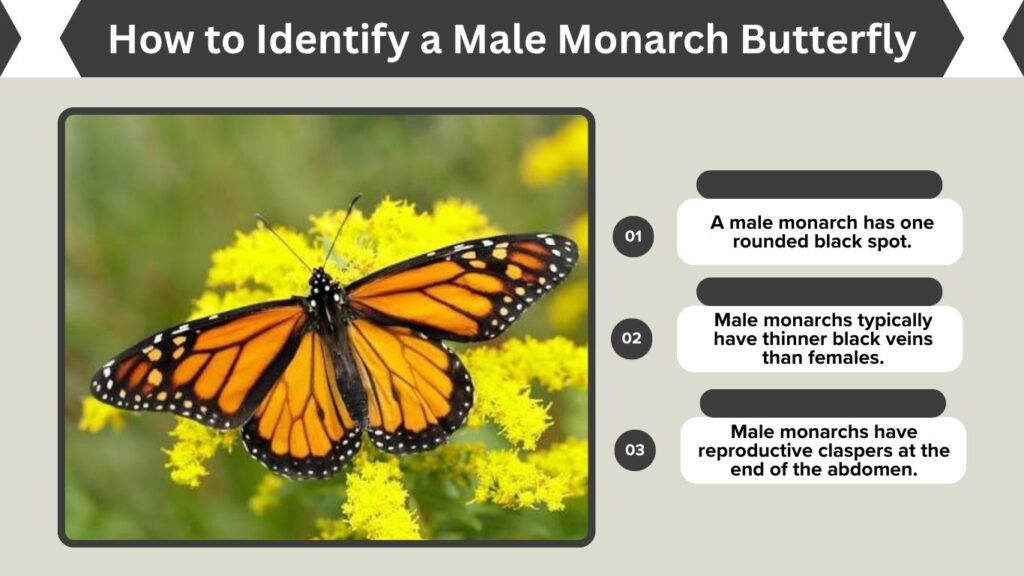
Male monarchs possess several visible characteristics, but their two black hindwing spots provide the most reliable field mark.
Black Spots on the Hindwings
A male monarch has one rounded black spot on a vein of each hindwing. With the wings open, the butterfly therefore displays two spots—one on either side of its body.
These markings consist of specialized scales and are sometimes called scent patches, alar glands, or androconial spots. Although similar structures release courtship chemicals in many butterflies, monarch mating does not appear to depend strongly on pheromones.
The spots may be harder to see when the wings are closed. Waiting for the butterfly to open its wings or examining a clear photograph usually makes identification easier.
Thinner Black Wing Veins
Male monarchs typically have thinner black veins than females. Because the veins occupy less of the wing surface, males may appear brighter or more orange.
Vein thickness is useful when the scent spots are hidden or difficult to see. However, lighting, wing position, wear, and photographic quality can affect how thick the veins appear. The hindwing spots remain the more dependable characteristic.
Male Body and Abdomen
Male monarchs have reproductive claspers at the end of the abdomen. These structures help the male attach to the female during mating.
The abdominal tip may look narrower or differently shaped than a female’s, but this difference can be difficult to observe on a living butterfly. Wing markings are generally safer and easier to use for identification.
How to Identify a Female Monarch Butterfly
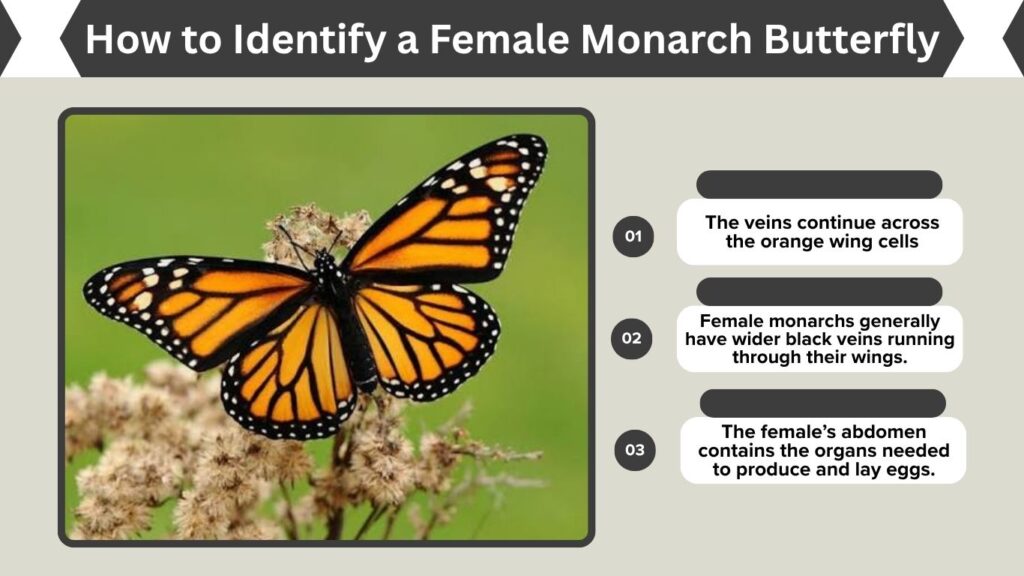
Female monarchs lack the specialized black spots found on male hindwings. Their darker vein pattern is usually the second most noticeable difference.
No Black Scent Spots
A female monarch does not have the two rounded black marks on her hindwings. The veins continue across the orange wing cells without forming the male’s enlarged black patches.
When checking a butterfly, examine both hindwings carefully. Random damage, shadows, dirt, or dark areas created by overlapping wings should not be mistaken for male scent spots.
Thicker and Darker Wing Veins
Female monarchs generally have wider black veins running through their wings. This heavier black pattern can give females a darker overall appearance than males.
Color alone is not completely reliable. Individual monarchs vary naturally, and older butterflies can lose wing scales or become faded. A female should therefore be identified through a combination of thick veins and the absence of hindwing spots.
Female Abdomen
The female’s abdomen contains the organs needed to produce and lay eggs. It may appear broader or fuller, particularly when she is carrying mature eggs.
Body thickness should not be used alone to identify sex. Feeding condition, viewing angle, age, and abdominal movement can change the butterfly’s appearance.
Key Wing Differences
Male and female monarchs have the same general orange, black, and white pattern. The differences are small modifications within that shared design.
| Wing Characteristic | Male | Female | Reliability |
| Two rounded hindwing spots | Yes | No | Very high |
| Thick black veins | No—usually thinner | Yes—usually wider | High |
| Darker appearance | Less common | More common | Moderate |
| Brighter orange color | More common | Less common | Moderate |
| White border spots | Present | Present | Not useful for sexing |
| General wing shape | Similar | Similar | Low |
Are Male Monarchs Larger Than Females?
Male monarchs are often slightly larger, according to the National Park Service. However, size varies among individuals and is influenced by conditions during larval development. A well-fed female may be larger than a particular male, so size is not a dependable identification method by itself.
Behavioral Differences Between Males and Females

Behavior can offer additional clues, particularly during the breeding season. Nevertheless, observing the wings is still more reliable than guessing sex from flight or feeding activity.
Male Monarch Behavior
Male monarchs commonly patrol areas containing milkweed while searching for females. They may chase other monarchs, circle around them in flight, or attempt to initiate courtship.
A male can use the claspers at the end of his abdomen to hold a female during mating. Monarch pairs may remain attached for many hours while reproductive materials are transferred.
Female Monarch Behavior
Female monarchs spend part of the breeding season searching for suitable milkweed plants. Milkweed is essential because monarch caterpillars depend on it for food.
A female tests plants using chemical receptors on her legs. She drums or touches the plant surface, which helps her determine whether it is an appropriate host before depositing an egg. Female monarchs normally lay their eggs individually rather than in large clusters.
Male and Female Reproductive Roles

The reproductive anatomy and behavior of male and female monarchs differ considerably, even though their wings look similar.
| Reproductive Feature | Male Monarch | Female Monarch |
| Produces | Sperm and mating materials | Eggs |
| Searches for | Receptive females | Suitable milkweed |
| Abdominal structure | Claspers used during mating | Egg-laying reproductive opening |
| Milkweed testing | Does not lay eggs | Tests plants with receptors on legs |
| Egg laying | No | Yes |
| Sex chromosomes | ZZ | ZW |
Female monarchs may lay hundreds of eggs during their reproductive period, although many eggs and young caterpillars do not survive. The butterfly’s sex is determined genetically; environmental temperature does not turn developing monarchs male or female.
Can You Identify Male and Female Monarch Caterpillars?
Male and female monarch caterpillars have the same black, white, and yellow striped appearance. They also pass through the same five larval growth stages and eat the same milkweed plants.
There is no simple external feature that allows an ordinary observer to identify a caterpillar as male or female. The distinctive wing spots and vein differences do not become visible until the adult butterfly emerges.
Do Male and Female Monarchs Migrate?
Both male and female monarch butterflies participate in migration. They use nectar flowers for energy and travel toward suitable seasonal habitat.
The migratory generation delays reproductive development during its southward journey and overwintering period. Reproductive activity resumes as conditions change and the monarchs begin their northward movement. Therefore, the presence of egg-laying behavior depends on season and generation rather than sex alone.
Common Identification Mistakes
Several factors can cause people to incorrectly identify a male or female monarch:
- Mistaking a shadow or damaged scale patch for a male scent spot
- Using orange color alone to determine sex
- Assuming every larger monarch is male
- Examining only the forewings instead of the hindwings
- Confusing a monarch with a viceroy, queen, or another orange butterfly
- Trying to identify the sex of a caterpillar from its stripes
For the most accurate result, look for two clearly defined black spots on the hindwings. Spots indicate a male; no spots combined with thicker veins indicates a female.
FAQs
What Is the Main Difference Between a Male and Female Monarch?
The main difference is the presence of black spots on the hindwings. Male monarchs have one rounded black spot on each hindwing, while females have none. Females also usually have thicker black wing veins.
Do Female Monarchs Have Black Spots?
Female monarchs have many black markings, veins, and borders, but they do not have the two specialized rounded spots found on male hindwings. Dark shadows or wing damage can occasionally resemble these spots.
Are Female Monarch Butterflies Darker?
Females often appear darker because their wing veins are thicker and contain more black scaling. However, age, wear, lighting, and natural variation affect color, so darkness should be used together with other identifying features.
Which Monarch Butterfly Lays Eggs?
Only female monarch butterflies lay eggs. They search for milkweed and use sensory receptors on their legs to evaluate potential host plants. The resulting caterpillars depend on milkweed for food after hatching.
Can You Tell a Monarch’s Sex When Its Wings Are Closed?
Identification is more difficult when the wings are closed because the male’s hindwing spots may be hidden. A side view may occasionally reveal a spot, but waiting for the monarch to open its wings provides a much more reliable view.
