

If you live in Texas or anywhere in the southern United States, chances are you’ve come across a red wasp nest hanging from a porch ceiling, tucked under barn rafters, or hidden among tree branches. These papery, umbrella-shaped nests are home to colonies of Polistes carolina, one of the most recognizable wasps in the region. While they provide ecological benefits like pest control, their presence around homes can also pose serious risks due to painful stings. Knowing how to identify, understand, and safely deal with red wasp nests is essential for both safety and coexistence.
What is a Red Wasp Nest?
Red wasps are a species of paper wasp, and their nests reflect this classification. Unlike hornets, which build large enclosed football-shaped nests, or yellowjackets, which prefer underground burrows, red wasps construct open-comb, umbrella-like nests. These nests are made from chewed wood fibers mixed with saliva, which dries into a papery material.
Each hexagonal cell within the nest serves as a nursery where the queen lays eggs. As the colony grows, worker wasps expand the nest, creating additional cells for developing larvae. The open design of a red wasp nest makes it easy to identify since you can often see the larvae or pupae inside the cells.
How Red Wasps Build Their Nests

Nest construction begins in early spring, when a fertilized queen emerges from hibernation and seeks a safe location. She starts with a small stalk and a few cells, laying the first eggs that hatch into workers. These workers then take over nest expansion, foraging for wood fibers, and feeding the next generation of larvae.
The building process follows a clear cycle:
- Queen establishes the nest – a small comb of a few cells.
- Workers enlarge the nest – adding dozens of new cells as the colony grows.
- Peak population in summer – nests may house 20–30 wasps by midsummer.
By fall, the nest reaches its maximum size. Only new queens survive into winter, while the old nest is abandoned and never reused the following year.
Identification of a Red Wasp Nest

The appearance and placement of a nest can help distinguish it from other wasp or hornet nests.
A typical red wasp nest is:
- Umbrella-shaped with visible hexagonal cells
- Attached by a single stalk to a surface such as wood, metal, or brick
- Usually containing reddish-brown wasps visible crawling on or around it
Common nesting locations include:
- House eaves, porches, attics, and barns
- Low tree branches or shrubs
- Outdoor equipment like mailboxes or farm tools
This preference for sheltered but open areas makes red wasp nests common in both urban and rural Texas. Their habit of nesting close to human activity is also the main reason they become problematic.
Seasonal Activity and Nest Life Cycle

Red wasp nests follow a predictable seasonal cycle in Texas and other warm regions. In spring, queens build small starter nests. By summer, these nests grow quickly as workers increase in number and food is abundant. Colonies peak in late summer, often holding dozens of adults along with developing larvae.
In fall, the colony declines. Workers die off as temperatures cool, while newly fertilized queens leave to find sheltered overwintering sites such as hollow trees, attics, or beneath bark. The old nest remains intact but is no longer inhabited. Unlike honeybees, red wasps never reuse an old nest. Each spring, the cycle begins anew.
Dangers of Red Wasp Nests Near Homes
While red wasps are not as aggressive as yellowjackets, their nests pose a risk when built near people. Wasps are defensive of their colonies and will attack if they sense a threat. A disturbed nest can result in multiple stings within seconds.
Three key dangers of red wasp nests around homes are:
- Multiple Stings: Unlike bees, wasps can sting repeatedly, releasing pheromones that signal others to join the attack.
- Allergic Reactions: For individuals with wasp venom allergies, a single sting can trigger severe reactions, including anaphylaxis.
- High-Risk Locations: Nests built on porches, attics, or playground equipment increase the chance of accidental contact by children or pets.
In rural Texas, nests in barns or farm equipment are particularly dangerous, as people may accidentally disturb them while working. For outdoor workers, farmers, and homeowners, awareness and caution are critical.
Red Wasp Nest vs Other Wasp Nests (Quick Comparison)

| Feature | Red Wasp (Polistes carolina) | Yellowjacket | Hornet | Other Paper Wasps |
| Nest shape | Open, umbrella-shaped comb (cells exposed) | Enclosed paper nest; often underground or wall voids | Large football-shaped paper nest, fully enclosed | Open comb like red wasp, but species usually brown/black |
| Typical location | Eaves, barns, porch ceilings, shrubs | Ground burrows, soffits, wall voids | Trees, building overhangs, high shrubs | Eaves, fences, light fixtures |
| Aggression near nest | Defensive; moderate | Highly aggressive | Moderately aggressive | Generally moderate |
| Seasonality | Spring start → summer peak → fall decline | Similar, but many persist into late fall | Similar | Similar |
What to Do If You Find a Red Wasp Nest
Rapid Assessment (3 checks)
- Distance & traffic: Is it near doors, play areas, or animal paths?
- Size: Golf-ball starter, palm-sized, or larger with dozens of adults?
- Access & height: Can you reach safely without ladders or contortions?
If it’s small, high, and away from people, consider leaving it until winter when it’s abandoned.
Safe DIY Removal (Small Nests Only)
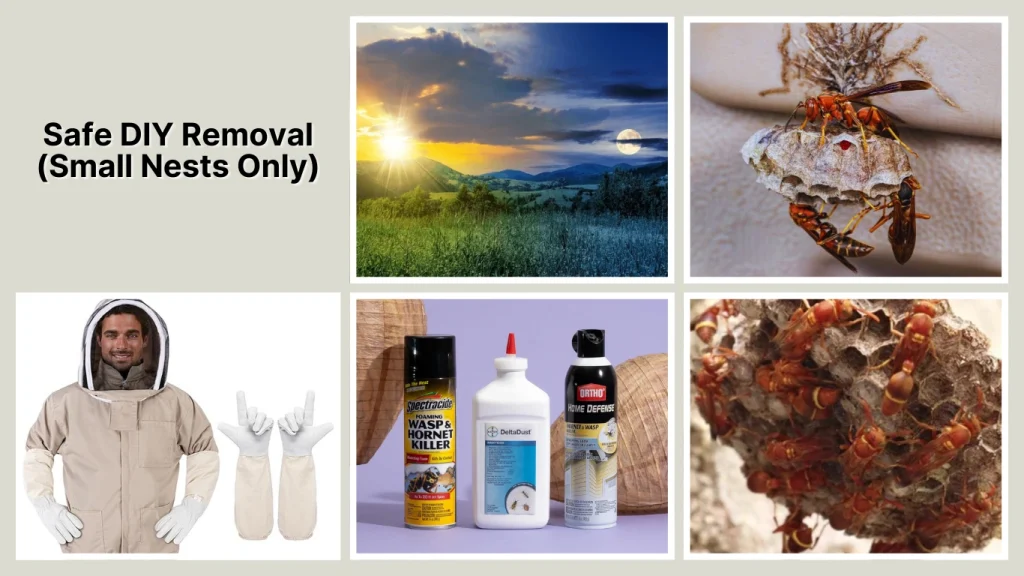
Only attempt if the nest is small (a few cells) and located where you have a safe retreat path.
Step-by-Step (Nighttime Procedure)
- Suit up: Thick clothing, gloves, hat/hood, and eye protection. Avoid perfumes.
- Choose the time: 1–2 hours after dark; minimal wind; red light/headlamp pointed away.
- Approach quietly: Stand at an angle (not directly under). Keep your exit route clear.
- Apply spray: Use a jet-stream wasp spray labeled for paper wasps (10–20 ft range). Saturate the comb and the attachment stalk.
- Wait & verify: Step back for 10–15 minutes. Observe from a distance for survivors.
- Remove comb: Using a long scraper/trowel, detach the nest and place it in a sealed bag.
- Clean site: Wipe the attachment spot with soapy water or vinegar to remove pheromone cues.
When Not to DIY
- Nest larger than your palm or with many active adults
- High ladders, tight corners, or near electrical equipment
- History of allergy or unknown sting reaction
Preventing Red Wasp Nests Around Your Home

Priority Actions
- Seal & screen: Caulk gaps at eaves/soffits; install screens on vents.
- Deny anchor points: Paint or seal rough wood; wasps prefer easy-to-chew fibers.
- Reduce attractants: Keep outdoor bins closed; cover sugary drinks; rinse recyclables.
- Routine checks: Inspect eaves, pergolas, mailboxes, play sets weekly in spring.
- Deterrents: Use motion-activated water sprayers or place decoy combs early in spring (effect varies).
Ecological Importance (Why Not Eradicate Everything)
Red wasps are valuable predators of caterpillars and soft-bodied pests and also visit flowers for nectar, providing incidental pollination. Where nests are away from human traffic, allowing them to persist supports garden and farm health. The balanced approach: manage risk near people, preserve benefits elsewhere.
Interesting Facts About Red Wasp Nests
- A single queen can found a nest that reaches 20–30 adults by midsummer.
- Old nests are not reused, but the same sheltered site is often selected next spring.
- If the queen survives a failed removal, workers can rebuild a new comb within days.
FAQs
How big can a red wasp nest get?
Most household red wasp nests remain palm-sized to hand-sized, holding a few dozen adults at peak. In ideal, undisturbed sites, combs can expand to saucer size with multiple layers. Because cells are exposed, growth is easy to spot—regular checks in spring help you act before colonies mature.
Do red wasps reuse old nests?
No. Colonies die out in fall, and old combs aren’t reused. However, queens often return to the same location if it remains sheltered. Removing the comb and cleaning the anchor point (soapy water or vinegar) reduces pheromone cues that attract next year’s founders.
Is soap-and-water spray a safe alternative?
A strong soap solution can wet wings and reduce flight briefly, but it’s less reliable than labeled wasp products and doesn’t deliver residual control. For safety and efficacy—especially at a distance—use an EPA-labeled wasp spray or hire professionals.
What time of day is safest for removal?
After dark (cool, calm nights) when most workers are on the comb and less reactive. Use a red-filtered light angled away from the nest, move slowly, and keep your escape route clear. Avoid dawn/dusk when traffic spikes.
