

When most people in Texas or across the South think of red wasps, they imagine swarms of reddish-brown insects guarding umbrella-shaped nests. But at the heart of every colony is a single, powerful figure: the queen red wasp. She is the founder, the egg-layer, and the ultimate reason the colony exists. Without her, the entire social structure collapses.
Understanding the queen’s role sheds light on how red wasp populations survive from one year to the next, and why their nests can become such a problem around homes and farms.
What is a Queen Red Wasp?
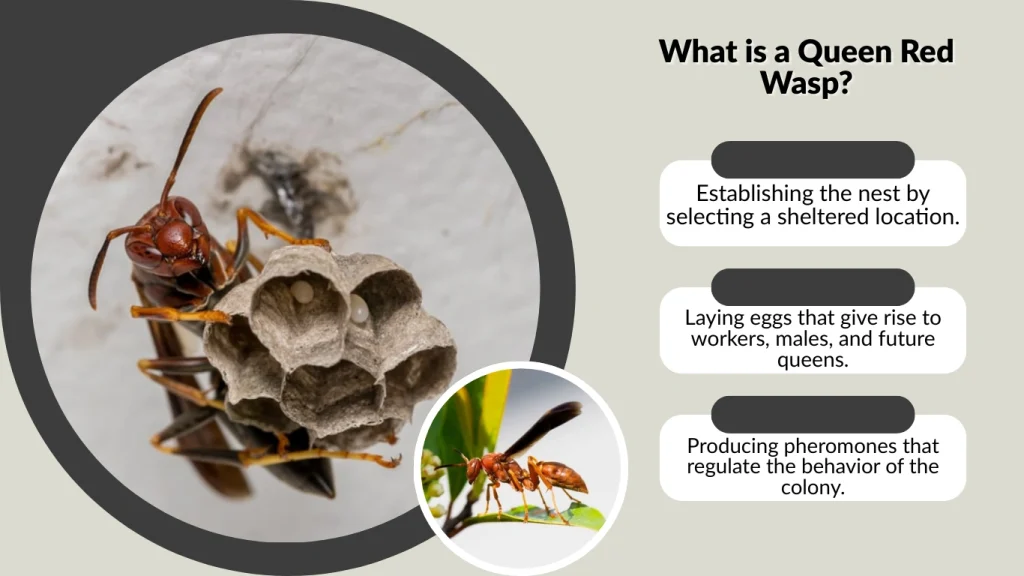
The queen red wasp is the reproductive female that starts and sustains the colony. Like other paper wasps, she emerges from overwintering in early spring, often from protected spaces such as hollow logs, under bark, or even in attics. Unlike worker wasps, which live only a few months, the queen’s life cycle can last close to a year.
Her main functions include:
- Establishing the nest by selecting a sheltered location.
- Laying eggs that give rise to workers, males, and future queens.
- Producing pheromones that regulate the behavior of the colony.
This makes her the central figure in red wasp society, much like a monarch in a small kingdom.
Identification of a Queen Red Wasp
At first glance, a queen looks similar to her workers, but there are subtle differences. She is slightly larger, averaging 1 inch or more in length, compared to ¾ inch for most workers. Her body has the same rusty-red coloration, but queens often appear bulkier and more robust, with a larger abdomen that accommodates egg production.
Observers sometimes mistake a queen for just another worker, since they all share the same general appearance. However, in early spring, if you see a single red wasp building the first cells of a nest, it is almost certainly a queen. Workers do not exist yet at this stage of the season.
Life Cycle of the Queen Red Wasp

The queen’s life follows a seasonal pattern, tied closely to Texas’s warm climate.
Spring: Founding the Nest
In March or April, fertilized queens emerge from hibernation. Each one searches for a sheltered spot under eaves, barn rafters, or tree branches. She chews wood fibers into pulp, forming a small stalk and a few open cells. Into these, she lays her first eggs. At this point, she is both the builder and the caretaker—feeding larvae with chewed-up caterpillars and nectar.
Summer: Expansion and Control
By May and June, the first brood hatches into adult workers. These workers take over nest expansion and larval care, allowing the queen to focus almost exclusively on egg-laying. The queen produces pheromones that suppress worker reproduction, ensuring she remains the sole egg-layer. During this phase, the colony may grow to 20–30 wasps or more, with the queen at the center.
Fall: New Queens and Males
As the season progresses, the queen shifts her egg-laying strategy. Instead of producing mostly workers, she lays eggs that develop into new queens and males. These reproductive wasps leave the nest to mate. Fertilized young queens then seek overwintering sites, while males die before winter.
Winter: Death and Renewal
The original queen rarely survives past late fall. After months of labor, she weakens and dies, leaving the cycle to begin anew with the young queens.
Behavior and Colony Leadership
The queen red wasp is not just an egg-laying machine; she also influences colony behavior. Her pheromones communicate her status to workers, keeping them from laying eggs themselves. Workers, in turn, remain loyal, defending her and the nest.
Queens are less aggressive than workers when it comes to stinging, but their survival is paramount. If threatened, the colony reacts defensively, swarming to protect her. This is why disturbing a red wasp nest is so dangerous—workers respond with intensity when they sense the queen is at risk.
Sting Myths and Reality

Many people wonder whether the queen red wasp’s sting is more powerful than that of her workers. In truth, her sting is similar in strength—it causes sharp pain, burning, and swelling. The queen does not sting more frequently than workers; her priority is reproduction, not defense. However, because she is usually surrounded by loyal workers, any perceived threat to her results in a collective defense, where dozens of wasps may attack at once.
The myth of a “super sting” likely comes from encounters where disturbing a nest provoked an entire colony. The pain and danger come not from one queen’s sting, but from the multiple stings delivered by workers rushing to defend her.
Ecological Importance of the Queen
Though feared, the queen red wasp is vital to ecosystems in Texas and beyond. By founding new colonies each year, she ensures the continuation of a species that helps maintain balance in nature. Her workers prey on caterpillars, beetle larvae, and other soft-bodied insects that could otherwise damage crops and gardens. Indirectly, every queen contributes to natural pest control.
Queens and their colonies also feed on nectar, which makes them secondary pollinators. While they are not as efficient as bees, their visits to flowers aid in the transfer of pollen. Eliminating all red wasps would mean losing these ecological benefits, which is why experts recommend managing nests near homes rather than attempting total eradication.
Queen Red Wasp vs Worker Wasps

While queens and workers look similar, their roles and lifespans differ significantly.
- Role: The queen is the sole reproductive female, while workers build the nest, forage for food, and defend the colony.
- Lifespan: Queens may live up to a year, surviving winter hibernation, while workers only live a few months.
- Behavior: Workers are more aggressive because they are tasked with defense. Queens are less likely to sting unless directly handled.
This division of labor ensures efficiency: the queen’s survival and productivity, combined with the workers’ loyalty, allow the colony to thrive.
Dangers of Queen Red Wasps Near Homes

A single queen in early spring is rarely a problem—she is just beginning her nest. The danger arises once her colony grows. By summer, dozens of wasps may be defending the nest, turning a quiet porch or barn corner into a hazard zone.
Three main dangers arise when queen-led colonies establish nests near homes:
- Multiple Stings: Workers defend aggressively when the queen or nest is threatened.
- Allergic Reactions: Individuals with venom allergies may suffer life-threatening reactions from even one sting.
- Recurring Nests: Because queens often return to the same sheltered sites, porches, eaves, and barns can become annual hotspots for new colonies.
For families, especially those with children and pets, this makes early nest detection and removal essential.
Preventing Queen Red Wasp Nests

The key to reducing encounters with red wasps is prevention, particularly in spring when queens are searching for nest sites.
- Seal Entry Points: Close cracks, vents, and gaps under eaves or in barns where nests could be anchored.
- Smooth Surfaces: Paint or seal rough wood, as queens prefer surfaces they can easily chew and attach nests to.
- Early Inspections: Check porches, sheds, and play areas weekly in spring for small starter nests.
- Limit Attractants: Keep outdoor garbage sealed and sugary drinks covered, as these can draw scouting wasps.
By stopping a queen early in her nest-building process, homeowners avoid much larger problems later in summer.
FAQs
How can you tell a queen red wasp from a worker?
Queens are slightly larger, often measuring over an inch, and appear more robust. In early spring, any lone red wasp starting a nest is almost certainly a queen, since workers have not yet hatched.
Do queen red wasps sting?
Yes, they are capable of stinging, and the sting is painful. However, queens are less aggressive than workers. The danger comes when workers swarm to protect the queen if she is threatened.
How long does a queen red wasp live?
Queens can survive nearly a year, much longer than workers. They overwinter in protected sites and emerge in spring to begin new nests.
Are queen red wasps more dangerous than workers?
Not individually. Their sting is the same strength, but because the queen’s survival is critical, workers will defend her aggressively. This can make a queen-led nest more dangerous as a whole.
Can you prevent a queen from nesting near your home?
Yes. Regular inspections in early spring, sealing cracks, and removing small starter nests before they expand are effective ways to stop a queen from establishing a full colony.
