
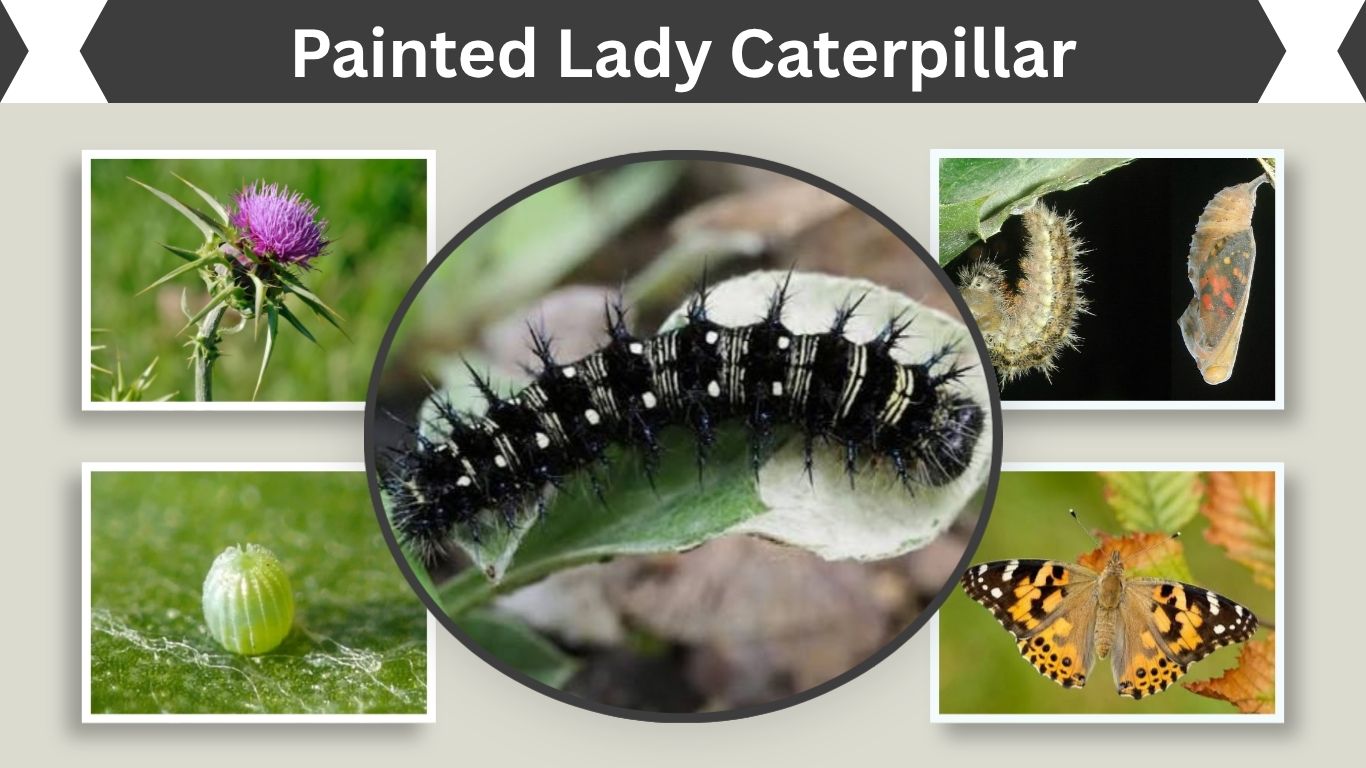
The painted lady caterpillar is the larval stage of the painted lady butterfly, Vanessa cardui. Recognizable by its dark, spiny body and pale markings, it feeds rapidly before forming a hanging chrysalis. Painted ladies are among the world’s most widespread butterflies and are frequently raised in classroom butterfly kits. Understanding their food, molting behavior, silk shelters, anatomy, and pupation signs makes it easier to identify and care for them without disrupting their development.
What Does a Painted Lady Caterpillar Look Like?
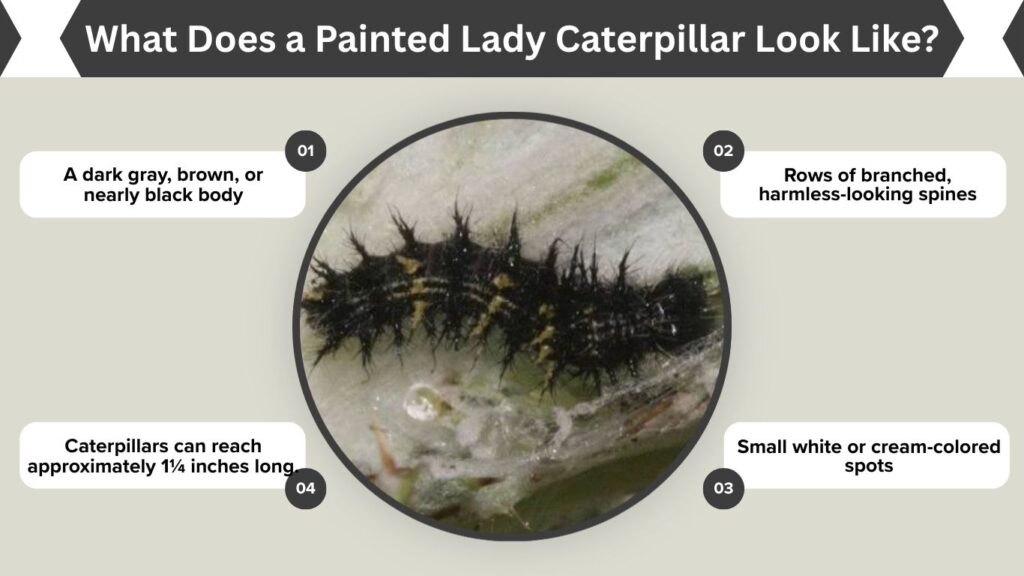
Painted lady caterpillars change noticeably as they grow. Newly hatched larvae are extremely small and difficult to spot, while mature caterpillars can reach approximately 1¼ inches long.
Identification Features
A mature painted lady caterpillar commonly has:
- A dark gray, brown, or nearly black body
- Rows of branched, harmless-looking spines
- Small white or cream-colored spots
- Broken yellowish lines along its sides
- An orange or reddish base around some spines
- A black or dark-brown head
- Fine hairs covering parts of the body
Color varies with age, temperature, diet, and geographic population. Some larvae appear mostly black, while others have stronger yellow, brown, or reddish markings. A pale or whitish caterpillar may simply be preparing to molt, but persistent white fuzzy growth can indicate mold or disease.
Painted Lady Caterpillar Anatomy
Like other butterfly larvae, a painted lady caterpillar has a head, thorax, and abdomen. Its head contains powerful chewing mouthparts and a spinneret that produces silk.
A caterpillar has six true legs—three pairs attached to its thorax—and five pairs of soft abdominal prolegs, including the rear anal pair. It therefore appears to have 16 legs, although only six are permanent insect legs. The prolegs disappear during metamorphosis.
Painted lady caterpillars have six simple eyes, called stemmata, on each side of the head. These 12 light-sensitive structures detect light, darkness, and nearby movement but do not provide detailed vision like an adult butterfly’s compound eyes.
Painted Lady Caterpillar Food
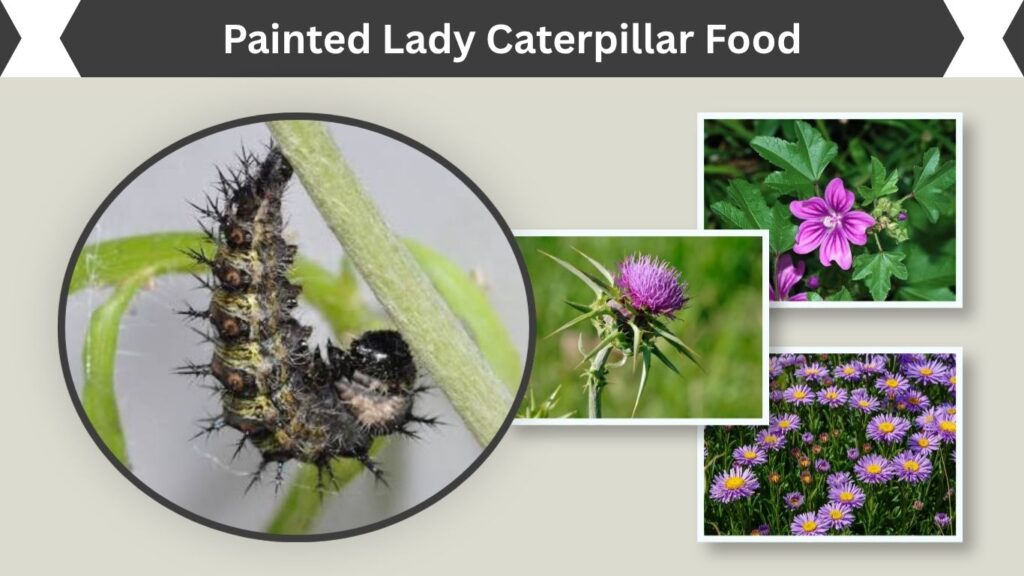
Painted lady caterpillars are generalist feeders that can develop on numerous plant species. However, they cannot survive on arbitrary leaves, fruit, or adult butterfly nectar.
Natural Host Plants
Preferred host plants include:
- Thistles
- Hollyhocks
- Mallows
- Sunflowers
- Calendula
- Borage
- Burdock
- Nettles
- Lupines
- Soybeans and other legumes
Plants in the aster, mallow, and borage families are particularly important. Wisconsin Horticulture lists thistles, mallow, hollyhock, calendula, and sunflower among their common foods.
Caterpillars often use silk to join leaves around themselves, creating a protective web or leaf tent. They remain inside or near this shelter while feeding. Heavy populations may skeletonize leaves, but serious long-term damage to established garden plants is uncommon.
What Is Artificial Caterpillar Food Made Of?
Commercial painted lady diets usually contain a formulated blend of plant-based ingredients, protein, carbohydrates, vitamins, minerals, moisture, and preservatives that limit mold and bacterial growth. The exact ingredients differ among suppliers.
A homemade recipe using mashed plants, flour, sugar, or water may spoil quickly or lack essential nutrients. For captive caterpillars, use the prepared food supplied with the kit or provide clean, pesticide-free leaves from a correctly identified host plant. Avoid switching diets unnecessarily once feeding has begun.
Never feed caterpillars leaves collected from roadsides or chemically treated gardens. Pesticide residue can kill them even when the plant looks healthy.
Painted Lady Caterpillar Life Cycle
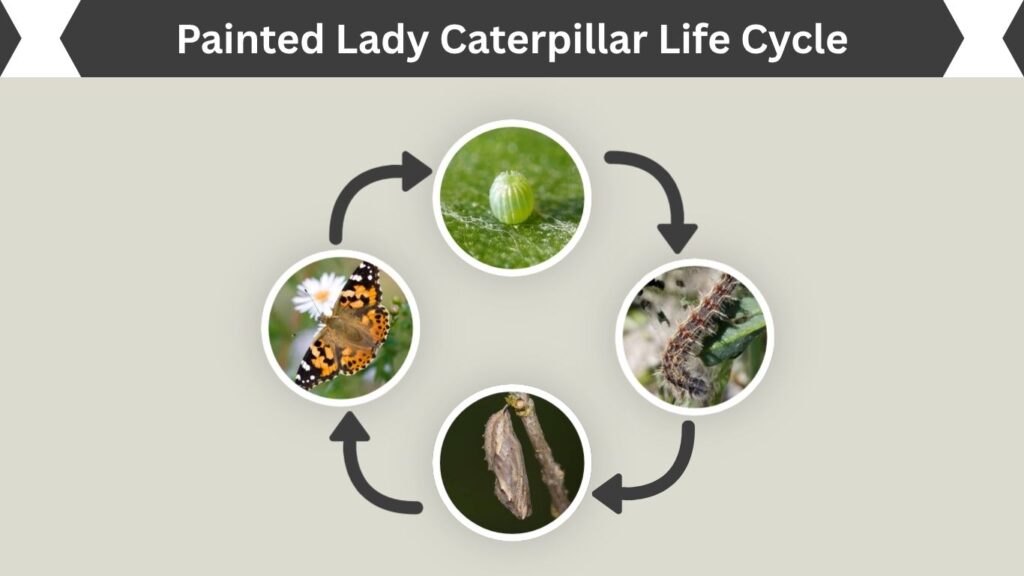
Painted ladies undergo complete metamorphosis through egg, larva, pupa, and adult stages. Developmental timing depends heavily on temperature, diet, humidity, and the caterpillar’s age when obtained.
| Life stage | Approximate duration | Main activity |
|---|---|---|
| Egg | 3–5 days | Embryo develops on a host plant |
| Caterpillar | About 7–14 days | Feeds, grows, and molts |
| Pre-pupa | 1–2 days | Hangs in a J shape |
| Chrysalis | About 7–14 days | Transforms into a butterfly |
| Adult | Commonly 2–4 weeks | Feeds, mates, migrates, and lays eggs |
These periods are estimates rather than fixed deadlines. Cooler conditions usually slow development.
Eggs and Baby Caterpillars
Females generally deposit small, pale-green, barrel-shaped eggs individually on suitable leaves. An egg hatches after several days, and the tiny larva may first consume part of its eggshell before eating the host plant.
Young caterpillars create small silk shelters and produce tiny pieces of waste called frass. Their food consumption and frass production increase rapidly as they grow.
Instars and Molting
Painted lady caterpillars normally pass through five larval stages called instars. Between instars, the caterpillar stops eating, remains still, and sheds its restrictive exoskeleton.
A molting caterpillar may:
- Become inactive for several hours
- Look pale, dull, or whitish
- Remain attached to silk
- Pull away from its old head capsule
- Leave a dry piece of shed skin behind
Do not assume an inactive caterpillar is dead or attempt to peel away its skin. Disturbance during molting can cause injury.
Silk, Webbing, and Frass
Producing silk and webbing leaves together are normal behaviors. Silk gives the caterpillar protection from weather and predators while also providing a secure surface for movement.
The small pellets found near a caterpillar are frass, not eggs. Their color reflects the food being digested and can range from green and brown to dark red. Red frass may result from pigments or artificial diet, but persistent liquid waste combined with weakness or discoloration can indicate illness.
From Caterpillar to Chrysalis
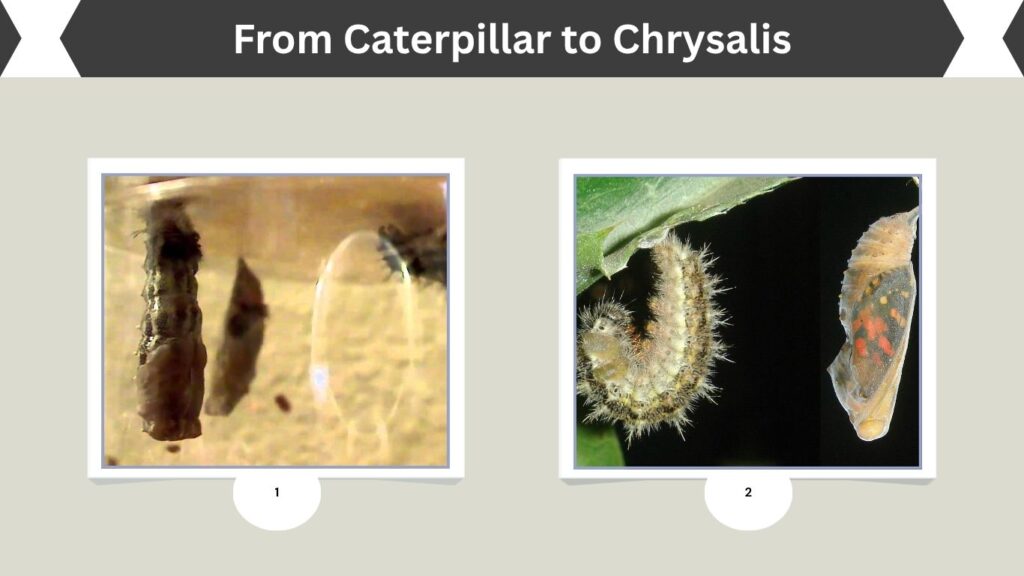
A fully grown caterpillar eventually stops eating and leaves its feeding area to find a protected pupation site. Its behavior during this period differs sharply from ordinary resting.
Why Does It Hang in a J Shape?
The caterpillar spins a small silk pad and anchors its rear end to it using a hooked structure called the cremaster. It then hangs head downward, forming a shape resembling the letter J.
The J position is a normal pre-pupal stage. The caterpillar may hang almost motionless for 12–24 hours or longer before its skin splits, revealing the chrysalis underneath. Do not touch or relocate it during this delicate process.
Chrysalis, Not a Cocoon
Painted lady caterpillars form a chrysalis rather than a cocoon. A chrysalis is the hardened outer body of a butterfly pupa. A cocoon is an additional silk covering spun around the pupa by many moth caterpillars.
The painted lady chrysalis is usually grayish-brown or tan with metallic gold or silver spots. It hangs vertically and may occasionally wiggle when disturbed. This movement is a defensive response and does not mean the pupa is trying to escape.
How Long Is the Caterpillar in a Chrysalis?
An adult commonly emerges seven to ten days after the chrysalis forms under warm, stable conditions. Development may take closer to two weeks in cooler environments.
Shortly before emergence, the chrysalis darkens and becomes partly transparent, allowing the butterfly’s wing pattern to become visible. The adult breaks free, hangs beneath the empty chrysalis, and pumps fluid into its folded wings. It needs several hours before it can fly safely.
A red liquid released after emergence is meconium—a waste product left from metamorphosis. It is not blood and should not be confused with red caterpillar frass. North Carolina Cooperative Extension notes that this red discharge is normal after adult emergence.
Painted Lady Caterpillar Care
Captive caterpillars require suitable food, stable temperatures, ventilation, and freedom from unnecessary handling. A simple, clean setup is generally better than an elaborate enclosure.
Basic Care Requirements
For caterpillars supplied in a prepared cup:
- Keep the cup upright and closed as instructed.
- Place it in bright, indirect light.
- Maintain a stable room temperature around 68–78°F.
- Keep it away from direct sunlight and heating vents.
- Do not add water to the prepared food.
- Avoid opening the container unnecessarily.
- Protect it from ants and household sprays.
Direct sunlight can quickly overheat a small container. Excess moisture can encourage mold, while an overly dry environment may harden the prepared diet.
Can You Touch a Painted Lady Caterpillar?
Their branched spines are not venomous and do not normally sting. Nevertheless, handling can injure a caterpillar, transfer oils or germs, or interrupt molting.
It is best to observe through the container or allow a wild caterpillar to remain on its host plant. If relocation is necessary, encourage it to walk onto a leaf instead of pulling it with your fingers.
How to Tell If a Caterpillar Is Dead
Stillness alone does not prove death. Caterpillars remain motionless while resting, molting, and preparing to pupate. Signs that may indicate death include a collapsed body, severe discoloration, fluid leakage, a foul odor, or no response over an extended period when gently observed.
Do not shake, squeeze, or repeatedly prod an inactive caterpillar. Give it time unless obvious decomposition or dangerous mold is present.
Painted Lady vs. American Lady vs. Monarch Caterpillar
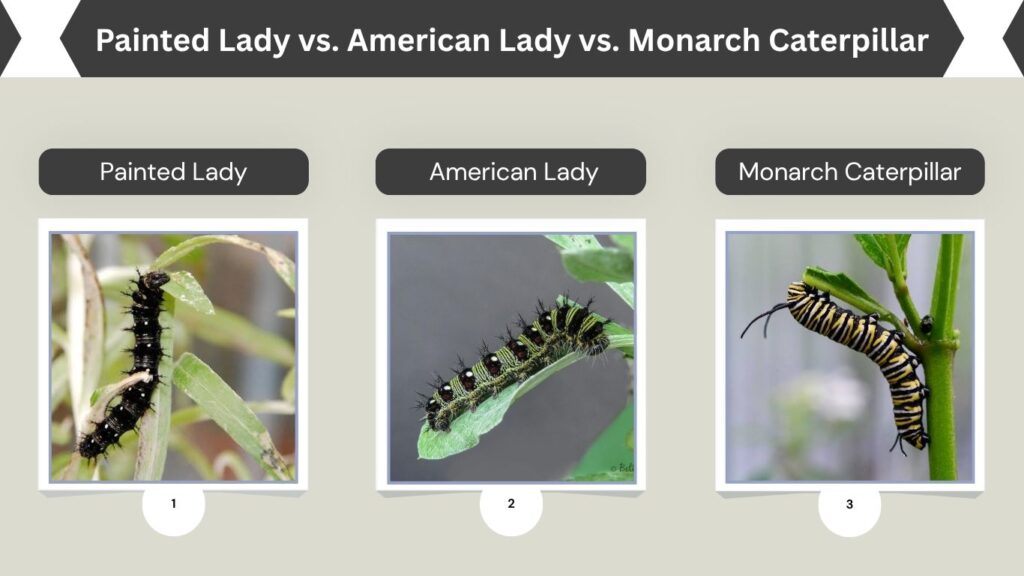
Several butterfly larvae can be confused because they have dark bodies, spines, or pale markings.
| Feature | Painted lady | American lady | Monarch |
|---|---|---|---|
| Scientific name | Vanessa cardui | Vanessa virginiensis | Danaus plexippus |
| Main appearance | Dark with spots and branched spines | Dark with strong yellow bands and spines | Black, white, and yellow stripes |
| Host plants | Thistles, mallows, sunflower, many others | Everlastings, pussytoes, cudweeds | Milkweeds only |
| Leaf shelter | Often webs leaves together | Commonly creates a silk leaf shelter | Usually feeds openly |
| Long tentacles | Absent | Absent | Two pairs present |
The Australian painted lady, Vanessa kershawi, is a separate but closely related species. Its caterpillars feed mainly on native everlasting daisies and other members of the daisy family, as well as certain introduced plants. The Australian Museum identifies everlastings, capeweed, Scotch thistle, and lavender as recorded foods.
FAQs
Are painted lady caterpillars poisonous?
No. Painted lady caterpillars are not considered poisonous or venomous, and their spines do not inject venom. However, handling is still discouraged because their bodies are delicate. People with highly sensitive skin should avoid unnecessary contact with any hairy or spiny caterpillar.
How long does a painted lady remain a caterpillar?
The visible caterpillar stage commonly lasts about one to two weeks under warm captive conditions, although wild development can take longer. Temperature, food quality, humidity, and the larva’s age influence timing. During this period, it passes through five instars and molts four times.
Why is my painted lady caterpillar turning white?
Temporary paleness may occur before or during a molt as the old exoskeleton loosens. A caterpillar may also look faded when preparing to pupate. Fuzzy white growth, spreading discoloration, an unpleasant smell, or a soft collapsing body may instead indicate mold, infection, or death.
What does painted lady caterpillar poop look like?
Painted lady caterpillar waste, called frass, usually appears as small green, brown, black, or reddish pellets. Larger caterpillars produce larger quantities. Red coloration can come from food pigments. Watery waste accompanied by inactivity, odor, or body discoloration may suggest a health problem.
Can painted lady caterpillars eat lettuce?
Lettuce is not an appropriate host plant and does not provide the nutrition required for normal development. Feed pesticide-free thistle, mallow, hollyhock, sunflower, or another confirmed host plant. Caterpillars from commercial kits should receive the prepared diet supplied by the manufacturer.
