
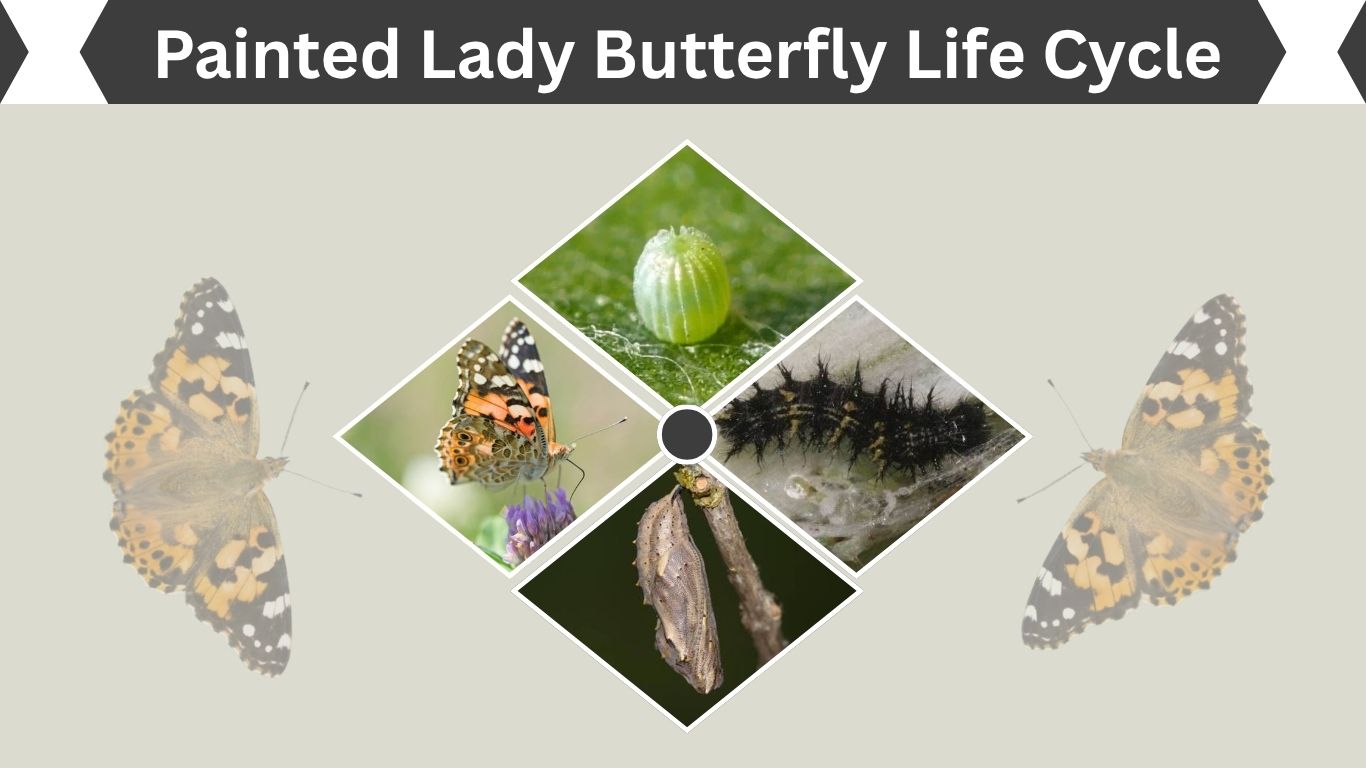
The painted lady butterfly life cycle is a remarkable transformation completed through four stages: egg, caterpillar, chrysalis, and adult butterfly. Under warm, favorable conditions, the process from egg to adult may take approximately three to five weeks. Temperature, weather, food quality, and geographic location can shorten or extend the timeline. Each stage has a different appearance and purpose, from the tiny green egg to the colorful, long-distance-flying adult painted lady.
Painted Lady Butterfly Life Cycle Timeline
The painted lady, scientifically known as Vanessa cardui, undergoes complete metamorphosis. This means the young caterpillar looks and behaves entirely differently from the adult butterfly.
| Life-cycle stage | Typical duration | Main development |
|---|---|---|
| Egg | 3–5 days | Embryo develops inside the egg |
| Caterpillar | 7–14 days | Larva feeds, grows, and molts |
| Pre-pupa | 1–2 days | Caterpillar hangs in a J shape |
| Chrysalis | 7–14 days | Butterfly develops inside the pupa |
| Adult butterfly | Usually 2–4 weeks | Adult feeds, migrates, mates, and lays eggs |
These periods are estimates. Cooler temperatures may make the complete life cycle last five weeks or longer, while warm, controlled conditions may produce an adult in about three weeks.
Stage 1: Painted Lady Butterfly Egg
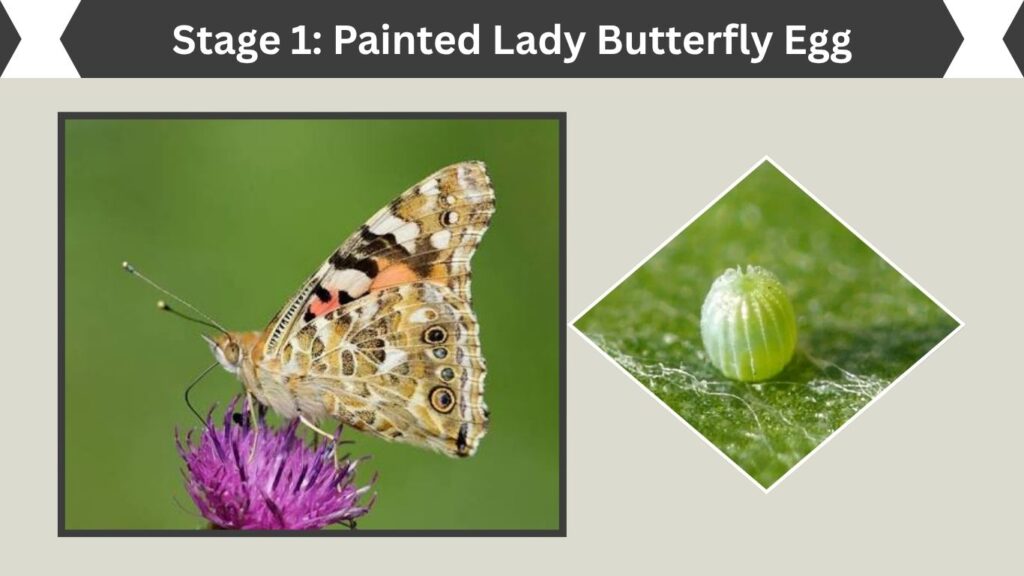
The life cycle begins when a female painted lady finds a suitable host plant. Host plants provide the leaves that her caterpillars will need immediately after hatching.
Egg Appearance and Location
Painted lady eggs are tiny, pale green, barrel-shaped structures with vertical ridges. Each egg is approximately the size of a pinhead, making it easy to overlook without close examination.
A female normally lays her eggs individually rather than depositing them in large clusters. They may be placed on the upper surface of leaves, young plant growth, or near a flower bud.
Common host plants include:
- Thistles
- Hollyhocks
- Mallows
- Sunflowers
- Borage
- Calendula
- Burdock
- Nettles
- Lupines
- Certain legumes
Painted lady caterpillars can feed on many plant species, but thistles and plants from the mallow family are especially important.
How Long Before the Egg Hatches?
An egg commonly hatches within three to five days. Development may be slower during cool weather. As the embryo matures, the egg may darken enough for the young caterpillar’s head to become visible through the shell.
After hatching, the tiny larva may consume part of its eggshell before moving onto the host leaf. Eating the shell allows it to recover valuable nutrients before it begins regular feeding.
Stage 2: Painted Lady Caterpillar
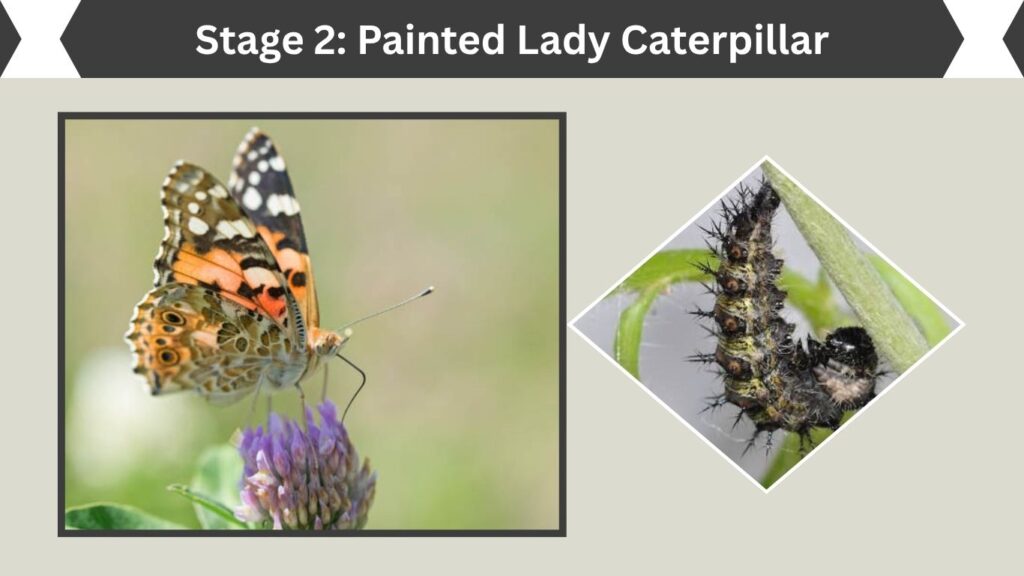
The caterpillar, or larval stage, is devoted primarily to eating and growing. During this brief period, the caterpillar increases dramatically in size and stores energy needed for metamorphosis.
What Does the Caterpillar Look Like?
A newly hatched caterpillar is extremely small and generally gray or dark-colored. A mature painted lady caterpillar can reach approximately 1¼ inches long.
Identification features include:
- A dark gray, brown, or black body
- Branched spines along the body
- Fine, pale hairs
- Small white or cream spots
- Broken yellow lines along the sides
- Orange or reddish areas around some spines
- A dark head with chewing mouthparts
Although the spines look sharp, they do not contain venom and do not normally sting. Handling should still be avoided because the caterpillar is delicate.
Five Caterpillar Instars
Painted lady caterpillars grow through five developmental stages known as instars. Their exoskeleton cannot stretch indefinitely, so each caterpillar must shed its old skin four times.
Before molting, the caterpillar may stop eating, become inactive, and look unusually pale. It anchors itself with silk while the old skin loosens. After emerging, its new exoskeleton is initially soft but soon hardens and darkens.
The entire caterpillar period commonly lasts seven to fourteen days. According to Wisconsin Horticulture, caterpillars can feed continuously for five to ten days in warm conditions while passing through their five instars.
Silk Webs and Leaf Shelters
Painted lady caterpillars produce silk through a spinneret located beneath their mouth. They use this silk to connect or fold leaves, creating protective shelters.
A silk-covered leaf does not necessarily indicate a spider or plant disease. Look inside carefully, and you may find a caterpillar, shed skin, damaged plant tissue, and small waste pellets known as frass.
Stage 3: J Shape and Chrysalis
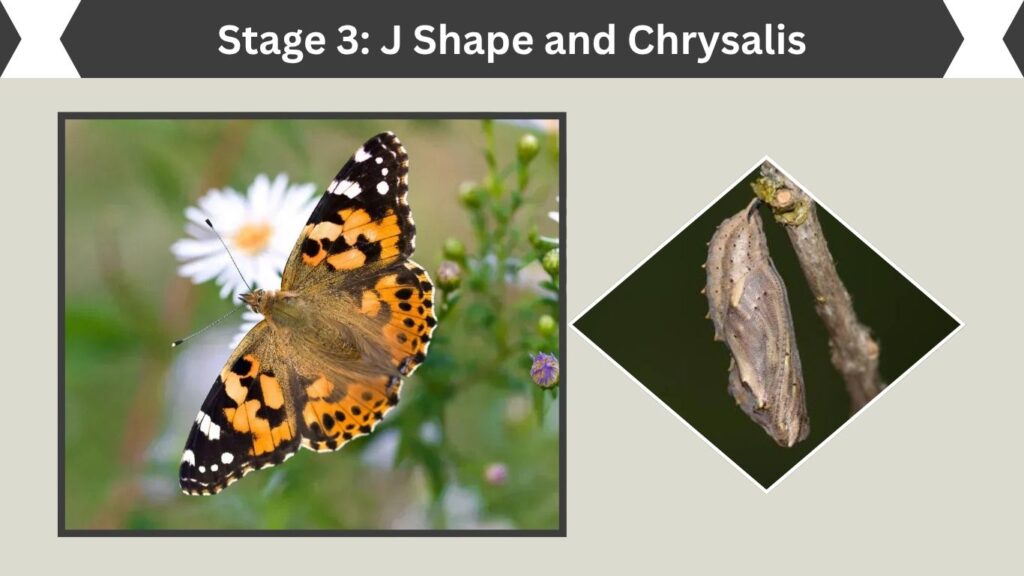
When fully grown, the caterpillar stops feeding and begins searching for a protected place to transform. It may leave its food plant and wander around its enclosure or nearby vegetation.
Why Does the Caterpillar Form a J Shape?
The caterpillar spins a small silk pad on a leaf, stem, lid, branch, or another stable surface. It attaches its rear end to the pad with a hook-covered structure called the cremaster.
Once secured, it hangs head downward and curls into the shape of the letter J. This is called the pre-pupal stage and normally lasts approximately one day, although timing varies.
A J-shaped caterpillar is not sick or dead. Do not touch, move, or straighten it. Disturbing the silk attachment could cause it to fall during its final molt.
How Does the Chrysalis Form?
While hanging, the caterpillar’s skin splits near the head. It wriggles until the old skin slides upward and falls away, exposing the soft pupa underneath.
The new chrysalis gradually hardens into a protective casing. A painted lady chrysalis is usually:
- Tan, gray, or brown
- Approximately ¾ to 1 inch long
- Marked with darker patches
- Decorated with metallic gold or silver spots
- Suspended vertically from its cremaster
Painted ladies form a chrysalis, not a cocoon. The chrysalis is the butterfly’s hardened pupal body, while a cocoon is an additional silk covering constructed by many moth caterpillars.
What Happens Inside the Chrysalis?
The insect’s body is extensively reorganized during the pupal stage. Adult features such as wings, long legs, antennae, compound eyes, and a nectar-feeding proboscis complete their development.
The chrysalis may wiggle when touched or disturbed. This is a natural defensive response intended to discourage predators. Repeatedly provoking the movement wastes energy and should be avoided.
Stage 4: Adult Painted Lady Butterfly
The pupal stage commonly lasts seven to fourteen days. As emergence approaches, the chrysalis darkens and becomes partly transparent. The orange, black, and white wing pattern may become visible through the casing.
Emerging From the Chrysalis
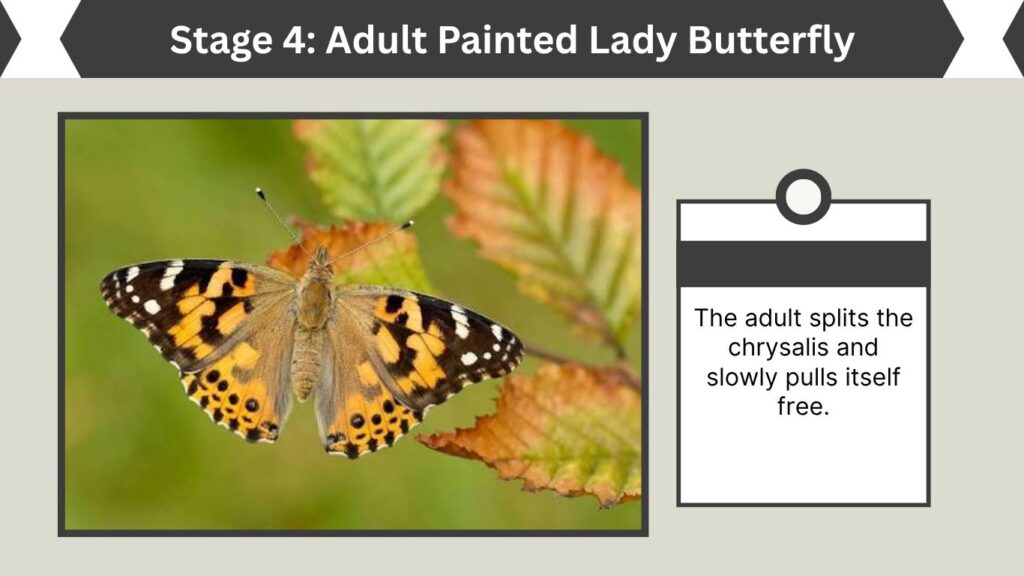
The adult splits the chrysalis and slowly pulls itself free. At first, its wings are small, wrinkled, and wet, while its abdomen appears unusually large.
The butterfly hangs beneath the empty chrysalis and pumps hemolymph—its circulating body fluid—through the wing veins. The wings gradually expand to their full size and require several hours to harden.
A newly emerged butterfly may release a red or brown liquid called meconium. This is a normal waste product remaining from metamorphosis, not blood.
Adult Appearance and Feeding
An adult painted lady has orange-brown wings marked with black patches and white spots. The undersides are mottled brown and gray, with small eyespots on the hindwings. Its wingspan is usually around two to three inches.
Adults drink nectar using a coiled, straw-like proboscis. Popular nectar plants include:
- Asters
- Coneflowers
- Lantana
- Milkweed flowers
- Zinnias
- Goldenrod
- Buddleia
- Thistles
Unlike the caterpillar, the adult does not chew leaves. Its primary activities are feeding, migrating, finding a mate, and reproducing.
Mating, Egg Laying, and Migration
The life cycle begins again after male and female butterflies mate. Females search for healthy host plants and may lay hundreds of eggs throughout their adult lives.
Painted Lady Migration
Painted ladies are powerful migratory butterflies. Their movements allow populations to reach seasonally suitable areas where nectar and host plants are abundant.
In North America, butterflies migrate northward during spring and may produce multiple generations across the continent. Later generations move toward warmer southern regions. The same individual does not necessarily complete the entire round-trip journey; successive generations participate in different portions of the migration.
In the UK, painted ladies arrive as migrants from continental Europe and North Africa. Favorable weather can produce highly visible mass arrivals. The species generally cannot survive the coldest northern winters in every life stage, so migration helps maintain its seasonal presence.
Painted Lady Life Cycle in Butterfly Kits
Painted lady caterpillars are commonly used in classrooms because their transformation is relatively fast and easy to observe. Commercial kits usually provide caterpillars in a ventilated cup containing prepared food.
What to Expect From a Kit
A typical kit timeline includes:
- Caterpillars feed and grow for approximately 5–10 days.
- Mature caterpillars attach to the container lid.
- They hang in a J shape and form chrysalises.
- Hardened chrysalises are moved to a mesh habitat as directed.
- Butterflies emerge approximately 7–10 days later.
- Adults rest while their wings expand and harden.
- Healthy butterflies are released during suitable weather.
Keep the habitat out of direct sunlight. Small containers can overheat rapidly. Avoid unnecessary handling, shaking, excessive moisture, household pesticide sprays, and attempts to help a butterfly leave its chrysalis.
Follow the supplier’s instructions when moving chrysalises. A newly formed chrysalis is soft and vulnerable, so it should normally be allowed to harden before relocation.
American Painted Lady Life Cycle
The American lady, sometimes called the American painted lady, is Vanessa virginiensis. It is related to Vanessa cardui but represents a separate species.
Both butterflies pass through egg, caterpillar, chrysalis, and adult stages. However, American lady caterpillars commonly use everlastings, pussytoes, and cudweeds as host plants. Their dark, spiny caterpillars often show more prominent yellow bands.
The American lady chrysalis may be greenish or grayish with dark markings. Like a painted lady, the mature caterpillar hangs in a J shape before pupating.
Painted Lady Life Cycle Facts for Kids
- A painted lady begins life inside a tiny green egg.
- The caterpillar is also called a larva.
- It sheds its skin four times while growing.
- Its five growth stages are called instars.
- The caterpillar uses silk to make a leaf shelter.
- It hangs like the letter J before becoming a chrysalis.
- A butterfly chrysalis is different from a moth cocoon.
- A newly emerged butterfly must dry its wings before flying.
- The red liquid after emergence is waste, not blood.
- Painted ladies can travel very long distances during migration.
FAQs
How long is the complete painted lady butterfly life cycle?
Development from egg to adult generally takes about three to five weeks. Warm conditions and nutritious food may speed up the process, while cooler temperatures slow it. The adult then commonly lives another two to four weeks, although environmental conditions influence longevity.
What are the four stages of a painted lady butterfly?
The four stages are egg, caterpillar, chrysalis, and adult. The caterpillar is the feeding and growing stage, while the chrysalis is the transformation stage. The winged adult drinks nectar, migrates, mates, and lays eggs that begin another generation.
How long does a painted lady remain in its chrysalis?
A painted lady commonly remains inside its chrysalis for seven to fourteen days. Many kit-raised butterflies emerge in approximately seven to ten days. Cooler temperatures can lengthen the pupal period. The chrysalis usually darkens and reveals the wing pattern shortly before emergence.
Why is my painted lady chrysalis shaking?
A chrysalis may wiggle when it senses touch, movement, or vibration. This is a natural defense that may startle potential predators. Occasional movement is normal, but repeatedly touching or shaking the chrysalis should be avoided because the developing butterfly needs to conserve energy.
When should painted lady butterflies be released?
Release healthy butterflies after their wings have fully expanded and hardened, preferably during daylight when temperatures are mild and rain or strong winds are not expected. Follow local wildlife guidance and the kit supplier’s instructions, especially when the butterflies were obtained outside their natural range.
