
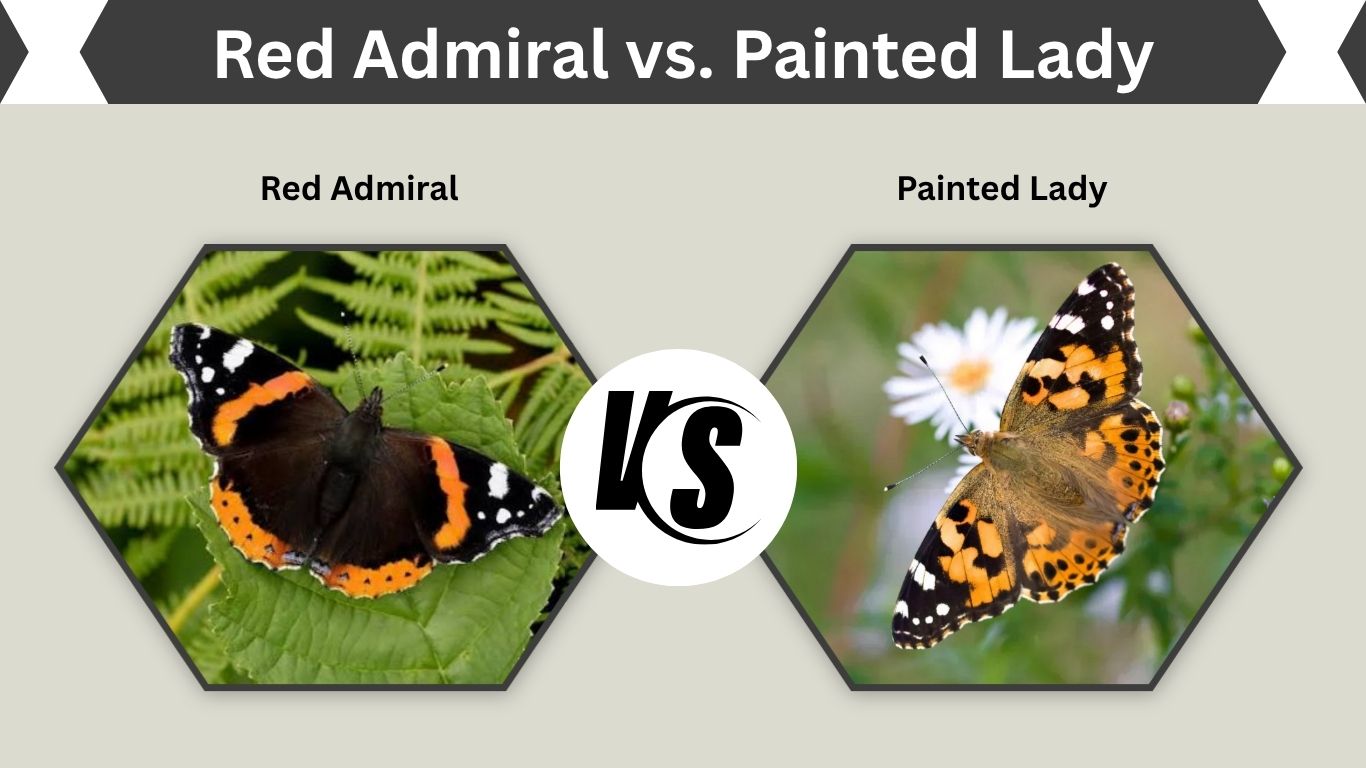
The Red Admiral and Painted Lady are closely related butterflies that can be confused because both have orange-red, black, and white wing markings. However, the Red Admiral has a darker appearance with bold red bands, while the Painted Lady is primarily orange with a checkered pattern. Their caterpillars also depend on different host plants. Examining the upper wings, underwings, size, caterpillar appearance, and feeding habits makes identification considerably easier.
Red Admiral vs. Painted Lady: Quick Comparison
The Red Admiral is scientifically known as Vanessa atalanta, while the Painted Lady is Vanessa cardui. Both belong to the brush-footed butterfly family, Nymphalidae, and are strong seasonal migrants.
| Feature | Red Admiral | Painted Lady |
|---|---|---|
| Scientific name | Vanessa atalanta | Vanessa cardui |
| Main wing color | Mostly black | Mostly orange or salmon |
| Bright markings | Bold red-orange bands | Orange patches and black spots |
| Forewing tips | Black with white spots | Black with several white spots |
| Hindwings | Black with a red marginal band | Orange-brown with rows of dark spots |
| Main caterpillar food | Nettles | Thistles, mallows, and many other plants |
| Behavior | Territorial and strong-gliding | Highly migratory and fast-flying |
| Distribution | North America, Europe, Asia, and North Africa | Nearly worldwide except Antarctica |
| Adult food | Nectar, sap, and fermenting fruit | Primarily flower nectar |
Appearance and Identification
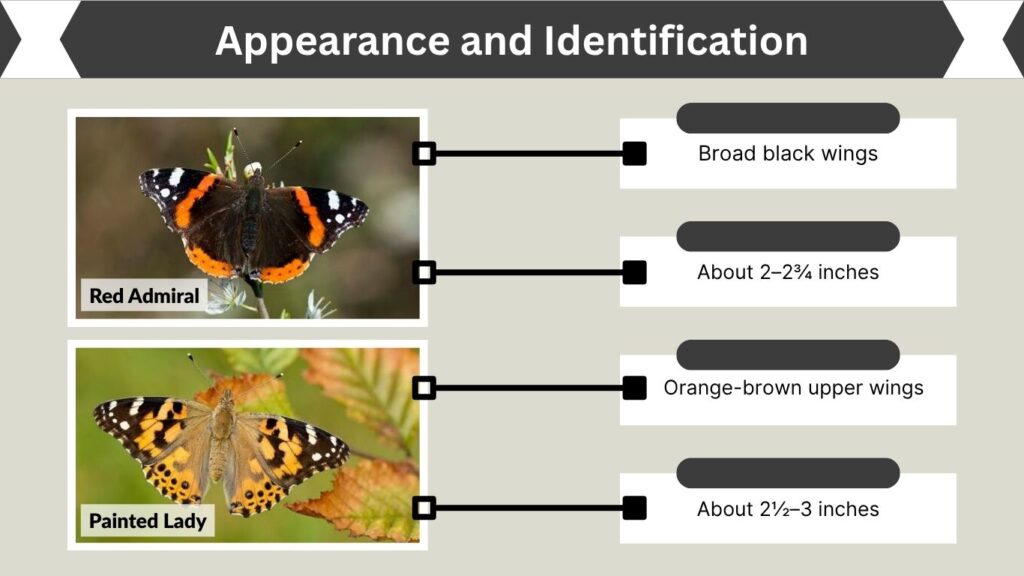
The easiest way to separate these butterflies is to examine the overall balance of black and orange. A Red Admiral looks dark with clearly defined red stripes, whereas a Painted Lady looks lighter and more heavily patterned.
Red Admiral Identification
The upper side of a Red Admiral’s wings is predominantly velvety black. A bold red-orange band crosses each forewing, while another red-orange band follows the outer edge of each hindwing.
Additional identification features include:
- Broad black wings
- A bright red-orange forewing band
- A red border on each hindwing
- White spots near the forewing tips
- Small blue markings near the hindwing edges
- A mottled brown, black, and blue-gray underside
When resting with its wings closed, the Red Admiral’s hindwing underside provides excellent camouflage against tree bark. The forewing underside still displays part of the red-orange band.
Painted Lady Identification
A Painted Lady has a lighter, more complicated wing pattern. Most of the upper surface is pale orange, salmon, or orange-brown rather than black.
Look for:
- Orange-brown upper wings
- Black patches and irregular spots
- Black forewing tips containing white marks
- Rows of dark spots near the hindwing edges
- A marbled gray and brown underwing
- Several small eyespots beneath each hindwing
Painted Ladies may appear bright salmon when freshly emerged. Their colors gradually fade after exposure to sunlight and normal wing wear.
Size Differences
Both species are medium-to-large butterflies, but the Red Admiral often appears slightly larger and heavier-bodied. Exact measurements vary between populations and reference methods.
| Measurement | Red Admiral | Painted Lady |
|---|---|---|
| Typical wingspan | About 2½–3 inches | About 2–2¾ inches |
| Body shape | Robust | Relatively slender |
| Flight appearance | Dark, powerful, and gliding | Light-colored, rapid, and direct |
| Wings at rest | Often opens wings while basking | Frequently rests with wings partly or fully open |
Butterfly Conservation recommends looking for the Red Admiral’s black background and bright red bands, compared with the Painted Lady’s lighter orange wings and spotted hindwing margins.
Caterpillar Differences
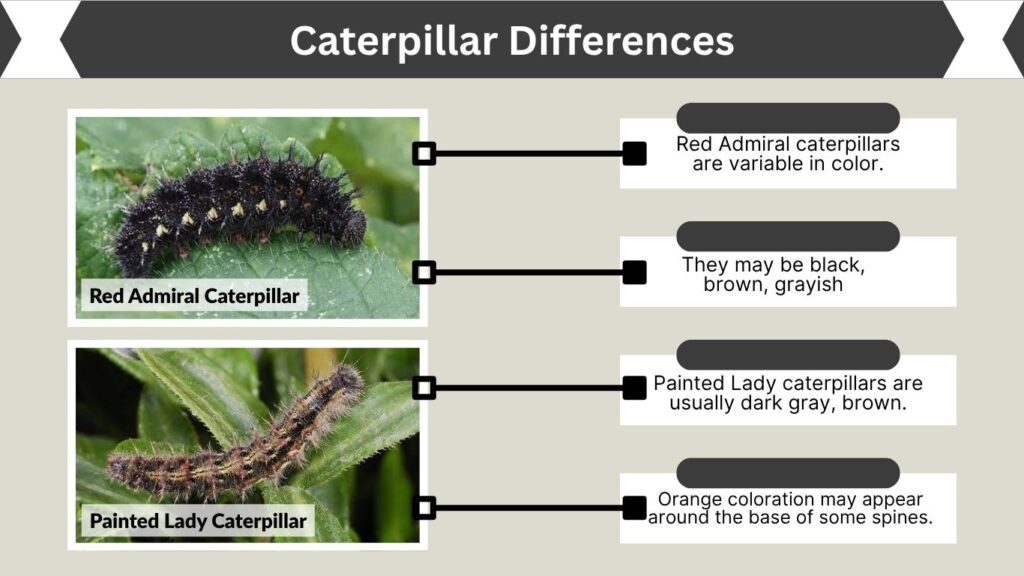
Red Admiral and Painted Lady caterpillars are both dark and spiny, making them more difficult to distinguish than the adults. The host plant is often the most useful identification clue.
Red Admiral Caterpillar
Red Admiral caterpillars are variable in color. They may be black, brown, grayish, or occasionally greenish. Their bodies are covered with branched spines and frequently display pale yellow spots or broken side markings.
They feed primarily on plants in the nettle family, including:
- Stinging nettle
- Small nettle
- False nettle
- Pellitory-of-the-wall
- Related nettle species
A caterpillar folds or joins a nettle leaf with silk to create an individual shelter. It generally remains inside this folded leaf when resting and comes out to feed.
Painted Lady Caterpillar
Painted Lady caterpillars are usually dark gray, brown, or black with branched spines, pale speckles, and broken yellow lines. Orange coloration may appear around the base of some spines.
Their host plants include:
- Thistles
- Hollyhocks
- Mallows
- Sunflowers
- Borage
- Calendula
- Burdock
- Lupines
- Nettles
- Certain legumes
Painted Lady larvae also produce silk shelters, but they may web together several pieces of leaf material. Thistles are particularly important host plants in many regions.
| Caterpillar feature | Red Admiral | Painted Lady |
|---|---|---|
| Typical color | Black, gray, brown, or greenish | Dark gray, brown, or black |
| Body covering | Branched spines | Branched spines and fine hairs |
| Main host plants | Nettles | Thistles and mallows |
| Shelter | Usually one folded nettle leaf | Webbed or folded leaves |
| Mature length | Approximately 1¼ inches | Approximately 1¼ inches |
| Venomous spines | No | No |
Life Cycle Differences
Both butterflies undergo complete metamorphosis through four stages: egg, caterpillar, chrysalis, and adult. Their developmental times are similar and depend on temperature, food quality, and seasonal conditions.
Egg to Caterpillar
Females lay small, pale-green eggs individually on suitable host plants. Red Admirals normally choose nettles, while Painted Ladies select from a much broader variety of plants.
The eggs usually hatch within several days. Young caterpillars begin eating the host leaves and construct protective silk shelters. Each caterpillar passes through five growth stages, called instars, shedding its exoskeleton between them.
Chrysalis and Adult Emergence
When fully grown, each caterpillar attaches itself to a silk pad and hangs head downward in a J shape. It then sheds its final larval skin and becomes a chrysalis.
The Painted Lady chrysalis is commonly gray, tan, or brown with metallic gold spots. A Red Admiral chrysalis is also brown or grayish and may have shiny gold areas. The adult generally emerges after approximately one to two weeks, although cool conditions can extend development.
Habitat and Distribution
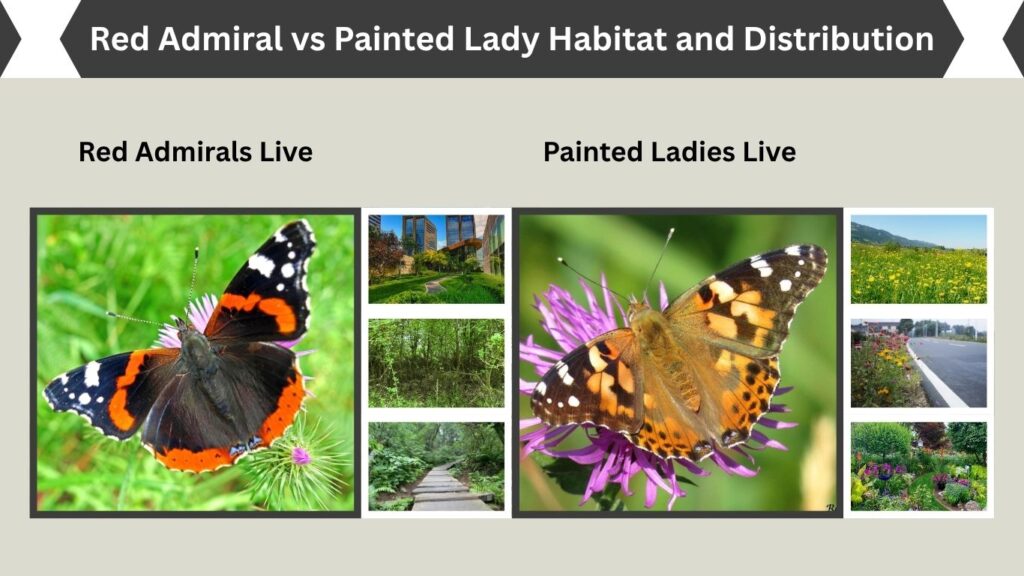
Both species occupy gardens, woodland edges, roadsides, parks, meadows, and other sunny places with abundant flowers. Their seasonal distribution is strongly affected by migration.
Where Red Admirals Live
Red Admirals occur across North America, Europe, parts of Asia, and North Africa. In North America, populations frequently move northward during spring and retreat or migrate south as cold weather approaches.
They can be found in:
- Gardens and urban parks
- Moist woodland edges
- Clearings and trails
- Areas containing nettles
- Orchards with fallen fruit
- Sunny territories near trees
In parts of the UK, some Red Admirals now survive mild winters, although migrating individuals continue to strengthen the population. Butterfly Conservation identifies common nettle as their most important British caterpillar food plant.
Where Painted Ladies Live
Painted Ladies have one of the broadest distributions of any butterfly. They occur across North and South America, Europe, Africa, and Asia, with closely related forms found in Australia.
They prefer open, sunny environments such as:
- Meadows and grasslands
- Roadsides
- Gardens
- Fields
- Desert margins
- Mountain clearings
- Areas with thistles and nectar flowers
Painted Ladies undertake multigenerational migrations covering enormous distances. In the UK, they arrive primarily from southern Europe and North Africa, sometimes appearing in spectacular numbers.
Feeding and Behavior
The two species overlap at nectar flowers, but their additional feeding habits and territorial behavior can help with identification.
What Do Adult Red Admirals Eat?
Red Admirals drink nectar from asters, milkweed, goldenrod, buddleia, and other flowers. They are also strongly attracted to:
- Fermenting fallen fruit
- Tree sap
- Animal droppings
- Moist mineral-rich soil
Males often defend sunny territories and may repeatedly chase other butterflies, insects, or moving objects. A Red Admiral may return to the same resting location after completing a patrol.
What Do Painted Ladies Eat?
Adult Painted Ladies primarily drink flower nectar. They visit thistles, asters, coneflowers, zinnias, goldenrod, lantana, and many other flowering plants.
Their flight is fast, direct, and strongly associated with migration. Males may perch in sunny locations to watch for females, but Painted Ladies are generally less noticeably territorial than Red Admirals.
Painted Lady Butterfly Red Liquid
A Painted Lady may release a red or brown liquid shortly after emerging from its chrysalis. This substance is called meconium. It contains metabolic waste that accumulated during the pupal stage.
Meconium is not blood, and its presence does not normally mean the butterfly is injured. It may appear on the mesh, tissue, leaves, or floor of a butterfly enclosure. A newly emerged butterfly should be allowed to hang undisturbed while its wings expand and harden.
Is Red Caterpillar Poop Normal?
Painted Lady caterpillar waste is called frass. It normally appears as small green, brown, black, or occasionally reddish pellets. The color can reflect pigments in fresh leaves or artificial caterpillar food.
Red caterpillar frass is different from the liquid meconium released by an adult butterfly. Persistent watery discharge, body collapse, foul odor, or unusual inactivity may indicate illness rather than normal digestion.
Which Butterfly Did You See?
Begin with the main wing color. A mostly black butterfly with sharp red-orange bands is a Red Admiral. A mostly orange butterfly with a checkered black pattern is a Painted Lady.
Next, examine the hindwings. Red Admirals have a continuous red band along the edge, while Painted Ladies have rows of separate black spots. If you find a caterpillar, examine its plant: nettle strongly suggests Red Admiral, while thistle or mallow more strongly suggests Painted Lady.
FAQs
Is a Red Admiral the same as a Painted Lady?
No. They are separate species within the same genus. The Red Admiral is Vanessa atalanta, while the Painted Lady is Vanessa cardui. Both are migratory brush-footed butterflies, but they differ in wing patterns, caterpillar host plants, feeding behavior, and distribution.
Which is larger, a Red Admiral or a Painted Lady?
The Red Admiral is generally the larger and more robust-looking species, although their size ranges overlap. Identification should not rely on size alone. The Red Admiral’s mostly black wings and bold red bands provide more dependable clues than a visual estimate of wingspan.
Are Red Admiral and Painted Lady caterpillars poisonous?
Neither caterpillar is considered poisonous or venomous. Their branched spines do not inject venom, although the caterpillars should still be handled minimally because their bodies are delicate. People with sensitive skin may prefer to avoid direct contact with any spiny or hairy caterpillar.
Why did my Painted Lady butterfly release red liquid?
The red liquid is normally meconium, a waste product released after the butterfly emerges from its chrysalis. It is not blood. Place absorbent paper beneath the emergence area and allow the butterfly to hang undisturbed until its wings have fully expanded and hardened.
Can Red Admir Admirals and Painted Ladies use the same host plant?
They can occasionally overlap on nettles because Painted Lady caterpillars use many plant species. However, Red Admiral caterpillars strongly favor nettles, while Painted Ladies more commonly use thistles, mallows, hollyhocks, and related plants. The caterpillar’s appearance should also be examined before confirming identification.
