
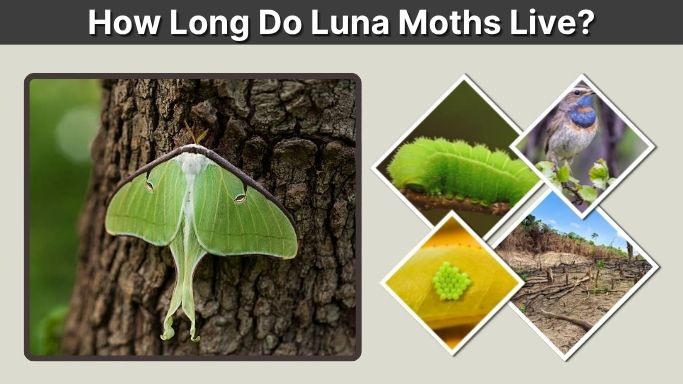
Luna moths live a short but fascinating life. As adults, they usually survive for about one week because they do not eat or drink. However, their full life cycle lasts much longer when you include the egg, caterpillar, cocoon, and adult stages. This guide explains how long luna moths live, how long they stay in a cocoon, and what affects their survival.
How Long Do Luna Moths Live?
Luna moths live longest when you count their entire life cycle, not just the adult moth stage. The adult luna moth is the large green moth most people notice, but it is only the final stage of life. Before that, the insect spends time as an egg, caterpillar, and pupa inside a cocoon.
In most cases, an adult luna moth lives around 7 to 10 days. Some may live slightly less, while others may survive a little longer under safe conditions. The full life cycle can last several weeks to several months depending on climate, season, and whether the pupa overwinters.
Adult Luna Moth Lifespan
Adult luna moths usually live for about one week. Their adult life is short because they do not have functional mouthparts. They cannot eat nectar, drink water, or chew leaves. Instead, they rely on energy stored from the caterpillar stage.
During this short adult stage, the moth’s main purpose is reproduction. Males search for females, females lay eggs, and the next generation begins. Because adults do not feed, they must use their stored energy carefully.
Most adult luna moths are active at night. They may rest during the day on tree trunks, leaves, walls, or other sheltered surfaces. Their pale green wings help them blend with foliage, but birds, bats, and other predators can still shorten their lives.
Male vs Female Luna Moth Lifespan
Male and female luna moths have similar adult lifespans, but their behavior is different. Males often spend more energy flying long distances to find females. Their large, feathery antennae help them detect female pheromones at night.
Females may fly less than males, especially before laying eggs. After mating, a female lays eggs on suitable host plants. Once she has used her stored energy and finished laying eggs, her life ends naturally.
A female may look slightly larger or heavier than a male because she carries eggs. Males often have wider antennae and may appear more active at night.
Luna Moth Lifespan in Captivity
In captivity, adult luna moths still do not live long. Even with protection from predators, they cannot eat, so their lifespan is limited. Most adult luna moths in captivity live around one week, similar to wild adults.
Captivity may protect them from birds, bats, bad weather, or accidents, but it cannot change their biology. Since they do not feed as adults, offering fruit, flowers, sugar water, or honey will not extend their life.
If you are keeping a luna moth briefly for observation, it should have space, ventilation, and a calm environment. It should not be handled often because its wings and body are delicate.
Luna Moth Life Cycle Timeline
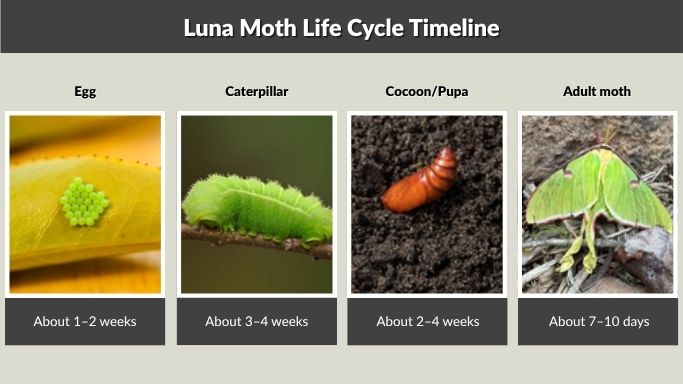
The luna moth’s full life cycle includes four main stages: egg, caterpillar, pupa, and adult moth. Each stage has a different length and purpose. The caterpillar stage is for feeding and growth, while the adult stage is for mating and laying eggs.
The timeline can vary depending on temperature and region. Warm weather speeds development, while cooler conditions slow it down. In some areas, luna moths may have more than one generation per year. In colder areas, they may spend winter inside the cocoon.
| Life Stage | Average Duration | Main Purpose |
| Egg | About 1–2 weeks | Embryo development |
| Caterpillar | About 3–4 weeks | Feeding and growth |
| Cocoon/Pupa | About 2–4 weeks or through winter | Transformation |
| Adult moth | About 7–10 days | Mating and egg laying |
How Long Do Luna Moth Eggs Take to Hatch?
Luna moth eggs usually hatch in about 1 to 2 weeks. The exact timing depends on temperature, humidity, and overall conditions. Warmer weather often helps eggs develop faster, while cooler weather may slow development.
Female luna moths lay eggs on or near host plants. These host plants are important because newly hatched caterpillars need the right leaves right away. If eggs hatch far from suitable food, the tiny caterpillars may not survive.
The egg stage is quiet and easy to miss. The eggs are small, and many may be eaten by predators before they hatch. Once the caterpillar emerges, it begins feeding soon after.
How Long Do Luna Moth Caterpillars Live?
Luna moth caterpillars usually live for about 3 to 4 weeks before they are ready to spin a cocoon. During this stage, they eat leaves and grow quickly. They pass through several growth phases called instars.
Each time the caterpillar becomes too large for its skin, it molts. After several molts, it becomes a large green caterpillar. A mature luna moth caterpillar may look thick, smooth, and bright green.
This stage is very important because the caterpillar stores the energy needed for the rest of its life. Adult luna moths do not eat, so the food eaten during the caterpillar stage supports both pupation and the short adult stage.
How Long Is a Luna Moth in a Cocoon?
A luna moth may stay in its cocoon for about 2 to 4 weeks during the active season. However, if the caterpillar forms a cocoon late in the year, it may remain inside through winter and emerge the next spring.
This means cocoon duration can be short or long depending on timing. In warm months, the adult may emerge within weeks. In colder climates, the pupa may overwinter for several months.
The cocoon is usually made with silk and leaves. It may be found in leaf litter near host trees. This is one reason fallen leaves are useful in natural habitats. Removing all leaf litter can accidentally remove moth cocoons.
How Long Do Luna Moths Pupate?
Luna moth pupation usually lasts a few weeks in warm conditions. Inside the cocoon, the caterpillar transforms into an adult moth. This process is part of complete metamorphosis.
During pupation, the moth does not eat. It survives on stored energy from the caterpillar stage. The pupa may look inactive from the outside, but major changes are happening inside.
If the pupa enters winter dormancy, development pauses or slows until conditions improve. When the weather becomes suitable, the adult moth emerges, expands its wings, and begins the final stage of life.
Why Do Adult Luna Moths Live So Short?
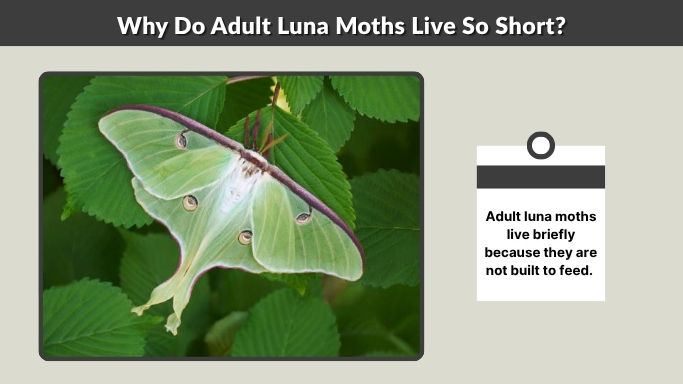
Adult luna moths live briefly because they are not built to feed. Their mouthparts are reduced and nonfunctional. Since they cannot replace energy by eating, they survive only on stored reserves.
Their short life is not a problem for the species. It is part of their natural strategy. Caterpillars spend weeks eating and storing energy. Adults then use that energy quickly to find mates and reproduce.
No Functional Mouthparts
Adult luna moths do not have working mouthparts for feeding. Many butterflies and moths use a long proboscis to drink nectar, but luna moths cannot do this.
Because of this, adult luna moths do not eat flowers, fruit, leaves, sugar water, or honey. They also do not drink water. This makes their adult lifespan naturally short.
Even in perfect conditions, they cannot live for months as adults. Their bodies are designed for a short reproductive period, not long-term survival.
Energy Stored from the Caterpillar Stage
The caterpillar stage is the feeding stage of the luna moth. Caterpillars eat leaves from host plants such as sweetgum, hickory, walnut, birch, persimmon, sumac, and willow.
As the caterpillar grows, it stores nutrients and fat. This stored energy supports the cocoon stage and adult stage. Once the adult emerges, it uses the remaining energy for flying, mating, and egg laying.
This is why healthy host plants are so important. A caterpillar with good food has a better chance of reaching adulthood and reproducing successfully.
Main Goal Is Reproduction
The adult luna moth’s main goal is reproduction. Males search for females at night by detecting pheromones. Females release scent signals and later lay eggs on host plants.
Once mating and egg laying are complete, the adult moth’s job is finished. It does not need a long adult life to complete its role in the life cycle.
This short adult phase is one reason luna moth sightings feel special. The moth may only be visible for a few nights before its life ends naturally.
What Affects Luna Moth Lifespan?
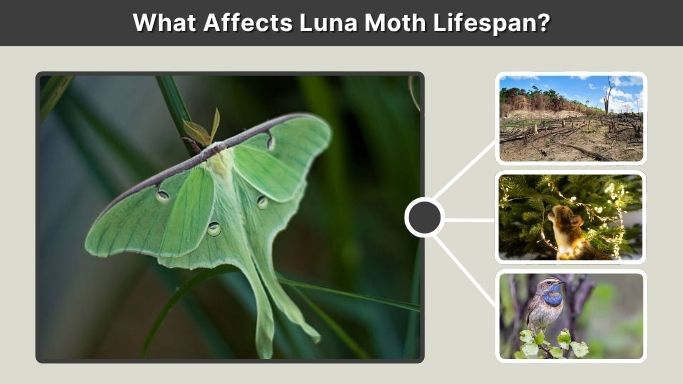
Several factors can affect how long luna moths live. Some factors are natural, such as predators and weather. Others are caused by human activity, such as pesticide use, habitat loss, and artificial lighting.
A luna moth may have the genetic ability to live about a week as an adult, but real survival can be shorter if conditions are poor.
Weather and Temperature
Temperature affects luna moth development. Warm weather can speed up egg hatching, caterpillar growth, and pupation. Cooler weather can slow these stages.
Storms, heavy rain, drought, and sudden cold can reduce survival. Adult luna moths are delicate, and their wings can be damaged by rough weather.
Cocoons may be safer than adults because they are hidden in leaves or protected places. However, extreme weather can still harm pupae, especially if leaf litter is disturbed or removed.
Predators
Luna moths face predators at every life stage. Eggs may be eaten by small insects. Caterpillars may be eaten by birds, wasps, ants, spiders, and other predators. Adult moths may be eaten by bats, birds, frogs, or spiders.
The long tails on adult luna moth wings may help confuse bats. These tails can draw attacks away from the body. If a predator damages only the tail, the moth may still escape.
Still, predation is a normal part of nature. Not every egg, caterpillar, or moth survives to reproduce.
Pesticides and Habitat Loss
Pesticides can shorten luna moth life by killing caterpillars or reducing the insects they depend on in the ecosystem. Broad insecticides are especially harmful because they do not only target pests.
Habitat loss is another problem. Luna moths need host trees for caterpillars and safe places for cocoons. Removing native trees, clearing leaf litter, and over-cleaning natural areas can reduce their survival.
A moth-friendly yard with native trees, fewer chemicals, and some natural leaf litter can help support their full life cycle.
How Long Do Luna Moths Live by Season?
Season has a strong effect on the luna moth life cycle. In warm regions, luna moths may complete more than one generation in a year. In colder regions, they may have fewer generations and spend winter as pupae.
This means the same species can have different timing depending on location.
Spring and Summer Generations
In spring and summer, eggs may hatch quickly, caterpillars may grow in a few weeks, and pupae may emerge as adults within the same season. The full cycle can move faster when temperatures are warm and host plants are fresh.
Adults seen in spring may come from cocoons that overwintered. Adults seen later in summer may be from a new generation that developed during the warm season.
In southern regions, multiple generations may appear across the year. In northern regions, the active season is shorter.
Overwintering in the Cocoon
If a luna moth caterpillar spins a cocoon late in the season, it may remain inside through winter. This stage is called overwintering. The pupa waits until warmer weather returns before emerging.
During overwintering, the moth does not eat. It stays protected inside the cocoon, often hidden among fallen leaves. This is why leaf litter under host trees can be important.
If leaves are removed too aggressively, cocoons may be thrown away or exposed to predators and weather.
Can You Make a Luna Moth Live Longer?
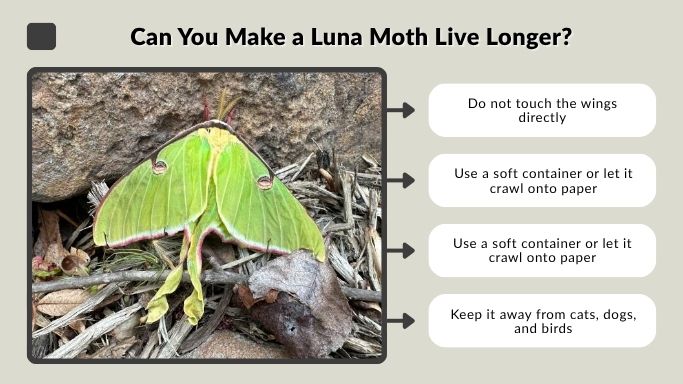
You cannot greatly extend the adult life of a luna moth because adults cannot eat. However, you can help protect one from early death by reducing stress and danger.
If you find an adult luna moth, avoid handling it. Keep it away from pets, bright indoor lights, and unsafe surfaces. If it is indoors, gently release it outside near trees or shrubs after dark.
Safe Care Tips
If you need to move or protect a luna moth, follow these tips:
- Do not touch the wings directly
- Use a soft container or let it crawl onto paper
- Keep it away from cats, dogs, and birds
- Avoid keeping it in a closed jar
- Do not offer food or force water
- Release it near trees or shrubs
- Turn off unnecessary outdoor lights
These steps may help the moth complete its natural adult purpose. The goal is not to keep it alive unnaturally, but to let it continue its life cycle safely.
FAQs
How long do luna moths live as adults?
Adult luna moths usually live about 7 to 10 days. They have a very short adult life because they do not eat or drink. Their main purpose during this stage is to find a mate, reproduce, and lay eggs before their stored energy runs out.
How long does a luna moth stay in its cocoon?
A luna moth may stay in its cocoon for about 2 to 4 weeks in warm weather. If the cocoon forms late in the season, the pupa may stay inside through winter and emerge the following spring when temperatures become suitable.
How long do luna moth eggs take to hatch?
Luna moth eggs usually hatch in about 1 to 2 weeks. Warm temperatures can speed up hatching, while cooler conditions may slow it down. After hatching, the tiny caterpillars begin feeding on suitable host plant leaves nearby.
How long is a luna moth a caterpillar?
A luna moth is usually a caterpillar for about 3 to 4 weeks. During this time, it eats leaves, grows quickly, and molts several times. Once fully grown, it leaves the host plant or finds a sheltered place to spin a cocoon.
Do luna moths live longer in captivity?
Adult luna moths do not live much longer in captivity because they cannot eat. They may be protected from predators and weather, but their adult lifespan is still usually around one week. Captivity cannot change their natural short adult life.
