
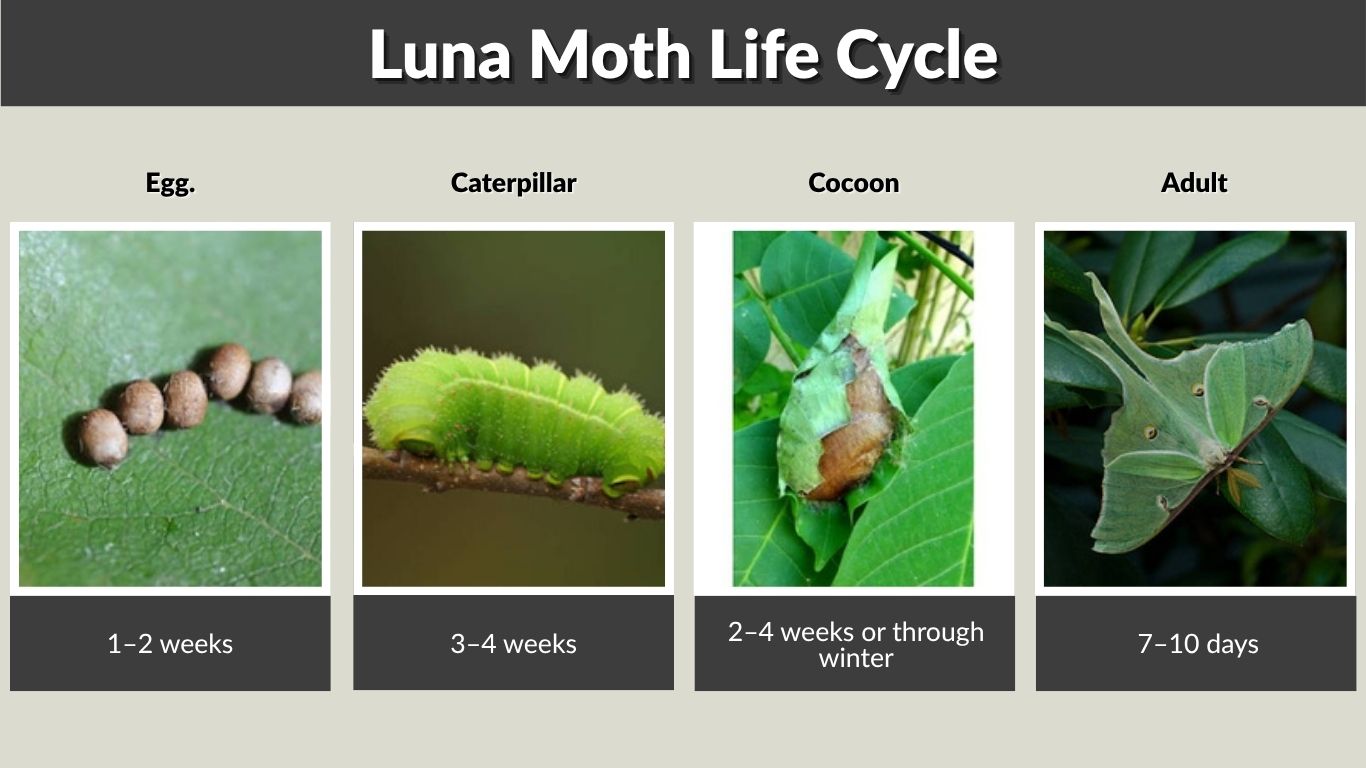
The luna moth life cycle is a beautiful example of complete metamorphosis. This green silk moth begins as a tiny egg, grows into a hungry caterpillar, changes inside a cocoon, and finally emerges as a large adult moth with long tails. Each stage has a different purpose. The caterpillar eats and stores energy, while the adult moth lives briefly to mate and lay eggs.
What Is the Luna Moth Life Cycle?
The luna moth life cycle has four main stages: egg, caterpillar, pupa inside a cocoon, and adult moth. These stages are very different from each other. The egg is the beginning, the caterpillar is the feeding stage, the cocoon is the transformation stage, and the adult is the reproductive stage.
Luna moths are members of the giant silk moth family. Their scientific name is Actias luna. Like butterflies, they go through complete metamorphosis. This means the young stage does not look like the adult. A luna moth caterpillar looks nothing like the pale green adult moth that later emerges.
Luna Moth Life Stages
The life cycle includes these important stages:
- Egg stage: the female lays eggs on host plant leaves
- Caterpillar stage: the larva eats leaves and grows quickly
- Molting stage: the caterpillar sheds its skin several times
- Cocoon stage: the mature caterpillar spins a silk cocoon
- Pupa stage: the body transforms inside the cocoon
- Adult stage: the moth emerges, mates, and lays eggs
- Reproduction stage: females begin the next generation
Each stage depends on temperature, season, and food availability. In warm areas, luna moths may complete more than one generation in a year. In colder regions, they may spend winter as pupae inside cocoons.
Luna Moth Life Cycle Timeline
A luna moth’s life cycle can last several weeks or several months. The adult moth usually lives only about one week, but the full life cycle is much longer. Eggs may hatch in 1 to 2 weeks, caterpillars may feed for 3 to 4 weeks, and the cocoon stage may last a few weeks or through winter.
| Life Stage | Usual Duration | Main Purpose |
| Egg | 1–2 weeks | Development before hatching |
| Caterpillar | 3–4 weeks | Feeding, growth, and energy storage |
| Cocoon/Pupa | 2–4 weeks or through winter | Transformation into adult |
| Adult moth | 7–10 days | Mating and egg laying |
The timeline is not always exact. Warm weather can speed up development, while cooler weather can slow it down. If a caterpillar forms a cocoon late in the season, the adult may not emerge until spring.
Luna Moth Egg Stage
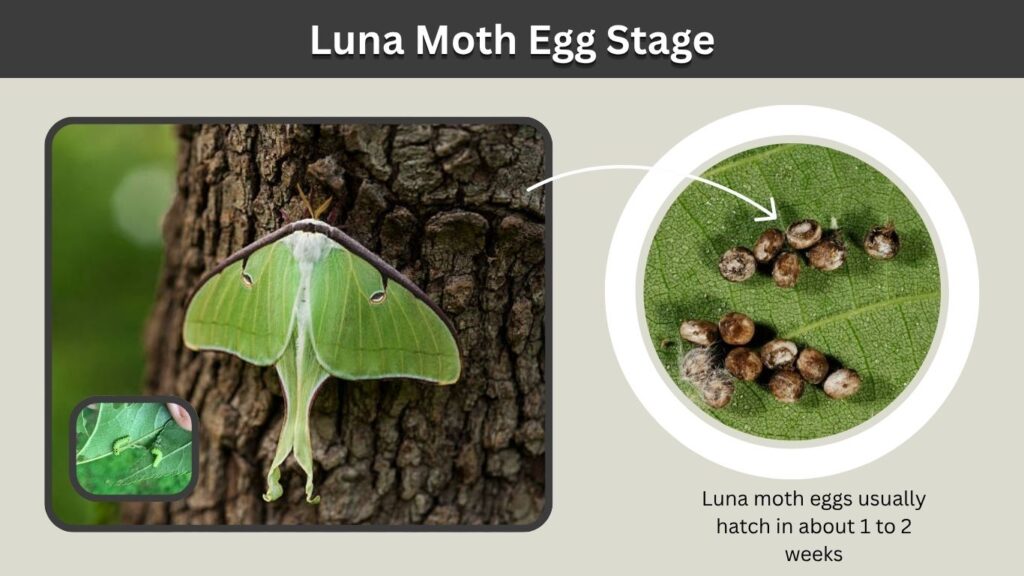
The egg stage is the first part of the luna moth life cycle. A female luna moth lays eggs after mating, usually on or near the leaves of host trees. These plants are important because the tiny caterpillars need the correct food as soon as they hatch.
The eggs are small and easy to miss. They may be laid singly or in small groups. Although they look simple from the outside, important development is happening inside. After several days, a tiny caterpillar forms and prepares to hatch.
Where Female Luna Moths Lay Eggs
Female luna moths lay eggs on host plants that can feed the caterpillars. Common host plants include sweetgum, hickory, walnut, birch, persimmon, sumac, willow, alder, beech, and pecan. The exact plant choice may vary by region.
The female does not care for the eggs after laying them. Instead, she chooses a suitable plant and leaves the next generation to continue naturally. If the eggs are placed on a good host plant, the young caterpillars have a better chance of survival.
How Long Luna Moth Eggs Take to Hatch
Luna moth eggs usually hatch in about 1 to 2 weeks. Warm conditions can make hatching faster, while cool weather may delay it. Humidity and plant quality can also affect survival.
When the caterpillar hatches, it may eat part of the eggshell before moving to the leaf. This gives it a small first meal. After that, it begins feeding on fresh leaves from the host plant.
Challenges During the Egg Stage
The egg stage is fragile. Many eggs may be eaten by ants, small insects, spiders, or other predators. Bad weather can also reduce survival. Eggs laid on poor host plants may hatch, but the caterpillars may not find suitable food.
This is why host plant selection is important. A female luna moth that lays eggs on the right tree gives her offspring a stronger start.
Luna Moth Caterpillar Stage
The caterpillar stage is the main feeding stage of the luna moth life cycle. During this time, the caterpillar eats leaves, grows larger, and stores energy. This stored energy is essential because adult luna moths do not eat.
Luna moth caterpillars are green and blend well with leaves. Young caterpillars are small, but they grow quickly. As they mature, they become plump, bright green, and easier to recognize.
What Luna Moth Caterpillars Eat
Luna moth caterpillars feed on leaves from specific host trees. Their diet may include:
- Sweetgum leaves
- Hickory leaves
- Walnut leaves
- Birch leaves
- Persimmon leaves
- Sumac leaves
- Willow leaves
- Pecan leaves
- Alder leaves
- Beech leaves
They usually do not feed on vegetables, clothes, stored food, or household items. If a green caterpillar is eating tomato plants, it is probably not a luna moth caterpillar. Luna moth larvae are mostly tree-leaf feeders.
Caterpillar Growth and Instars
Luna moth caterpillars grow through several stages called instars. An instar is the period between molts. As the caterpillar grows, its skin becomes too tight. It sheds the old skin and continues growing with a larger body.
This process happens several times. Early instars are small and delicate. Later instars are larger and stronger. By the final instar, the caterpillar has stored enough energy to prepare for pupation.
Molting is risky because the caterpillar is vulnerable during the process. It may stop feeding for a short time before shedding its skin. After molting, it usually begins feeding again.
How Long the Caterpillar Stage Lasts
The luna moth caterpillar stage usually lasts about 3 to 4 weeks. In warm weather with good food, growth may be faster. Cooler weather or poor food quality can slow development.
When fully grown, the caterpillar stops feeding and begins searching for a safe place to spin its cocoon. It may leave the host tree and crawl on the ground, across paths, or through leaf litter. This wandering behavior is normal before pupation.
Luna Moth Cocoon and Pupa Stage
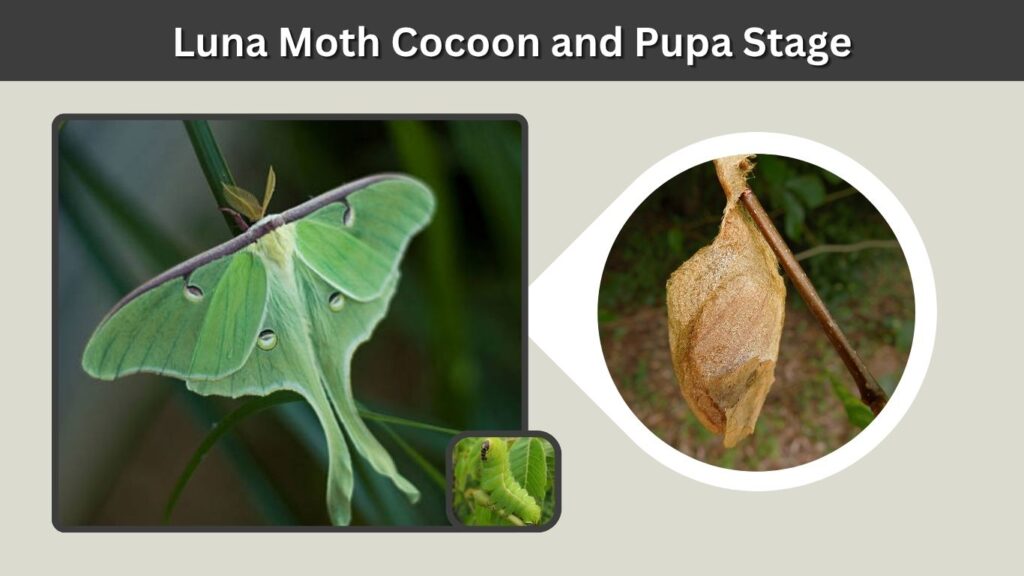
The cocoon stage is one of the most important parts of the luna moth life cycle. After the caterpillar finishes feeding, it spins a silk cocoon. This cocoon often includes leaves and may be hidden in leaf litter near the base of a tree.
Inside the cocoon, the caterpillar becomes a pupa. During this stage, the body changes dramatically. The caterpillar form breaks down and reorganizes into an adult moth with wings, antennae, legs, and reproductive organs.
How Luna Moths Make Cocoons
A mature luna moth caterpillar uses silk to form a protective cocoon. The cocoon may be wrapped in leaves, making it hard to see. It is often brownish because of the dried leaves around it.
The cocoon protects the pupa from some predators, weather, and drying out. However, it is not completely safe. Birds, rodents, insects, and parasites may still find it.
The cocoon may be located on the ground, in leaf litter, or attached loosely to plant material. This is why natural leaf cover can be helpful for luna moth survival.
How Long Luna Moths Stay in a Cocoon
Luna moths may stay in a cocoon for about 2 to 4 weeks during warm seasons. If the cocoon forms late in the year, the pupa may remain inside through winter and emerge the following spring.
This overwintering stage allows the moth to survive cold months. The adult emerges when temperature and seasonal conditions are suitable. In colder regions, this long cocoon period may be a normal part of the yearly cycle.
What Happens Inside the Cocoon
Inside the cocoon, the luna moth does not eat. It uses energy stored during the caterpillar stage. The pupa may look inactive, but major transformation is happening inside.
The adult wings, antennae, legs, and body structure form during this stage. When development is complete, the adult moth breaks out of the cocoon. It then pumps fluid into its wings and waits until they expand and harden.
Adult Luna Moth Stage
The adult luna moth is the final stage of the life cycle. This is the large pale green moth with long hindwing tails and eyespots. Adults are beautiful, but their lives are very short. They usually live for about 7 to 10 days.
Adult luna moths do not eat or drink. Their mouthparts are reduced and do not function for feeding. Because of this, the adult stage is focused only on mating and reproduction.
Adult Luna Moth Appearance
Adult luna moths are easy to recognize. They have pale green wings, long curved tails, and eyespots on all four wings. Their wingspan may reach about 3 to 4.5 inches. The body is light-colored and fuzzy.
Males and females look similar, but males usually have wider, more feather-like antennae. Females often have fuller abdomens because they carry eggs. The antennae are one of the best ways to tell male and female luna moths apart.
Why Adult Luna Moths Do Not Eat
Adult luna moths do not eat because they do not have working mouthparts. They cannot drink nectar, sip water, chew leaves, or eat fruit. They survive using energy stored while they were caterpillars.
This explains why the adult lifespan is so short. The moth has only a few days to find a mate and reproduce. Even in captivity, adult luna moths usually do not live much longer because food cannot extend their life.
Mating and Egg Laying
After emerging, adult luna moths search for mates at night. Females release pheromones, which are chemical signals that males can detect with their large antennae. Males fly to locate females.
After mating, the female lays eggs on host plants. These eggs start the next life cycle. Once mating and egg laying are complete, the adult moth’s natural role is finished.
Seasonal Life Cycle of Luna Moths
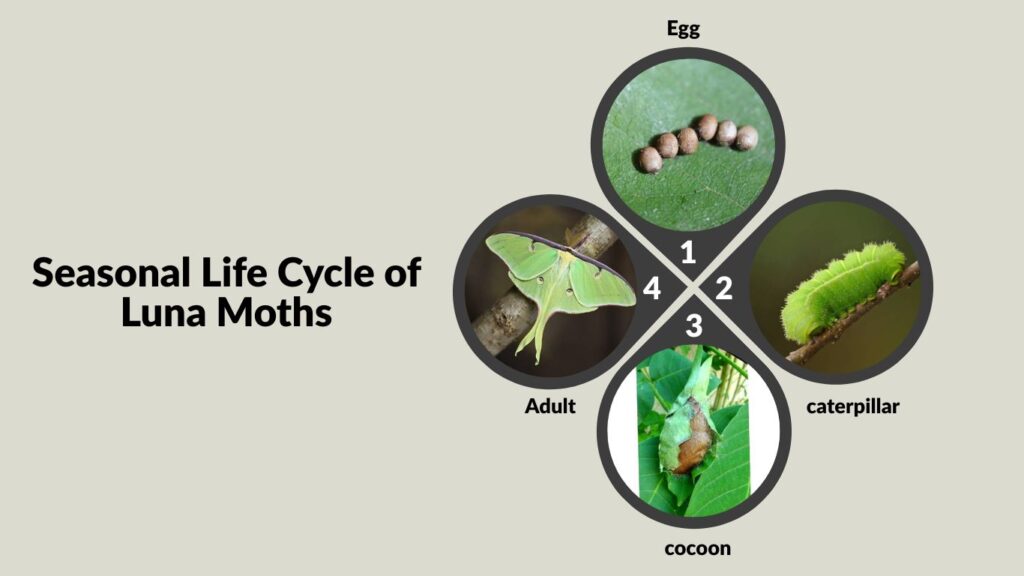
The luna moth life cycle changes depending on season and location. In warmer southern areas, luna moths may have multiple generations in one year. In cooler northern areas, they may have only one or two generations.
Season affects egg development, caterpillar growth, cocoon length, and adult emergence. Temperature is one of the biggest factors controlling how quickly the life cycle moves.
Spring Generation
In spring, adult luna moths may emerge from cocoons that survived winter. These adults mate and lay eggs on fresh host plant leaves. The eggs hatch into caterpillars, which feed during spring and early summer.
Spring generations are important because host plants are producing new leaves. Fresh leaves can support strong caterpillar growth.
Summer Generation
In warm regions, luna moths may produce another generation during summer. Caterpillars grow during warm weather, spin cocoons, and adults may emerge again within the same season.
This cycle can repeat if conditions remain favorable. However, hot dry weather, pesticide use, and lack of host plants can reduce survival.
Overwintering Stage
In colder regions, late-season caterpillars may spin cocoons and remain inside through winter. The pupa waits until spring before emerging as an adult moth.
This overwintering period protects the developing moth from cold weather. Leaf litter, natural ground cover, and undisturbed areas can help cocoons survive until spring.
Why the Luna Moth Life Cycle Matters
The luna moth life cycle matters because each stage supports the next. Caterpillars need host trees, pupae need safe shelter, and adults need enough habitat to find mates. If one stage is disrupted, the whole cycle can suffer.
Luna moths are also part of the food web. Their caterpillars and adults provide food for birds, bats, spiders, wasps, and other animals. They are not pests in the usual household sense and are harmless to people.
How to Support Luna Moths
You can support luna moths by creating a natural, moth-friendly space:
- Plant or protect native host trees
- Avoid broad pesticide use
- Leave some fallen leaves under trees
- Reduce bright outdoor lighting at night
- Keep wooded edges and shrubs when possible
- Avoid handling caterpillars or adult moths
- Let harmless caterpillars remain on host plants
These steps help luna moths complete their life cycle naturally. They also benefit butterflies, native bees, beetles, birds, and other wildlife.
Common Threats to the Life Cycle
Luna moths face many threats during their life cycle. Eggs and caterpillars may be eaten by predators. Cocoons may be destroyed by yard cleanup. Adults may be confused by artificial lights or eaten by bats and birds.
Human activity can also reduce survival. Pesticides, habitat loss, and removal of host trees can make it harder for luna moths to reproduce. Even small habitat improvements can make a difference.
FAQs
What is the life cycle of a luna moth?
The luna moth life cycle has four stages: egg, caterpillar, cocoon/pupa, and adult moth. The caterpillar feeds on host tree leaves, the pupa transforms inside a cocoon, and the adult moth emerges to mate and lay eggs before dying naturally.
How long is the luna moth life cycle?
The full luna moth life cycle may last several weeks or several months. Eggs hatch in about 1 to 2 weeks, caterpillars feed for about 3 to 4 weeks, and the cocoon stage may last a few weeks or through winter. Adults usually live about 7 to 10 days.
How long does a luna moth stay in its cocoon?
A luna moth may stay in its cocoon for about 2 to 4 weeks in warm weather. If the cocoon forms late in the season, the pupa may remain inside through winter and emerge the next spring when conditions are suitable.
What do luna moth caterpillars eat during the life cycle?
Luna moth caterpillars eat leaves from host trees such as sweetgum, hickory, walnut, birch, persimmon, sumac, willow, alder, beech, and pecan. This feeding stage is important because adult luna moths do not eat or drink.
Do adult luna moths live long?
No, adult luna moths do not live long. They usually survive about 7 to 10 days. Adult luna moths cannot eat because they do not have functional mouthparts. Their short adult life is focused on mating and laying eggs.
