
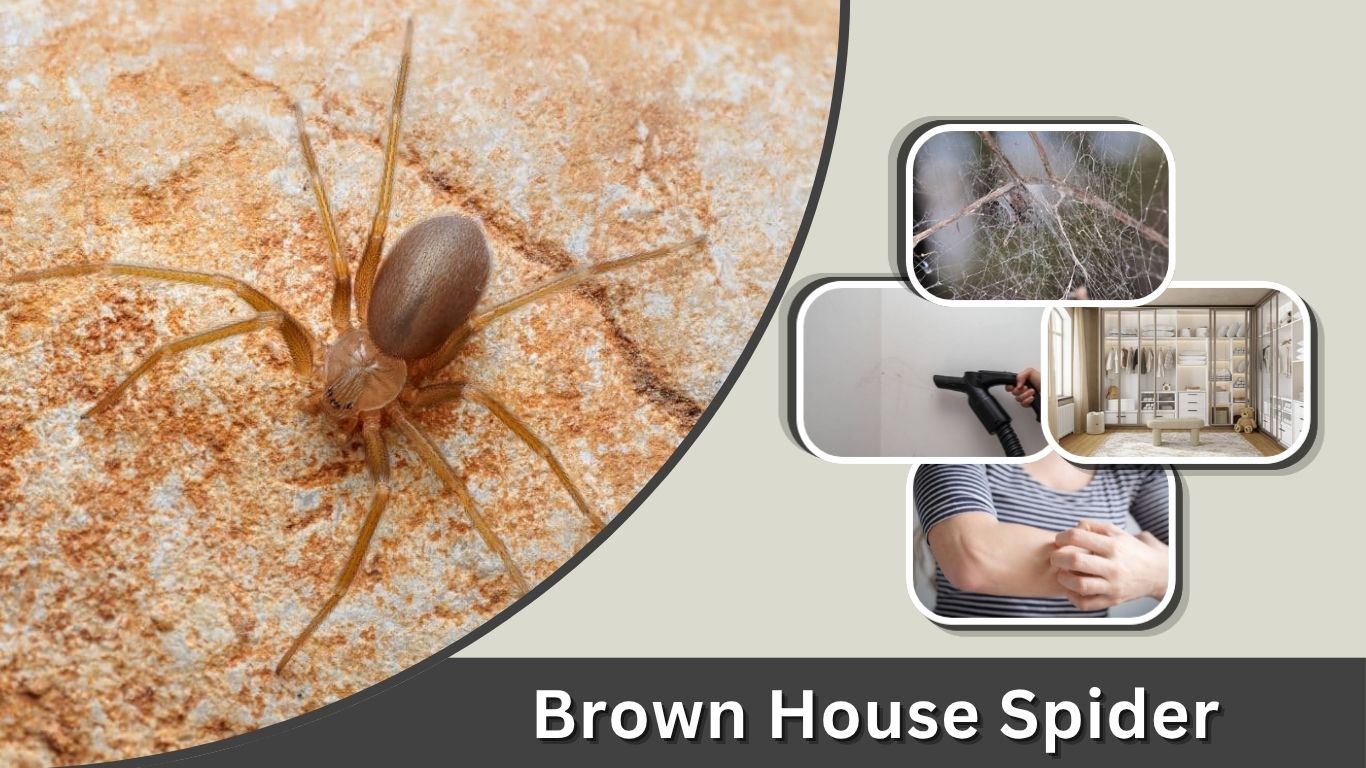
A brown house spider may be small and harmless or large enough to cause concern when it suddenly appears indoors. However, the name does not identify one specific species. People commonly use it for common house spiders, southern house spiders, false widows, grass spiders, and other brown spiders found around buildings. This guide explains how to identify these spiders, distinguish them from brown recluses, understand possible bite symptoms, and remove them safely from your home.
What Is a Brown House Spider?
“Brown house spider” is a general descriptive name rather than a precise scientific classification. In North America, the spider may be a common house spider (Parasteatoda tepidariorum), southern house spider (Kukulcania hibernalis), false widow (Steatoda species), grass spider, or another indoor species.
Correct identification depends on more than color. Size, body shape, markings, web design, location, and behavior all provide useful clues. Brown coloration alone cannot determine whether a spider is dangerous.
Common Species Called Brown House Spiders
The following spiders frequently receive this informal name:
- Common house spider: A small, yellowish-brown to dark-brown cobweb spider with a rounded abdomen.
- Southern house spider: A medium to large crevice-weaving spider found in warm regions.
- False widow or cupboard spider: A dark-brown spider with a smooth, bulbous abdomen.
- Grass spider: A brown, striped spider that produces a sheet-shaped web with a funnel retreat.
- Wolf spider: A strong, hairy hunting spider that does not build a prey-catching web.
- Hobo spider: A funnel-weaving species sometimes found around basements and ground-level structures.
Brown House Spider Identification
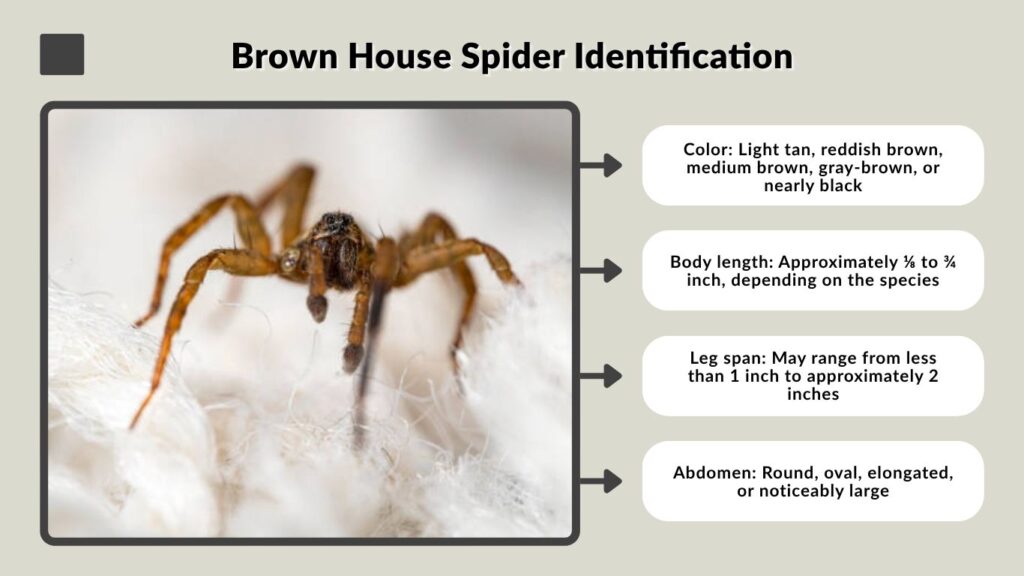
The appearance of a brown house spider can vary considerably. Some have rounded abdomens and thin legs, while others are hairy, long-legged, or marked with stripes. Examine the spider from a safe distance instead of handling it.
Main Identification Features
- Color: Light tan, reddish brown, medium brown, gray-brown, or nearly black
- Body length: Approximately ⅛ to ¾ inch, depending on the species
- Leg span: May range from less than 1 inch to approximately 2 inches
- Abdomen: Round, oval, elongated, or noticeably large
- Markings: Spots, chevrons, pale patches, stripes, or mottled patterns
- Legs: Thin and smooth or thick and visibly hairy
- Web: Tangled cobweb, funnel web, sheet web, or no permanent prey-catching web
- Behavior: Usually retreats when disturbed rather than approaching people
Small and Tiny Brown House Spiders
A small brown house spider in a window corner or ceiling space is often a common house spider. Adult females usually have rounded abdomens, thin legs, and mottled coloring. Males are smaller and more elongated.
Tiny spiders may also be juveniles. Their colors and patterns can change as they mature, making identification from size alone unreliable. Newly hatched spiders sometimes gather near an egg sac before dispersing.
Big Brown House Spiders
A big brown house spider running across the floor could be a wolf spider, grass spider, fishing spider, or male southern house spider. These spiders often appear more intimidating because of their long legs, speed, or hairy bodies.
A large female southern house spider may be dark brown or black and have a velvety appearance. Males are lighter, thinner, and longer-legged. Despite their appearance, southern house spiders are generally considered nuisance spiders and feed primarily on insects.
Colors, Spots, and Stripes
Light-brown house spiders are often males or species adapted to dry, sheltered areas. A dark-brown house spider with a smooth, fat abdomen could be a false widow, while a reddish-brown spider with large jaws might be a woodlouse spider.
A brown house spider with white spots or stripes is unlikely to be a brown recluse. Grass spiders, wolf spiders, orb weavers, and juvenile cobweb spiders commonly have visible markings. North American recluse spiders normally have plain abdomens and uniformly colored legs.
Brown House Spider Web and Habitat
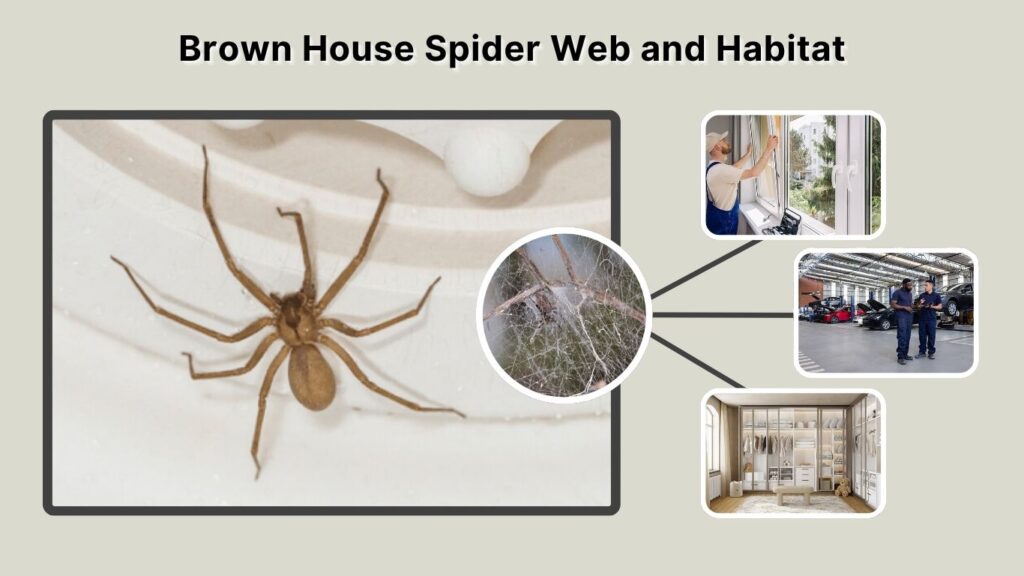
The type and location of the web can help narrow down the spider’s identity. Indoor web-building spiders usually choose undisturbed places where insects are available and human activity is limited.
Common Web Types
A common house spider constructs an irregular, tangled web without a symmetrical pattern. These cobwebs frequently appear in window frames, garages, sheds, closets, basements, and upper wall corners.
Southern house spiders build messy, woolly-looking webs extending from a hole or narrow crevice. Grass and hobo spiders construct flatter sheet webs leading into a funnel-shaped retreat. Wolf spiders do not use webs to catch prey and are usually seen wandering across floors.
Where Brown House Spiders Hide
Common hiding places include:
- Behind furniture and appliances
- Inside closets, attics, and basements
- Around window frames and doorways
- Beneath cardboard boxes
- Inside wall cracks and foundation gaps
- In garages, sheds, and barns
- Behind outdoor shutters and siding
- Near porch lights that attract insects
Most house spiders become active after dark. They may remain hidden during the day and emerge at night to repair webs, hunt, or search for mates.
Brown House Spider vs. Brown Recluse
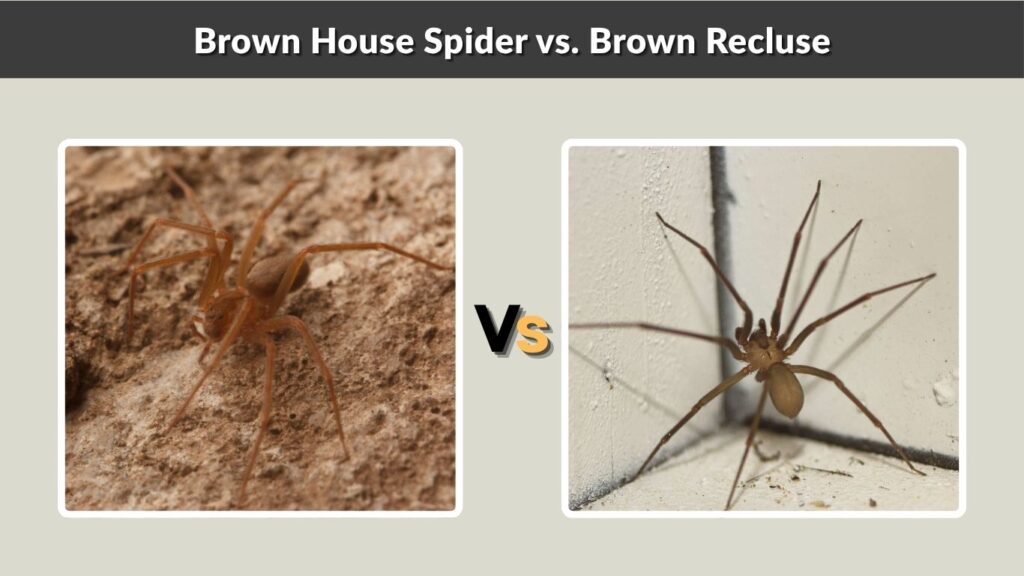
Many ordinary brown spiders are incorrectly identified as brown recluses. A dark mark resembling a violin is not enough to confirm a recluse. Eye arrangement, leg structure, abdomen pattern, and geographic range are more dependable characteristics.
| Feature | Typical Brown House Spider | Brown Recluse |
| Eyes | Usually eight | Six, arranged in three pairs |
| Abdomen | Often spotted, mottled, or striped | Plain and uniformly colored |
| Legs | May have bands, stripes, or prominent spines | Uniformly colored without obvious spines |
| Web | Often an exposed cobweb or funnel | Irregular retreat web in a secluded location |
| Body shape | Varies by species | Relatively flat, plain, and slender |
| Behavior | Web-building or active hunting | Secretive and mainly nocturnal |
| U.S. distribution | Widespread | Primarily south-central and Midwestern states |
The true brown recluse occurs mainly from southeastern Nebraska and southwestern Ohio southward through Texas to northern Georgia. Established brown recluse populations are not found in California, although other recluse species occur in limited desert areas. The violin marking is not reliable by itself; experts place greater importance on the spider’s six-eye arrangement and other combined features.
Because inspecting a spider’s eyes requires magnification, avoid placing your face or hands near a live specimen. Capture it under a clear container or photograph it from a safe distance if professional identification is necessary.
Brown House Spider vs. Other Look-Alikes
Several common spiders can resemble one another when viewed briefly. Their movement, body shape, and webs can make identification easier.
Wolf Spider vs. Brown House Spider
Wolf spiders have sturdy, hairy bodies and prominent eyes. They actively hunt insects instead of waiting in a prey-catching web. A wolf spider found indoors normally entered accidentally while searching for prey or shelter.
Common house spiders usually have thinner legs and more rounded abdomens. They spend much of their time inside tangled cobwebs.
Hobo Spider vs. Brown House Spider
Hobo spiders and related funnel weavers have elongated bodies, patterned abdomens, and relatively long legs. Their webs form horizontal sheets with funnel-shaped retreats. They are frequently confused with recluses, but their anatomy and markings are different.
Southern House Spider vs. Brown Recluse
The male southern house spider is one of the most common recluse look-alikes. It has long legs and a brown body but lacks the true recluse’s diagnostic combination of six eyes, plain abdomen, and uniformly colored spineless legs.
Female southern house spiders are darker, heavier, and more velvety. Both sexes usually live in crevices around buildings.
Are Brown House Spiders Dangerous?
Most spiders described as brown house spiders are not medically dangerous to healthy people. They possess venom because they need it to immobilize prey, but “venomous” does not automatically mean dangerous to humans. “Poisonous” is technically inaccurate because a spider injects venom through its fangs rather than harming someone when swallowed or touched.
House spiders generally avoid confrontation. A bite is most likely when a spider becomes trapped inside clothing, bedding, gloves, or shoes or is pressed directly against the skin.
Children, older adults, people with serious health conditions, and individuals with severe allergies may require more cautious medical evaluation after any suspected bite.
Brown House Spider Bite Symptoms
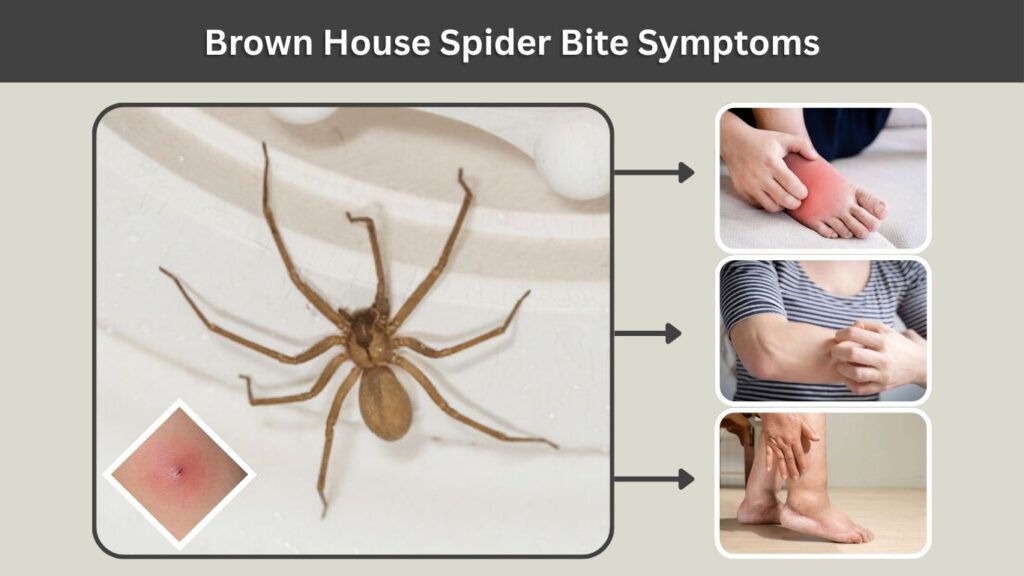
A confirmed brown house spider bite is uncommon. Many unexplained red bumps are caused by mosquitoes, fleas, bed bugs, skin infections, allergic reactions, or other conditions rather than spiders.
Possible symptoms from a minor house-spider bite include:
- Immediate pinching or stinging
- Localized redness
- Mild swelling
- Itching or tenderness
- A small raised bump
- Discomfort lasting several hours or days
The appearance of two puncture marks does not confirm a spider bite. Fang marks may be invisible, and many unrelated skin conditions can produce paired marks.
What to Do After a Suspected Bite
Wash the area gently with soap and water. Apply a wrapped cold pack for short intervals to reduce pain and swelling, and elevate the affected limb when practical. Do not cut the skin, squeeze the wound, or attempt to remove venom.
If the spider can be contained without touching it, place a clear container over it or take a photograph. Do not risk another bite by attempting to pick it up.
When to Seek Medical Help
Contact a medical professional if pain or swelling becomes worse, a blister or spreading wound develops, or symptoms do not improve. Seek urgent care for:
- Difficulty breathing or swallowing
- Facial or throat swelling
- Severe or spreading pain
- Muscle cramps or weakness
- Fever, chills, nausea, or vomiting
- Heavy sweating, dizziness, or fainting
- A rapidly enlarging blister or discolored lesion
- A suspected widow or recluse bite
- Any concerning symptoms in a young child
The CDC recommends washing a suspected spider bite, applying a cold cloth or wrapped ice, elevating the area, and obtaining professional care when warranted. CDC/NIOSH
Brown House Spiders in Different Locations
Brown spiders occur throughout the United States, but the species found inside homes vary by climate and geography.
California
A brown house spider in California is far more likely to be a common house spider, false widow, grass spider, Titiotus spider, or Mediterranean false wolf spider than a brown recluse. Southern California also supports southern house spiders and, in restricted locations, certain non-native recluse species.
Florida and the Southeast
Warm conditions support southern house spiders, common house spiders, wolf spiders, huntsman spiders, and several orb weavers. Southern house spiders frequently occupy cracks around windows, eaves, garages, and exterior walls.
Texas and the Central United States
Texas has common house spiders, southern house spiders, wolf spiders, grass spiders, and true recluse species. Consequently, a plain brown spider in Texas should be identified carefully instead of being judged only by color.
Northern and Western States
Homes in Colorado, Oregon, Washington, Michigan, Illinois, Ohio, Pennsylvania, and New York may contain common house spiders, funnel weavers, sac spiders, false widows, and wandering wolf spiders. Local extension offices can provide more reliable regional identification.
How to Get Rid of Brown House Spiders
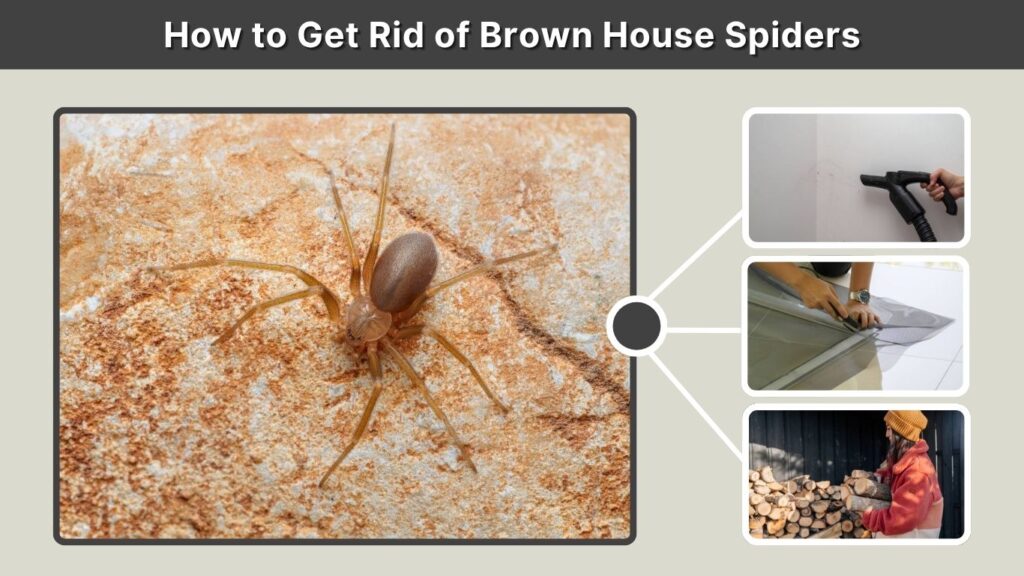
One or two spiders usually do not indicate an infestation. They often enter through gaps or remain because indoor insects provide food. Reducing prey and closing entry points offers better long-term control than repeatedly spraying individual spiders.
Safe Removal and Prevention
- Capture individual spiders using a container and stiff paper.
- Vacuum spiders, webs, and egg sacs from indoor corners.
- Empty the vacuum outdoors or seal and discard its contents.
- Seal gaps around doors, windows, pipes, vents, and foundations.
- Repair damaged screens and install door sweeps.
- Reduce clutter in garages, closets, attics, and basements.
- Store clothing, shoes, and seasonal items in sealed containers.
- Shake out gloves, towels, shoes, and clothing before use.
- Move firewood, cardboard, and debris away from exterior walls.
- Trim vegetation that touches the house.
- Reduce unnecessary outdoor lighting or use less insect-attracting bulbs.
- Control flies, moths, ants, and other insects that provide food.
Contact a qualified pest-management professional if numerous spiders repeatedly appear, potentially dangerous species are suspected, or webs are located in inaccessible areas.
Frequently Asked Questions
Is a brown house spider poisonous?
Brown house spiders are venomous, not poisonous. Most common indoor species have venom that is effective against insects but is unlikely to cause serious illness in humans.
What is a small brown spider commonly found in houses?
It may be a common house spider, juvenile cobweb spider, sac spider, or young funnel weaver. Web structure and markings are needed for a closer identification.
Why does a brown house spider have a big abdomen?
A naturally rounded abdomen is common among cobweb spiders and false widows. A mature female may also appear larger before producing eggs or after eating.
Will a brown house spider bite while I sleep?
This is unlikely. Spiders do not seek sleeping people or feed on blood. A defensive bite could occur if a spider were accidentally trapped between the body and bedding.
Should I kill brown spiders in my house?
Not necessarily. Most are harmless predators that control insects. You can leave an undisturbed spider alone or relocate it safely. Removal becomes more appropriate when spiders are numerous, appear near beds or clothing, or cannot be confidently distinguished from a medically important species.
