
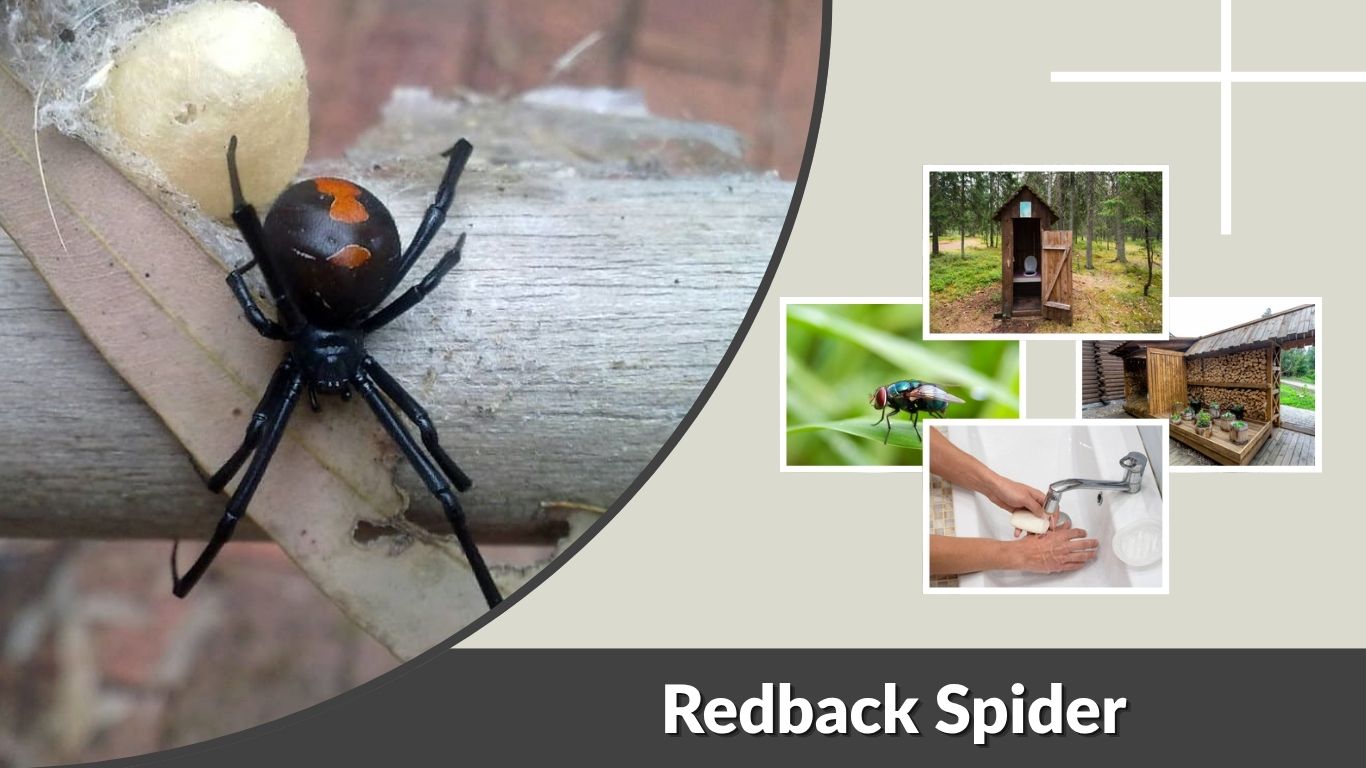
The redback spider is one of Australia’s best-known venomous spiders. Adult females are recognizable by their shiny black bodies and red abdominal markings, although color and pattern can vary. Redbacks normally remain inside messy webs built in dry, protected locations around homes, sheds, gardens, and outdoor equipment. They rarely bite unless trapped against the skin or their webs are disturbed. Nevertheless, a female’s bite can produce intense pain and systemic illness requiring professional medical assessment.
What Is a Redback Spider?
The redback spider, Latrodectus hasselti, belongs to the widow-spider genus Latrodectus. It is closely related to North American black widows but is recognized as a separate species.
Identification
- Scientific name: Latrodectus hasselti
- Family: Theridiidae
- Native range: Australia
- Female body length: Approximately 10 millimeters
- Male body length: Approximately 3–4 millimeters
- Legs: Slender and relatively long
- Eyes: Eight
- Web: Irregular, tangled, and sticky
- Diet: Primarily insects and other arthropods
- Female lifespan: Approximately two to three years
- Male lifespan: Approximately six to seven months
An adult female usually has a glossy black, rounded abdomen with an orange or red stripe on its upper surface. An orange-red hourglass-shaped marking may also appear beneath the abdomen. However, the stripe can be incomplete, faint, or occasionally absent.
Male and Juvenile Redbacks
Male redbacks look substantially different from adult females. They are much smaller and usually light brown, with white abdominal markings and less noticeable red coloration.
Juveniles frequently have white, cream, and reddish patterns that disappear or become less distinct as they mature. A brown or pale patterned spider near a redback web may therefore be a male or juvenile rather than another species.
Redback Spider Habitat
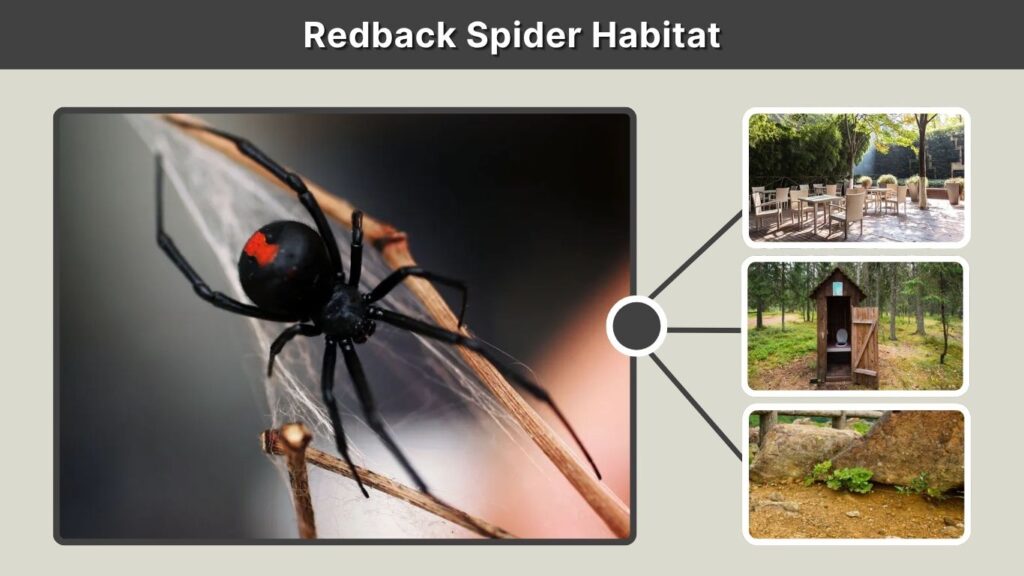
Redbacks occur throughout Australia and are especially common in disturbed environments associated with human activity. They prefer warm, dry, sheltered locations where a web can remain undisturbed.
Common Hiding Places
- Beneath outdoor furniture
- Inside sheds and garages
- Under plant pots
- Around rubbish or wood piles
- Beneath barbecue equipment
- Inside unused shoes or boots
- Around outdoor toilets
- Under children’s toys
- Inside electrical or irrigation boxes
- Beneath rocks and logs
- Around stored building materials
Redbacks occasionally enter houses, but most establish webs in sheltered outdoor or semi-outdoor areas. A spider found wandering across a floor may be a male or a female displaced from its web.
Redbacks in Texas and California
The Australian redback is not considered a common native spider in Texas or California. Reports from the United States frequently involve related black widows, false widows, or red-backed jumping spiders.
The red-backed jumping spider, Phidippus johnsoni, has a compact, hairy body and hunts without a capture web. It is not the Australian redback. A suspected imported redback should be photographed from a safe distance and reported to a local pest or wildlife authority.
Redback Spider Web and Nest
A redback does not produce the symmetrical web associated with garden orb-weavers. Instead, it creates an irregular three-dimensional structure in a protected corner.
Web Identification
The upper portion contains a tangled retreat where the spider hides. Strong vertical catching threads extend downward and attach to the ground or another surface. An insect touching one of these sticky lines may be lifted or restrained before the spider approaches.
Round, pale egg sacs may hang inside a female’s web. These sacs should not be handled because the female may remain hidden nearby.
Redback Spider Diet and Hunting Behavior
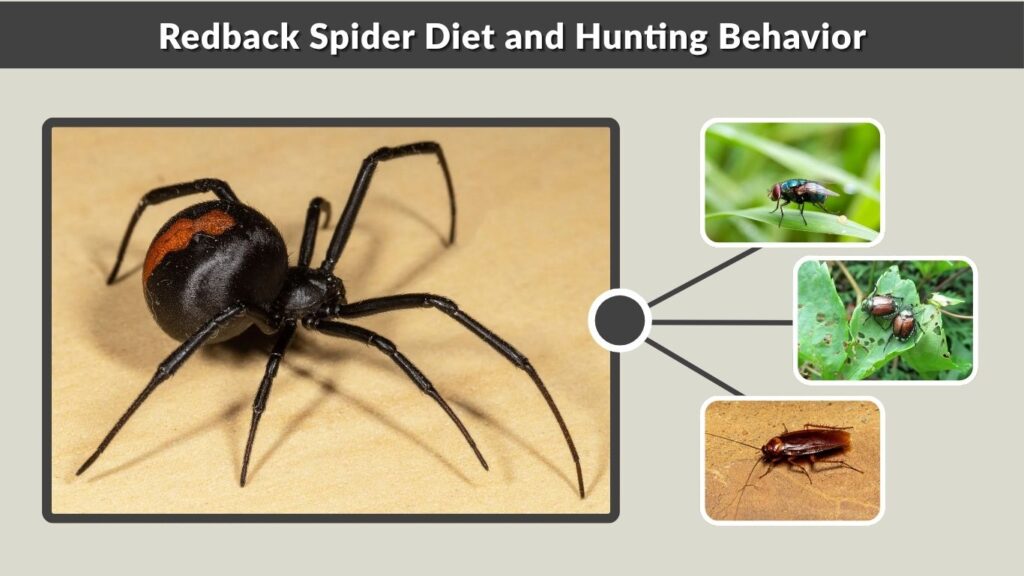
Redbacks primarily consume insects and other arthropods caught by their sticky silk. Their webs can occasionally restrain animals considerably larger than the spiders themselves.
Common Prey
- Flies
- Beetles
- Cockroaches
- Crickets
- Moths
- Other spiders
- Small lizards
- Large insects trapped near the ground
Rare reports show redbacks capturing very small snakes or other reptiles. This does not mean they regularly hunt snakes or can overpower a large, healthy one. Such incidents occur when a small animal becomes immobilized in a particularly strong web.
Mating and Life Cycle
A female redback can produce multiple round egg sacs, each potentially containing hundreds of eggs. Newly hatched spiderlings may consume unhatched eggs or one another before dispersing on silk carried by air currents.
Sexual Cannibalism
During courtship, the much smaller male carefully approaches the female’s web. He may position his abdomen near her mouthparts during mating, and many males are ultimately consumed.
Females can store sperm and use it to produce several egg sacs over an extended period. Under favorable conditions, this ability allows redback populations to expand rapidly around buildings.
Redback Spider vs. Black Widow
Redbacks and black widows belong to the same genus and share similar body shapes, web structures, hunting methods, and neurotoxic venom. However, they are not the same species.
| Feature | Redback spider | North American black widow |
| Scientific name | Latrodectus hasselti | Several Latrodectus species |
| Main distribution | Australia | North America |
| Upper abdomen | Usually has a red longitudinal stripe | Usually plain glossy black |
| Underside | May have a red-orange hourglass | Commonly has a red hourglass |
| Female size | About 10 mm body length | Varies, often around 8–13 mm |
| Medical concern | Potentially serious bite | Potentially serious bite |
Both should be observed rather than handled. Color alone is not always sufficient for identification because markings vary with species, sex, age, and individual development.
Are Redback Spiders Dangerous?
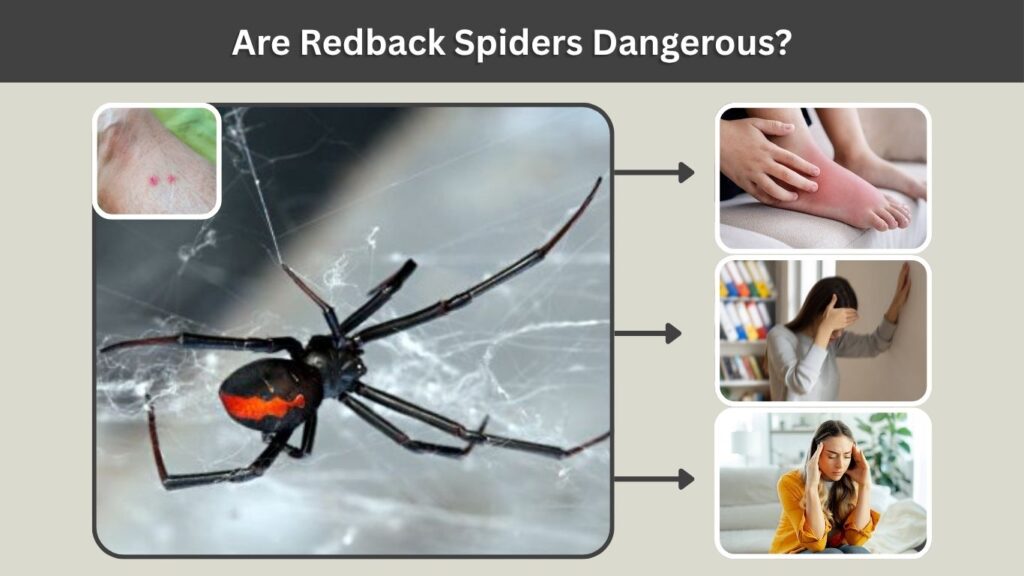
Female redbacks can inject neurotoxic venom that affects nerves and causes a condition known as latrodectism. Bites often occur when someone reaches into a web or puts on clothing, gloves, or footwear containing a spider.
The Australian Museum notes that the female’s bite presents an important medical danger because males are extremely small. Redbacks usually remain in their webs, so bites are uncommon unless direct contact occurs.
Redback Spider Bite Symptoms
- Immediate or increasing pain
- Redness or mild swelling
- Sweating around the bite
- Pain spreading from the bite site
- Swollen or tender lymph nodes
- Headache
- Nausea or vomiting
- Abdominal, back, or chest discomfort
- Muscle weakness or spasms
- General restlessness or illness
The bite may initially resemble a small pinprick. Severe pain can develop gradually and persist for hours or days. The affected area does not always develop dramatic swelling or visible fang marks.
Not every bite injects enough venom to cause serious illness. However, symptoms cannot be predicted safely from the initial appearance of the skin.
Redback Spider Bite First Aid
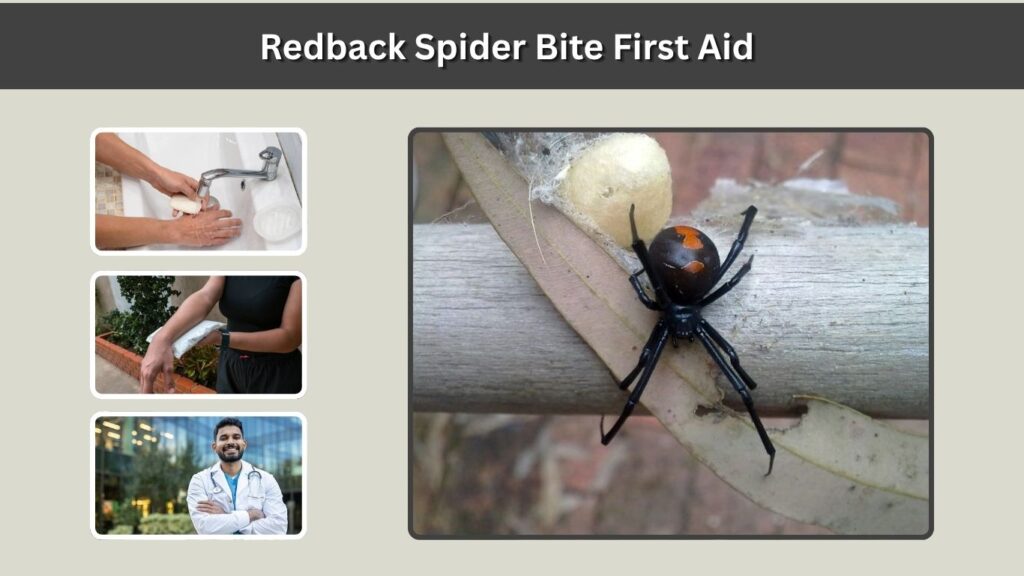
Redback first aid differs from first aid for Australian funnel-web spiders. A pressure-immobilization bandage is not recommended for a redback bite because it may increase localized pain.
What to Do
- Move away from the spider and remain calm.
- Wash the bite gently with soap and water.
- Apply a wrapped cold pack for approximately 15 minutes.
- Do not apply ice directly to the skin.
- Contact a medical professional or poison information service.
- Seek urgent care if pain is severe or systemic symptoms develop.
In Australia, call the Poisons Information Centre on 13 11 26 for individualized advice. Call 000 for breathing difficulty, collapse, loss of consciousness, severe weakness, or another medical emergency. People outside Australia should contact their local poison center or emergency service.
Do not cut the wound, suck out venom, apply a tourniquet, or attempt to catch the spider by hand. If it can be done safely, take a photograph for identification.
Medical Treatment
Treatment focuses on controlling pain and monitoring the patient for systemic envenomation. Clinicians may use appropriate pain medicine and supportive care. Redback antivenom is available in Australia, but the decision to use it depends on symptom severity, risks, and current clinical guidance.
Children, older adults, pregnant people, and anyone with serious medical conditions should receive prompt professional advice after a suspected bite.
Can a Redback Spider Kill You?
A redback bite can cause serious illness, but death is extremely rare with modern medical care. There is no reliable “death time” following a bite because the amount of venom, patient health, symptoms, and treatment vary.
Do not wait for life-threatening symptoms. Increasing pain, spreading sweating, vomiting, weakness, or muscle spasms are reasons to obtain medical advice promptly.
Redback Spider Control
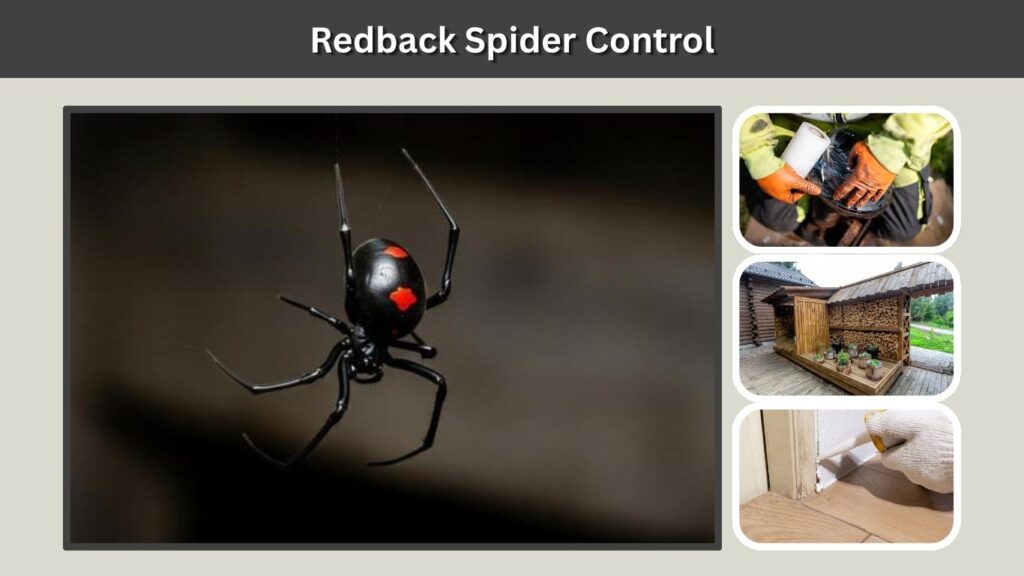
Reducing shelter, prey, and undisturbed web locations makes a property less attractive to redbacks.
Prevention and Removal
- Wear gloves while moving stored materials
- Shake out outdoor shoes and clothing
- Inspect furniture, toys, and barbecues
- Remove clutter from sheds and garages
- Store firewood away from the house
- Seal cracks around doors and foundations
- Remove abandoned webs carefully
- Keep children away from suspected nests
- Use a qualified pest professional for infestations
Do not place bare hands inside a web or beneath an object that may conceal a spider. A professional pest controller is the safest choice when numerous females or egg sacs are present.
FAQs
Is a redback spider the same as a black widow?
No. The redback and American black widows are closely related members of Latrodectus, but they are separate species with different natural distributions.
How big can a redback spider get?
An adult female’s body is approximately one centimeter long, excluding the legs. Males are much smaller at around three to four millimeters.
Do redback spider bites hurt?
Yes. Pain may start locally and become intense or spread over time. Sweating, nausea, headache, and muscle symptoms can also develop.
How long do bite symptoms last?
Mild symptoms may improve within hours, while significant pain or systemic effects can last several days. Persistent or worsening symptoms require medical assessment.
Are all black spiders with red markings redbacks?
No. Black widows, false widows, jumping spiders, and other species can have red markings. Location, body shape, web structure, and underside markings should all be considered.
