
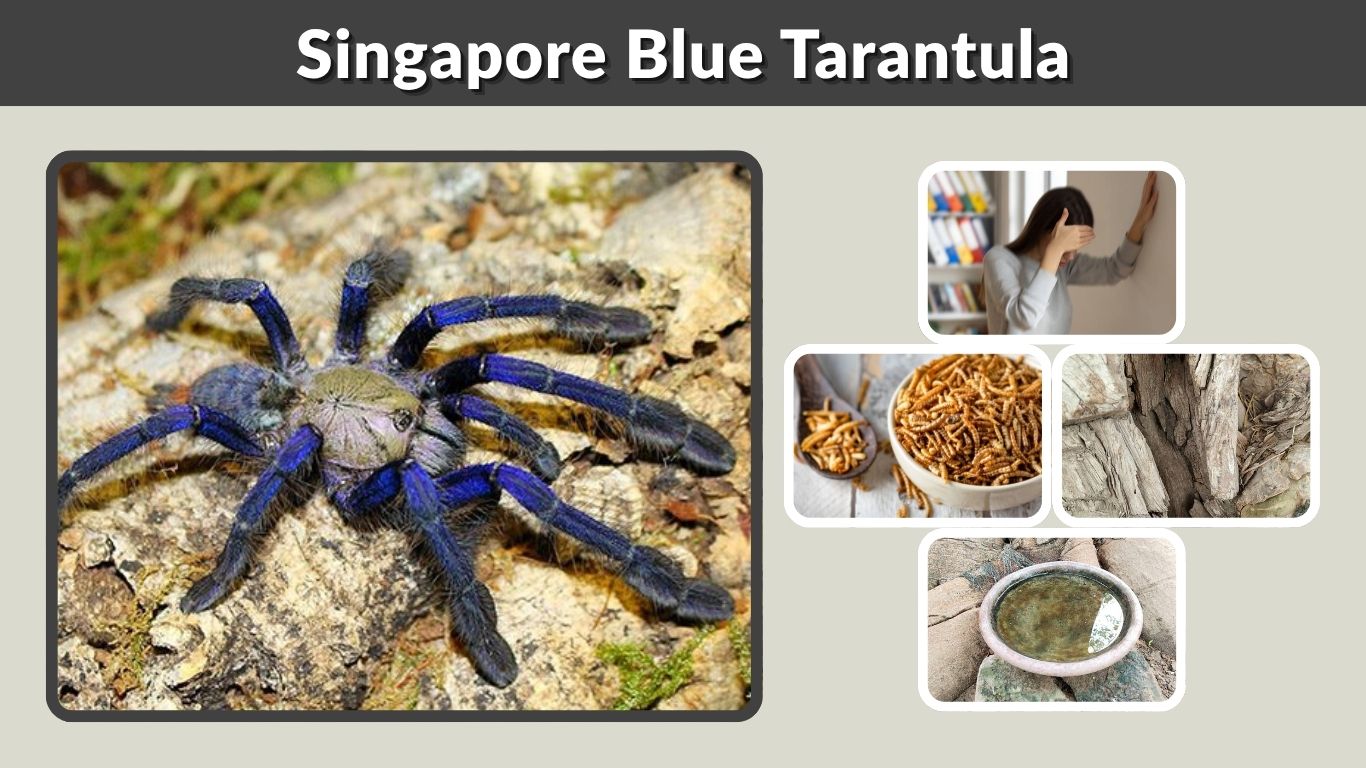
The Singapore blue tarantula is a massive arboreal species admired for the female’s metallic blue legs and contrasting golden-brown carapace. Native to the humid forests of Singapore and Peninsular Malaysia, it lives in silk-lined cavities within tree trunks. This Old World tarantula grows quickly, moves with exceptional speed, and may deliver a medically significant bite. It requires a tall, secure enclosure, vertical shelter, reliable hydration, careful moisture control, and an experienced keeper who can maintain it without handling.
What Is a Singapore Blue Tarantula?
The Singapore blue tarantula’s accepted scientific name is Omothymus violaceopes. Older books, care sheets, and sales listings may call it Lampropelma violaceopes or incorrectly spell the species name as “violaceopedes.”
The species naturally occurs in Singapore and Peninsular Malaysia, with Singapore serving as its type locality.
Identification
- Scientific name: Omothymus violaceopes
- Common names: Singapore blue and Malaysian blue
- Family: Theraphosidae
- Native range: Singapore and Peninsular Malaysia
- Type: Old World arboreal tarantula
- Adult leg span: Commonly 7–9 inches
- Growth rate: Fast
- Temperament: Defensive and extremely fast
- Experience level: Advanced
- Urticating hairs: Absent
- Venom: Potentially medically significant
Females and juveniles have deep blue or violet legs, a lighter brown or golden carapace, and a patterned abdomen. Their broad adhesive foot pads help them climb trees and enclosure walls.
Natural Habitat and Behavior
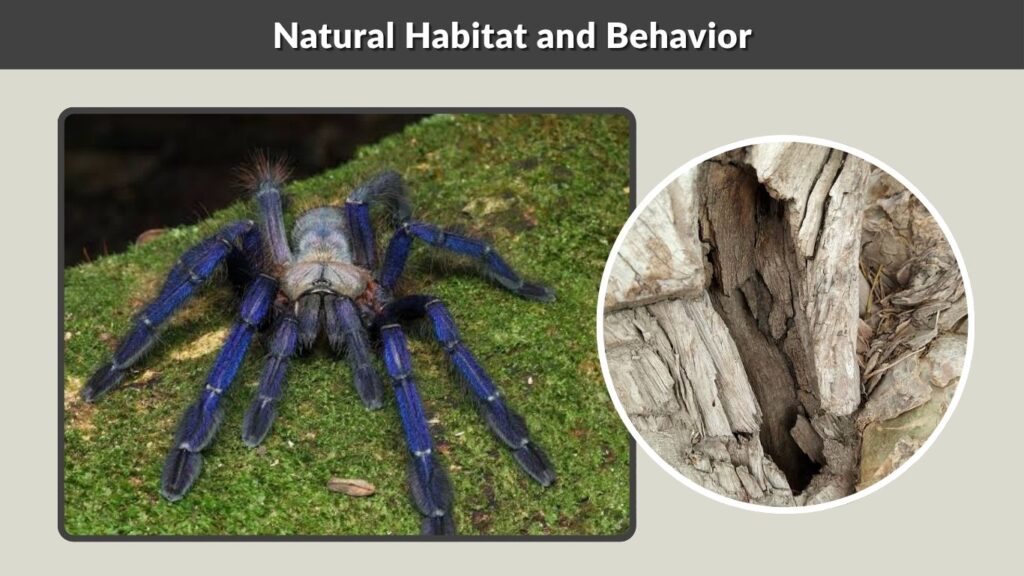
Singapore blue tarantulas inhabit warm, humid forests. Wild individuals use hollows and cracks in tree trunks, covering their retreats with dense silk. They have been recorded in mangroves and secondary forests and appear to be encountered infrequently in Singapore.
Arboreal Lifestyle
Adults are primarily arboreal, although young spiders may spend considerable time burrowing. Their retreats often extend downward behind bark or into the substrate, producing a protected vertical tunnel.
The tarantula normally waits inside its retreat and detects prey through vibrations in its web. It may become more visible after dark.
Temperament
This species is exceptionally fast and can move vertically or leap short distances when startled. It frequently retreats when given a safe escape route, but a cornered tarantula may display its fangs, strike, or bite.
As an Old World species, it lacks urticating hairs. Its principal defenses are speed, threat displays, and venom. It should only be maintained by keepers experienced with fast arboreal tarantulas.
Singapore Blue Tarantula Size and Growth Rate
The Singapore blue is among the largest arboreal tarantulas. Mature females commonly develop a diagonal leg span of 7–9 inches, although unusually large specimens may exceed this range.
How Fast Does It Grow?
Spiderlings grow relatively quickly when provided with stable warmth, adequate food, and sufficient moisture. Many reach substantial juvenile sizes within two or three years, but development varies among individuals.
Females become larger and heavier than mature males. A tarantula should not be power-fed to accelerate growth because excessive feeding can create a dangerously swollen abdomen.
Singapore Blue Tarantula Enclosure
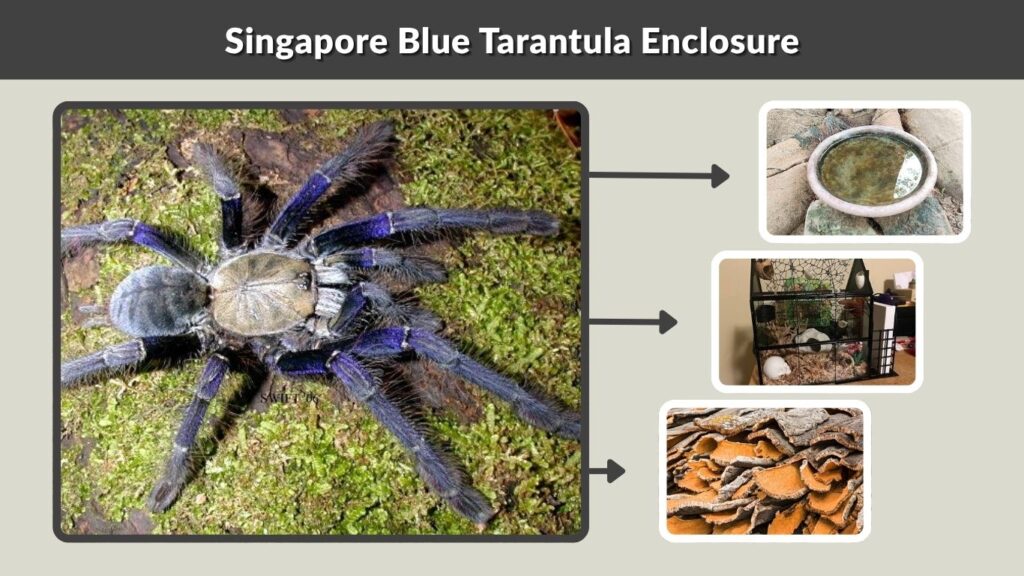
A tall enclosure provides climbing room, but its height should not be excessive. The space must allow the spider to establish a vertical retreat while minimizing the distance it could fall.
Adult Enclosure Requirements
- Typical size: Approximately 18 × 18 × 24 inches
- Orientation: Tall, arboreal enclosure
- Substrate depth: Approximately 4–6 inches
- Temperature: 72–80°F
- Moisture: Moderately humid with a moisture gradient
- Ventilation: Strong cross-ventilation
- Water: Clean water dish
- Retreat: Vertical cork-bark tube or slab
- Lid: Secure and escape-proof
Place a tall piece of curved cork bark against the enclosure wall to form a dark vertical cavity. Extend it into the substrate so the tarantula can construct a continuous retreat from the ground upward.
Artificial plants, smaller pieces of bark, and branches provide cover and web anchors. Secure all decorations so they cannot fall during burrowing or maintenance.
Substrate and Humidity
Use coconut fiber, pesticide-free topsoil, or a moisture-retaining mixture. The substrate should hold a burrow without becoming muddy or waterlogged.
Maintain slightly moist lower layers while allowing the surface to dry somewhat between watering. Good cross-ventilation prevents stagnant air, mold, and excessive condensation. Humidity numbers are less useful than providing appropriate moisture, airflow, and constant drinking water.
Avoid installing a heat mat beneath the enclosure. If additional warmth is necessary, heat the room rather than one surface of the enclosure.
Singapore Blue Tarantula Sling Care
Spiderlings may behave more like burrowing tarantulas than fully arboreal adults. Their container should provide both substrate depth and a small vertical retreat.
Sling Setup
- Use a securely ventilated vial or small enclosure
- Add several inches of slightly moist substrate
- Provide a piece of cork bark extending vertically
- Create a small starter burrow beneath the bark
- Maintain ventilation without escape-sized holes
- Offer water droplets or a suitably small water dish
- Remove uneaten food within 24 hours
Feed small roach nymphs, pinhead crickets, flightless fruit flies, or pre-killed prey once or twice weekly. A sling can scavenge freshly killed food, making this a safe option when live prey is too large.
Move the spider to a larger enclosure before it becomes crowded. Prepare the new retreat in advance so it can hide immediately after rehousing.
Singapore Blue Tarantula Diet and Feeding
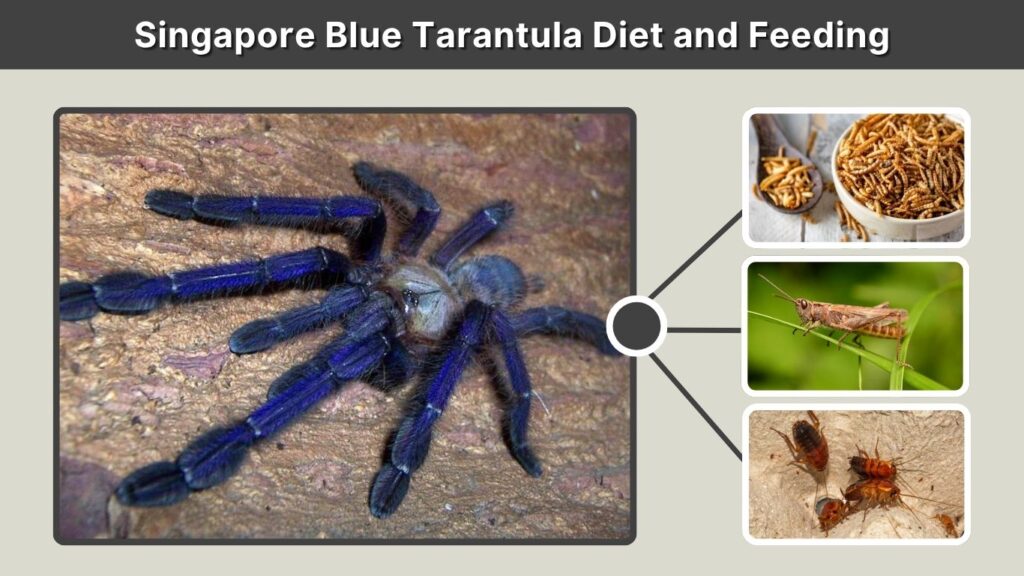
Singapore blue tarantulas are insect-eating ambush predators. They usually display a strong feeding response, but appetite can decrease before a molt.
Suitable Foods
- Dubia roaches
- Red runner roaches
- Crickets
- Locusts
- Mealworms
- Superworms
- Black soldier fly larvae
Feed juveniles approximately once or twice weekly. A large adult may receive one or two suitably sized insects every 7–10 days. Reduce feeding when the abdomen becomes excessively large.
Mice are unnecessary and should not be offered. Vertebrate prey can injure the tarantula, create considerable waste, and provide no essential benefit over properly raised insects.
Water and Hydration
A clean water dish should always be present. Arboreal species can receive a dish mounted above the substrate, but a stable ground-level dish is also acceptable if the spider can reach it easily.
How Long Can It Survive Without Water?
A tarantula may survive without food for weeks or months, particularly before molting. Water deprivation is much more dangerous and can lead to dehydration, weakness, unsuccessful molting, and death.
There is no safe period for intentionally withholding water. Refill the dish whenever it becomes empty and occasionally apply water to one area of the substrate. A dehydrated tarantula may appear weak, have a shrunken abdomen, or hold its legs tightly beneath its body.
Singapore Blue Tarantula Molting
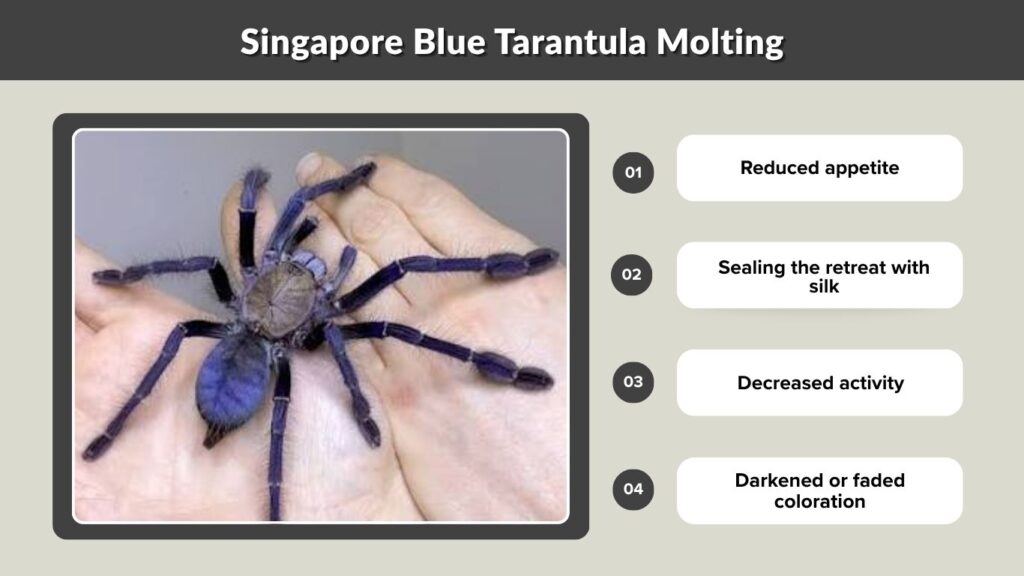
Molting allows the tarantula to grow and replace its exoskeleton. A spider approaching a molt may remain hidden and refuse food for an extended period.
Premolt Signs
- Reduced appetite
- Sealing the retreat with silk
- Decreased activity
- Darkened or faded coloration
- Enlarged abdomen
- Lying on its back or side
Remove all live prey once premolt behavior begins. Never turn over a tarantula lying on its back.
Wait until the new fangs become completely black before feeding again. Juveniles may require approximately five to seven days, while large adults may need 10–14 days.
Male vs. Female Singapore Blue Tarantula
This species displays noticeable sexual dimorphism after the male reaches maturity. Before maturity, determining sex from a preserved molt is more dependable than judging coloration or body shape.
Main Differences
- Adult female: Vibrant blue or violet legs
- Mature male: Brown, bronze, olive, or greenish coloration
- Female build: Larger and heavier
- Male build: Slimmer with proportionally longer legs
- Female lifespan: Commonly around 10–15 years
- Male lifespan: Often approximately three to five years
- Mature male pedipalps: Enlarged emboli resembling boxing gloves
Mature males wander more frequently while searching for females and may stop eating regularly. Increased activity does not necessarily indicate poor enclosure conditions.
Singapore Blue Tarantula Bite, Venom, and Handling
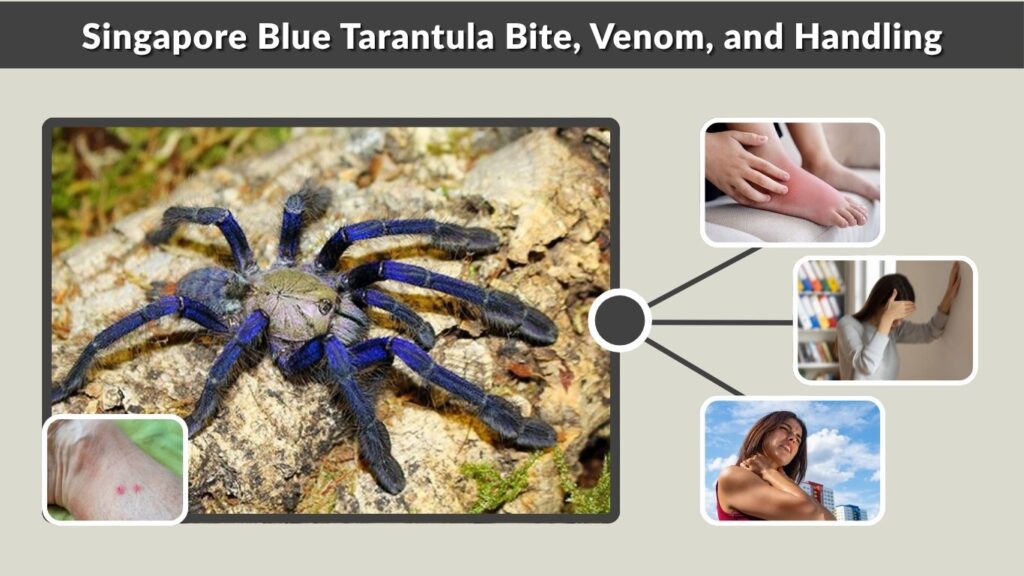
The Singapore blue is venomous, and its bite should be treated as potentially medically significant. Reliable species-specific bite reports remain limited, so the exact frequency and severity of symptoms cannot be predicted.
Possible Bite Symptoms
- Intense localized pain
- Swelling and redness
- Muscle cramping
- Nausea
- Fatigue or weakness
- Tingling sensations
- Symptoms extending beyond the bite area
Wash a bite with soap and water and seek medical advice. Obtain urgent assistance if symptoms become severe or include breathing difficulty, widespread muscle cramps, faintness, or signs of an allergic reaction.
Handling should never be attempted. The spider’s speed creates a substantial escape risk, and a fall can fatally injure its abdomen. Use long tools, a catch cup, and a clear working area during maintenance or rehousing.
Buying a Singapore Blue Tarantula
Price depends on the spider’s size, sex, availability, and seller. Confirmed females normally cost much more than slings or mature males because females are larger and live longer.
Before purchasing, check:
- Whether the spider is captive-bred
- Its current size and feeding history
- Whether the sex is confirmed
- The seller’s live-arrival policy
- Weather restrictions for shipping
- Local ownership and import laws
- The seller’s experience with Old World species
Never remove a Singapore blue from the wild. Choose a reputable captive breeder and ensure the enclosure is fully prepared before the tarantula arrives.
FAQs
Is the Singapore blue tarantula suitable for beginners?
No. Its extreme speed, defensive temperament, large adult size, and medically significant venom make it appropriate only for experienced keepers.
How large does a Singapore blue tarantula grow?
Adult females commonly reach approximately 7–9 inches in diagonal leg span. Males are generally slimmer and may be smaller.
Is the Singapore blue tarantula poisonous?
It is venomous rather than poisonous. It injects venom through its fangs, while “poisonous” describes an animal that causes harm when touched or consumed.
Can you handle a Singapore blue tarantula?
No. Handling creates unnecessary risks of a bite, escape, or fatal fall. It should be observed inside its enclosure.
Why is my Singapore blue tarantula hiding?
Hiding is normal. It may be resting, building its retreat, digesting food, or preparing to molt. Avoid opening a sealed retreat unless there is a clear emergency.
