
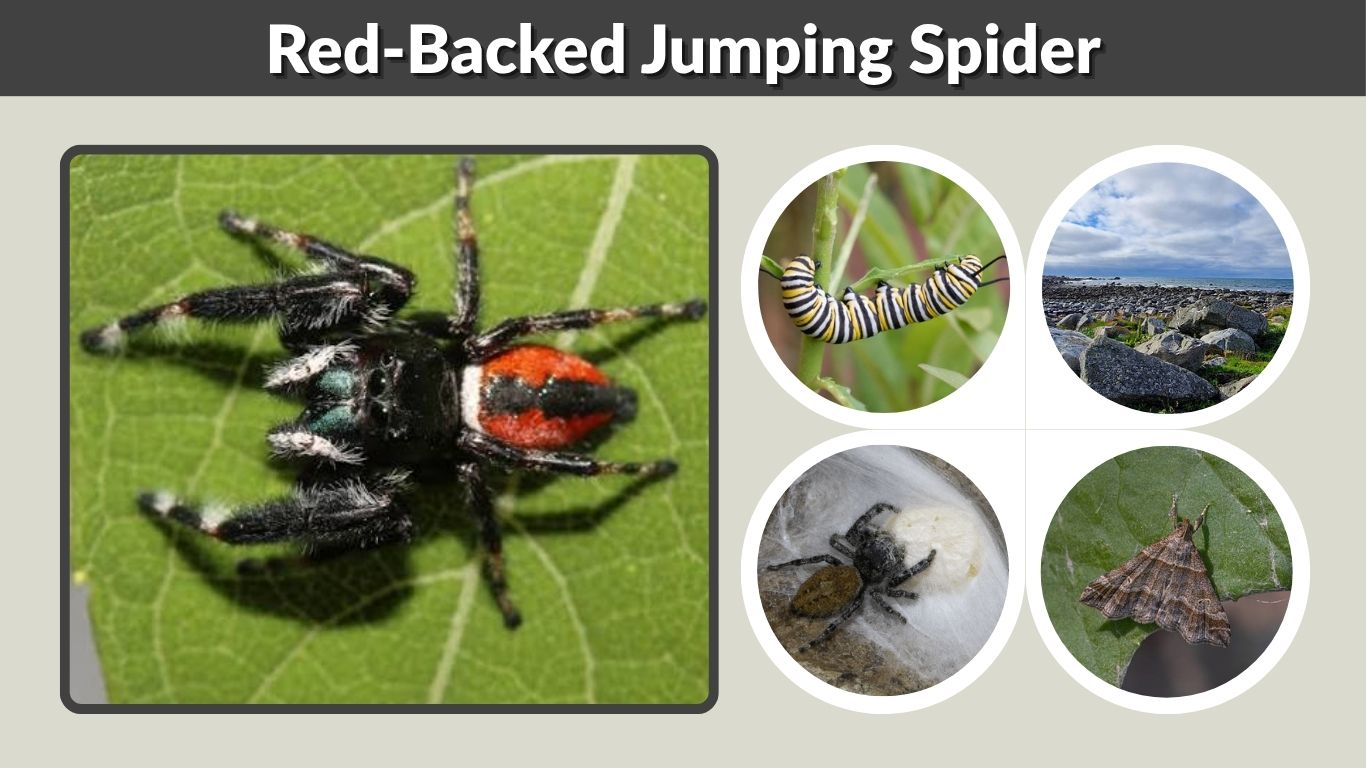
The red-backed jumping spider (Phidippus johnsoni) is a striking black-and-red jumping spider found mainly across western North America. Its fuzzy body, bright red abdomen, large forward-facing eyes, and impressive jumping ability make it easy to notice. Although its vivid coloration can look intimidating, this spider is not considered dangerous to humans. Red-backed jumping spiders are active hunters that use excellent eyesight to stalk insects rather than trapping prey in webs. They are especially common in California and other dry western habitats.
What Is a Red-Backed Jumping Spider?
The red-backed jumping spider, also called Johnson’s jumping spider, belongs to the jumping spider family Salticidae. It is one of the larger and more recognizable jumping spiders of western North America.
Unlike web-building spiders, it spends much of the day walking, watching its surroundings, and jumping onto prey. Adults generally measure about 9–14 mm in body length, although individual size varies.
Quick Identification
- Scientific name: Phidippus johnsoni
- Family: Salticidae
- Body length: Usually about 9–14 mm
- Main colors: Black and red or reddish orange
- Eyes: Eight, including two very large front-facing eyes
- Movement: Walks quickly and makes controlled jumps
- Diet: Insects and other small arthropods
- Main range: Western North America
- Danger to humans: Low
The combination of a dark body and conspicuous reddish abdomen is particularly characteristic, although males, females, and juveniles do not all look identical.
Red-Backed Jumping Spider Identification
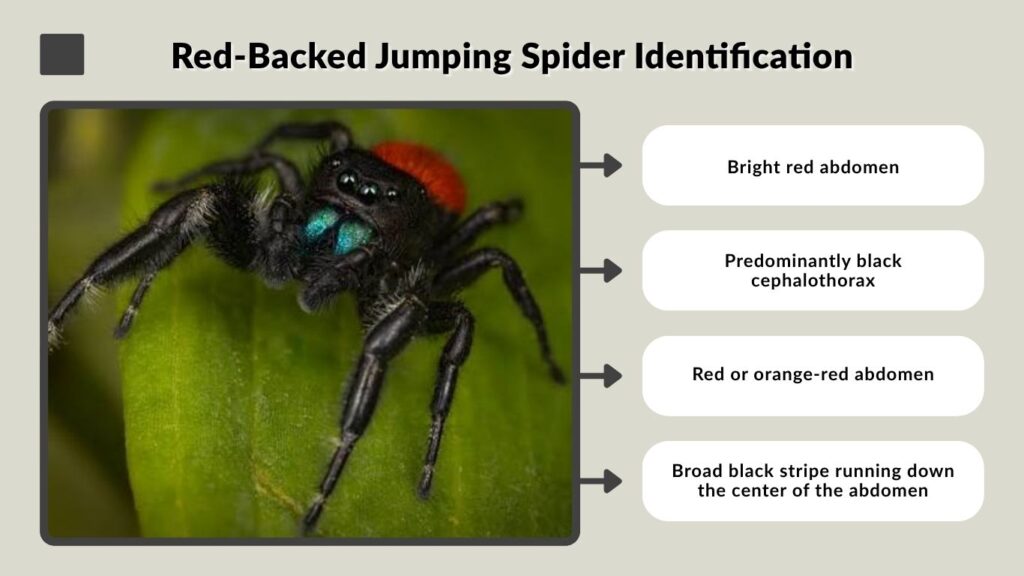
A black jumping spider with a red back is often Phidippus johnsoni in western North America, but color should never be the only identification feature. Several other jumping spiders can show red or orange markings, especially while immature.
Male Red-Backed Jumping Spider
Adult males are especially colorful. Their abdomen is typically almost entirely bright red or reddish orange, contrasting strongly with the black head, legs, and front portion of the body.
Males commonly have:
- Bright red abdomen
- Predominantly black cephalothorax
- Dark, hairy legs
- Large front-facing eyes
- Metallic-looking chelicerae
- Relatively slimmer abdomen than mature females
The vivid red back makes adult males one of the easiest forms to recognize. BugGuide describes the male abdomen as entirely red.
Female Red-Backed Jumping Spider
Females are also red and black, but their abdominal pattern usually differs from that of males.
A typical female has:
- Red or orange-red abdomen
- Broad black stripe running down the center of the abdomen
- Black cephalothorax
- Robust, hairy body
- Strong legs adapted for jumping
The central dark abdominal stripe is one of the easiest ways to distinguish an adult female from a typical male.
Juvenile Red Jumping Spiders
Young jumping spiders may look different from fully mature individuals. Their markings can change as they molt, and immature spiders of several Phidippus species can resemble one another.
This means a tiny black jumping spider with a red dot is not automatically P. johnsoni.
Black Jumping Spider With a Red Dot
One of the most common identification problems involves a black jumping spider with a red dot or red spots on its back. In many cases, this may actually be a juvenile bold jumping spider (Phidippus audax), rather than a red-backed jumping spider.
Young bold jumping spiders frequently have orange or reddish abdominal spots that become white as they mature.
Red-Backed Jumper vs. Bold Jumper
Red-backed jumping spiders usually have a much larger continuous reddish area on the abdomen. Adult males can have an almost completely red abdomen, while females commonly retain a dark central stripe.
Bold jumping spiders usually have several separate abdominal spots instead of an extensively red back.
Geography also helps. P. johnsoni is primarily western, whereas bold jumping spiders occur much more widely across North America.
Red-Backed Jumping Spider Habitat and Distribution
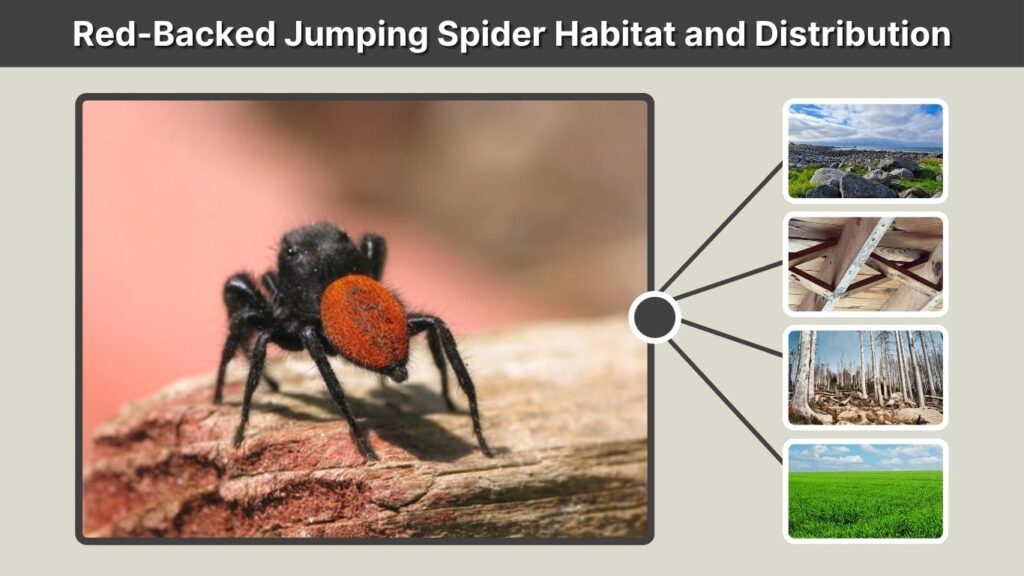
The red-backed jumping spider is strongly associated with western North America. It inhabits a broad range of relatively open and dry environments, although it can also occur around human structures.
BugGuide records its range from northern portions of Canada south through California and Arizona, extending eastward into parts of the northern Great Plains.
Where Do Red-Backed Jumping Spiders Live?
They may be encountered:
- Beneath rocks
- Under pieces of wood
- On shrubs
- Among grasses
- On fences
- Around gardens
- On walls and buildings
- In vineyards
- In dry woodland
- Across coastal and open scrub habitats
Rather than remaining permanently exposed, these spiders construct small tubular silk retreats where they can rest safely.
Red Jumping Spiders in California
California is one of the best-known areas for Phidippus johnsoni. Documented observations extend through northern and southern parts of the state, including the San Francisco Bay Area and Southern California.
A California red jumping spider with a mostly red abdomen and dark body therefore has a reasonable chance of belonging to this species, although photographs are still needed for confident identification.
A red jumping spider found in Texas, Oklahoma, or farther east should not automatically be labeled P. johnsoni, because several other Phidippus species may show similar coloration.
How Does the Red-Backed Jumping Spider Hunt?
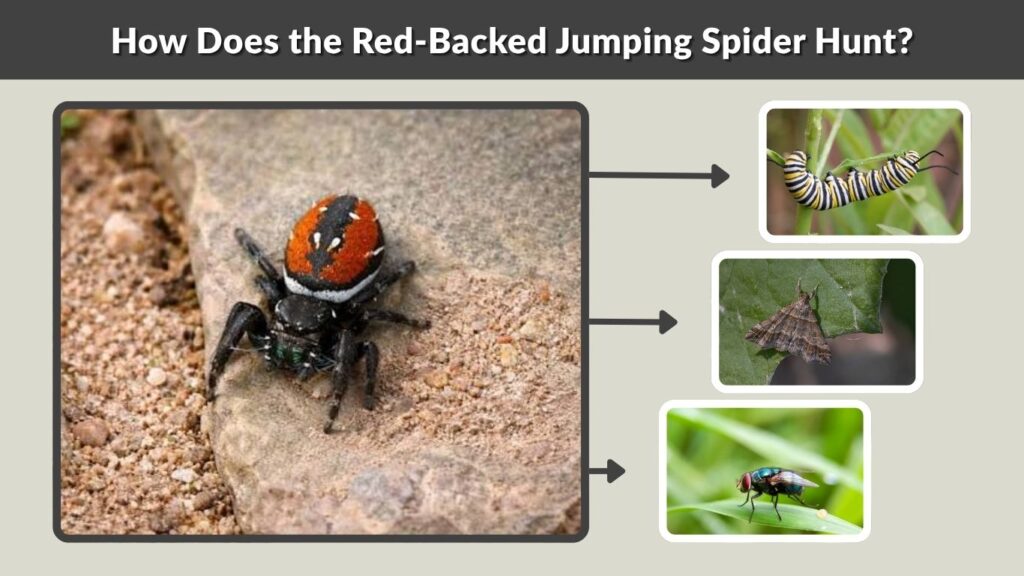
Red-backed jumping spiders do not build traditional prey-catching webs. Instead, they are visual hunters.
Their exceptionally developed eyes allow them to notice movement, judge distance, and approach insects carefully before attacking.
Hunting Behavior
A red-backed jumper typically:
- Notices potential prey using its large eyes.
- Turns its body toward the target.
- Slowly stalks closer.
- Attaches a silk safety line.
- Jumps rapidly onto the prey.
- Grabs it using its front legs.
- Delivers venom through its fangs.
The silk safety line acts like a climbing rope. If the spider misses a jump or falls, it can often climb back to its previous position.
What Do Red-Backed Jumping Spiders Eat?
Their diet consists mostly of small arthropods, including:
- Flies
- Moths
- Small beetles
- Caterpillars
- Gnats
- Other spiders
- Various small insects
Because they prey on many insects, red-backed jumping spiders can serve as beneficial predators in gardens and natural environments.
Web, Shelter, and Daily Behavior
Although they do not use webs to catch food, red-backed jumping spiders produce plenty of silk.
They construct compact tubular silk retreats, often beneath rocks, pieces of wood, vegetation, or other protected surfaces. The spider may remain inside the retreat overnight or during cold, rainy, or otherwise unfavorable weather.
These silk shelters also have other important functions.
What Happens Inside the Silk Retreat?
- Resting at night
- Protection during bad weather
- Molting
- Egg laying
- Guarding eggs
- Courtship and sometimes mating
This behavior distinguishes jumping spiders from species such as orb weavers, which depend heavily on large exposed webs to capture insects.
Red-Backed Jumping Spider Mating and Life Cycle
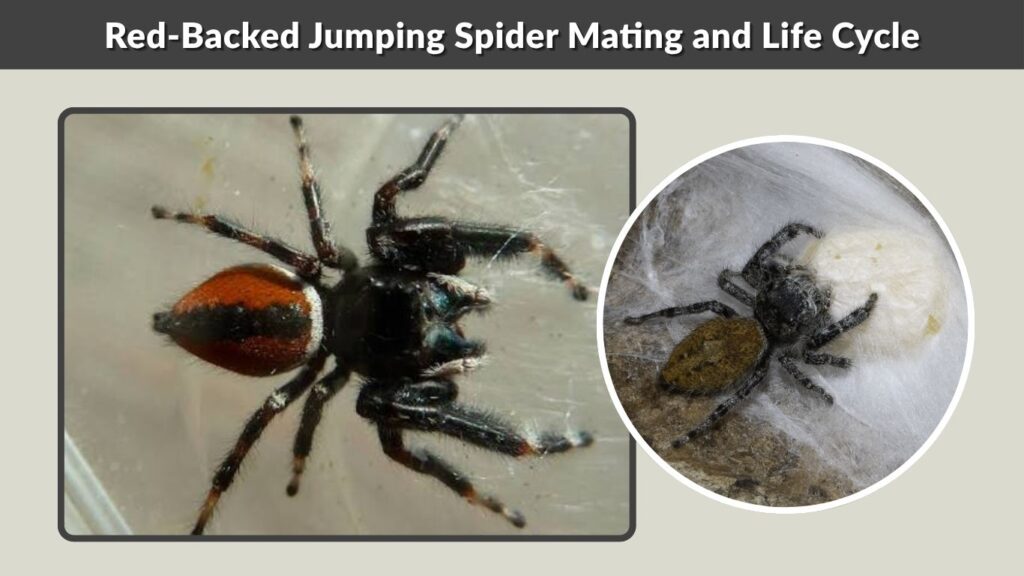
Jumping spiders rely heavily on vision during courtship. A male approaching a female cannot simply run toward her because she could mistake him for food.
Instead, he performs deliberate movements involving his legs and body to demonstrate that he is a potential mate.
Eggs and Spiderlings
After mating, the female creates a protected silk structure and deposits her eggs inside. She may remain with the eggs, guarding them while the embryos develop.
The spiderlings eventually hatch and undergo a series of molts as they grow. Their colors and markings may change significantly before adulthood.
Exact lifespan depends on temperature, food supply, sex, and environmental conditions. Like many larger Phidippus jumping spiders, individuals can survive through multiple seasons under favorable conditions.
Are Red-Backed Jumping Spiders Poisonous?
The red-backed jumping spider is venomous, not poisonous.
Venom is injected through the fangs and is primarily designed to immobilize small arthropod prey. However, Phidippus johnsoni is not considered medically dangerous to humans.
Its red and black coloration may cause concern because people sometimes associate those colors with dangerous spiders, but appearance alone does not indicate medical risk.
Red-Backed Jumping Spider Bite
A red-backed jumping spider can bite when physically trapped, squeezed, or handled in a way that makes it feel threatened. It does not normally seek out people to bite.
Possible minor symptoms can include:
- Localized pain
- Mild swelling
- Redness
- Itching
- Temporary tenderness
BugGuide notes that a defensive bite can be painful but does not regard the species as harmful to people.
Wash a suspected minor bite with soap and water and avoid scratching it. Seek medical care if symptoms become severe, rapidly worsen, or include breathing difficulty, widespread swelling, or another serious reaction.
Red-Backed Jumping Spider vs. Black Widow
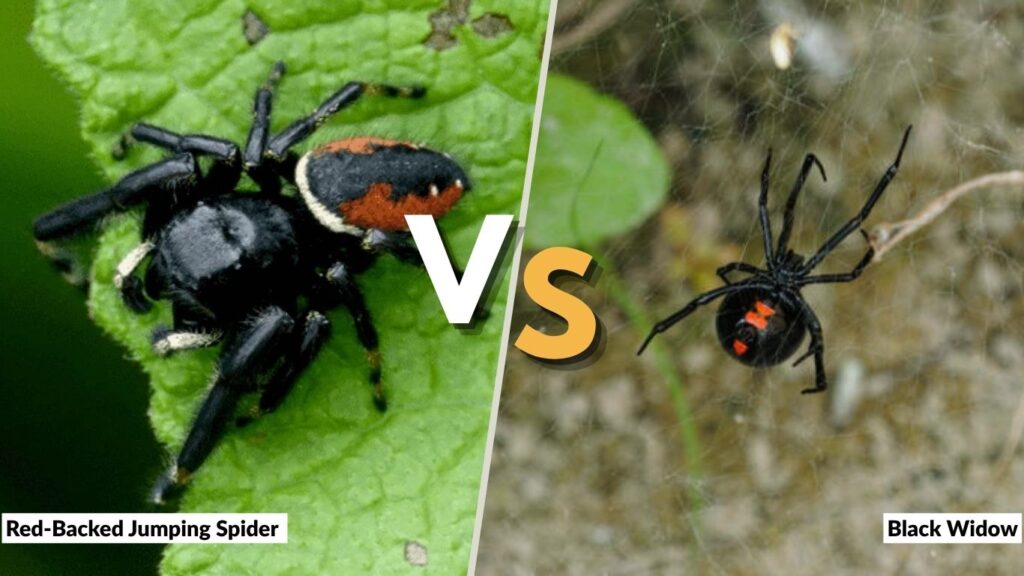
A red-backed jumping spider may occasionally be mistaken for a black widow because both can combine black and red coloration. Their body shapes and lifestyles, however, are very different.
| Feature | Red-Backed Jumping Spider | Black Widow |
| Family | Salticidae | Theridiidae |
| Body | Compact and hairy | Smooth with rounded abdomen |
| Eyes | Large front-facing eyes obvious | Eyes relatively small |
| Movement | Active and frequently jumps | Usually remains near web |
| Web | Small silk retreat | Irregular prey-catching web |
| Red marking | Large red area on back | Usually hourglass underneath |
| Medical importance | Low | Medically significant venom |
The jumping spider’s fuzzy body, large eyes, active movement, and jumping behavior make it relatively easy to distinguish once viewed closely.
Are Red-Backed Jumping Spiders Good to Have Around?
Yes. These spiders are useful predators and generally do not need to be killed when found outdoors.
They help control small insects and other arthropods while posing little threat to people. If one enters a home, it can usually be captured gently in a container and released outside.
Their large eyes and curious behavior can make them appear unusually aware of nearby movement. A jumping spider may turn and appear to watch a person because vision plays such an important role in its hunting and survival.
FAQs
What is the scientific name of the red-backed jumping spider?
The species commonly called the red-backed or Johnson’s jumping spider is Phidippus johnsoni.
Is a red-backed jumping spider dangerous?
No. It has venom for hunting prey, but it is not considered medically dangerous to humans. Bites are uncommon and generally occur only when the spider is threatened or trapped.
What is the difference between male and female red-backed jumping spiders?
Adult males usually have an almost entirely red abdomen, while females commonly have a red abdomen with a prominent black stripe running down its center.
Where are red-backed jumping spiders found?
They occur primarily throughout western North America and are particularly familiar in California and other western states.
Why does a black jumping spider have a red dot?
A red spot may indicate an immature jumping spider, including a juvenile bold jumper. A true adult red-backed jumping spider generally has a much larger red area across the abdomen rather than only one small red dot.
