
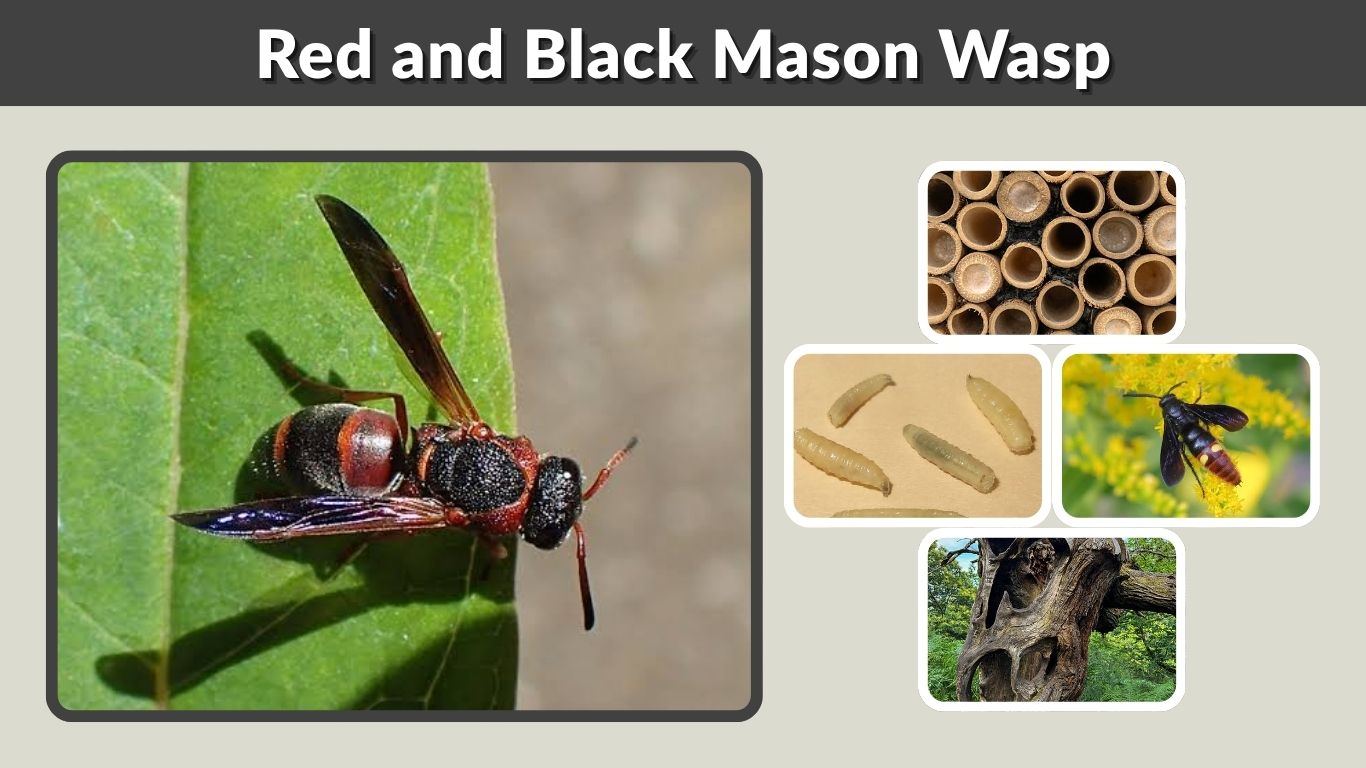
The red and black mason wasp (Pachodynerus erynnis) is a small, solitary wasp recognized by its striking rusty-red and black markings. Unlike social yellowjackets and hornets, it does not establish large colonies or aggressively defend communal nests. Instead, females use narrow cavities to create individual brood cells and hunt caterpillars to feed their developing young. Although a female can sting when threatened, these wasps generally avoid people and can actually be beneficial around gardens by helping control caterpillar pests.
What Is a Red and Black Mason Wasp?
The red and black mason wasp is a member of the family Vespidae and subfamily Eumeninae, which contains potter and mason wasps. Its scientific name is Pachodynerus erynnis. “Red and black mason wasp” is a suggested common name rather than a formally accepted one; the species is also called the red-marked Pachodynerus. It is primarily found in the southeastern United States.
Identification
Important features of a black and red mason wasp include:
- Adult body length of approximately 7–14 mm
- Alternating black and dull rusty-red coloration
- A reddish horseshoe-shaped marking behind the head when viewed from above
- A reddish triangular pattern visible from the side
- Completely black coloration immediately behind the eyes
- Dark or somewhat smoky-looking wings
- A compact body and narrow wasp waist
Its red-and-black pattern resembles several other southeastern U.S. mason and potter wasps, so markings around the head can be especially useful for identification.
Red and Black Mason Wasp Face
The face can help distinguish males from females. Male Pachodynerus erynnis have distinctive yellow markings on parts of the head, particularly a yellow clypeus—the shield-like plate on the front of the face.
Females have a dull red-and-black clypeus instead. Both sexes lack the reddish spot behind the eyes found in some similar-looking wasps.
Male vs Female
Males and females are similar overall, but the face provides an obvious clue. Males have yellow facial markings, whereas females have a mostly dull red-and-black face.
There is also a more technical distinction: males have 10 flagellomeres in the antenna, while females have 11. Females are responsible for finding nesting cavities, constructing brood cells, hunting caterpillars, and provisioning those cells for their offspring.
Where Do Red and Black Mason Wasps Live?
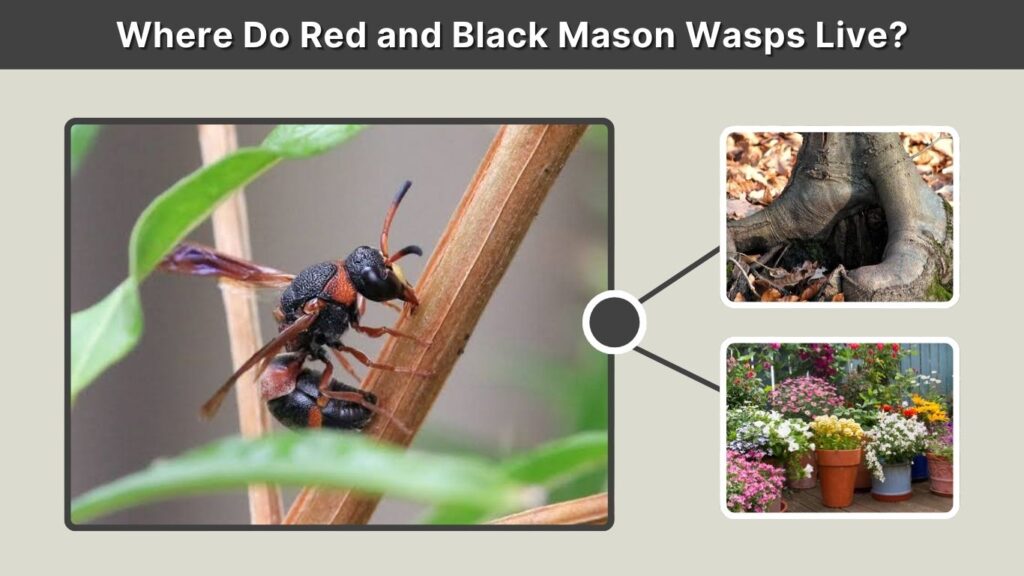
The natural distribution of Pachodynerus erynnis is centered in the southeastern United States. They can occur in gardens, landscaped areas, wooded habitats, and neighborhoods where suitable nesting cavities and flowering plants are available. Because they readily use small artificial cavities, they sometimes become noticeable around houses even though they are fundamentally solitary wildlife.
Red and Black Mason Wasp Location
The species is most strongly associated with:
- Florida
- North Carolina
- Gulf and Atlantic coastal areas
- Louisiana
- Eastern Texas
- Other portions of the southeastern United States
Occasional records exist farther north, but these are outside the species’ principal range and may result from accidental transport or weather events.
Red and Black Mason Wasp in Florida
Florida is an important part of this wasp’s range. The species can be found visiting flowers, hunting caterpillars, and investigating narrow cavities suitable for nesting.
Florida observations have also documented females reusing old nests constructed by other potter wasps. Its ability to use both natural and artificial cavities helps explain why homeowners sometimes find nests around buildings.
What About Australia and New Zealand?
A red-and-black mason or potter wasp seen in Australia or New Zealand should not automatically be identified as Pachodynerus erynnis. The established range of this particular species is centered in southeastern North America.
Australia and New Zealand have other wasps that may display similar red, orange, and black coloration. Geographic location therefore needs to be considered together with body markings before assigning a species name.
Red and Black Mason Wasp Nest
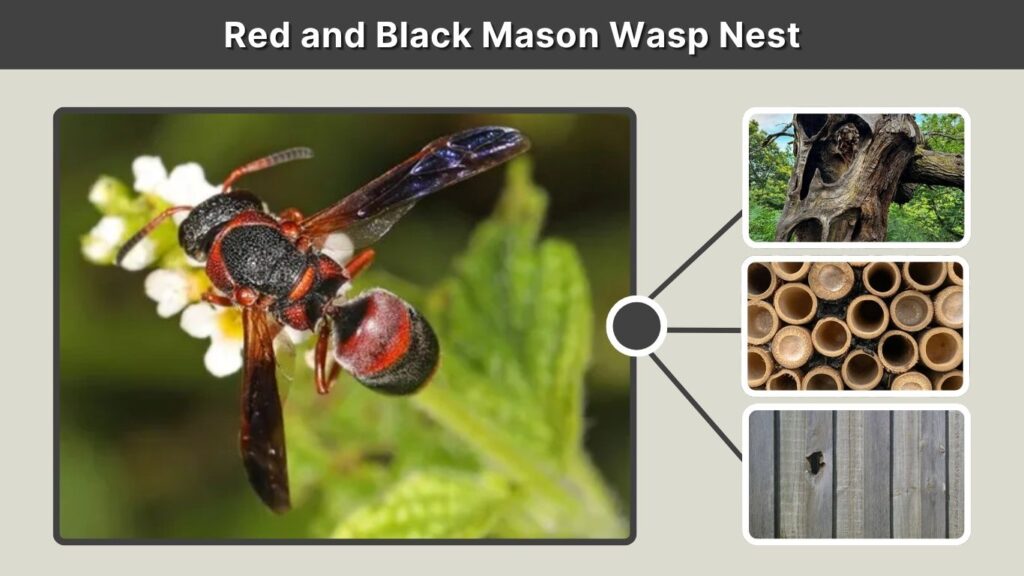
Red and black mason wasps are solitary. A female does not produce a paper nest full of workers like a paper wasp or yellowjacket. Instead, she looks for a narrow pre-existing cavity and divides it into individual chambers. Suitable spaces can occur in wood, hollow stems, old insect nests, fences, and even small openings in human structures.
Common Nesting Locations
Females may use:
- Holes in dead or damaged wood
- Hollow plant stems or bamboo
- Wooden fence cavities
- Old nests made by other solitary wasps
- Small openings in buildings
- Artificial insect nesting blocks
- Other narrow tubular cavities
UF/IFAS reports that usable cavities can range from about 1.27 to 12.7 cm in length.
How the Nest Is Built
Once a suitable cavity is selected, the female creates partitions using aggregated sand and grit. She lays an egg in a cell, gathers caterpillars, paralyzes them, and places them inside as food for the future larva.
The cell is then sealed before another is constructed. Nests may contain one to eight provisioned cells, with about four being typical in documented nests. The entrance is eventually closed with a durable sand-and-grit plug.
Why Caterpillars Are Stored Inside
Female mason wasps actively hunt caterpillars rather than collecting them for themselves. After locating suitable prey, the female stings and paralyzes the caterpillar and transports it to her nest.
Each developing larva may receive several caterpillars. UF/IFAS reports roughly seven to ten caterpillars in individual provisioned cells. This predatory behavior makes Pachodynerus erynnis useful for natural control of various plant-feeding caterpillars.
Are Red and Black Mason Wasps Dangerous?
Despite their warning-like coloration, red and black mason wasps are not considered highly aggressive toward humans. Their solitary lifestyle means they do not have a colony containing hundreds or thousands of workers to defend. Nevertheless, they are stinging wasps, so they should be observed rather than handled. A defensive sting can occur when a female is trapped, grabbed, or strongly disturbed.
Do Red and Black Mason Wasps Sting?
Yes. Female red and black mason wasps can sting.
The sting has an important biological function because females use it to paralyze caterpillars before placing the prey inside brood cells. That same stinger can also be used defensively.
The safest approach is therefore to:
- Avoid picking up the wasp
- Do not trap it against bare skin
- Avoid damaging an occupied nest
- Give a female room to leave
- Keep children from handling nests or insects
- Seek medical care for serious reactions after any insect sting
Individual reactions to wasp venom vary, and severe allergic reactions are possible after wasp stings in susceptible people.
Are Red and Black Mason Wasps Poisonous?
No. Describing them as venomous rather than poisonous is more accurate.
A poisonous animal causes harm when it is eaten, touched, or otherwise exposes another organism to a toxin. A venomous animal actively delivers venom through a structure such as a stinger or fang.
Female mason wasps can inject venom with their sting. They are therefore venomous wasps, but that does not mean they normally pose a serious threat to someone simply standing nearby.
Will They Attack People?
Red and black mason wasps generally have little reason to attack people. They spend their time visiting flowers, searching for nesting locations, mating, or hunting caterpillars.
Unlike social yellowjackets, there is no large worker colony defending a communal nest. Giving the insect space is normally enough to avoid conflict.
What Do Red and Black Mason Wasps Eat?
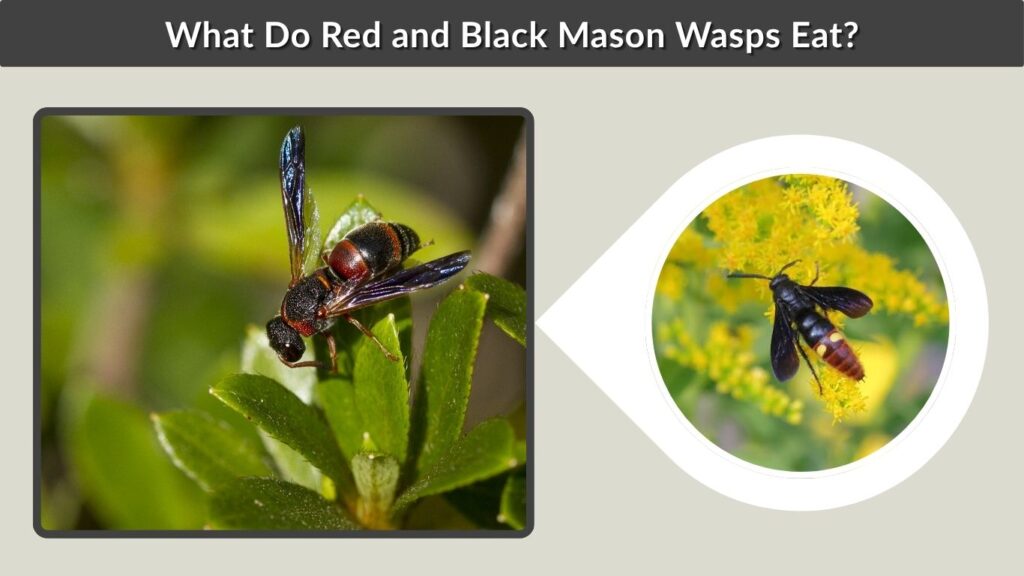
Adults and larvae have very different diets. Adult mason wasps visit flowers and consume nectar and pollen, while females hunt caterpillars specifically to supply their developing young. This combination of flower visitation and caterpillar predation can make the species useful in gardens and managed landscapes.
Adult Diet
Adult wasps obtain energy primarily while visiting flowering plants. Flowers can therefore attract adults even when their nests are somewhere else nearby.
Finding a wasp feeding on flowers does not mean there is necessarily a nest in the plant.
Caterpillars Used for Larvae
Documented prey includes caterpillars from numerous moth families. Important examples include pests such as:
- Fall armyworms
- Black cutworms
- Cabbage loopers
- Corn earworms
- Pickleworms
- Strawberry leafrollers
- European corn borers
Because females remove these caterpillars from vegetation, researchers consider the species a potentially useful biological-control insect.
Red and Black Mason Wasp Life Cycle
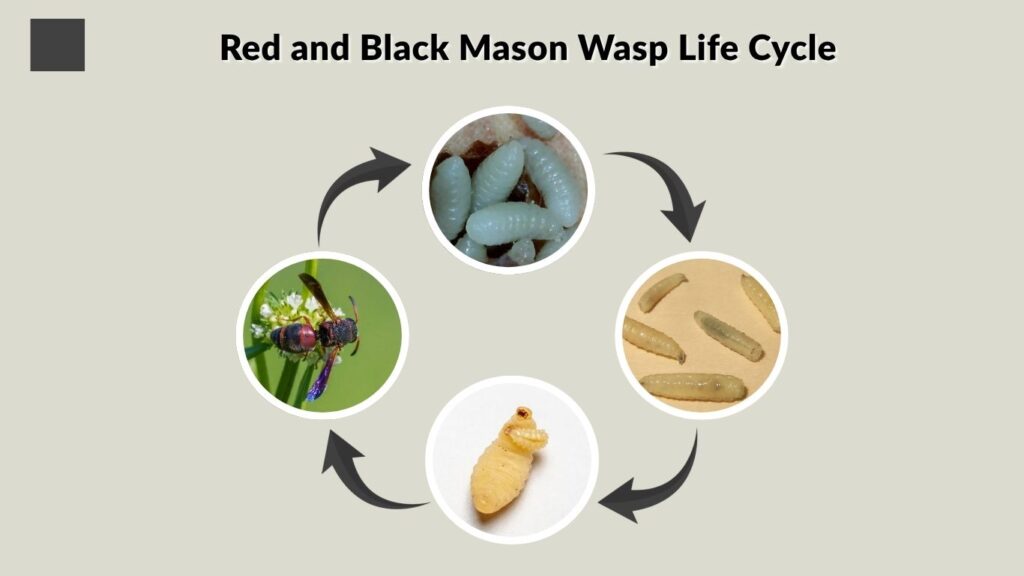
The life cycle begins when a female selects a suitable cavity and constructs individual brood chambers. One egg is deposited in each provisioned cell. Rather than caring for the larva after it hatches, the female leaves enough paralyzed prey inside to support development before permanently sealing the chamber.
Egg and Larval Development
A female attaches a single egg inside each chamber. After hatching, the larva consumes the stored caterpillars.
Interestingly, female eggs tend to be placed deeper inside the nest, while male eggs occur nearer the entrance. Males develop somewhat faster, allowing them to emerge before females positioned farther inside.
Pupa to Adult
After feeding, the larva spins a thin silk cocoon and pupates. Development time varies, but males generally spend about 18–28 days in the cocoon and females approximately 19–33 days under reported conditions.
After emerging from the cocoon, the adult waits briefly for its exoskeleton to harden before chewing its way out of the nesting cavity. Adults may be active through much of the year in warm parts of their range.
Should You Remove a Red and Black Mason Wasp Nest?
A nest usually does not need to be destroyed simply because it is present. These solitary wasps can help reduce caterpillar populations and are not normally defensive in the same manner as social wasps. However, a nest inside frequently handled equipment or another sensitive location may create unnecessary opportunities for accidental contact.
When to Leave the Nest Alone
Consider leaving it undisturbed when:
- It is outdoors in a low-traffic location
- Nobody needs to handle the nesting cavity
- Wasps are simply visiting flowers
- The insects are not entering living spaces
- No one nearby is at high risk from wasp stings
Since each female operates largely independently, seeing several mason wasps around suitable nesting habitat does not necessarily indicate a dangerous colony.
When Removal May Be Appropriate
Professional advice may be useful when a nest occurs inside a frequently used doorway, equipment, furniture, or another location where accidental contact is difficult to avoid.
Do not plug an actively occupied cavity while adult wasps are moving in and out. First confirm the species and determine whether intervention is actually necessary.
FAQs
Red and black mason wasps attract attention because their bold colors can make them appear more threatening than their behavior typically suggests. Understanding their sting, nest structure, geographic distribution, and solitary nature makes it easier to distinguish them from more defensive social wasps.
1. Are Red and Black Mason Wasps Dangerous?
Usually, they present a relatively low risk when left alone. They are solitary wasps rather than aggressive colony-defending insects. However, females possess a functional stinger and may sting when handled or trapped.
2. Do Red and Black Mason Wasps Sting?
Yes. Females can sting both to paralyze caterpillar prey and for defense. Avoid handling the insects or disturbing occupied nesting cavities.
3. Are Red and Black Mason Wasps Poisonous?
No. “Venomous” is the more accurate term because females inject venom through a stinger. Simply seeing or being near one does not expose you to venom.
4. Where Do Red and Black Mason Wasps Live?
Pachodynerus erynnis occurs primarily in the southeastern United States, including Florida and areas extending north toward North Carolina and westward along the Gulf region.
5. Are Red and Black Mason Wasps Beneficial?
Yes. Females capture caterpillars—including several agricultural and garden pests—to feed their larvae. Research in Florida landscapes has associated these wasps with increased caterpillar predation, making them potentially valuable natural pest-control insects.
