
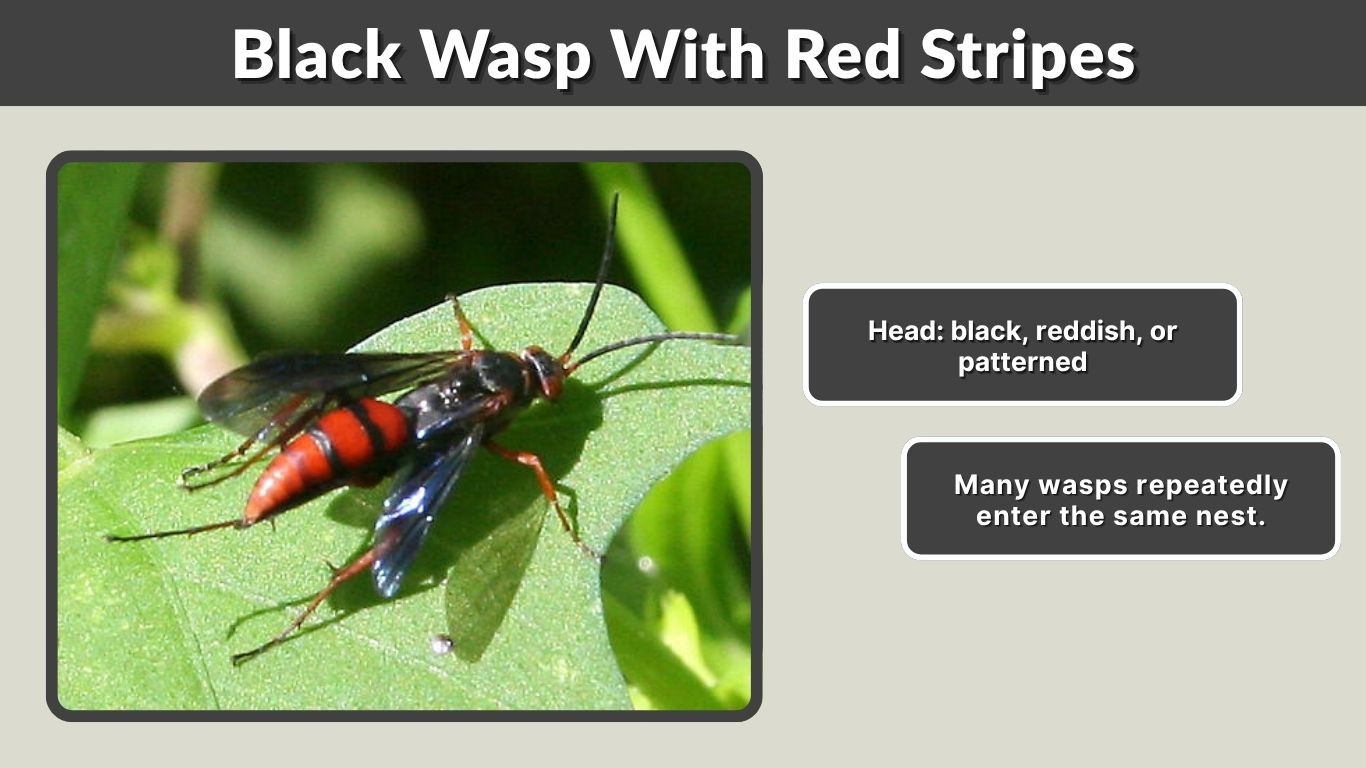
A black wasp with red stripes can look alarming, especially when the insect is large, fast-moving, or has dark wings. However, this color pattern does not identify one specific species. Several spider wasps, sand wasps, velvet ants, and other solitary wasps can appear black with red, orange, or reddish abdominal bands. Identifying a red and black striped wasp requires looking at its body shape, wings, hair, behavior, location, and the exact position of the colored markings.
What Is a Black Wasp With Red Stripes?
The phrase “black wasp with red stripes” describes an appearance rather than a single species. Depending on where you live, the insect may belong to the spider wasp, sand wasp, velvet ant, or another group. Some have one red abdominal band, while others have several reddish sections or patches that look like stripes from a distance.
Color Alone Is Not Enough for Identification
Red, orange, and black are common warning colors among wasps. Several unrelated species can therefore look surprisingly similar.
For example, some spider wasps have dark bodies with reddish abdominal sections, while Stizoides renicinctus is a dark sand-wasp relative that can show a conspicuous orange-red band on the abdomen. Velvet ants—despite their name—are also wasps and commonly combine black with red or orange coloration.
Quick Identification Clues
When trying to identify a black and red striped wasp, check:
- Number of red stripes: one band or several reddish abdominal segments
- Body texture: smooth and shiny or densely hairy
- Wings: present, absent, clear, smoky, or dark
- Legs: unusually long legs may suggest a spider wasp
- Size: some species are less than an inch long, while others appear much larger
- Behavior: flying around flowers, running on the ground, or dragging spiders
- Location: lawn, sandy soil, garden flowers, walls, or woodland edges
These features are much more useful than color alone.
Common Types of Red and Black Striped Wasps
Several insects may match searches such as red and black striped wasp, black wasp red stripe, or red wasp with black stripes. Exact identification often requires a clear photograph and geographic location. Still, the following groups are among the more useful possibilities to compare.
Spider Wasps
Spider wasps belong to the family Pompilidae. They are generally solitary wasps with long legs and dark bodies and wings. Some species also have reddish areas on their abdomens.
Their behavior provides an important clue. Female spider wasps hunt spiders, paralyze them, and transport them to nesting sites where the spider becomes food for developing larvae. Seeing a black-and-red wasp running rapidly across the ground or dragging a spider strongly suggests this group.
Stizoides renicinctus
Stizoides renicinctus is another possible match for a black wasp with one red stripe. Adults are predominantly dark and can have a prominent reddish-orange abdominal band.
The species reaches about 20 mm in examples documented by BugGuide and occurs from southern Canada through parts of North America into central Mexico. It is associated with other solitary wasps rather than behaving like a typical social yellowjacket.
Velvet Ants
A fuzzy red and black striped wingless wasp may actually be a velvet ant. Velvet ants belong to the wasp family Mutillidae rather than being true ants.
Females are wingless and commonly run across open ground. Their dense hairs may be red, orange, black, brown, or patterned. Males have wings. Females can deliver a very painful sting when handled, although they generally try to escape rather than attack people.
Other Possible Lookalikes
A red-and-black insect should not automatically be identified as one particular wasp. Possible lookalikes include:
- Scoliid wasps
- Other sand wasps
- Different spider wasp species
- Male velvet ants
- Certain solitary ground wasps
- Wasp-mimicking flies
- Other red-and-black insects with narrow bodies
For example, Scolia dubia is primarily blue-black, with reddish hairs toward the rear of its abdomen and yellow abdominal spots. At a glance, its markings can be interpreted incorrectly.
How to Identify a Red and Black Striped Wasp
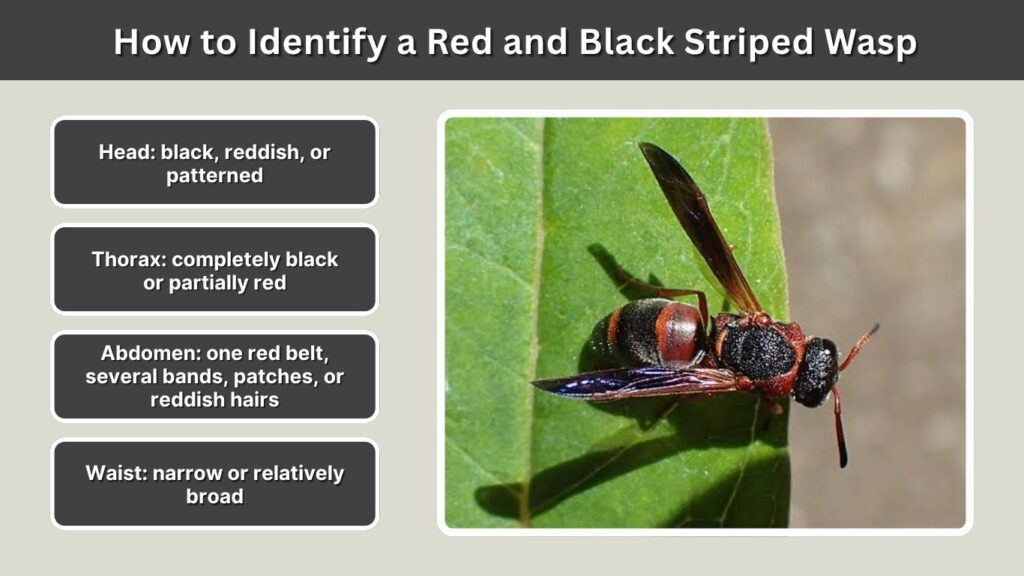
Identification becomes much easier when several physical and behavioral characteristics are considered together. Pay particular attention to where the red marking appears. A solid black wasp with a red stripe on the abdomen may be very different from a fuzzy insect with several red and black bands.
Important Features to Check
Look carefully without attempting to catch the insect.
- Head: black, reddish, or patterned
- Thorax: completely black or partially red
- Abdomen: one red belt, several bands, patches, or reddish hairs
- Waist: narrow or relatively broad
- Wings: black, blue-black, transparent, or absent
- Hair: smooth-bodied or noticeably furry
- Antennae: long and straight or shorter and differently shaped
- Movement: flying normally, running rapidly, digging, or hunting prey
A clear side and top photograph usually provides far more identification information than color alone.
Wings and Body Shape
Long legs combined with a dark, streamlined body may indicate a spider wasp. Spider wasps also commonly have dark, oily-looking wings and are active hunters.
A very furry insect with no wings is more consistent with a female velvet ant. Velvet ants can have striking red-and-black warning coloration and are regularly mistaken for large ants.
Where You Found the Wasp Matters
Habitat provides another valuable clue. Spider wasps may search across soil, vegetation, sheds, and other places where spiders occur. Velvet ants frequently wander across sunny open ground while searching for nests of other insects.
Flower-visiting individuals may simply be feeding on nectar. A solitary wasp repeatedly entering the same small hole may have a ground nest nearby rather than a large social colony.
Are Black and Red Striped Wasps Dangerous?
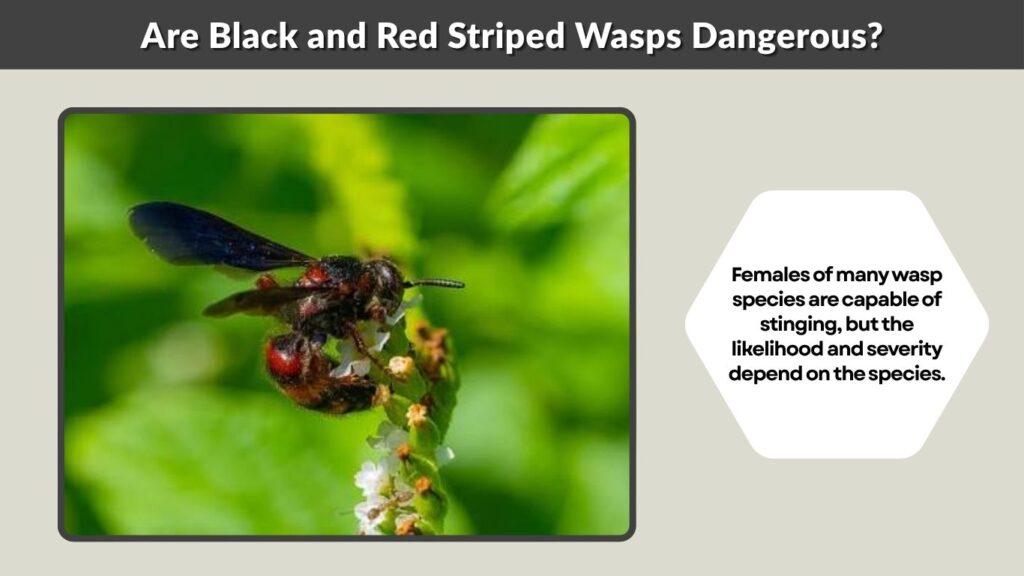
The presence of red and black markings does not automatically mean that a wasp is unusually aggressive. Many insects matching this description are solitary species. Solitary wasps generally spend their time feeding, hunting prey, or reproducing instead of defending a large worker colony.
Can They Sting?
Females of many wasp species are capable of stinging, but the likelihood and severity depend on the species.
Spider wasps can produce painful stings, although their hunting behavior is primarily directed toward spiders. Female velvet ants are particularly well known for painful defensive stings. Male velvet ants cannot sting.
Safety Around an Unknown Wasp
If you encounter an unidentified large black wasp with a red stripe:
- Do not pick it up with bare hands.
- Avoid stepping on a wingless red-and-black wasp.
- Do not swat at an insect flying nearby.
- Give ground-running wasps room to escape.
- Keep children and pets away from unfamiliar wasps.
- Observe from a safe distance if you want photographs for identification.
A solitary wasp simply crossing the yard usually does not require control.
Why Are Red and Black Wasps in Your Yard?
Gardens and yards provide nectar, prey, nesting areas, and host insects, making them attractive to many solitary wasps. Finding one red-and-black wasp does not necessarily indicate an infestation or a hidden colony.
Feeding and Hunting Behavior
Adult solitary wasps frequently visit flowers for nectar. Spider wasps search for spiders, while other groups specialize in different prey or hosts.
Scoliid wasps, for example, develop as parasitoids of beetle grubs and are generally considered beneficial insects around lawns and gardens. They are usually non-aggressive toward people.
Nesting Behavior
Different species have completely different life cycles. Spider wasps commonly provision nests with paralyzed spiders. Velvet ants instead seek nests of other ground-nesting bees and wasps where their offspring develop using the host’s immature stages.
Therefore, seeing a red-and-black wasp does not necessarily mean it has built a nest on your property.
What Should You Do If You Find One?
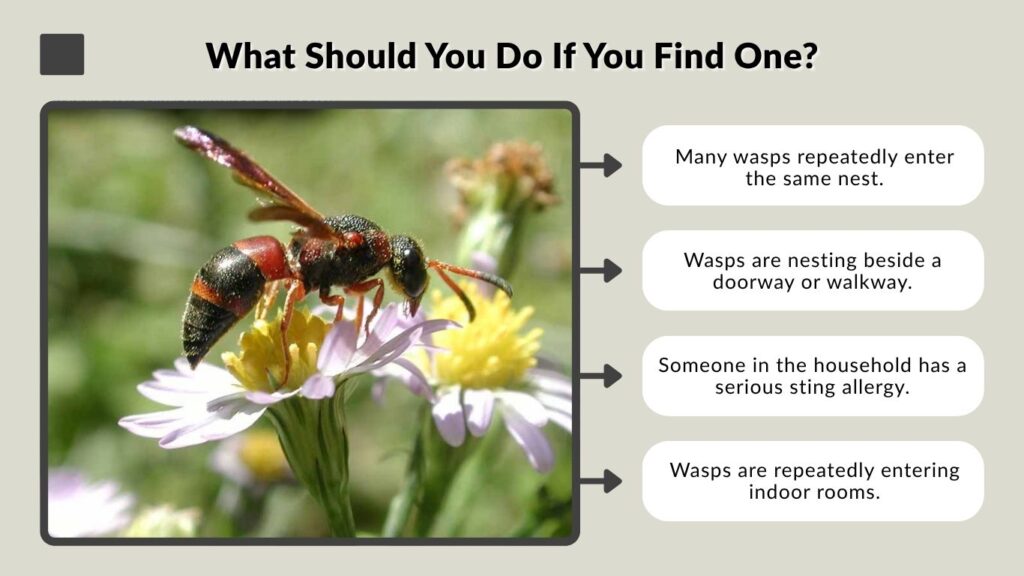
Most solitary red-and-black wasps can simply be left outdoors. They generally play natural ecological roles as predators, parasitoids, or flower visitors. Identification becomes more important when numerous insects repeatedly emerge from one location or when a nest is positioned where people frequently walk or work.
When You Can Leave It Alone
A single wasp usually requires no action if it is outdoors and not threatening anyone. Allowing solitary wasps to remain can support natural insect population control.
Avoid disturbing ground holes or handling unfamiliar species solely to identify them.
When Extra Attention May Be Needed
Consider professional identification or pest-management advice when:
- Many wasps repeatedly enter the same nest.
- Wasps are nesting beside a doorway or walkway.
- Someone in the household has a serious sting allergy.
- Wasps are repeatedly entering indoor rooms.
- You cannot safely determine whether the insects are solitary or social.
- Aggressive nest-defense behavior is occurring.
Correct identification should come before deciding whether control is necessary.
FAQs
People commonly notice color before any other characteristic, which explains searches such as black wasp with red stripe, red wasp black stripes, and what kind of wasp is black with a red stripe? The following answers address the most common identification and safety questions about these striking insects.
What Kind of Wasp Is Black With a Red Stripe?
There is no single species represented by that description. Spider wasps and Stizoides renicinctus are possible matches, while some velvet ants and other solitary wasps also have red-and-black markings. Location, body shape, number of bands, wings, and behavior are necessary for a stronger identification.
What Is a Black Wasp With One Red Stripe on Its Abdomen?
One possibility is Stizoides renicinctus, a dark wasp that can have a prominent orange-red abdominal band. However, several other insects can produce a similar appearance, so a single stripe should not be used as definitive identification.
What Is a Red and Black Striped Fuzzy Wasp?
A fuzzy red-and-black insect may be a velvet ant. Female velvet ants are wingless wasps and are commonly mistaken for large hairy ants. Their striking coloration serves as a useful warning because females can sting painfully.
Are Black Wasps With Red Stripes Aggressive?
Many likely candidates are solitary rather than colony-forming wasps and are not normally interested in attacking people. They may still sting defensively when grabbed, trapped against the skin, or otherwise threatened.
Should I Kill a Red and Black Striped Wasp?
Usually not. A solitary wasp outdoors can generally be left alone, particularly if it is hunting prey or visiting flowers. Control becomes more relevant when a nest creates a genuine safety concern or the species has first been correctly identified.
