
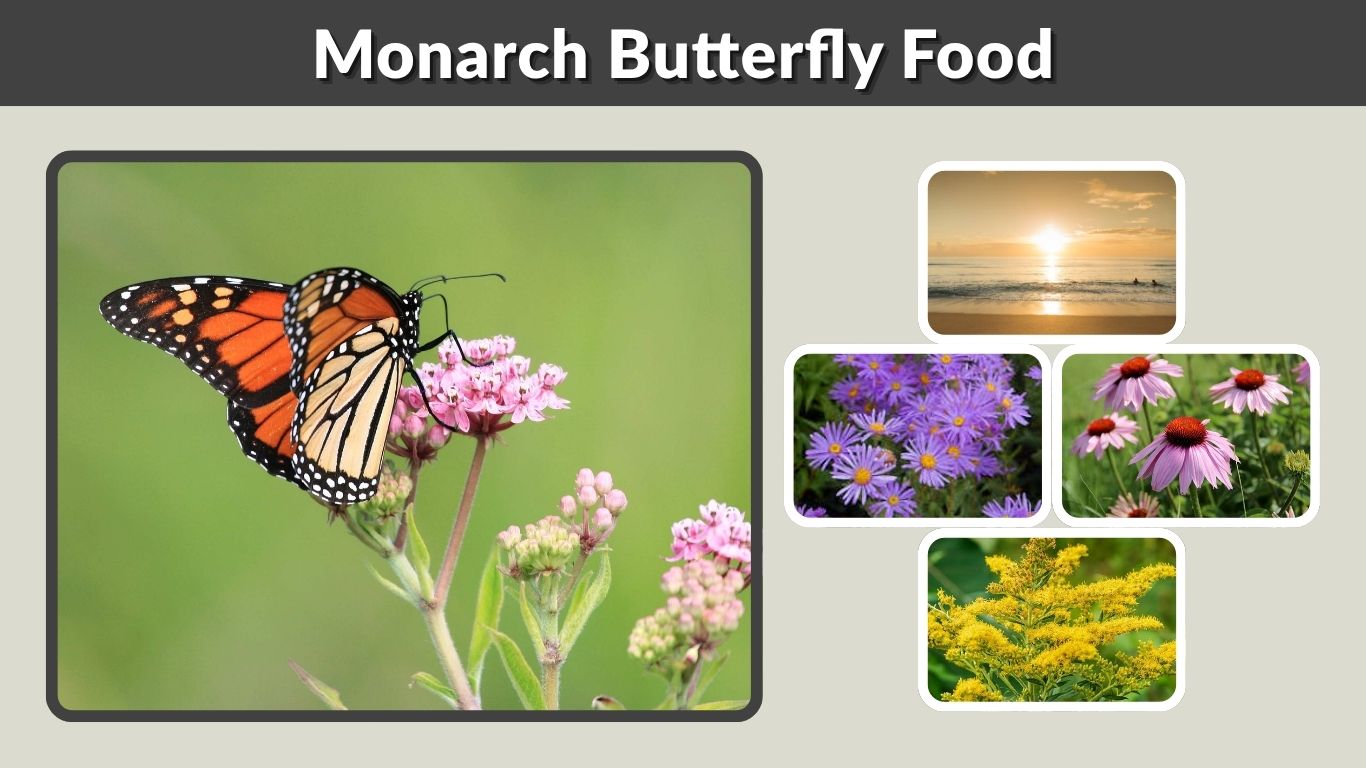
Monarch butterfly food changes dramatically throughout the insect’s life cycle. As caterpillars, monarchs depend almost entirely on milkweed leaves for growth and protection. As adults, they switch to flower nectar, using a long proboscis to drink sugary liquids that provide energy for flying, mating, and migration. A healthy monarch habitat therefore needs both milkweed for larvae and nectar-rich flowers for adults. Understanding what monarch butterflies eat can help gardeners provide better food sources throughout the breeding and migration seasons.
What Do Monarch Butterflies Eat?
Adult monarch butterflies mainly eat—or more accurately, drink—flower nectar.
Nectar contains sugars that provide quick energy for:
- Flying
- Migration
- Mating
- Searching for host plants
- Maintaining normal activity
Adult monarchs visit many kinds of flowering plants rather than depending on a single species.
Best Food for Monarch Butterflies
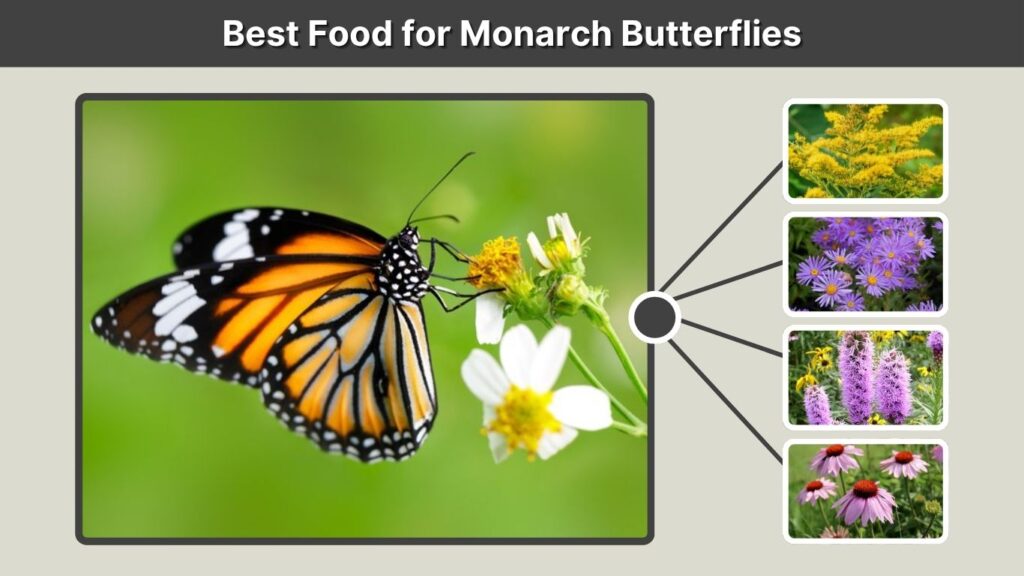
Some useful nectar plants include:
- Goldenrod
- Asters
- Blazing star
- Joe-Pye weed
- Coneflowers
- Zinnias
- Verbena
- Lantana
- Sunflowers
- Ironweed
- Tickseed
- Butterfly weed
Native flowering plants are especially valuable because they are adapted to local growing conditions and often bloom at times when migrating monarchs need food.
What Is a Monarch Butterfly’s Favorite Food?
There is no single flower that every monarch prefers.
Adult monarchs are attracted to nectar-rich flowers that are easy to access and produce plenty of sugar-rich nectar.
During migration, they often gather on large patches of late-blooming flowers such as asters and goldenrods.
The most useful butterfly garden provides several flowering species with overlapping bloom times rather than relying on one plant.
Monarch Butterfly Caterpillar Food
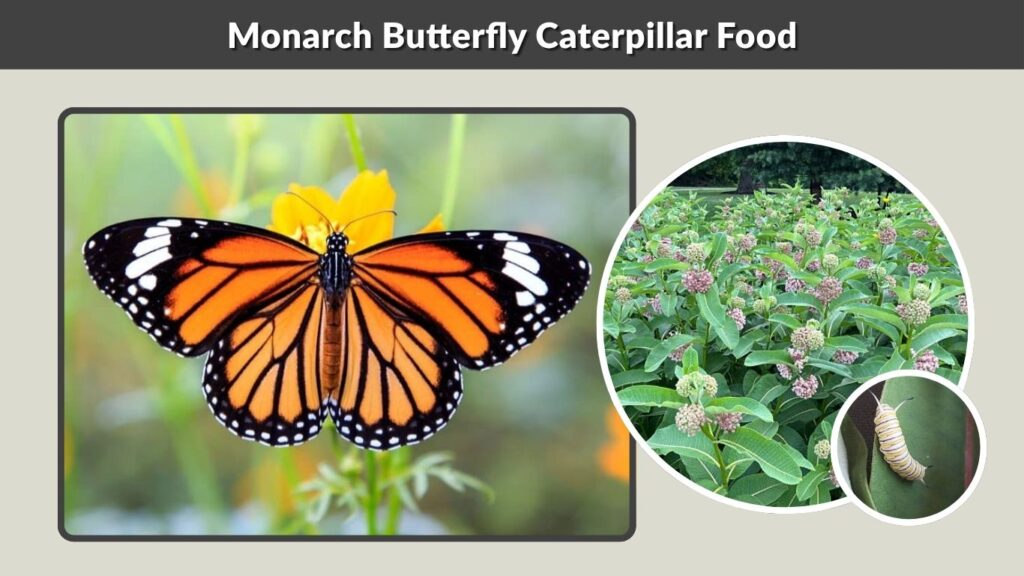
Monarch caterpillars have a much more specialized diet than adults.
Their primary food plants are milkweeds, especially plants in the genus Asclepias.
Female monarchs search for suitable milkweed and usually lay their eggs directly on the plant. Once the tiny caterpillar hatches, it often begins by eating its eggshell before moving on to milkweed leaves.
Why Do Monarch Caterpillars Eat Milkweed?
Milkweed provides both nutrition and chemical protection.
Many milkweed species contain compounds called cardenolides. Monarch caterpillars can store some of these chemicals in their bodies.
Those compounds can make monarchs unpleasant or toxic to certain predators.
The monarch’s bright black, yellow, and white caterpillar coloration—and the adult’s orange-and-black wings—also serve as warning signals to potential predators.
Is Milkweed the Only Food for Monarch Caterpillars?
Milkweed and closely related host plants are the natural and appropriate food for monarch larvae.
They should not be treated like generalist caterpillars that can simply switch to lettuce, spinach, or random garden leaves.
Common monarch host plants include:
| Milkweed Plant | Scientific Name |
| Common milkweed | Asclepias syriaca |
| Swamp milkweed | Asclepias incarnata |
| Butterfly weed | Asclepias tuberosa |
| Showy milkweed | Asclepias speciosa |
| Tropical milkweed | Asclepias curassavica |
| Antelopehorn milkweed | Asclepias asperula |
Whenever possible, choose milkweed species native to your region.
Alternative Food for Monarch Caterpillars
There is no ideal replacement for fresh milkweed.
People sometimes experiment with foods such as pumpkin, squash, cucumber, or artificial diets when milkweed runs out. These should not be considered nutritionally equivalent substitutes.
Monarch caterpillars raised on inappropriate foods may experience poor development or fail to complete metamorphosis successfully.
If you are raising monarch caterpillars, the best solution is to maintain an adequate supply of fresh, pesticide-free milkweed.
What Do Newly Hatched Monarch Caterpillars Eat?
A newly hatched monarch caterpillar is extremely small.
Its first meal may be part or all of its eggshell. Afterward, it begins eating the tender surface of the milkweed leaf where the egg was laid.
As the caterpillar grows through five larval stages, called instars, its appetite increases dramatically.
Large fifth-instar caterpillars can consume substantial amounts of milkweed before leaving the plant to form a chrysalis.
What Do Adult Monarch Butterflies Eat After Emerging?
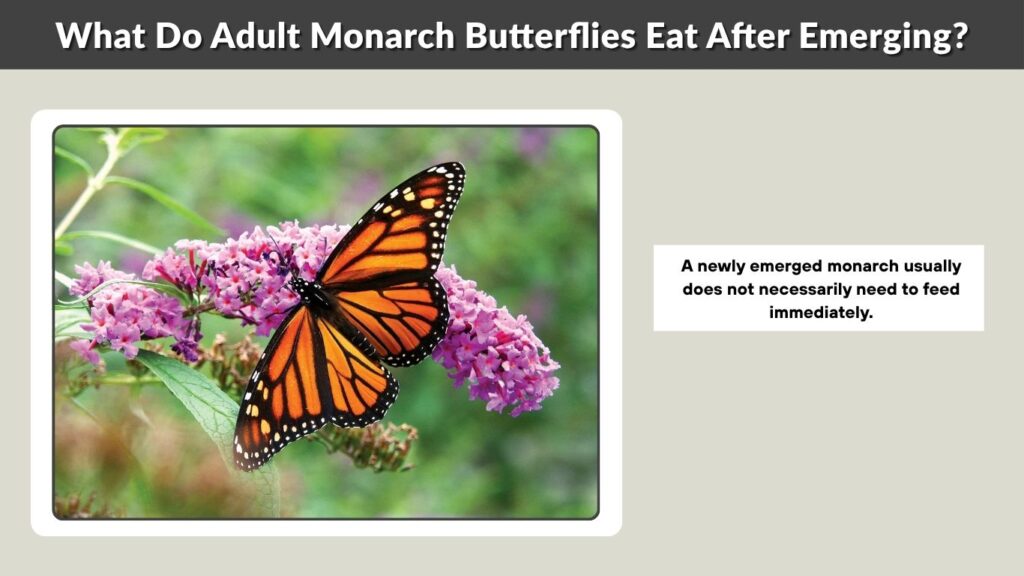
A newly emerged monarch usually spends its first hours allowing its wings to expand, dry, and strengthen.
It does not necessarily need to feed immediately.
Once ready, the adult searches for nectar-rich flowers and drinks nectar through its proboscis.
Do Monarchs Need Food Before Release?
If a healthy monarch has recently emerged and will be released within a reasonable period under suitable weather conditions, it can usually find nectar outdoors.
If it must remain protected for longer, access to appropriate nectar or a temporary sugar solution may be useful.
However, captive feeding should not replace access to natural flowers whenever suitable nectar plants are available.
How Do Monarch Butterflies Get Their Food?
Adult monarchs do not chew food.
Instead, they have a long tube-like mouthpart called a proboscis.
When not feeding, the proboscis remains curled beneath the head. When the butterfly lands on a flower, it uncoils the proboscis and inserts it into the flower to reach nectar.
Monarchs locate flowers using several senses, including:
- Vision
- Color recognition
- Chemical cues
- Taste receptors
Their feet also contain sensory structures that help them evaluate plants after landing.
Monarch Butterfly Food Plants
A complete monarch garden should contain two major groups of plants.
1. Host Plants
Milkweed provides food for monarch caterpillars and gives females a place to lay eggs.
2. Nectar Plants
Flowering plants provide food for adult monarch butterflies.
For best results, gardeners should provide flowers that bloom from spring through fall. Late-season nectar is particularly important for monarchs preparing for long-distance migration.
Can Monarch Butterflies Feed From Butterfly Bush?
Yes. Adult monarchs commonly visit butterfly bush (Buddleja) for nectar.
However, butterfly bush should not be confused with milkweed.
It may provide nectar for adults, but monarch caterpillars generally cannot use it as their host food plant.
A monarch-friendly garden therefore needs milkweed plus nectar flowers, not nectar flowers alone.
How to Make Food for a Monarch Butterfly
Natural nectar flowers are the best food source for healthy adult monarchs.
When flowers are temporarily unavailable, a simple sugar solution may sometimes be used for short-term captive feeding.
A commonly used temporary mixture is approximately:
- 1 part plain white sugar
- 9–10 parts water
Dissolve the sugar completely and offer a small amount on an absorbent surface where the butterfly can extend its proboscis without becoming stuck or soaked.
Avoid leaving concentrated sugary liquids on the wings.
Honey, artificial sweeteners, soft drinks, and heavily flavored liquids are not ideal replacements for natural nectar.
How Long Can a Monarch Butterfly Live Without Food?
There is no exact number that applies to every monarch.
Temperature, age, activity level, hydration, and stored energy all influence survival.
A newly emerged monarch can normally go several hours without feeding while its wings finish developing. Healthy adults may survive longer without nectar, particularly when cool and inactive, but extended food deprivation reduces their energy reserves.
Migrating monarchs need regular access to nectar because flying hundreds or thousands of miles requires enormous amounts of energy.
Monarch Butterfly Food Chain
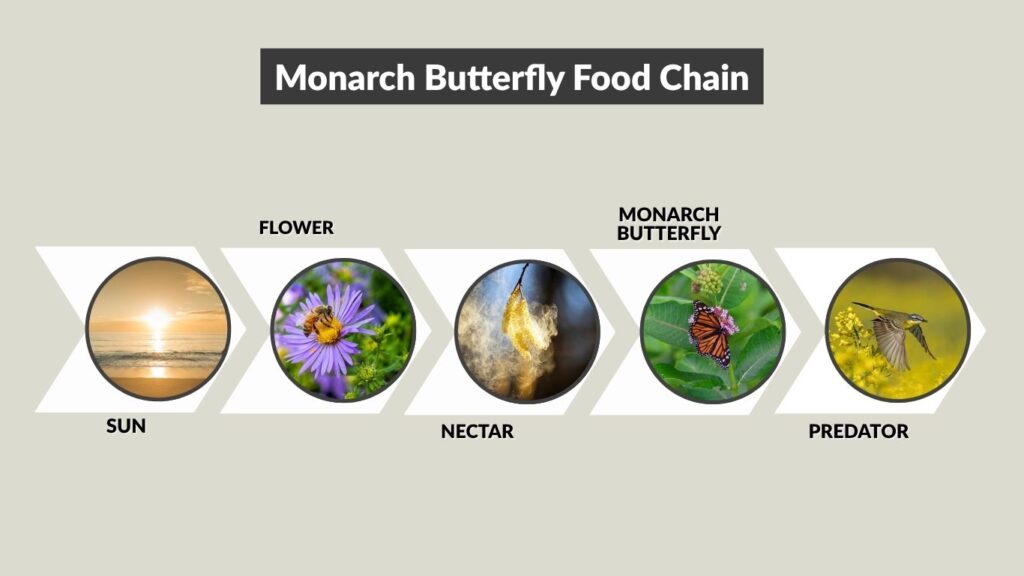
Monarchs are both consumers and prey within their ecosystem.
A simplified monarch butterfly food chain might look like this:
Sun → Milkweed → Monarch Caterpillar → Predator
For adults:
Sun → Flower → Nectar → Monarch Butterfly → Predator
Monarch predators can include certain:
- Birds
- Spiders
- Wasps
- Ants
- Insects
- Small mammals
Not every predator can safely eat monarchs because chemicals obtained from milkweed make them distasteful or toxic to some animals.
Monarch Butterfly Food Web
A food web is more complicated than a simple food chain because monarchs interact with many organisms.
Milkweed supports caterpillars, while flowers provide nectar for adults. Monarch eggs and caterpillars may be eaten by ants, spiders, wasps, and other predators. Adults may occasionally be eaten by birds or other animals capable of tolerating their chemical defenses.
Monarchs also contribute to pollination when they move pollen between flowers while feeding, although they are not as efficient as some major pollinating insects.
FAQs
1. What is the main food of a monarch butterfly?
Adult monarch butterflies primarily drink flower nectar. Nectar provides carbohydrates that give them energy for flight, reproduction, and migration. They visit many different flowering plants, including asters, goldenrods, blazing stars, coneflowers, and other nectar-rich species.
2. What do monarch caterpillars eat?
Monarch caterpillars primarily eat milkweed. Females lay their eggs on suitable host plants so newly hatched larvae immediately have access to food. Caterpillars consume increasing amounts of milkweed as they pass through their five stages of growth.
3. Is milkweed food for adult monarch butterflies?
Milkweed flowers can provide nectar for adult monarchs, but the leaves are mainly important as caterpillar food. Adult butterflies drink nectar rather than eating leaves. Milkweed therefore serves two purposes when flowering: a larval host plant and a possible nectar source.
4. Can monarch butterflies eat fruit?
Adult monarchs are primarily nectar feeders, though butterflies may occasionally take liquids from overripe fruit or other sugary sources. For monarch gardens, nectar-producing flowers remain a much better and more natural food source than fruit.
5. What should I plant to feed monarch butterflies?
Plant native milkweed for caterpillars along with a variety of nectar-producing flowers for adults. Choose plants that bloom at different times of year so monarchs have continuous food during breeding and migration periods.
