
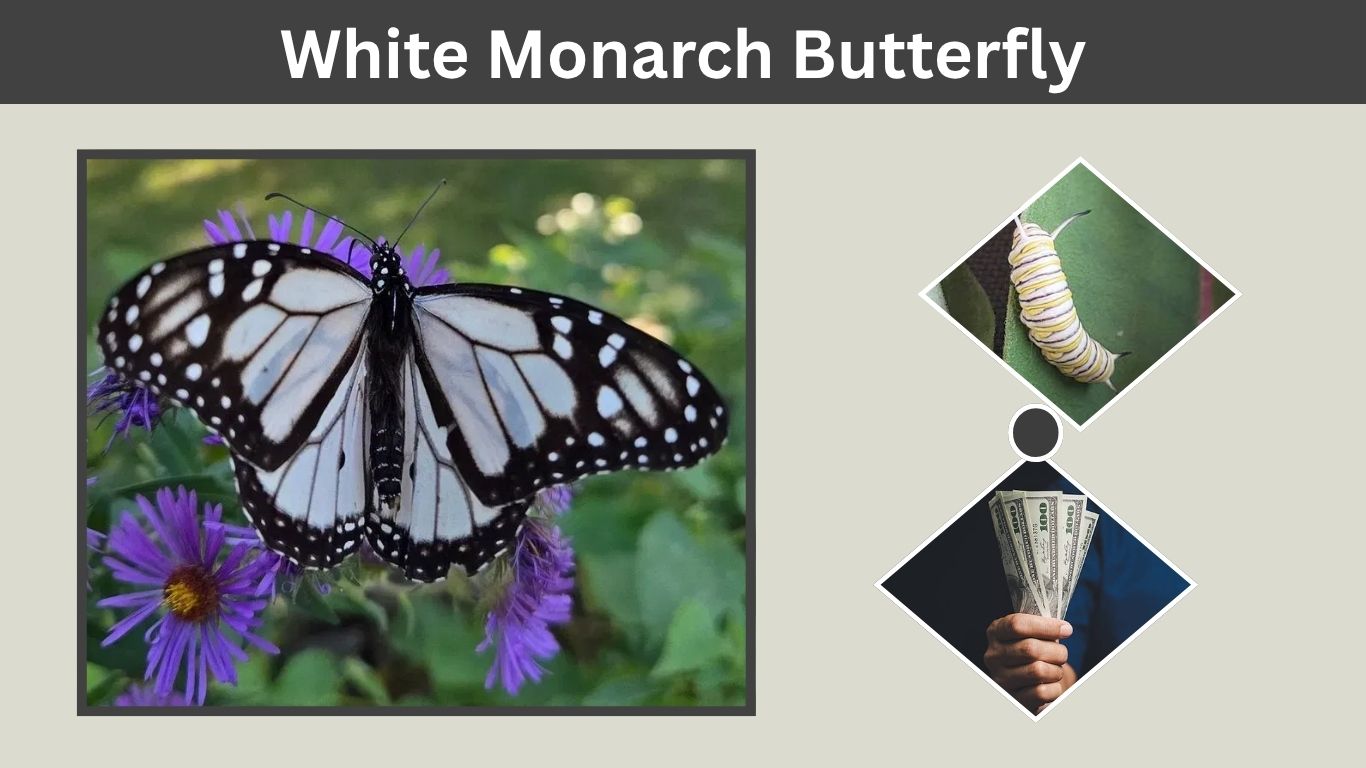
A white monarch butterfly is a rare color form of the ordinary monarch, Danaus plexippus. Known as the nivosus morph, it has grayish-white or cream-colored wing areas where a typical monarch is orange. Its black veins, borders, and white edge spots remain visible. It is not a separate butterfly species, an albino, or a different life-cycle stage. White monarchs have been reported in several countries, but they are especially associated with Hawaii.
What Is a White Monarch Butterfly?
The white monarch is a genetically determined variation of the orange-and-black monarch butterfly. Scientists use the name nivosus for this form. Apart from its pale wings, it has the same basic anatomy, behavior, host plants, and development as an ordinary monarch.
| Feature | White monarch |
| Scientific species | Danaus plexippus |
| Color form | Nivosus |
| Main wing color | Grayish white or cream |
| Wing markings | Black veins, borders, and white spots |
| Caterpillar | Black, white, and yellow striped |
| Host plants | Milkweeds |
| Best-known population | Oahu, Hawaii |
| Separate species? | No |
Identification
- Grayish-white areas replacing the normal orange color
- Thick black veins crossing all four wings
- Broad black borders around the wings
- Small white spots inside the black margins
- Similar size and shape to an orange monarch
- Clubbed antennae and a slender black body
- Males may have a dark scent spot on each hindwing
- Females usually have thicker black wing veins
A faded orange monarch should not automatically be identified as a white morph. Age, sun exposure, scale loss, lighting, and photography can make normal monarchs appear paler than they really are.
Why Are Some Monarch Butterflies White?
The nivosus form is inherited through a recessive genetic trait. A white monarch generally receives the white-form allele from both parents. Monarchs carrying only one copy usually retain the familiar orange coloration. Earlier breeding work found that white parents produced white offspring, while crosses with orange monarchs followed patterns expected from autosomal recessive inheritance.
Genomic research later linked the color difference to variation near a myosin gene called DPOGS206617. The findings suggest that the mutation interferes with pigment transport rather than completely preventing pigment production. The result is a butterfly whose normally orange wing scales appear pale gray or white.
Is a White Monarch an Albino?
No. An albino animal lacks normal melanin or related pigmentation throughout much of its body. A white monarch still has bold black veins, borders, body coloration, and wing spots.
The term color morph is more accurate. Its pale appearance comes from a specific inherited change affecting the orange wing coloration rather than a complete absence of all pigments.
White Monarch Butterflies in Hawaii
White monarchs are most famously associated with Oahu, Hawaii. The nivosus form has been documented there since at least the late 1800s and historically occurred at much higher frequencies than in most other monarch populations. Studies reported that the white form represented roughly 1–8% of some Oahu populations during particular survey periods.
One proposed explanation involves predator-driven selection. Research suggested that introduced red-whiskered and red-vented bulbuls may have preyed more frequently on orange monarchs, potentially giving white individuals a survival advantage under certain conditions. This hypothesis helps explain historical changes but does not mean every Hawaiian population has the same white-monarch percentage today.
Monarchs are not native Hawaiian butterflies. The islands’ native Kamehameha butterfly is a separate species with different markings, host plants, and evolutionary history.
White Monarch Caterpillar
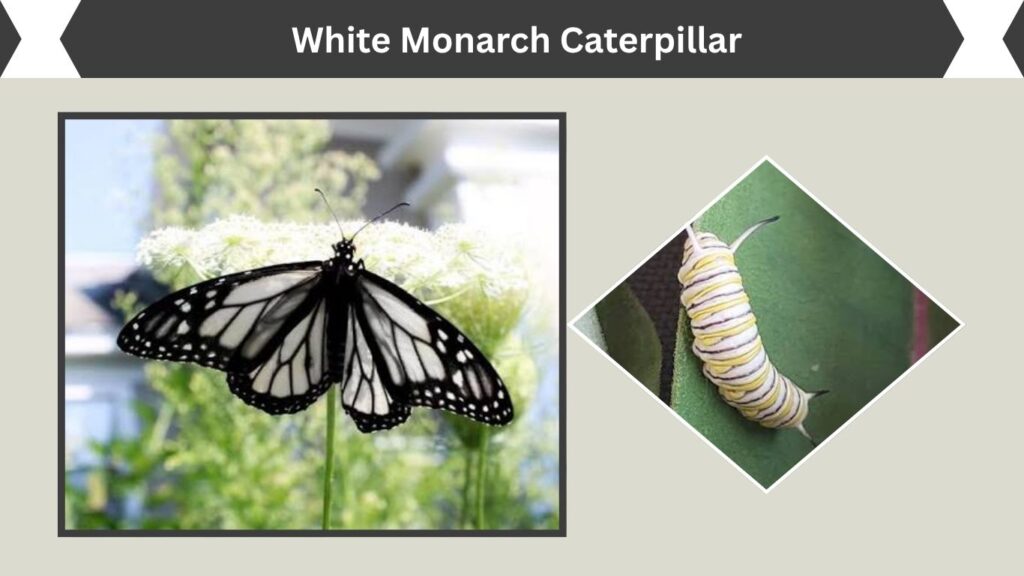
A caterpillar that will become a white monarch generally looks like a normal monarch caterpillar. It has alternating black, white, and yellow bands, along with two pairs of flexible black filaments—one near the head and another near the rear.
Monarch caterpillars feed on milkweed plants. Newly hatched larvae can appear pale grayish-white or translucent before developing their familiar striped pattern. The white adult form usually cannot be predicted simply by looking at the caterpillar.
White Monarch Chrysalis
A white monarch does not normally produce a white chrysalis. Like an orange monarch, it forms a smooth green chrysalis decorated with small metallic-looking gold spots.
Shortly before the adult emerges, the chrysalis becomes transparent and the developing wing pattern can be seen through its outer covering. Only at this late stage might the pale wing coloration become visible.
Why Do Monarch Butterflies Have White Spots?
Both orange and white monarchs normally have small white spots within their black wing borders. These markings are a standard part of the monarch pattern and do not indicate disease, old age, or the nivosus mutation.
Research comparing monarch populations found that long-distance migrants tended to have larger white wing spots, suggesting that these markings could influence flight conditions or solar-energy absorption. That research concerned normal variation in spot size, not the pale nivosus color form.
A monarch without obvious white spots may simply have worn scales, damaged wing edges, an unusual individual pattern, or poor visibility in a photograph.
Black and White Butterfly That Looks Like a Monarch
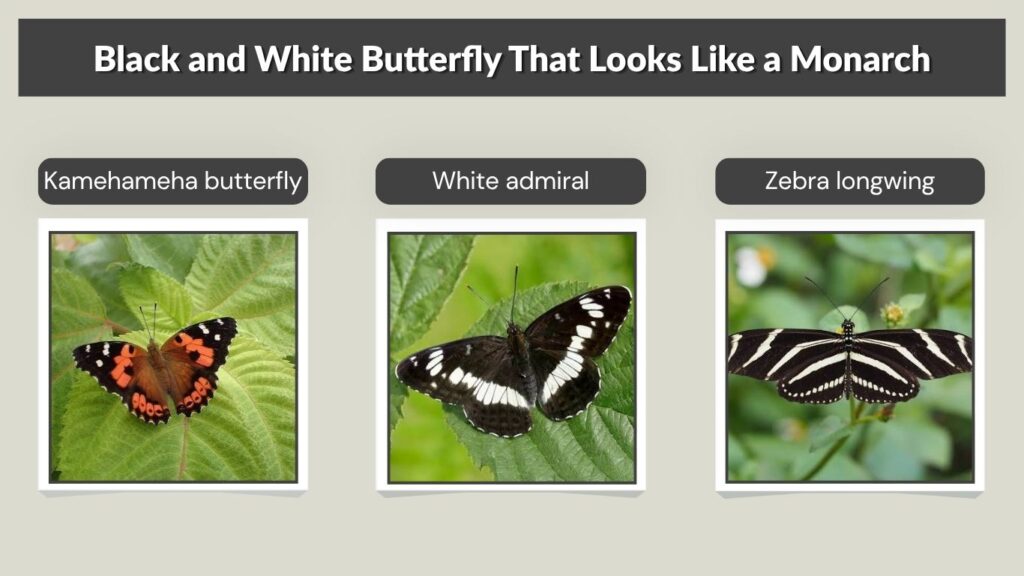
A genuine white monarch retains the classic monarch layout: black veins, broad dark borders, and pale central wing panels. However, several other butterflies may be described as black and white and mistakenly connected with monarchs.
| Butterfly | Difference from a white monarch |
| Kamehameha butterfly | Native to Hawaii; different forewing patches |
| White admiral | Broad white bands rather than monarch-like veins |
| Zebra longwing | Long narrow wings with pale yellow stripes |
| Paper kite butterfly | Much larger pale panels and different vein pattern |
| Viceroy | Usually orange and has an extra black hindwing line |
Location and a clear view of both wing surfaces are important for identification. A butterfly photographed in monochrome may simply be an ordinary orange monarch shown in black-and-white photography.
Do Monarchs Like White Flowers?
Monarchs visit many nectar-producing flowers, including species with white blooms. They are not limited to one flower color. Flower shape, nectar production, seasonal availability, and accessibility are generally more important than whether a bloom is white, pink, yellow, or purple.
Adult nectar plants provide energy, but milkweed remains essential for reproduction because monarch caterpillars can develop only on suitable milkweed host plants.
White Monarch Butterfly Meaning
A white monarch has no scientifically established spiritual meaning. In art, tattoos, and personal symbolism, people may associate it with transformation, rarity, peace, purity, remembrance, freedom, or a new beginning.
These interpretations are cultural or personal rather than biological. The butterfly’s actual pale coloration results from inherited genetic variation.
Can You Buy a White Monarch Butterfly?
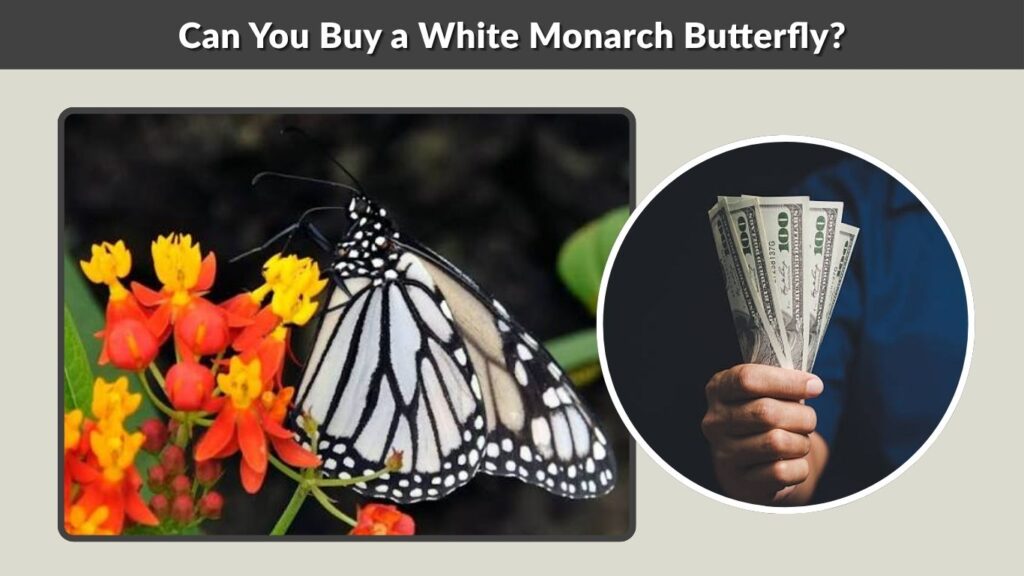
White monarchs occasionally appear in captive-reared lines, but they should not be treated as decorative collectibles. Releasing commercially raised butterflies can spread disease, mix populations, or introduce poorly adapted individuals.
Anyone raising monarchs should follow local wildlife rules, use clean equipment, avoid overcrowding, and obtain milkweed and butterflies responsibly. A pale monarch with crumpled wings or missing abdominal scales may be sick rather than genetically white; laboratory examination is the dependable way to test for the monarch parasite Ophryocystis elektroscirrha.
FAQs
Are white monarch butterflies real?
Yes. The nivosus monarch is a genuine, naturally occurring color morph of Danaus plexippus. Its normally orange wing regions are grayish white, while the black veins, dark borders, and white edge spots remain visible.
How rare is a white monarch butterfly?
It is extremely rare across most of the monarch’s global range. Historical studies found it more frequently on Oahu, where it sometimes represented several percent of the local population. Its current frequency can vary by place and year.
Is the white monarch a separate species?
No. White and orange monarchs belong to the same species and can reproduce with one another. The pale coloration results from a recessive genetic variation affecting wing pigment transport.
Does a white monarch have a white caterpillar?
No. Its caterpillar normally displays the same black, white, and yellow bands as other monarch larvae. Its chrysalis is also usually green with gold-colored spots rather than white.
Are white monarchs found outside Hawaii?
Yes. Individual white monarchs have been reported from the continental United States, Australia, New Zealand, Indonesia, and other regions. However, established sightings are much more strongly associated with Hawaii, particularly Oahu.
