
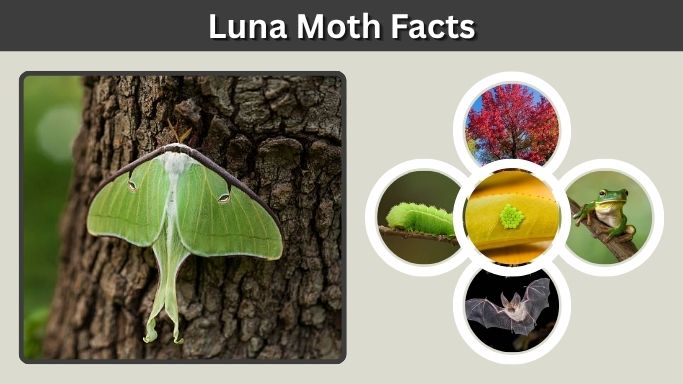
The luna moth is one of the most beautiful moths in North America. With pale green wings, long tails, and moon-like eyespots, it looks almost magical when seen at night. But this moth is more than just pretty. Its short adult life, unusual diet, caterpillar stage, and role in nature make it fascinating. Here are 12 important luna moth facts you should know.
1. Luna Moths Are Large Green Silk Moths
Luna moths belong to the giant silk moth family. Their scientific name is Actias luna. They are known for their pale green wings, long hindwing tails, and soft white bodies. Their graceful appearance makes them one of the most recognizable moths in North America.
Adult luna moths are usually seen at night or early morning. They may rest on walls, tree trunks, leaves, or near outdoor lights. Because of their delicate green color, they can blend well with leaves during the day.
Identification Features
You can identify a luna moth by these features:
- Pale green or yellow-green wings
- Long curved tails on the hindwings
- Eyespots on all four wings
- White, fuzzy body
- Large wingspan
- Feather-like antennae
- No biting or stinging parts
- Mostly active at night
The long tails are one of their most famous features. These tails are not just decorative. They may help confuse predators, especially bats.
2. Luna Moths Can Have a Wide Wingspan
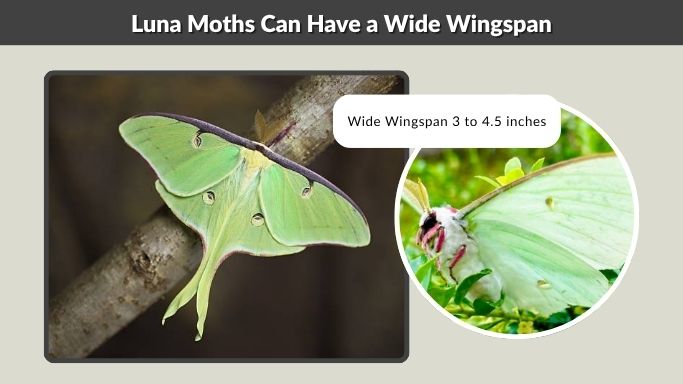
Luna moths are much larger than many common moths. Their wingspan often reaches about 3 to 4.5 inches. Because they hold their wings flat when resting, they can look even bigger than they really are.
Their wide wings help them fly slowly and gracefully at night. The wings are usually light green, but older moths may look faded. Some may appear yellowish or whitish after several days.
Size Compared With Other Moths
Luna moths are considered large moths, but they are not the largest moths in the world. Still, they are impressive because of their wing shape, long tails, and bright color. Many people notice them immediately because they look different from small brown house moths.
The large size also makes them easier to observe. However, they are delicate, so they should not be handled roughly.
3. Adult Luna Moths Do Not Eat
One of the most surprising luna moth facts is that adult luna moths do not eat. They do not drink nectar, chew leaves, eat fruit, or sip water. Adult luna moths have reduced mouthparts that do not work for feeding.
This means adult luna moths live on energy stored during the caterpillar stage. Once they emerge from the cocoon, their main goal is to mate and reproduce.
Why They Cannot Eat
Many butterflies and moths have a tube-like mouthpart called a proboscis. They use it to drink nectar. Luna moths do not have a functional feeding system as adults.
Because they cannot eat, their adult life is short. Even if someone offers sugar water, flowers, fruit, or honey, the moth cannot use it. Its body is designed for reproduction, not feeding.
4. Luna Moth Caterpillars Eat Tree Leaves
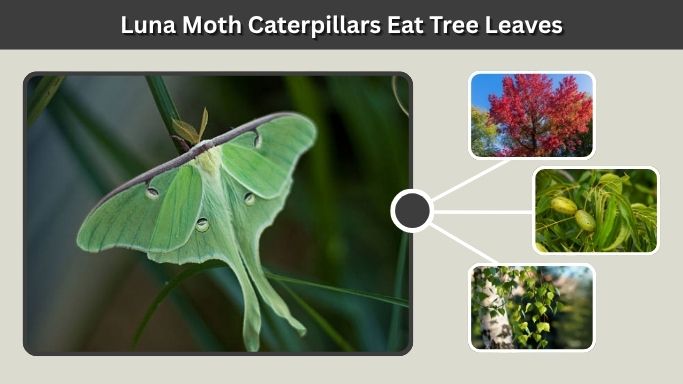
Although adult luna moths do not eat, luna moth caterpillars eat a lot. The caterpillar stage is the feeding stage of the life cycle. Caterpillars need leaves from specific host plants to grow and store energy.
They usually feed on hardwood trees and shrubs. These host plants vary by region, but several are commonly used.
| Host Plant | Used By Caterpillars? | Notes |
| Sweetgum | Yes | Common host in many areas |
| Hickory | Yes | Important native host tree |
| Walnut | Yes | Often used by caterpillars |
| Birch | Yes | Common in cooler regions |
| Persimmon | Yes | Useful host in some areas |
| Willow | Yes | Can support larvae |
| Sumac | Yes | Used in some regions |
Common Caterpillar Foods
Luna moth caterpillars may eat:
- Sweetgum leaves
- Hickory leaves
- Walnut leaves
- Birch leaves
- Persimmon leaves
- Willow leaves
- Sumac leaves
- Pecan leaves
- Alder leaves
- Beech leaves
They do not normally eat clothes, stored food, or household materials. They are outdoor leaf-feeding insects.
5. The Luna Moth Life Cycle Has Four Stages
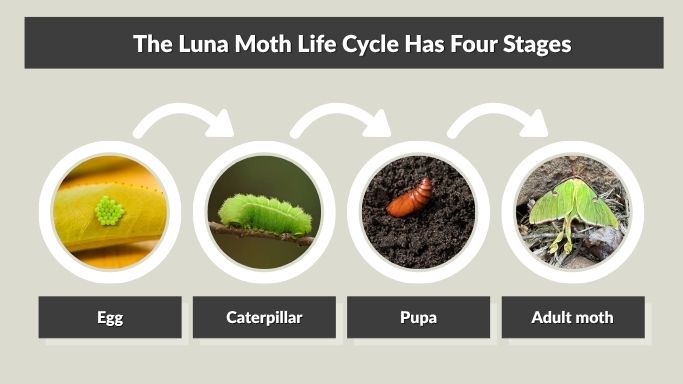
The luna moth life cycle includes egg, caterpillar, cocoon, and adult moth. This is called complete metamorphosis. The caterpillar looks very different from the adult moth.
Each stage has a special purpose. Eggs start the next generation. Caterpillars eat and grow. Cocoons protect the transformation stage. Adults mate and lay eggs.
Life Cycle Stages
The main luna moth life stages are:
- Egg: laid on or near host plant leaves
- Caterpillar: feeds on leaves and grows quickly
- Cocoon: made with silk and leaves
- Pupa: transforms inside the cocoon
- Adult moth: emerges, mates, and lays eggs
In warm weather, the full cycle may move quickly. In colder areas, the pupa may stay in the cocoon through winter and emerge in spring.
6. Adult Luna Moths Live Only About One Week
Adult luna moths usually live about 7 to 10 days. Their short lifespan is linked to the fact that they cannot eat. Once they become adults, they survive only on stored energy.
During this brief time, males search for females, females release pheromones, mating occurs, and females lay eggs. After reproduction, the adult moth dies naturally.
Full Lifespan vs Adult Lifespan
The full life cycle lasts longer than the adult stage. Eggs may take about 1 to 2 weeks to hatch. Caterpillars may feed for about 3 to 4 weeks. The cocoon stage may last a few weeks or through winter.
So, when people ask how long luna moths live, the answer depends on the stage. The adult moth lives only about a week, but the full life cycle may last several weeks or months.
7. Male and Female Luna Moths Look Different
Male and female luna moths look similar at first, but they have a few important differences. The easiest way to tell them apart is by looking at the antennae.
Male luna moths have wide, bushy, feather-like antennae. Female luna moths have thinner antennae. Males use their large antennae to detect female pheromones at night.
Male vs Female Differences
Male luna moths usually have:
- Wider antennae
- Slimmer bodies
- More active night flight
- Strong ability to detect female scent
Female luna moths usually have:
- Thinner antennae
- Fuller abdomen
- Egg-laying role
- Less long-distance searching behavior
Females may look heavier because they carry eggs. However, size alone is not always the best clue. Antennae are more reliable.
8. Female Luna Moths Attract Males With Pheromones
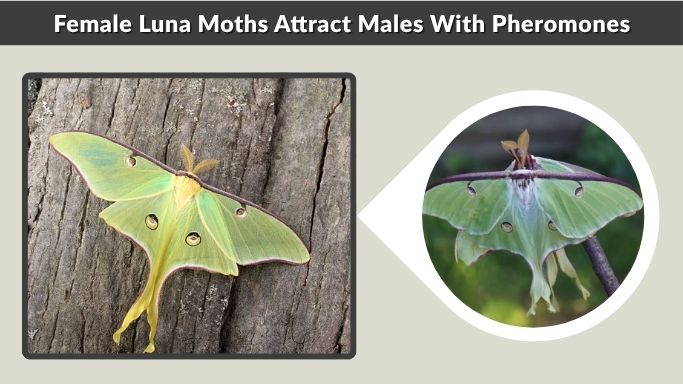
Female luna moths attract males by releasing chemical signals called pheromones. These signals travel through the air at night. Male luna moths detect them using their large antennae.
This is why male antennae are so feathery. They work like sensitive scent detectors. A male may fly through the night searching for a female.
Mating Behavior
After emerging from the cocoon, a female may wait in a safe place and release pheromones. When a male finds her, mating can happen. After mating, the female lays eggs on suitable host plants.
Female luna moths do not care for the eggs after laying them. The eggs hatch on their own, and the young caterpillars begin feeding on leaves.
9. Luna Moths Are Nocturnal
Luna moths are mostly active at night. They usually fly after dark and may be attracted to porch lights, streetlights, or garden lights. During the day, they rest quietly on trees, leaves, walls, or other surfaces.
Their pale green wings help them blend into leaves. This camouflage can protect them from birds and other daytime predators.
Why Lights Attract Them
Like many moths, luna moths can be attracted to artificial lights. Outdoor lights may confuse them or cause them to remain in unsafe places. A moth resting near a door, window, or walkway may be exposed to pets, birds, or human activity.
Reducing bright outdoor lighting during moth season can help protect luna moths and other nocturnal insects.
10. Luna Moths Are Harmless to Humans
Luna moths do not bite, sting, poison people, or damage homes. Adult luna moths cannot chew because they do not have working mouthparts. They also do not eat clothes, wood, paper, carpets, or stored food.
Caterpillars feed on tree leaves, but they are not usually serious pests. They are part of a natural ecosystem and rarely cause major damage to healthy trees.
Safe to Observe
If you find a luna moth, it is safe to watch from a respectful distance. Avoid touching the wings because moth wings are delicate. Handling can damage the scales on the wings or injure the moth.
If one enters your home, gently guide it outside. Place it near trees or shrubs, preferably in a safe shaded place.
11. Luna Moths Have Predators
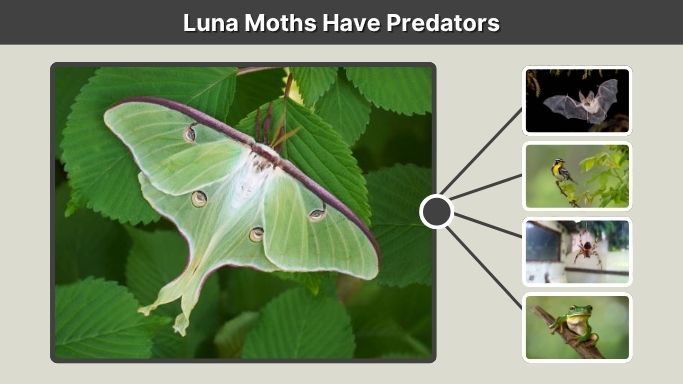
Luna moths are beautiful, but they are also food for many animals. Predators may attack eggs, caterpillars, cocoons, or adult moths. This is a normal part of the food chain.
Adult luna moths are especially vulnerable to bats because they fly at night. Birds may also eat adults when they rest during the day.
Animals That Eat Luna Moths
Common luna moth predators include:
- Bats
- Birds
- Spiders
- Frogs
- Lizards
- Ants
- Wasps
- Small mammals
- Predatory insects
- Parasitoid flies and wasps
The long tails on adult wings may help protect them from bats. The tails can confuse a bat’s attack and draw attention away from the moth’s body.
12. Luna Moths Have Symbolic Meaning
Luna moths are often connected with beauty, transformation, mystery, and renewal. Because they go through complete metamorphosis, many people see them as a symbol of change and personal growth.
Their moon-like name and nighttime activity also make them feel spiritual or mysterious to some people. Seeing one can feel special because adult luna moths live only a short time.
Luna Moth Symbolism
Common symbolic meanings include:
- Transformation
- Rebirth
- New beginnings
- Inner growth
- Beauty in short moments
- Moon energy
- Mystery and intuition
- Letting go of the past
These meanings are cultural and personal, not scientific. Scientifically, seeing a luna moth usually means suitable trees and habitat are nearby.
FAQs
Are luna moths rare?
Luna moths are not always rare, but they are not seen often because adults live only about a week and fly mostly at night. They may be present in wooded areas but hidden during the day. Their short adult life makes sightings feel special.
Do luna moths eat anything?
Adult luna moths do not eat or drink. They have reduced mouthparts and survive on stored energy from the caterpillar stage. Luna moth caterpillars do eat leaves from host plants such as sweetgum, hickory, walnut, birch, persimmon, and willow.
Are luna moths poisonous?
Luna moths are not poisonous to humans. They do not sting, bite, or harm people. Their caterpillars are also not known as dangerous stinging caterpillars. Still, it is better to avoid unnecessary handling because moths and caterpillars are delicate.
How long do luna moths live?
Adult luna moths usually live about 7 to 10 days. The full life cycle is longer because the moth also spends time as an egg, caterpillar, and pupa. If the pupa overwinters, the full cycle may last several months.
What does a luna moth mean spiritually?
Spiritually, a luna moth is often seen as a symbol of transformation, renewal, and short-lived beauty. Because it changes from caterpillar to moth and lives briefly as an adult, many people connect it with growth, change, and appreciating temporary moments.
