
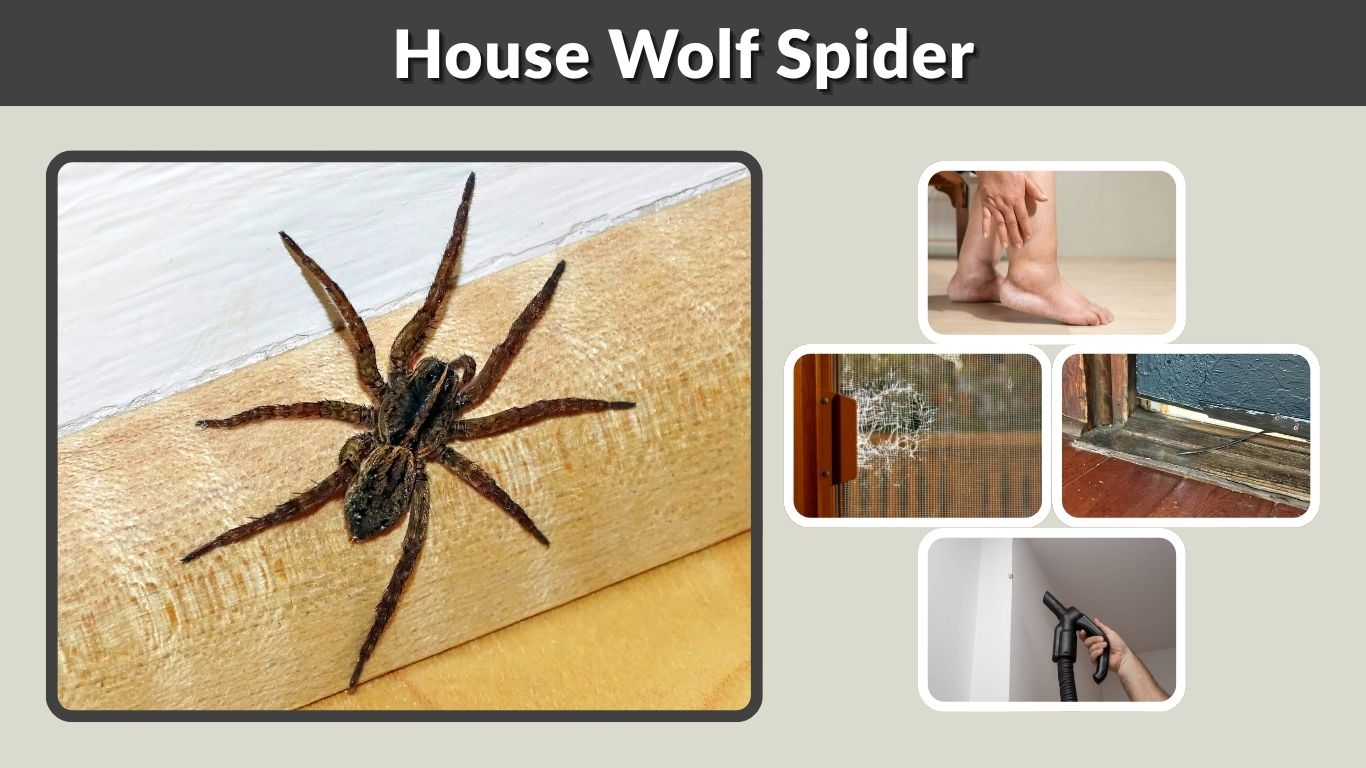
Finding a large, fast brown spider running across the floor can be alarming, and wolf spiders are frequent suspects. A house wolf spider is not a separate species; the term generally refers to any wolf spider in the family Lycosidae that has wandered indoors. Wolf spiders are ground-hunting predators rather than permanent web-building house spiders. Most are brown, gray, or blackish with striped or mottled markings. Although they possess venom for subduing insects, they are generally shy, rarely bite people, and are not considered medically dangerous.
What Does a House Wolf Spider Look Like?
Wolf spiders range considerably in size because Lycosidae contains many species. Their bodies are typically robust and somewhat hairy, with strong legs adapted for running across the ground.
University of Minnesota Extension describes wolf spiders as moderate to large spiders, commonly around 1/4 to 1 inch in body length, although some species become larger.
House Wolf Spider Identification
Look for:
- Brown, gray, tan, or nearly black coloration
- Robust, hairy body
- Long, powerful legs
- Stripes or mottled markings
- Eight eyes arranged in three rows
- Two especially large forward-facing eyes
- Fast running behavior
- No prey-catching web
- Usually found on or close to the ground
The eye arrangement is particularly useful. Wolf spiders have four small eyes in a lower row, two very large eyes above them, and another pair farther back.
At night, their large eyes can reflect flashlight beams, sometimes producing a noticeable greenish eyeshine.
Why Is There a Wolf Spider in My House?
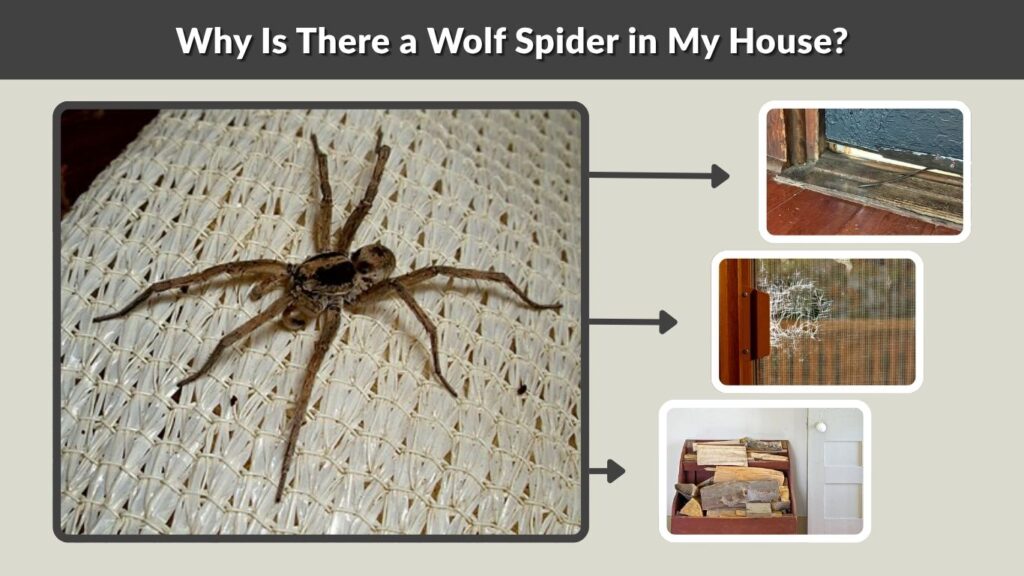
Wolf spiders primarily live outdoors in gardens, grass, leaf litter, woodland, beneath stones, and similar ground-level habitats.
They occasionally enter houses accidentally while searching for prey, shelter, mates, or protected overwintering sites. Habitat disturbance around newly developed properties can also increase indoor encounters.
How Do Wolf Spiders Get Inside?
Common entry points include:
- Gaps beneath exterior doors
- Cracks around foundations
- Open garage doors
- Damaged window screens
- Gaps around pipes and cables
- Basement windows
- Door frames
- Firewood carried indoors
Late summer and fall can bring more indoor sightings in cooler regions as some wolf spiders seek protected locations.
Seeing one wolf spider does not necessarily mean you have an infestation.
Are House Wolf Spiders Dangerous?
For most people, wolf spiders are not dangerous.
They are active hunters that use venom to immobilize insects and other small prey, but they normally try to escape when approached by a person.
Penn State Extension describes them as nonaggressive, while Minnesota Extension similarly notes that their large size and speed can be alarming despite their lack of aggressive behavior.
Are House Wolf Spiders Poisonous?
Technically, the appropriate term is venomous, not poisonous.
Wolf spiders possess venom and inject it through their fangs when capturing prey. However, their venom is not generally considered medically significant to humans.
They are therefore very different from medically important spiders such as some widow and recluse species.
What Does a House Wolf Spider Bite Feel Like?
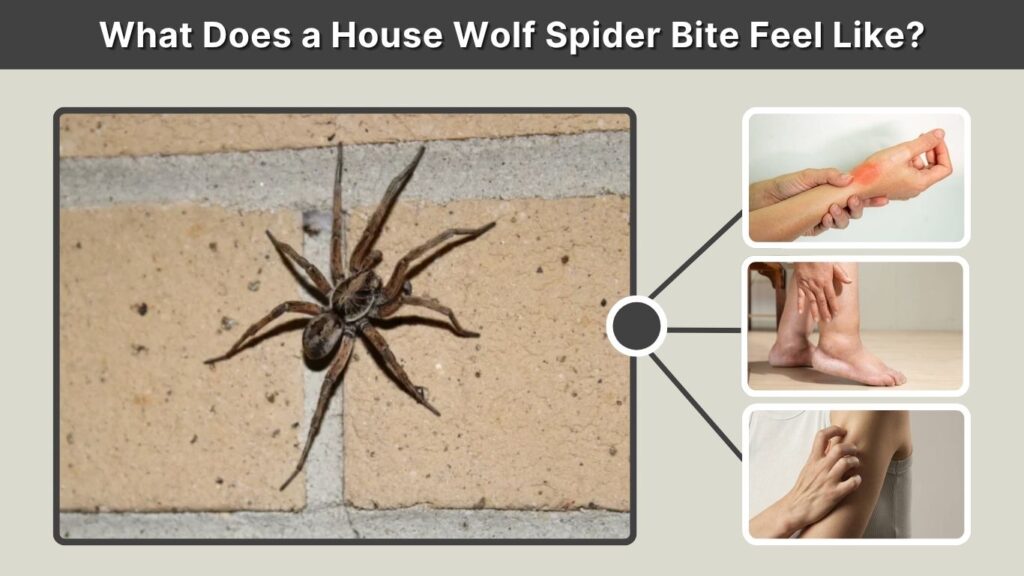
Wolf spiders rarely bite unless they are handled, squeezed, or trapped against the skin.
A bite may cause:
- Immediate pain
- Redness
- Mild swelling
- Local tenderness
- Temporary itching or discomfort
Penn State Extension reports that typical wolf spider bites involve initial pain and redness with possible localized swelling, with symptoms generally resolving within about 24 hours. Serious medical consequences have not typically been associated with their bites.
Seek medical care if a suspected spider bite causes severe or worsening pain, extensive swelling, breathing difficulty, systemic symptoms, or an unusual skin reaction—especially if the spider was never positively identified.
Wolf Spider vs House Spider
“House spider” can describe many species, so the differences depend on which spider is being compared.
A useful first question is whether the spider uses a web to catch food.
Key Differences
| Feature | Wolf Spider | Typical House Web Spider |
| Hunting | Actively chases prey | Waits in web |
| Location | Floors and ground | Corners and crevices |
| Body | Robust, hairy | Variable |
| Movement | Fast runner | Often remains near web |
| Prey web | No | Usually yes |
| Eyes | Large distinctive eyes | Usually smaller |
Wolf spiders may make silk-lined retreats, but they do not build webs for capturing prey.
Black House Spider vs Wolf Spider
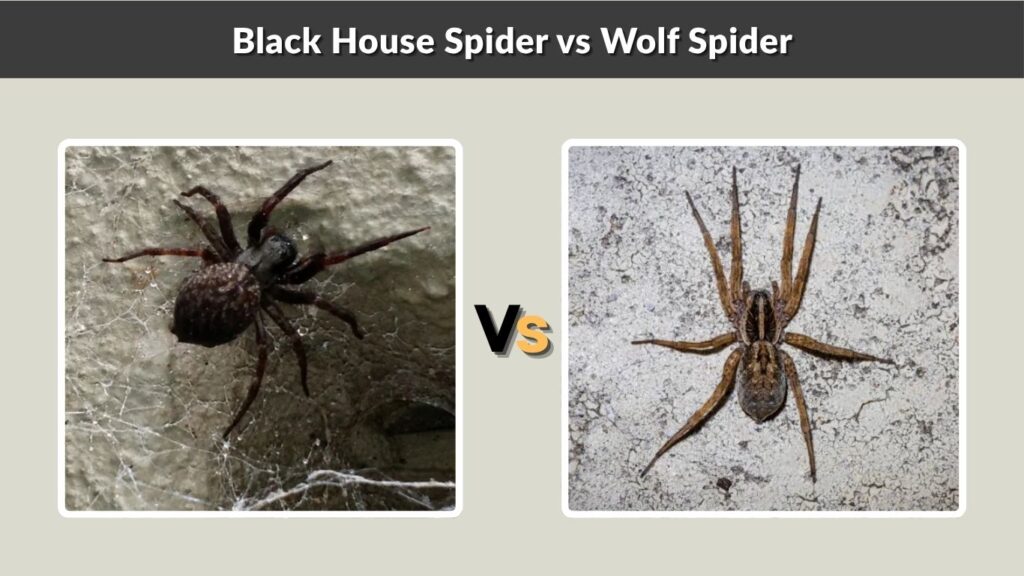
This comparison is especially relevant in Australia.
The Black House Spider (Badumna insignis) is a genuine web-building house spider. It commonly lives around window frames, wall crevices, tree trunks, and buildings.
Wolf spiders instead roam across the ground looking for prey.
Black House vs Wolf Spider
Black House Spider:
Has a dark body with a charcoal-gray abdomen and constructs a messy lace-like sheet web leading to a retreat.
Wolf Spider:
Usually has brown, gray, black, and pale mottling or stripes and hunts without a capture web.
Female Black House Spiders are roughly 12–18 mm in body length and tend to remain in their webs rather than running around floors.
Black House Spider bites are also uncommon, although bites can be painful and cause localized symptoms.
Giant House Spider vs Wolf Spider
A Giant House Spider can look surprisingly similar to a large wolf spider.
Giant House Spiders are funnel-weaving spiders with long legs and noticeable chevron-shaped markings on the abdomen. They are especially familiar in parts of Europe and the Pacific Northwest.
Wolf spiders generally have a more robust appearance and distinctive large eyes.
Easy Behavioral Clue
A wolf spider is primarily a ground hunter.
A Giant House Spider normally uses a funnel-like sheet web, although roaming adult males may leave their webs while searching for females.
Giant House Spiders can approach roughly three inches across when their legs are included, but they are not regarded as dangerous to people.
Wolf Spider vs Brown Recluse
This is one of the most important identification comparisons because large brown spiders are frequently mislabeled as Brown Recluses.
Key Differences
Wolf Spider:
- Often hairy
- Usually patterned or striped
- Eight eyes
- Two conspicuously large eyes
- Often banded or mottled legs
- Robust body
- Actively runs after prey
Brown Recluse:
- Six eyes arranged in three pairs
- Usually uniformly tan to brown
- Long, relatively thin legs
- Legs generally lack obvious bands
- May have a dark violin-shaped marking
University of Kentucky Extension specifically notes that banding on a wolf spider’s legs can immediately rule out a Brown Recluse identification.
Brown Recluses also have a limited established U.S. distribution centered largely in south-central and Midwestern states, and reports outside their established range are frequently misidentifications.
Wolf Spider vs Hobo Spider
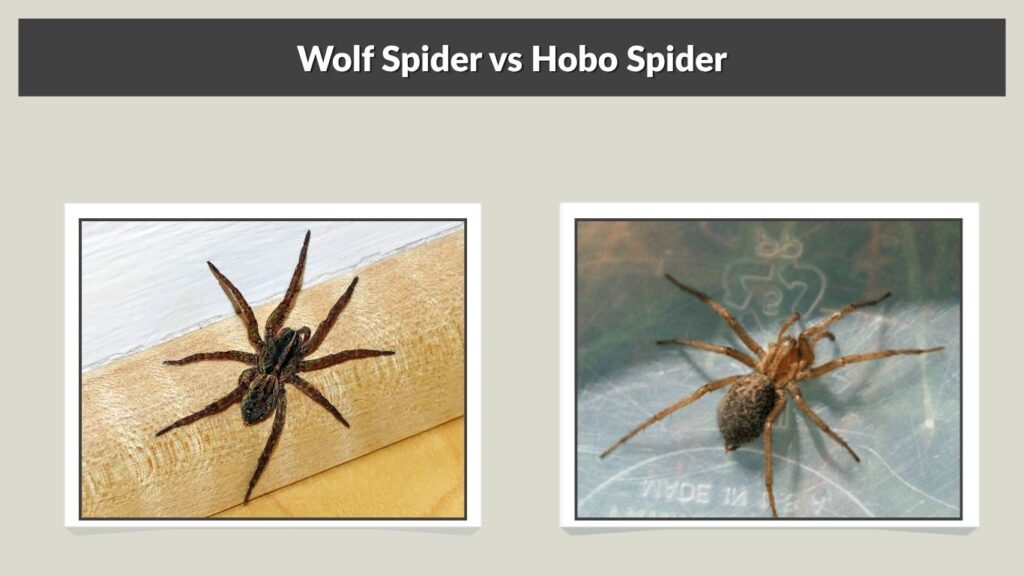
Hobo spiders are funnel-weaving spiders, while wolf spiders actively hunt.
The two can both be brown and fairly large, but their behavior provides useful clues.
A wolf spider normally runs freely across the ground and does not depend on a prey-catching web. Hobo and related funnel weavers build sheet-like webs connected to a funnel retreat.
Avoid trying to identify a potentially unfamiliar spider solely by color. Brown coloration is extremely common among unrelated spider families.
Do Wolf Spiders Build Nests in Houses?
Wolf spiders do not create communal nests like ants or social insects.
Some species construct silk-lined retreats or burrows, but they generally do not produce large indoor colonies.
Females have a particularly distinctive reproductive behavior.
Female Wolf Spider With Babies
A female attaches her egg sac directly to her spinnerets and carries it behind her.
After the spiderlings hatch, dozens can climb onto their mother’s abdomen and ride on her back.
Seeing a female covered in baby spiders can therefore look like an infestation, but it is actually normal maternal behavior unique to wolf spiders.
Should You Kill a Wolf Spider in Your House?
Usually, killing one is unnecessary.
Wolf spiders eat insects and other arthropods and are considered beneficial predators. If you do not want one indoors, removing it and releasing it outside is usually sufficient.
How to Remove a Wolf Spider
For a manageable spider:
- Place a large cup or container over it.
- Slide stiff paper or cardboard underneath.
- Keep the container covered.
- Carry it outside.
- Release it away from the doorway.
Because large wolf spiders can move very quickly, avoid picking one up with bare hands.
The Australian Museum similarly recommends dealing with wandering wolf spiders individually rather than treating them as household infestations.
How to Keep Wolf Spiders Out of the House
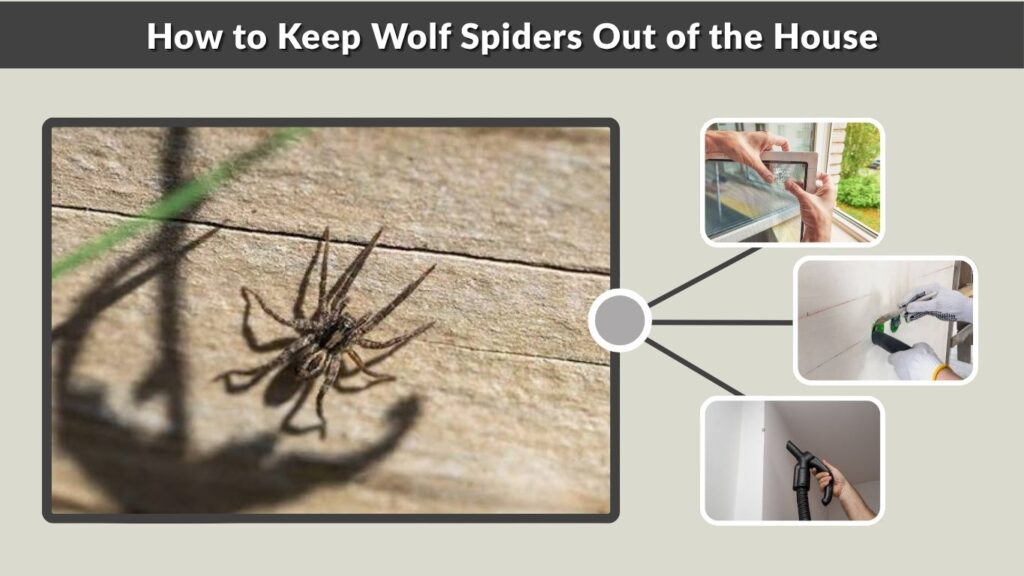
If wolf spiders appear repeatedly, focus on exclusion and reducing their prey rather than repeatedly killing individual spiders.
Prevention Methods
- Install weather stripping beneath doors.
- Repair damaged screens.
- Caulk foundation cracks.
- Seal gaps around plumbing and cables.
- Reduce clutter in basements and garages.
- Keep firewood away from the house.
- Vacuum spiders found indoors.
- Reduce insect populations that provide food.
- Keep doors closed when practical.
Penn State recommends cleaning and exclusion, including repairing screens and sealing gaps around doors, windows, pipes, and wires.
A perfectly spider-free home is unrealistic, but reducing entry points can substantially lower encounters.
Wolf Spiders in Australia, the UK and North America
Wolf spiders occur across an enormous geographic range.
Australia supports numerous species, from relatively small forms to large ground-dwelling species. The Australian Museum reports wolf spiders throughout Australia in habitats ranging from dry shrublands to forests and alpine areas.
North America likewise supports many wolf spider species, including large members of Hogna.
The UK also has wolf spiders, although many of its common lycosids are considerably smaller than the huge spiders people sometimes associate with the name.
FAQs
1. Is a house wolf spider dangerous?
Usually not. Wolf spiders are shy, nonaggressive predators. They can bite if trapped or mishandled, but their bites are generally not medically dangerous.
2. Why did I find a wolf spider inside my house?
It probably wandered indoors while searching for prey, shelter, a mate, or a protected location. Gaps beneath doors and around foundations are common entry routes.
3. Should I leave a wolf spider alone?
You can leave it alone if it is somewhere unobtrusive. Otherwise, capture it with a container and cardboard and relocate it outside.
4. How do I know if it’s a wolf spider or Brown Recluse?
Wolf spiders are usually hairy and patterned and have eight eyes, including two very large central eyes. Brown Recluses have six eyes, relatively uniform coloration, and generally unbanded legs.
5. Do wolf spiders infest houses?
They are mainly outdoor hunting spiders and usually wander indoors individually. Repeated sightings can indicate accessible entry points or plentiful insect prey rather than a true indoor colony.
