
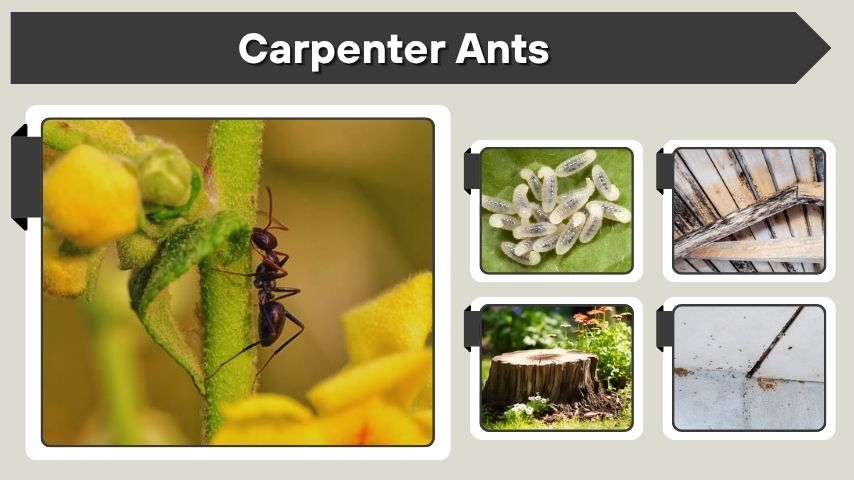
Carpenter ants identification is important because these ants can look like regular black ants, flying ants, or even termites. The easiest way to identify carpenter ants is to look at their size, body shape, antennae, waist, wings, and signs of wood activity. Carpenter ants do not eat wood like termites, but they can tunnel through damp or damaged wood to build nests.
What Do Carpenter Ants Look Like?
Carpenter ants are among the larger ants found around homes. They may be black, reddish-black, brown, red, or a mix of red and black depending on the species and region. Many homeowners first notice them in kitchens, bathrooms, basements, window sills, or near exterior wood.
Carpenter Ant Identification Characteristics
The most common carpenter ant identification features include:
- Large ant body, often bigger than typical house ants
- Narrow, pinched waist
- One raised node between the middle and rear body sections
- Smooth, evenly rounded thorax when viewed from the side
- Elbowed antennae
- Black, red, brown, or red-and-black coloring
- Workers of different sizes in the same colony
The evenly rounded thorax is one of the best clues. Many other ants have a bumpy or uneven thorax, while carpenter ants have a smooth arch behind the head.
How Big Are Carpenter Ants?
Carpenter ants vary in size. Worker ants are often around 1/4 to 1/2 inch long, though some may be smaller. A colony can have both small and large workers, so size alone is not enough for identification.
Large workers are sometimes mistaken for queens, but a queen is usually larger, heavier-bodied, and associated with nesting or swarming activity.
Carpenter Ant Identification Chart
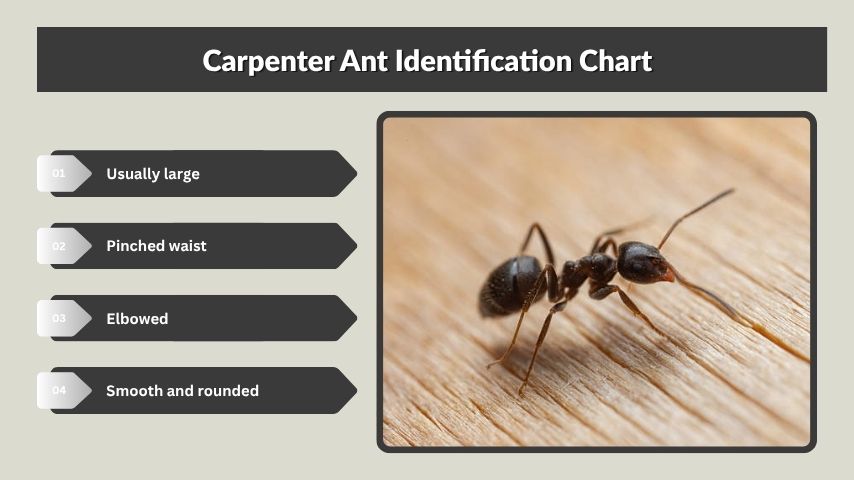
Use this simple chart to compare carpenter ants with other common pests.
| Feature | Carpenter Ants | Regular Black Ants | Termites |
|---|---|---|---|
| Body size | Usually large | Usually smaller | Varies |
| Waist | Pinched waist | Pinched waist | Broad, straight waist |
| Antennae | Elbowed | Elbowed | Straight |
| Thorax | Smooth and rounded | Often uneven or bumpy | Not ant-like |
| Wings | Front wings longer than back wings | May vary | Equal-length wings |
| Wood damage | Tunnels through wood | Usually no major wood damage | Eats wood |
| Debris | Sawdust-like frass | Usually none | Pellets or mud tubes |
This chart can help with quick identification, but a close inspection is still important. If you see wood damage, frass, or winged insects indoors, it may be worth getting a professional inspection.
Carpenter Ant vs Black Ant Identification
Many people search for “identification carpenter ant vs black ant” because carpenter ants can look like ordinary black ants. The difference is usually size, shape, and behavior.
How to Tell Carpenter Ants From Black Ants
Carpenter ants are usually larger than common house ants. They also have a smooth, rounded upper body when viewed from the side. Regular black ants may be smaller, more uniform in size, and less connected to wood damage.
Carpenter ants are also more likely to appear near damp wood, window frames, siding, decks, tree stumps, or wall voids. If you see large black ants repeatedly indoors, especially at night, carpenter ants are a possibility.
Are All Black Carpenter Ants the Same?
No. “Black carpenter ant” is a common name, but carpenter ants can vary by species and region. Some are fully black, while others are red and black or brownish. Color helps, but it should not be the only identification clue.
Carpenter Ant With Wings Identification
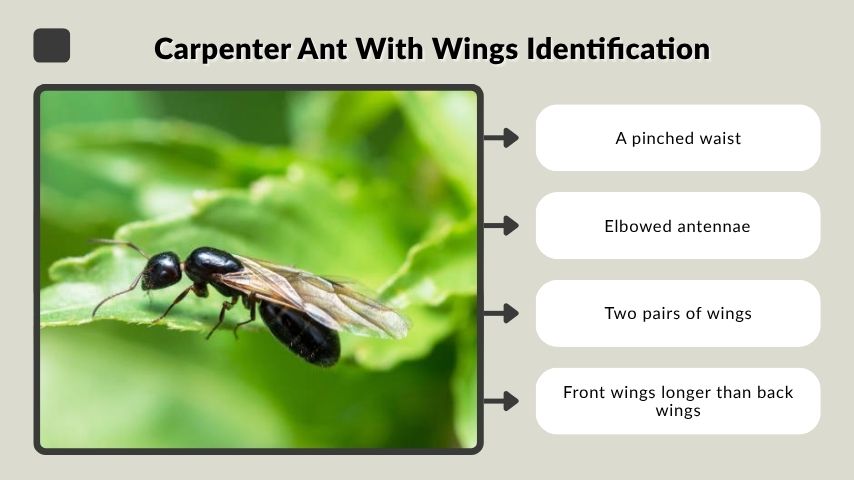
Winged carpenter ants are reproductive ants. They are often seen during swarming periods when mature colonies produce males and queens that leave to start new colonies.
What Do Winged Carpenter Ants Look Like?
Winged carpenter ants have:
- A pinched waist
- Elbowed antennae
- Two pairs of wings
- Front wings longer than back wings
- A larger body than many other flying ants
- Dark, reddish, or black coloring
Finding one winged ant indoors does not always mean there is a serious infestation. However, seeing many winged carpenter ants inside the house may suggest a nest is nearby or inside the structure.
Flying Carpenter Ants Identification
Flying carpenter ants are often confused with termite swarmers. The key is to look at the wings, waist, and antennae. Carpenter ants have bent antennae, a narrow waist, and uneven wing lengths. Termites have straight antennae, a broad waist, and wings that are about the same length.
If you find discarded wings near windows, doors, or lights, inspect the area carefully. Both carpenter ants and termites can swarm near light sources.
Carpenter Ants vs Termites Identification
Carpenter ants and termites are both associated with wood, but they are not the same pest. Correct identification matters because the treatment methods are different.
Main Differences Between Carpenter Ants and Termites
Carpenter ants have a narrow waist, elbowed antennae, and unequal wings when winged. Termites have a straight body, straight antennae, and equal-length wings. Carpenter ants tunnel through wood, while termites eat wood.
Carpenter ant damage often includes smooth galleries and sawdust-like frass. Termite damage may include mud tubes, hollow wood, or drywood termite pellets.
Which Is More Serious?
Both pests can damage a home, but termites usually cause more direct structural damage because they consume wood. Carpenter ants can still weaken wood over time by excavating galleries, especially if the colony is large or long-established.
If you are unsure whether you have carpenter ants or termites, do not guess. A mistaken identification can delay the right treatment.
Carpenter Ant Queen Identification
A carpenter ant queen is larger than the workers and has a fuller body. Queens are responsible for laying eggs and building the colony.
What Does a Carpenter Ant Queen Look Like?
A carpenter ant queen may have:
- A larger body than worker ants
- A thicker abdomen
- A pinched waist
- Elbowed antennae
- Wing scars after mating
- Wings before or during swarming season
Queens are not commonly seen foraging in the open. If you find a large winged carpenter ant indoors, it may be a reproductive queen or male. After mating, queens shed their wings and search for a nesting site.
Does Seeing a Queen Mean an Infestation?
Seeing a queen does not always mean there is already an established indoor colony. However, if you see multiple winged ants, workers, frass, or activity near wood, the chance of an infestation is higher.
Carpenter Ant Larvae Identification
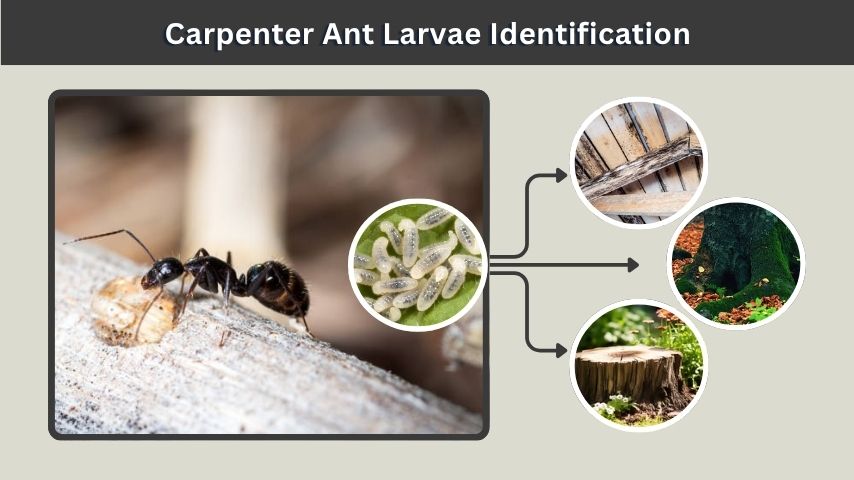
Carpenter ant larvae are rarely seen unless a nest is disturbed. They are small, pale, soft-bodied, and grub-like. They do not look like adult ants because they have not developed legs, antennae, or the adult body shape yet.
Where Are Larvae Found?
Larvae are usually hidden inside the nest. You may find them in:
- Damp wood
- Wall voids
- Hollow doors
- Decayed logs
- Tree stumps
- Firewood
- Nest galleries
If you find larvae along with large ants and wood debris, there may be an active nest nearby.
Carpenter Ant Frass Identification
Carpenter ant frass is one of the most important signs of an infestation. Frass looks like sawdust or small wood shavings. It is the material carpenter ants push out while making tunnels.
What Does Carpenter Ant Frass Look Like?
Carpenter ant frass may include:
- Fine sawdust
- Wood shavings
- Small insect parts
- Dead ant pieces
- Dust or insulation bits
- Mixed light and dark particles
Frass is often found near window sills, baseboards, door frames, decks, beams, or wall openings. If the pile returns after cleaning, ants may still be active.
Carpenter Ant Frass vs Termite Droppings
Carpenter ant frass is usually irregular and sawdust-like. Drywood termite droppings are more pellet-like and uniform. This difference can help with identification, but it is not always easy to confirm without inspection.
Carpenter Ant Mound Identification
Carpenter ants do not usually make large soil mounds like some outdoor ants. Their nests are often inside wood, tree cavities, logs, stumps, fence posts, or structural wood.
Where Carpenter Ants Nest Outside
Outdoor carpenter ant nests may be found in:
- Tree stumps
- Dead logs
- Hollow trees
- Firewood piles
- Fence posts
- Deck boards
- Landscape timbers
- Moist or decaying wood near the home
If ants are trailing from outdoor wood to your house, the main colony may be outside while satellite nests may be indoors.
Red Carpenter Ant Identification
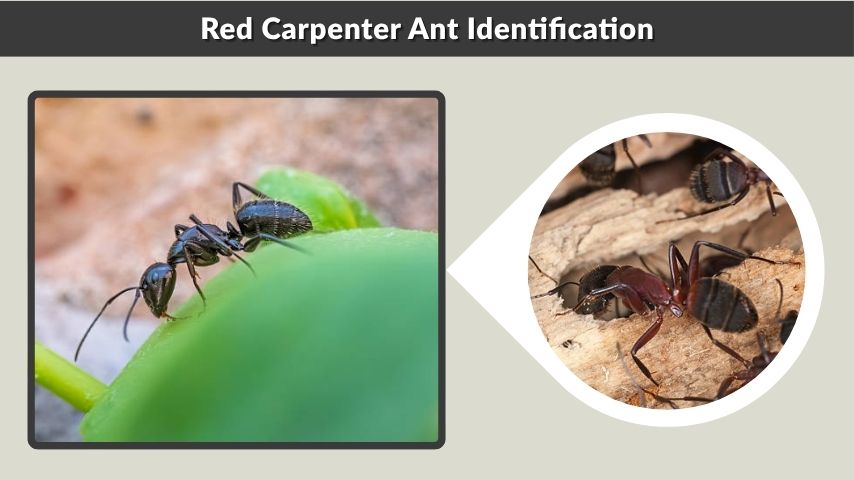
Not all carpenter ants are fully black. Some species are red, reddish-brown, or red and black. This causes confusion because people may assume carpenter ants must always be black.
Red and Black Carpenter Ants
Small red and black carpenter ants may still be carpenter ants if they have the right body features: one node, a rounded thorax, elbowed antennae, and a pinched waist. Color varies by species, location, and colony.
In places like Florida, Texas, California, Oregon, Pennsylvania, Ontario, Michigan, Wisconsin, Colorado, and New Jersey, carpenter ant appearance can vary. Regional species may differ in color and size, but the key identification traits remain similar.
Carpenter Ant Identification Pictures: What to Look For
If you are comparing carpenter ant identification pictures, focus on body features instead of color alone. Photos can be helpful, but lighting, angle, and ant size can make identification difficult.
Picture Checklist
When looking at a carpenter ant picture, check for:
- Is the waist narrow?
- Are the antennae bent?
- Is the thorax smoothly rounded?
- Is there one node between body sections?
- Are the front wings longer than the back wings?
- Is there sawdust-like frass nearby?
- Are there signs of damp or damaged wood?
A clear side-view photo is usually better than a top-view photo because the rounded thorax is easier to see from the side.
Signs You May Have Carpenter Ants
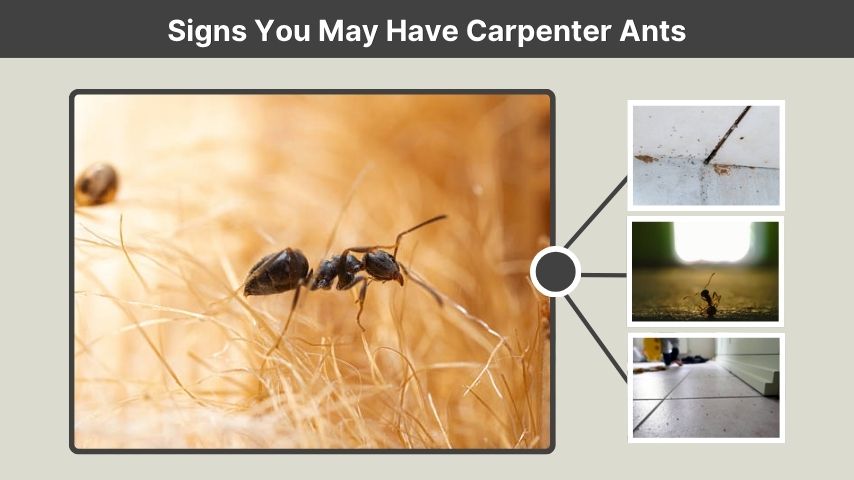
Identification is not only about the insect’s body. The signs around the home matter too.
Common Infestation Signs
You may have carpenter ants if you notice:
- Large ants indoors
- Ants active at night
- Winged ants inside
- Frass near wood
- Rustling sounds in walls
- Soft or damaged wood
- Ant trails near trees or decks
- Repeated ants near sinks, tubs, or windows
Carpenter ants prefer moist or decaying wood, so always check for leaks and water damage when you see signs of activity.
What to Do After Identifying Carpenter Ants
Once you identify carpenter ants, the next step is to determine whether they are just foraging or nesting in the structure. Seeing ants indoors occasionally may mean they are coming from outside. Seeing repeated activity, frass, or winged ants indoors is more concerning.
Next Steps
Start by inspecting moisture-prone areas, including windows, bathrooms, kitchens, basements, attics, and crawl spaces. Look for leaks, soft wood, and ant trails. Avoid random spraying because it may scatter ants and make the nest harder to locate.
Carpenter ant bait can help, but the best long-term solution is to find the nest, treat the colony, remove damaged wood, and fix moisture problems.
FAQs
How do I identify carpenter ants?
Look for large ants with a pinched waist, elbowed antennae, one node, and a smooth rounded thorax. Carpenter ants may be black, red, brown, or red and black. Frass, winged ants, and activity near damp wood are also strong signs.
How do I identify winged carpenter ants?
Winged carpenter ants have a narrow waist, bent antennae, and two pairs of wings. The front wings are longer than the back wings. Termite swarmers look different because they have straight antennae, broad waists, and equal-length wings.
What is the difference between carpenter ants and black ants?
Carpenter ants are usually larger and more connected to wood, moisture, and frass. Regular black ants are often smaller and less likely to damage wood. The smooth rounded thorax is one of the best carpenter ant identification clues.
What does carpenter ant frass look like?
Carpenter ant frass looks like sawdust, wood shavings, or mixed debris. It may appear near window sills, baseboards, door frames, or damaged wood. If the pile returns after cleaning, there may be active tunneling nearby.
Are carpenter ants the same as termites?
No. Carpenter ants are ants with pinched waists and elbowed antennae. They tunnel through wood but do not eat it. Termites have straighter bodies and straight antennae, and they consume wood. Correct identification is important because treatment is different.
