
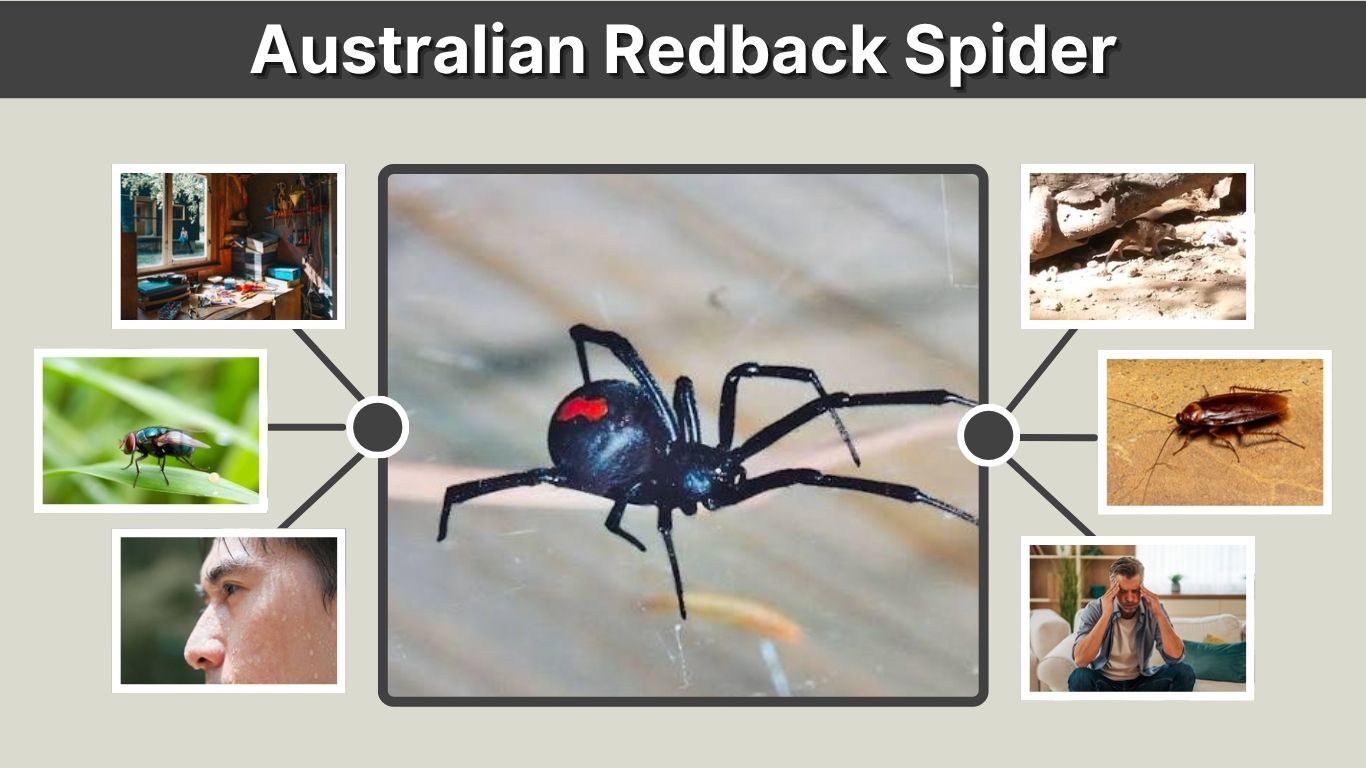
The Australian redback spider (Latrodectus hasselti) is one of Australia’s most recognizable venomous spiders. Females are famous for their glossy dark bodies and bright red abdominal stripe, while the much smaller males look quite different. Redbacks commonly live around homes, sheds, gardens, and other sheltered places. Although their venom can cause significant pain and other symptoms, serious outcomes are uncommon with modern medical care. Here is what you should know about redback spider identification, habitat, bites, mating, diet, and behavior.
What Is an Australian Redback Spider?
The Australian redback spider belongs to the widow-spider genus Latrodectus and the cobweb spider family Theridiidae. It is found across Australia and is particularly successful in environments modified by humans. Redbacks are primarily sedentary web-building predators rather than spiders that actively chase prey.
Quick Facts
- Scientific name: Latrodectus hasselti
- Family: Theridiidae
- Female body length: About 10 mm
- Male body length: About 3–4 mm
- Color: Females are usually black or dark brown
- Main marking: Red or orange stripe on the upper abdomen
- Diet: Mainly insects and other arthropods
- Distribution: Throughout Australia
- Habitat: Dry, protected spaces around natural and human-made structures
- Venomous: Yes
Is the Redback Spider Native to Australia?
Evidence indicates that the redback is a distinct species and is probably native to Australia. It is closely related to New Zealand’s katipō spider. Redbacks have likely benefited greatly from human settlement because sheds, fences, outdoor furniture, rubbish piles, and buildings provide ideal sheltered web sites.
Australian Redback Spider Identification
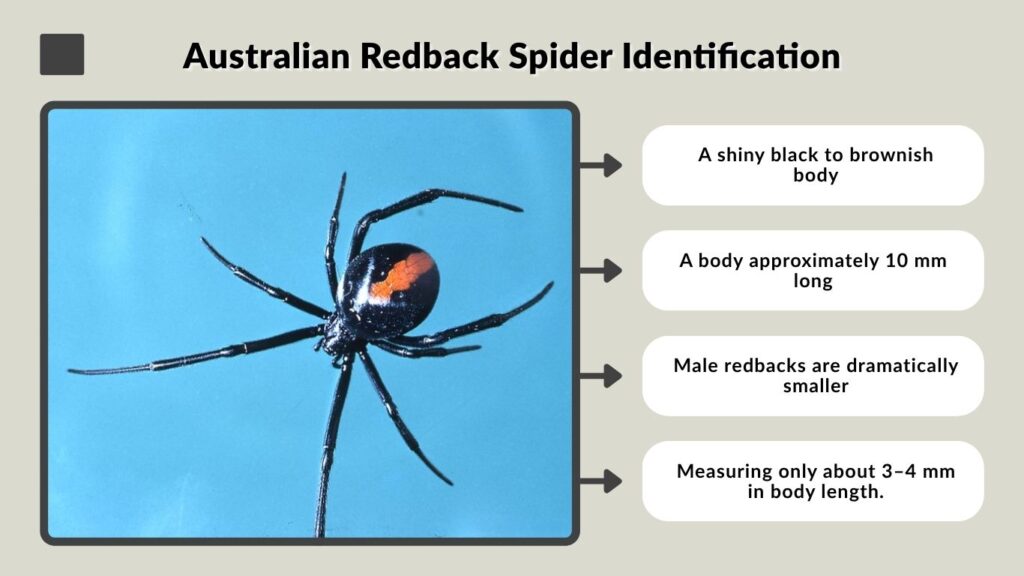
Adult females are usually much easier to recognize than males. Their rounded abdomen, dark coloration, and distinctive red marking make them one of Australia’s most familiar spiders. However, young spiders and males can have pale or white markings that make identification less obvious.
Female Australian Redback Spider
Female redbacks typically have:
- A shiny black to brownish body
- A rounded abdomen
- A red or orange longitudinal stripe across the upper abdomen
- A red-orange hourglass-shaped marking underneath
- Long, slender dark legs
- A body approximately 10 mm long
The stripe can occasionally appear broken or less obvious.
Male Australian Redback Spider
Male redbacks are dramatically smaller, measuring only about 3–4 mm in body length. They tend to be light brown and may have white abdominal markings. Their red markings are generally much less noticeable than those of adult females.
Baby Redback Spiders
Young redbacks do not immediately look like classic adult females. Spiderlings often have combinations of white, cream, brown, and reddish markings. Their appearance gradually changes as they mature.
Australian Redback Spider Habitat and Distribution
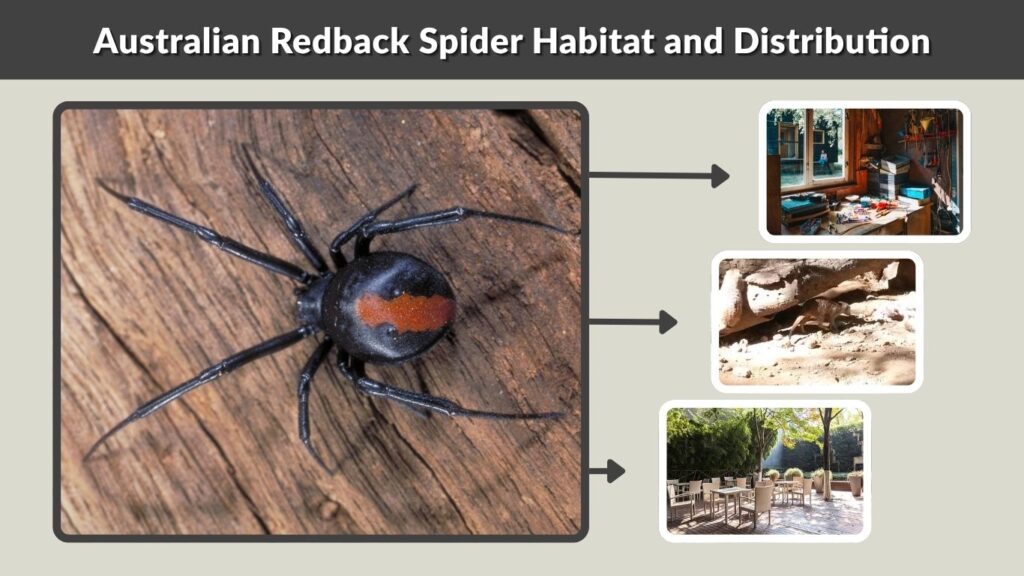
Redback spiders occur throughout Australia, including urban and suburban environments. They prefer dry, protected locations where their webs are unlikely to be disturbed by rain or strong winds.
Where Do Redback Spiders Live?
Common hiding and web-building sites include:
- Garden sheds and garages
- Under outdoor furniture
- Around fences
- Beneath logs and rocks
- Inside piles of stored materials
- Around rubbish or junk piles
- Under steps
- Near swimming pools
- Outdoor toilets and similar sheltered structures
They are particularly common around human habitation and disturbed environments.
What Does a Redback Spider Web Look Like?
A redback does not build the symmetrical circular web associated with orb-weaver spiders. Its web looks irregular and tangled.
The upper portion normally contains a sheltered retreat where the spider rests. Strong vertical sticky threads extend downward and function as prey-catching lines. When an insect becomes trapped, the spider can quickly immobilize it.
What Do Australian Redback Spiders Eat?
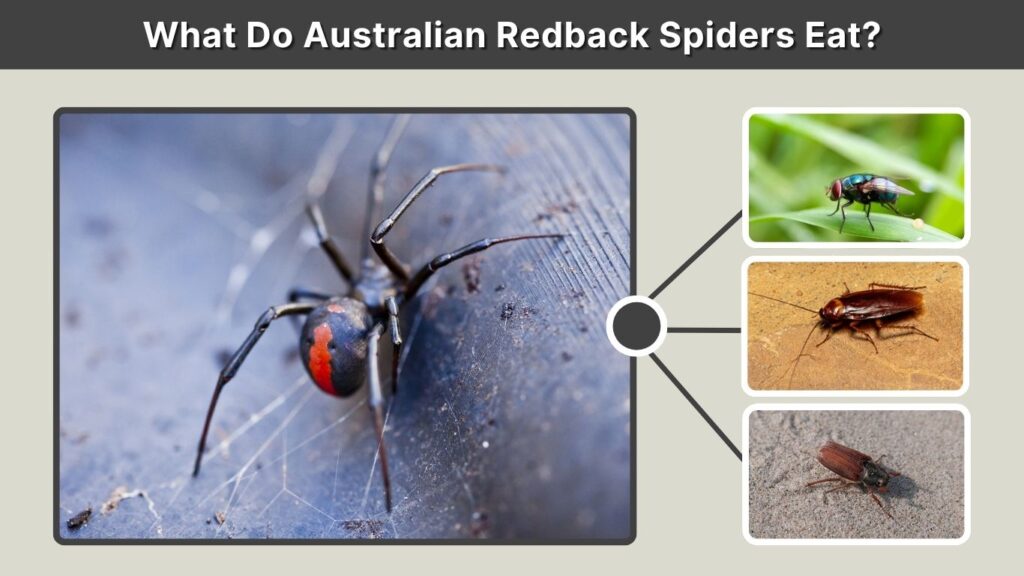
Redbacks primarily feed on insects and other arthropods captured in their strong webs. They can occasionally overpower surprisingly large animals compared with their own body size.
Known or observed prey includes:
- Flies and other insects
- Cockroaches
- Beetles
- Crickets
- Other spiders
- Small lizards
- Occasionally very small vertebrates
The Australian Museum reports that redbacks can capture relatively large prey such as king crickets, male trapdoor spiders, and small lizards.
Can a Redback Spider Eat a Snake?
It sounds unlikely, but there have been documented cases of small snakes becoming trapped in redback webs.
In 2024, a juvenile eastern brown snake about 20 cm long was discovered entangled in a redback web in South Australia. Similar encounters have been documented previously. These events are unusual and involve small snakes rather than full-grown animals.
Therefore, snakes are not a normal part of the redback’s diet, even though a strong web can occasionally trap a hatchling.
Australian Redback Spider Mating and Cannibalism
Redback mating behavior is one of the species’ most unusual characteristics. A male may approach a female’s web and perform prolonged courtship before mating.
Why Does the Male Redback Sacrifice Himself?
During mating, males may perform a somersault that positions their abdomen near the female’s mouthparts. The female may then consume part or all of the male.
This behavior is an example of sexual cannibalism. Research has investigated how male sacrifice can influence mating success and reproduction. Recent 2026 research also found evidence of a genetic component associated with this characteristic mating behavior.
Not every male is necessarily eaten, but cannibalism is strongly associated with redback reproduction.
Eggs and Life Cycle
After mating, females can store sperm for long periods and produce multiple egg sacs.
A female may produce up to about ten egg sacs, with roughly 250 eggs per sac. Spiderlings generally hatch after two to four weeks. Young spiders can even cannibalize siblings before dispersing.
Females may live two to three years, whereas males generally survive only around six or seven months.
Australian Redback Spider Bite
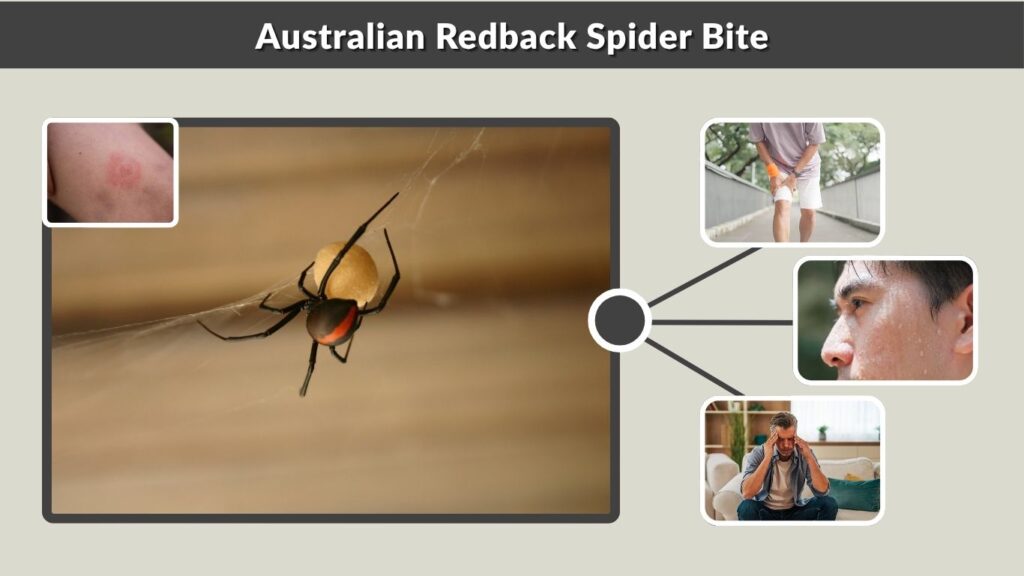
The female redback is medically important because its venom affects the nervous system. Bites commonly occur when someone accidentally touches or disturbs a spider hidden in a protected location.
Redback Spider Bite Symptoms
Symptoms can include:
- Pain around the bite
- Increasing or severe pain
- Sweating, particularly around the bite
- Headache
- Muscle weakness
- Muscle spasms
- Nausea or vomiting in some cases
Symptoms vary between individuals, and not every bite causes severe envenomation.
Redback Spider Bite First Aid
For a suspected redback bite:
- Wash the area gently with soap and water.
- Apply a wrapped cold pack for about 15 minutes to reduce pain.
- Monitor the person for worsening symptoms.
- Seek medical care if pain becomes severe or significant symptoms develop.
Do not use a pressure-immobilization bandage for a confirmed redback bite. Australian clinical guidance notes that pressure bandaging can worsen the pain and is recommended for funnel-web bites rather than redbacks.
In Australia, contact the Poisons Information Centre on 13 11 26 for advice. Call 000 if someone develops a severe or life-threatening reaction.
Australian Redback Spider vs Black Widow
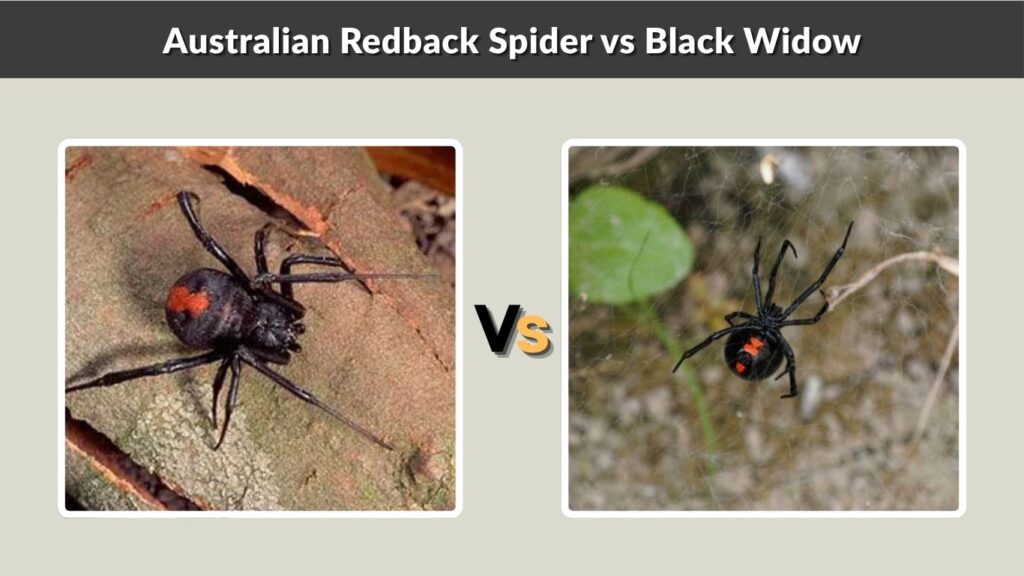
Redbacks and black widows are close relatives because both belong to the genus Latrodectus, but they are not the same species.
| Feature | Australian Redback | Black Widow |
| Genus | Latrodectus | Latrodectus |
| Main range | Australia | Several species occur worldwide |
| Upper abdomen | Often has red dorsal stripe | Usually lacks the typical redback dorsal stripe |
| Underside | Red/orange hourglass may occur | Red hourglass common in several species |
| Venom | Neurotoxic | Neurotoxic |
| Relationship | Distinct species | Close relatives |
The Australian Museum notes that the redback was once considered closely enough related to be treated as a black widow subspecies, but it is now recognized as its own species.
Are Australian Redback Spiders Deadly?
Redback venom deserves respect, but the spider’s reputation can make the danger seem greater than it usually is.
Bites can produce intense pain and systemic symptoms, but modern Australian medical care makes fatal outcomes exceptionally uncommon. The Australian Museum reports that no deaths have occurred since redback antivenom was introduced.
Avoid handling redbacks and use caution when moving objects from sheds, garages, wood piles, outdoor storage areas, or other sheltered locations.
FAQs
How big is an Australian redback spider?
Adult females have a body around 10 mm long, while males are much smaller at approximately 3–4 mm.
Are Australian redback spiders venomous?
Yes. Redbacks possess neurotoxic venom capable of causing significant pain, sweating, weakness, and other symptoms in humans.
Where are redback spiders found in Australia?
They occur throughout Australia and are especially common around homes, sheds, gardens, fences, rubbish piles, and other dry sheltered environments.
Do redback spiders eat snakes?
Small snakes can occasionally become trapped in redback webs, and documented incidents involve juvenile eastern brown snakes. However, snakes are not normal redback prey.
What is the difference between a redback and a black widow?
Both belong to the genus Latrodectus, but the Australian redback is a distinct species. Female redbacks typically have a noticeable red stripe running along the upper surface of the abdomen, which distinguishes them from many black widow species.
