

Monarch butterflies are not extinct, but their famous migratory populations remain under serious pressure. Habitat loss, declining milkweed, pesticide exposure, extreme weather, climate change, and degradation of wintering forests have all contributed to long-term declines. There is some encouraging news: the eastern migratory population increased during the 2025–2026 winter. However, western monarch numbers remain extremely low, and conservation experts still consider the species at risk. Understanding where monarchs go, particularly their winter migration to Mexico, helps explain both the threats they face and what can be done to protect them.
Are Monarch Butterflies Going Extinct?
Monarch butterflies (Danaus plexippus) are not currently extinct or inevitably headed for extinction, but migratory monarch populations face a significant long-term risk.
The migratory monarch is currently classified as Vulnerable on the IUCN Red List. In the United States, the U.S. Fish and Wildlife Service has proposed listing the monarch as threatened under the Endangered Species Act, but as of 2026 that proposal has not become a final federal listing.
The distinction is important: monarchs still number in the millions across their broader range, but their spectacular long-distance migration could become much less resilient if populations continue declining.
How Many Monarch Butterflies Are Left?
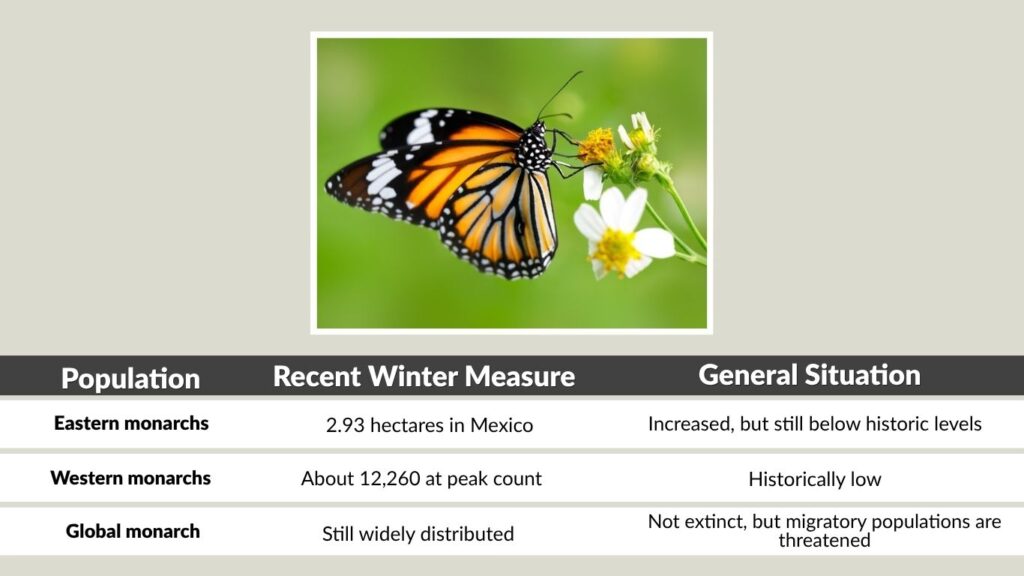
Counting every monarch is impossible, so scientists use different monitoring methods for eastern and western populations.
Eastern monarchs wintering in Mexico are estimated by measuring the forest area occupied by their colonies.
During the 2025–2026 winter, eastern monarch colonies occupied about 2.93 hectares (7.24 acres), up 64% from 1.79 hectares the previous winter. This was encouraging, but researchers note that the population remains below the roughly six-hectare level proposed as a target for a more resilient migratory population.
Western monarchs remain in a more precarious position. The 2025 peak Western Monarch Count recorded approximately 12,260 butterflies at 249 sites, the third-lowest peak count since monitoring began in 1997.
| Population | Recent Winter Measure | General Situation |
| Eastern monarchs | 2.93 hectares in Mexico | Increased, but still below historic levels |
| Western monarchs | About 12,260 at peak count | Historically low |
| Global monarch | Still widely distributed | Not extinct, but migratory populations are threatened |
Why Are Monarch Butterflies Declining?
There is no single cause behind monarch declines. They face challenges throughout an enormous annual migration cycle.
Loss of Milkweed
Monarch caterpillars depend on milkweed.
Female monarchs lay their eggs on milkweed, and the caterpillars feed on its leaves. When milkweed disappears because of development, land-use changes, roadside management, or agricultural practices, monarchs lose essential breeding habitat.
Fewer milkweed plants can mean fewer places for the next generation to develop.
Loss of Nectar Flowers
Adult monarchs need nectar from flowers.
During migration, butterflies stop repeatedly to replenish their energy reserves. Loss of wildflower habitat can therefore affect their ability to complete journeys covering thousands of miles.
Pesticide Exposure
Insecticides intended to kill agricultural or garden pests can also harm monarch eggs, caterpillars, and adults.
Herbicides can indirectly affect monarchs by reducing milkweed and flowering plants.
Climate Change and Extreme Weather
Monarchs rely heavily on seasonal timing.
Drought, excessive heat, severe storms, freezing temperatures, and changing rainfall patterns can affect milkweed emergence, nectar production, reproduction, migration, and overwintering survival.
The U.S. Fish and Wildlife Service identifies habitat degradation, insecticide exposure, and climate change among the important threats facing monarch populations.
Where Do Monarch Butterflies Go in Mexico?
Most monarchs from eastern North America migrate to the mountains of central Mexico.
Their primary overwintering region lies within portions of:
Michoacán and the State of Mexico (Estado de México).
Many gather within or around the Monarch Butterfly Biosphere Reserve, where high-elevation forests provide their specialized winter habitat.
During the 2025–2026 survey, researchers identified nine overwintering colonies: three in Michoacán and six in the State of Mexico. Five were inside the Biosphere Reserve and four were outside it.
Why Do Monarch Butterflies Go to Mexico?
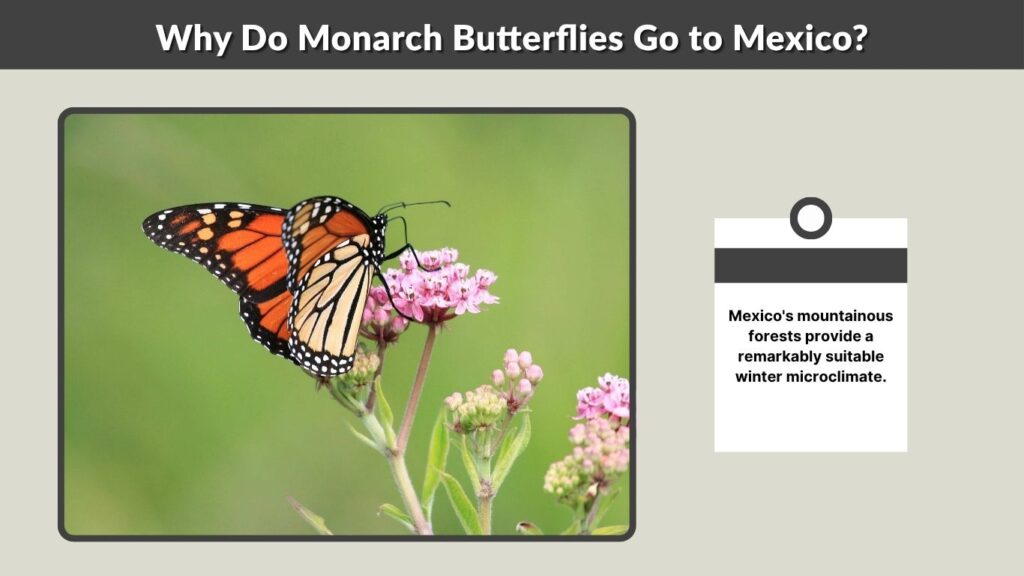
Mexico’s mountainous forests provide a remarkably suitable winter microclimate.
Monarchs primarily gather in high-elevation oyamel fir forests. These locations remain cool enough to slow butterfly metabolism while providing protection from strong winds and severe temperature fluctuations.
Cool conditions are essential because monarchs need to conserve the fat accumulated during their fall migration.
If temperatures remain too warm, they become more active and consume stored energy faster. If conditions become extremely cold and wet, large numbers can die.
How Do Monarch Butterflies Know Where to Go?
One of the most remarkable parts of monarch migration is that the butterflies traveling to Mexico have usually never been there before.
The migratory generation uses environmental cues and an internal navigation system to travel south.
Scientists have found that monarchs use a time-compensated sun compass, with their biological clocks helping them account for the changing position of the sun during the day.
They can travel up to roughly 3,000 miles from northern breeding areas to their central Mexican wintering grounds.
Where Do Monarch Butterflies Go at Night?
Migrating monarchs stop flying when daylight fades.
They gather in sheltered locations called roosts, often clustering together on trees.
A roost may contain dozens, hundreds, or sometimes thousands of butterflies. Grouping in protected trees helps shield them from wind and unfavorable nighttime temperatures.
After sunrise warms their flight muscles, they can continue migrating.
Where Do Monarch Butterflies Go When It Rains?
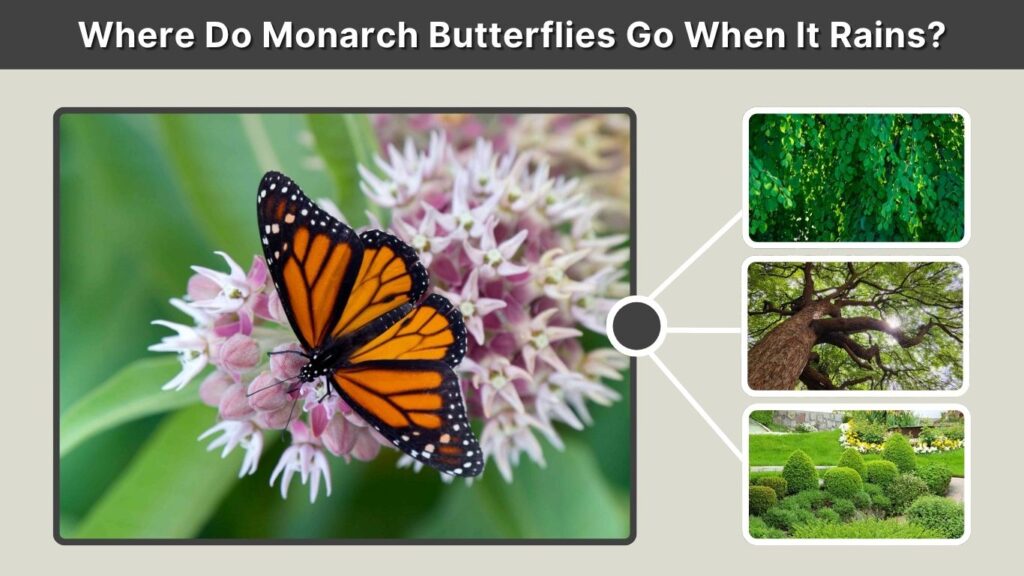
Monarchs usually seek shelter rather than flying through heavy rain.
They may rest beneath:
- Dense tree foliage
- Branches
- Shrubs
- Tall vegetation
- Other protected natural surfaces
Their wings can tolerate some moisture, but heavy rain and strong winds make flying difficult and potentially dangerous.
Once conditions improve and temperatures become suitable, monarchs resume normal activity.
What Happens If Monarch Butterflies Go Extinct?
The ecological consequences would extend beyond losing an attractive butterfly.
Adult monarchs visit many flowering plants and contribute to pollination as they move between flowers. They are also part of food webs involving birds, insects, spiders, and other animals.
However, perhaps the greatest loss would be the disappearance of one of Earth’s most extraordinary insect migrations.
Millions of butterflies moving between Canada, the United States, and Mexico represent a biological process spanning an entire continent.
Can Monarch Butterflies Recover?
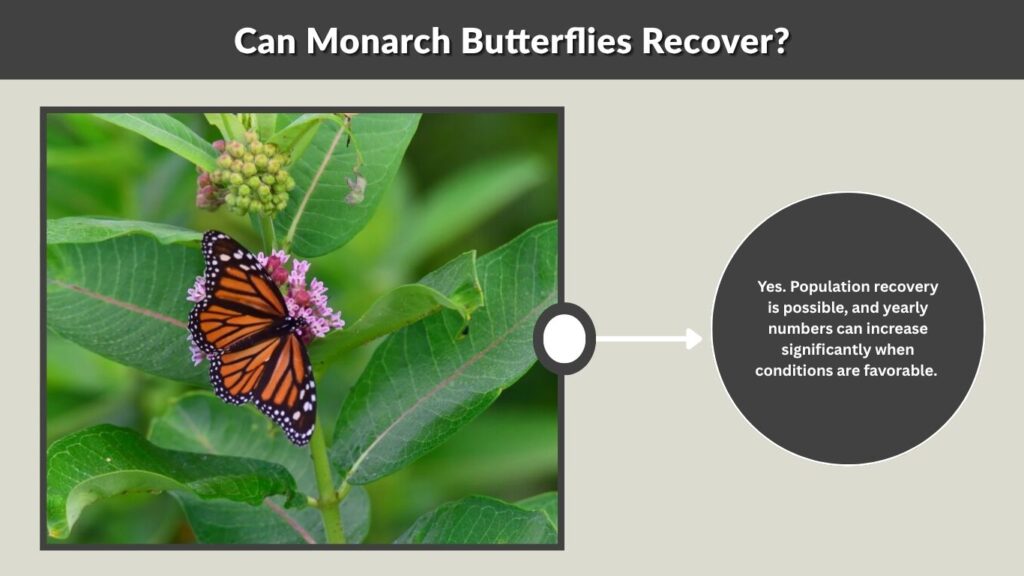
Yes. Population recovery is possible, and yearly numbers can increase significantly when conditions are favorable.
The eastern population’s 64% increase between the 2024–2025 and 2025–2026 winter surveys demonstrates how monarch numbers can rebound from one year to the next. But one good season does not reverse decades of concern.
Long-term recovery depends on maintaining suitable habitat throughout the entire migration route.
People can help by planting native milkweed, growing native nectar-rich flowers, limiting unnecessary pesticide use, and protecting natural breeding and migration habitat.
FAQs
1. Are monarch butterflies endangered?
The conservation terminology depends on the system being used. The migratory monarch is currently classified as Vulnerable on the IUCN Red List. In the United States, federal officials have proposed listing monarch butterflies as threatened under the Endangered Species Act, but the proposal has not yet become a final listing.
2. Are monarch butterflies going extinct in 2026?
Monarch butterflies are not about to disappear entirely in 2026. However, their migratory populations remain vulnerable to habitat loss, pesticides, extreme weather, and climate change. Western monarch numbers in particular remain historically low despite year-to-year fluctuations.
3. Where in Mexico do monarch butterflies go?
Eastern migratory monarchs mainly overwinter in mountainous forests in Michoacán and the State of Mexico. Many colonies occur within the Monarch Butterfly Biosphere Reserve, where cool, moist oyamel fir forests provide shelter during winter.
4. When do monarch butterflies go to Mexico?
The fall migration generally begins in late summer and fall. Monarchs traveling from Canada and the northern United States gradually move south, with many reaching their overwintering forests in central Mexico around late October and early November.
5. Why are monarch butterflies disappearing?
Their decline results from several interacting pressures rather than one cause. Major concerns include loss of milkweed and nectar habitat, development, pesticide exposure, degradation of overwintering forests, drought, extreme weather, and long-term climate changes affecting migration and reproduction.
