
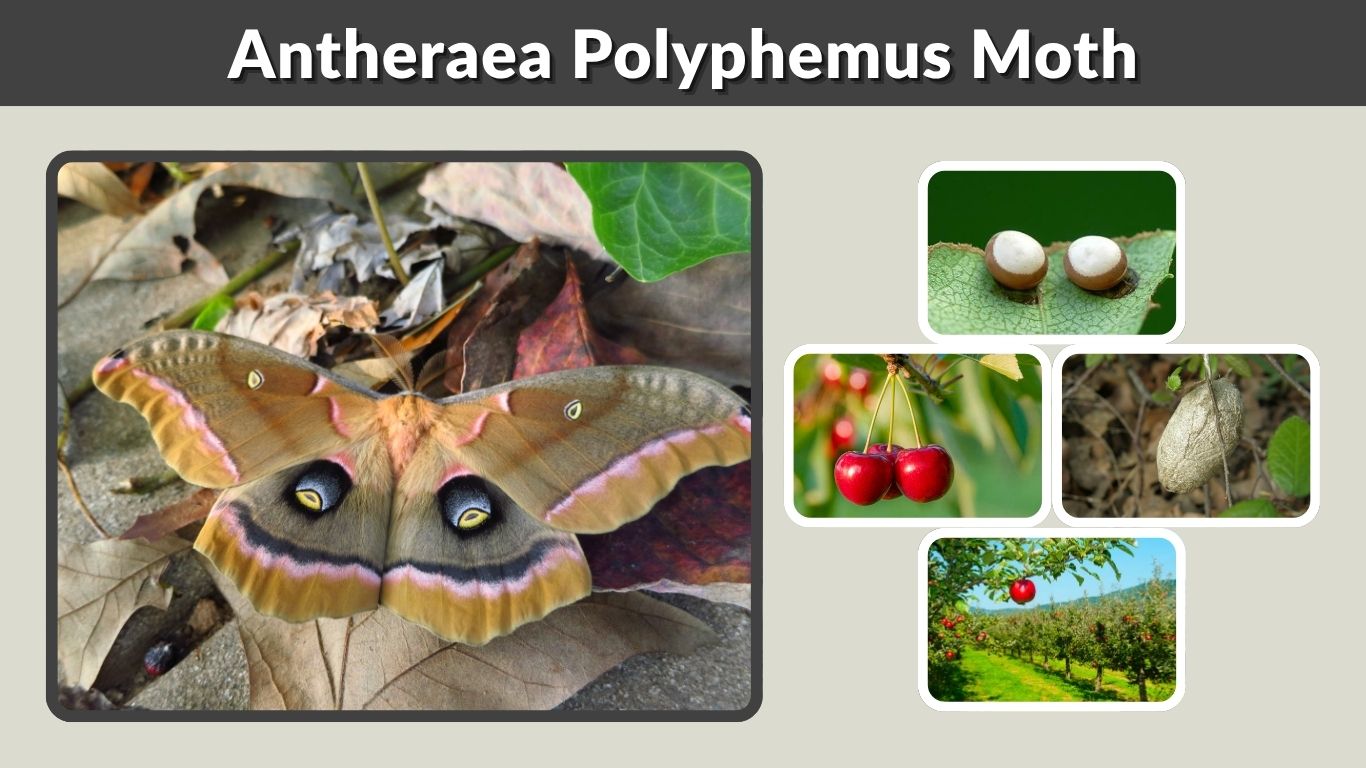
The Antheraea polyphemus moth, commonly called the Polyphemus moth, is one of the most impressive giant silk moths found across North America. Known for its large tan wings and dramatic eyespots, this species belongs to the Saturniidae family. Its life begins as a tiny egg before passing through a large green caterpillar stage and a protective silk cocoon. Adult Polyphemus moths live only briefly and do not normally eat, making their caterpillar stage especially important for storing the energy needed for reproduction.
What Is the Antheraea Polyphemus Moth?
Antheraea polyphemus is a large silk moth native to North America. Its common name comes from Polyphemus, the one-eyed Cyclops from Greek mythology, because each hindwing carries a large transparent or eye-like marking.
Adults have broad wings, thick bodies, and prominent feathered antennae. Their coloration helps them blend into tree bark and dried vegetation during daylight hours.
Antheraea Polyphemus Moth Identification
Several features make the Polyphemus moth relatively easy to recognize:
- Large tan to reddish-brown wings
- Prominent eyespots on the hindwings
- Smaller markings on the forewings
- Broad, hairy body
- Feathery antennae
- Wavy dark and light lines across the wings
- Wingspan commonly reaching several inches
The large hindwing eyespots are its most distinctive feature. When exposed, they may help surprise or discourage potential predators.
How Big Is a Polyphemus Moth?
Adult Polyphemus moths usually have an impressive wingspan of approximately 4 to 6 inches, although individual size varies.
Females are typically heavier-bodied because their abdomens contain large numbers of eggs. Males often have slimmer bodies but much broader antennae.
Their substantial size makes them one of the more noticeable silk moths encountered in North America.
Antheraea Polyphemus Moth Caterpillar
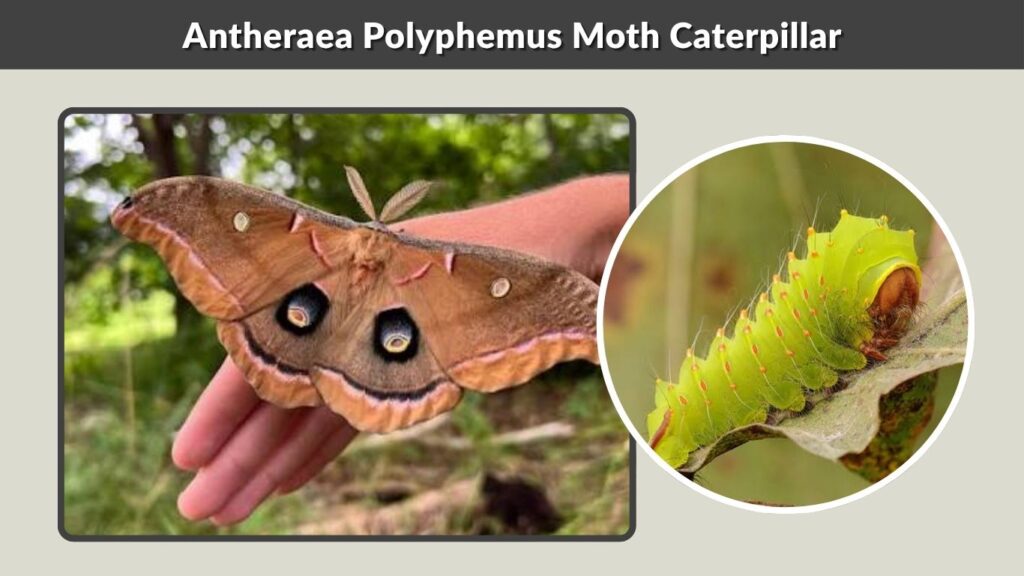
The Antheraea polyphemus moth caterpillar looks very different from the adult moth. Mature larvae are large, thick, and bright green, allowing them to blend effectively with leaves.
The caterpillar’s primary job is to eat, grow, and store enough energy to support metamorphosis and the adult stage.
What Does the Caterpillar Look Like?
A mature Polyphemus caterpillar has:
- Bright green coloration
- Thick segmented body
- Small yellow or orange tubercles
- Fine hairs
- Yellowish markings along the sides
- Several pairs of fleshy prolegs
Fully grown caterpillars may reach approximately 3 to 4 inches long.
Young larvae look somewhat different and gradually develop their recognizable green appearance through successive molts.
Is the Antheraea Polyphemus Caterpillar Dangerous?
Polyphemus moth caterpillars are not considered dangerously poisonous or venomous to people.
Their small hairs and raised tubercles may make them appear threatening, but they lack the powerful venomous spines found on certain other caterpillar species.
Handling is still best kept to a minimum. Caterpillars are delicate, and contact may occasionally irritate particularly sensitive skin.
What Do Antheraea Polyphemus Moths Eat?
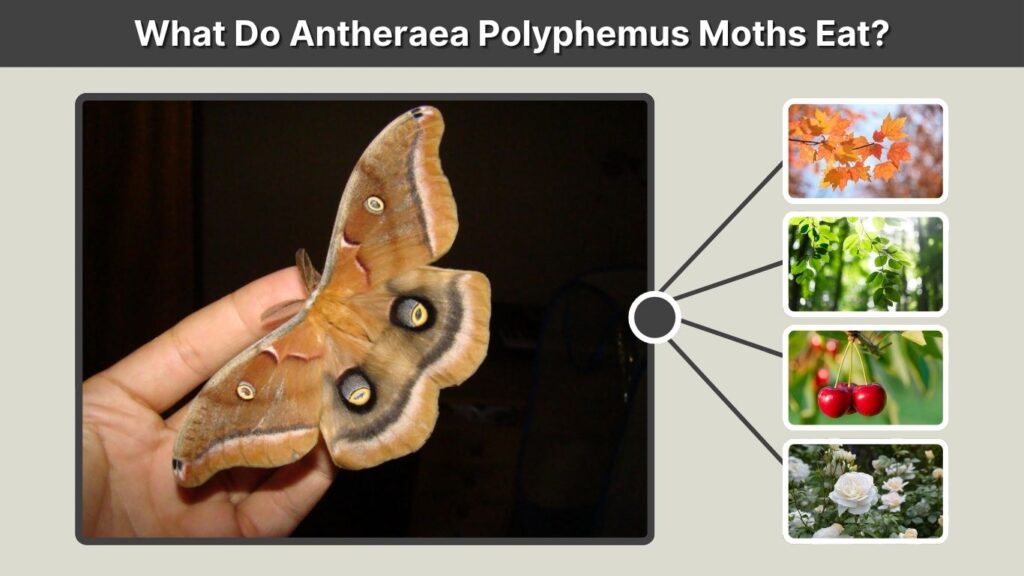
Diet depends entirely on the moth’s developmental stage.
The caterpillars eat large quantities of leaves, while adult moths essentially do not feed at all.
Polyphemus Caterpillar Diet
The larvae feed on numerous deciduous trees and shrubs. Common host plants include:
- Oak
- Maple
- Birch
- Willow
- Hickory
- Elm
- Beech
- Apple
- Cherry
- Rose
Caterpillars generally remain on suitable host plants where they continuously feed and grow.
As they approach maturity, their appetite becomes particularly strong because they must accumulate nutrients for pupation and adulthood.
What Do Adult Polyphemus Moths Eat?
Adult Antheraea polyphemus moths do not normally eat.
Like many giant silk moths, they have reduced mouthparts that are not designed for regular feeding. They survive using fat and energy reserves accumulated during the caterpillar stage.
Consequently, adulthood is focused almost entirely on reproduction.
Antheraea Polyphemus Moth Life Cycle
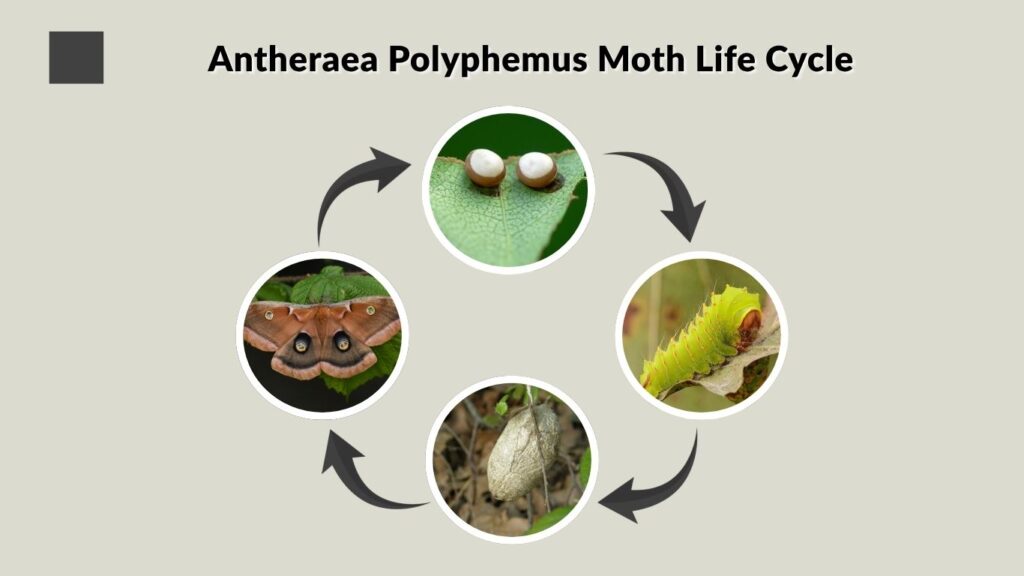
The Polyphemus moth experiences complete metamorphosis and develops through four major stages: egg, caterpillar, pupa, and adult.
Environmental temperature, season, and geographic location can influence how quickly each stage progresses.
Eggs
After mating, a female Polyphemus moth lays eggs on suitable host plants.
The eggs are usually somewhat flattened and pale in color, with darker markings developing as the larvae prepare to hatch.
Young caterpillars emerge and immediately begin feeding on leaves.
Larval Stage
Polyphemus larvae grow through several stages called instars.
Between each instar, the caterpillar sheds its old outer skin to accommodate its rapidly increasing body size.
Young caterpillars may initially appear yellowish or darker, while older larvae become predominantly green.
By the final stage, the caterpillar is thick, large, and consuming significant amounts of foliage.
Antheraea Polyphemus Moth Cocoon
When fully grown, the caterpillar stops eating and begins producing silk.
It wraps silk around itself, often incorporating a leaf into the structure, eventually creating a strong oval cocoon.
Inside the cocoon, the caterpillar transforms into a pupa. Dramatic internal changes occur as the larval body develops into an adult moth.
In colder climates, the pupa may remain inside the cocoon throughout winter.
Adult Emergence
When development is complete and environmental conditions are suitable, the adult moth emerges.
Its wings initially appear small, soft, and wrinkled. The moth pumps fluid through its wing veins, causing the wings to expand.
After several hours, the wings harden sufficiently for flight.
Antheraea Polyphemus Moth Lifespan
The entire Polyphemus moth life cycle may last for several months, depending particularly on whether the pupal stage passes through winter.
However, the adult moth lives for only a short period.
How Long Do Adult Polyphemus Moths Live?
Adult Polyphemus moths generally survive for about one week, sometimes somewhat longer depending on conditions.
Because adults cannot replenish their energy by eating, their stored reserves gradually decrease.
Their limited lifespan is sufficient for their primary tasks: finding a mate, reproducing, and, in females, laying eggs.
Male vs Female Antheraea Polyphemus Moth
Male and female Polyphemus moths share similar wing colors and markings, but several physical characteristics help distinguish them.
Male Polyphemus Moth
Males usually have extremely broad, feathery antennae.
These antennae contain sensory structures capable of detecting pheromones released by females. Males can follow these chemical signals while searching for potential mates.
Their abdomens are generally narrower than those of females.
Female Polyphemus Moth
Females typically have larger, rounder abdomens because they carry eggs.
Their antennae are still feathery but noticeably narrower than those of males.
Once a female emerges and becomes ready to mate, she releases pheromones that attract nearby males. After mating, she begins searching for suitable locations to deposit her eggs.
Polyphemus Moth Habitat and Range
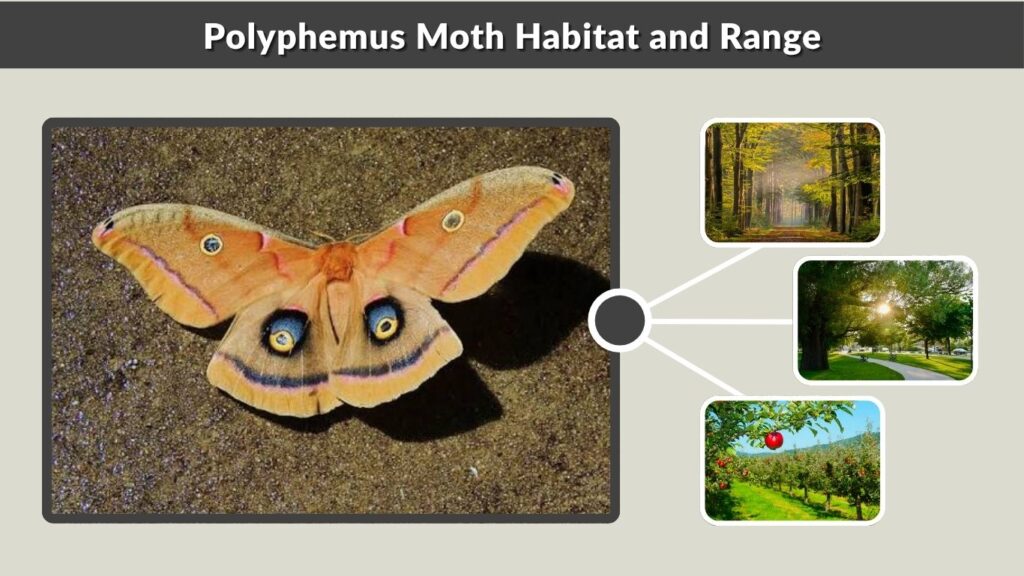
Antheraea polyphemus occurs widely across North America, including much of the United States and portions of Canada.
It is commonly associated with areas containing deciduous trees that provide food for its larvae.
Typical habitats include:
- Deciduous forests
- Woodland edges
- Gardens
- Parks
- Orchards
- Suburban neighborhoods
- Areas containing oak, maple, willow, and similar trees
Adults are mostly nocturnal and may occasionally be attracted to outdoor lights.
Polyphemus Moth vs Luna Moth
The Polyphemus moth and Luna moth are both giant silk moths, but adults are quite easy to distinguish.
Polyphemus moths are primarily tan or brown and possess enormous eyespots on their hindwings. Luna moths are pale green and have long tails extending from their hindwings.
Their caterpillars are more difficult to distinguish because both are large and predominantly green.
Host plants may also overlap, so close examination of body markings is usually necessary when identifying the larvae.
Are Antheraea Polyphemus Moths Harmful?
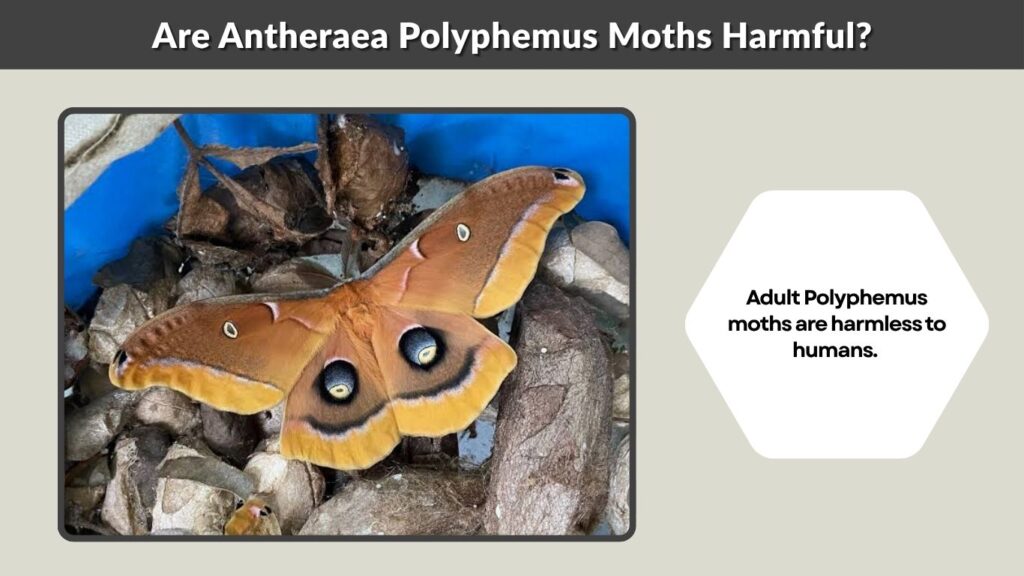
Adult Polyphemus moths are harmless to humans. They do not sting, and their reduced mouthparts prevent them from delivering a meaningful bite.
Their caterpillars may consume noticeable quantities of foliage, but individual larvae rarely pose a serious threat to healthy mature trees.
Finding one usually provides an opportunity to observe one of North America’s most fascinating native silk moths.
FAQs
What is the scientific name of the Polyphemus moth?
The scientific name is Antheraea polyphemus. It belongs to the Saturniidae family, which contains many of the world’s large silk moths. The species is widely distributed across North America and is especially recognizable by the enormous eyespots on its hindwings.
What do Antheraea polyphemus moths eat?
Adult Polyphemus moths do not normally eat because their mouthparts are greatly reduced. Caterpillars feed heavily on leaves from trees and shrubs such as oak, maple, birch, willow, hickory, elm, apple, cherry, and several other suitable host plants.
How long does a Polyphemus moth live?
The adult Polyphemus moth generally lives for roughly a week, although lifespan can vary. The complete life cycle is considerably longer because the insect spends weeks as a caterpillar and may remain as a pupa inside its cocoon for several months.
What does an Antheraea polyphemus caterpillar turn into?
The caterpillar eventually becomes a large adult Polyphemus moth. Once fully grown, it spins a silk cocoon and develops into a pupa. After metamorphosis is complete, an adult tan-colored moth with large hindwing eyespots emerges from the cocoon.
Are Polyphemus moths rare?
Polyphemus moths are widely distributed across North America and are not necessarily rare throughout their range. However, people may seldom see adults because the moths are nocturnal, well camouflaged, and have very short adult lifespans.
