
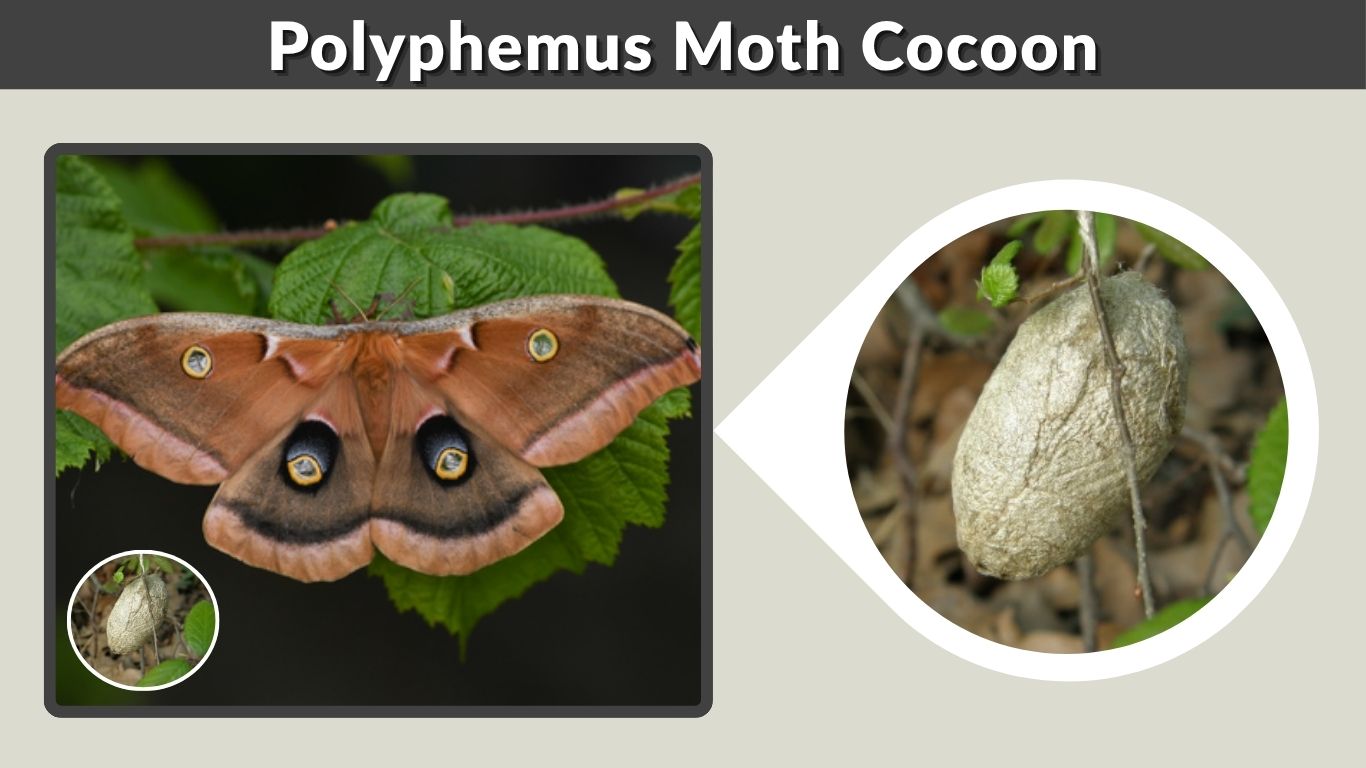
The Polyphemus moth cocoon is the protective silk structure where Antheraea polyphemus completes one of the most dramatic parts of its life cycle. After weeks of feeding and growing, the large green caterpillar stops eating, spins a tough cocoon, and changes into a pupa inside. Depending on the season, an adult moth may emerge within weeks or remain inside throughout winter. Understanding cocoon time, overwintering, care, size, and emergence can help you recognize what is happening during this fascinating stage.
What Does a Polyphemus Moth Cocoon Look Like?
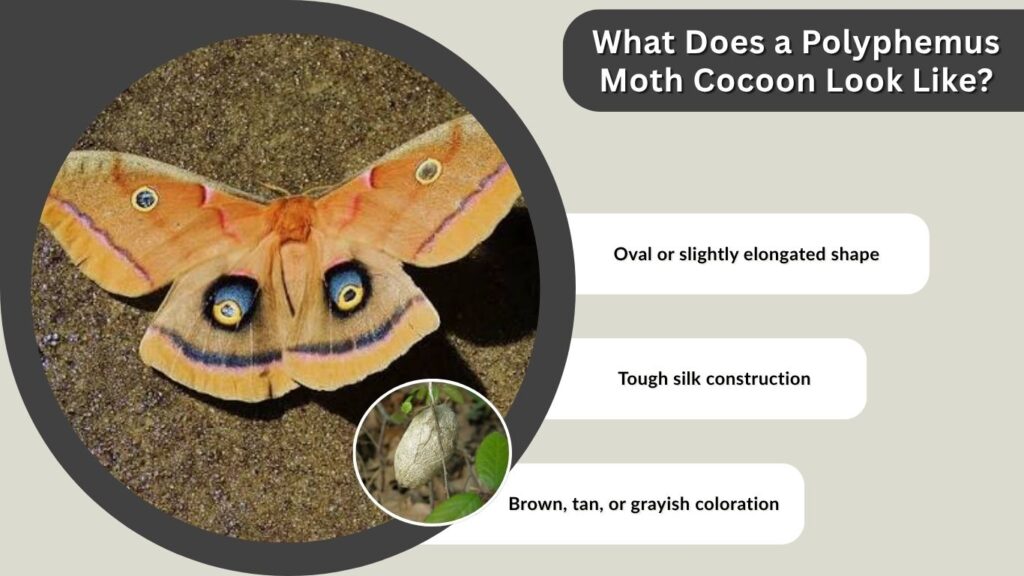
A Polyphemus moth cocoon is typically oval or elongated and constructed from strong silk produced by the mature caterpillar. It is often surrounded by or attached to a leaf, which can make it look like an ordinary dried leaf from a distance.
The cocoon protects the developing pupa from weather, predators, and physical damage.
Polyphemus Moth Cocoon Identification
Typical features include:
- Oval or slightly elongated shape
- Tough silk construction
- Brown, tan, or grayish coloration
- Often wrapped inside a dried leaf
- Usually attached to a twig or branch
- May fall to the ground with leaves
- Contains a single developing pupa
The appearance can vary depending on where the caterpillar builds it and how much surrounding plant material becomes incorporated into the silk.
Polyphemus Moth Cocoon Size
A Polyphemus cocoon is usually a few inches long and large enough to contain the thick pupa of this giant silk moth.
Its exact dimensions vary according to the size of the caterpillar and how much silk and leaf material surround the pupa.
Female pupae can sometimes be somewhat larger because adult females generally have heavier abdomens.
How Does a Polyphemus Caterpillar Make a Cocoon?
When a Polyphemus caterpillar reaches full size, its behavior begins to change. It stops feeding and starts searching for a protected location where it can pupate.
The caterpillar produces silk through specialized glands and gradually builds a protective enclosure around itself.
Caterpillar to Cocoon Stage
The process generally follows these steps:
- The mature caterpillar stops eating.
- It selects a leaf, twig, or other sheltered location.
- Silk is used to secure nearby material.
- The caterpillar spins increasingly dense layers of silk.
- Its body becomes completely enclosed.
- Inside, it sheds its larval skin and becomes a pupa.
The outside of the cocoon may appear inactive, but major biological changes are occurring inside.
What Happens Inside the Cocoon?
The caterpillar does not simply sleep inside its cocoon.
It transforms into a pupa, and its body undergoes extensive metamorphosis. Structures associated with the caterpillar are reorganized as adult features such as wings, antennae, legs, and reproductive organs develop.
Eventually, a fully formed adult Polyphemus moth is ready to emerge.
How Long Does a Polyphemus Moth Stay in Its Cocoon?
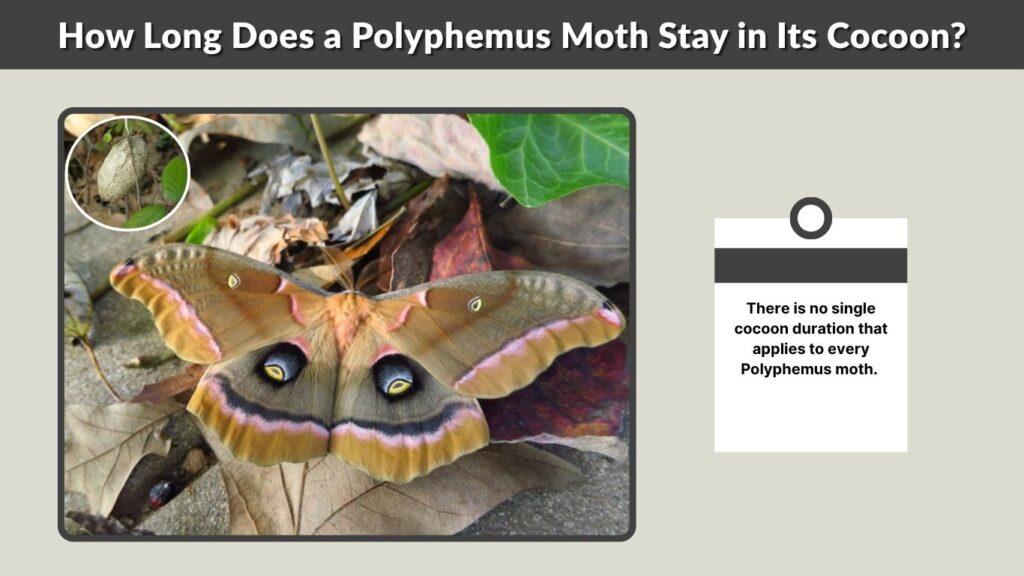
There is no single cocoon duration that applies to every Polyphemus moth. Cocoon time depends heavily on season, climate, temperature, and generation.
A cocoon formed during warm weather may produce an adult within several weeks, while a late-season cocoon may remain dormant throughout winter.
Warm-Season Cocoon Time
In regions where Polyphemus moths produce multiple generations, caterpillars that pupate early enough in the warm season may emerge as adults relatively quickly.
The pupal period may last several weeks under favorable temperatures.
The newly emerged adults then mate and produce another generation before colder weather arrives.
How Long Do Polyphemus Moths Stay in Cocoons Over Winter?
Late-season pupae frequently enter a dormant period known as diapause.
Instead of emerging immediately, the moth remains protected inside the cocoon throughout winter and develops or resumes activity when conditions become suitable in spring.
As a result, an overwintering Polyphemus cocoon may remain closed for several months.
A cocoon that does not hatch quickly is therefore not necessarily dead.
Polyphemus Moth Cocoon Overwintering
Overwintering is a normal part of the Polyphemus moth life cycle in colder parts of its range.
In nature, cocoons experience seasonal temperatures because they remain outdoors on branches, among vegetation, or within fallen leaves.
What Happens During Winter?
The pupa enters diapause, a period of greatly reduced developmental activity.
This adaptation prevents the adult moth from emerging during winter when temperatures are too low and suitable conditions for reproduction are unavailable.
As temperatures and seasonal conditions change, development eventually resumes.
Should You Bring a Cocoon Indoors?
If a wild cocoon is already outdoors in a safe location, leaving it where it naturally formed is generally the simplest option.
Bringing an overwintering cocoon into a continuously warm house can disrupt its seasonal cycle and potentially cause premature emergence.
An adult emerging during winter may have no opportunity to find a mate outdoors.
Polyphemus Moth Cocoon Care
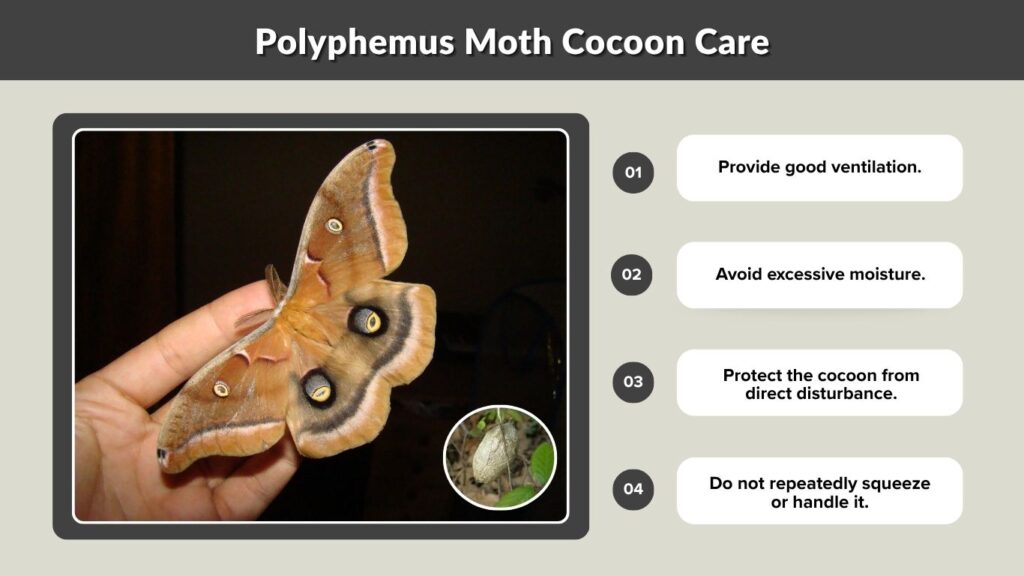
If you are responsibly raising a Polyphemus caterpillar, the cocoon should be disturbed as little as possible after it forms.
The developing moth needs protection, airflow, and enough space to emerge successfully.
Basic Cocoon Care
Important considerations include:
- Provide good ventilation.
- Avoid excessive moisture.
- Protect the cocoon from direct disturbance.
- Do not repeatedly squeeze or handle it.
- Keep overwintering cocoons exposed to appropriate seasonal conditions.
- Provide enough vertical space for the adult to expand its wings.
- Keep the enclosure protected from predators.
Avoid sealing a cocoon inside an airtight container.
Good airflow reduces the risk of excessive moisture and mold.
Why Space Matters
When an adult Polyphemus moth emerges, its wings are initially small, wrinkled, and soft.
The moth needs to climb onto a secure vertical or angled surface and hang while pumping fluid into its wings.
Without enough room, the wings may fail to expand normally.
Polyphemus Moth Emerging From Cocoon
Adult emergence is one of the most interesting parts of the Polyphemus moth life cycle.
Once the moth is fully developed, it breaks through the cocoon and begins climbing to a suitable surface.
What Happens After Hatching?
Immediately after emergence, the adult may look very different from a fully expanded moth.
Its abdomen can appear unusually large while the wings remain small and folded.
The moth pumps hemolymph, an insect body fluid, through the veins in its wings. The wings gradually expand to their full size.
Once expanded, they must harden before the moth can fly.
This process requires space and should not be interrupted.
When Do Polyphemus Moths Usually Emerge?
Adult emergence commonly occurs during the warmer months, although timing varies by geographic location and local climate.
Many giant silk moths emerge during evening or nighttime periods, which fits their primarily nocturnal lifestyle.
After its wings harden, the adult’s next major goal is reproduction.
Can a Polyphemus Cocoon Hatch Early?
A cocoon may appear to hatch earlier than expected if environmental temperatures encourage development.
This is particularly important with overwintering cocoons. Moving a dormant cocoon into a warm indoor environment can expose it to temperatures resembling spring or summer.
That change may stimulate development and adult emergence.
Maintaining an appropriate seasonal cycle is therefore important when overwintering a cocoon.
Polyphemus Moth Cocoon vs Luna Moth Cocoon
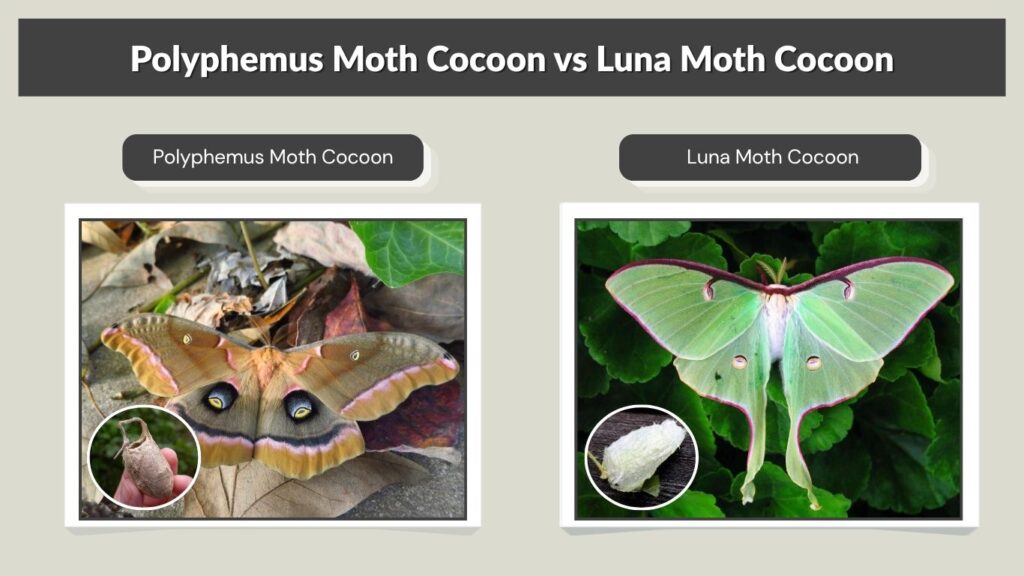
Polyphemus and Luna moths are both members of the giant silk moth family, and their cocoons can look surprisingly similar.
Both species may spin silk around leaves, and cocoons can eventually fall into leaf litter.
How Are They Different?
Identifying the species based entirely on the cocoon can be difficult.
The caterpillar observed before pupation provides a much stronger identification clue. Adult moths are even easier to distinguish.
The Polyphemus moth has tan to brown wings with enormous eyespots, while the Luna moth has pale green wings with long tails extending from the hindwings.
FAQs
How long is a Polyphemus moth in its cocoon?
The time varies considerably. A warm-season pupa may remain inside for several weeks, while a late-season Polyphemus moth can overwinter in its cocoon for several months. Temperature, climate, season, and geographic location all influence when the adult emerges.
How do you know if a Polyphemus cocoon is alive?
A cocoon may remain completely still even when a healthy pupa is developing inside. Lack of visible movement is therefore not proof that it is dead. Avoid repeatedly squeezing, opening, or disturbing the cocoon simply to check its condition.
Does a Polyphemus moth cocoon survive winter?
Yes. Polyphemus moths commonly overwinter as pupae inside their cocoons in colder regions. The dormant stage helps them survive unfavorable seasonal conditions. When warmer conditions return, development continues until the adult moth is ready to emerge.
What does a Polyphemus moth cocoon turn into?
Inside the cocoon, the caterpillar becomes a pupa and eventually transforms into an adult Polyphemus moth. The adult is a large tan or brown giant silk moth known for prominent transparent-looking eyespots on its hindwings.
Can you move a Polyphemus moth cocoon?
A cocoon can sometimes be moved carefully if it is in immediate danger, but unnecessary handling is best avoided. If it must be relocated, protect it from crushing, excessive moisture, and extreme artificial temperature changes while providing enough space for eventual adult emergence.
