
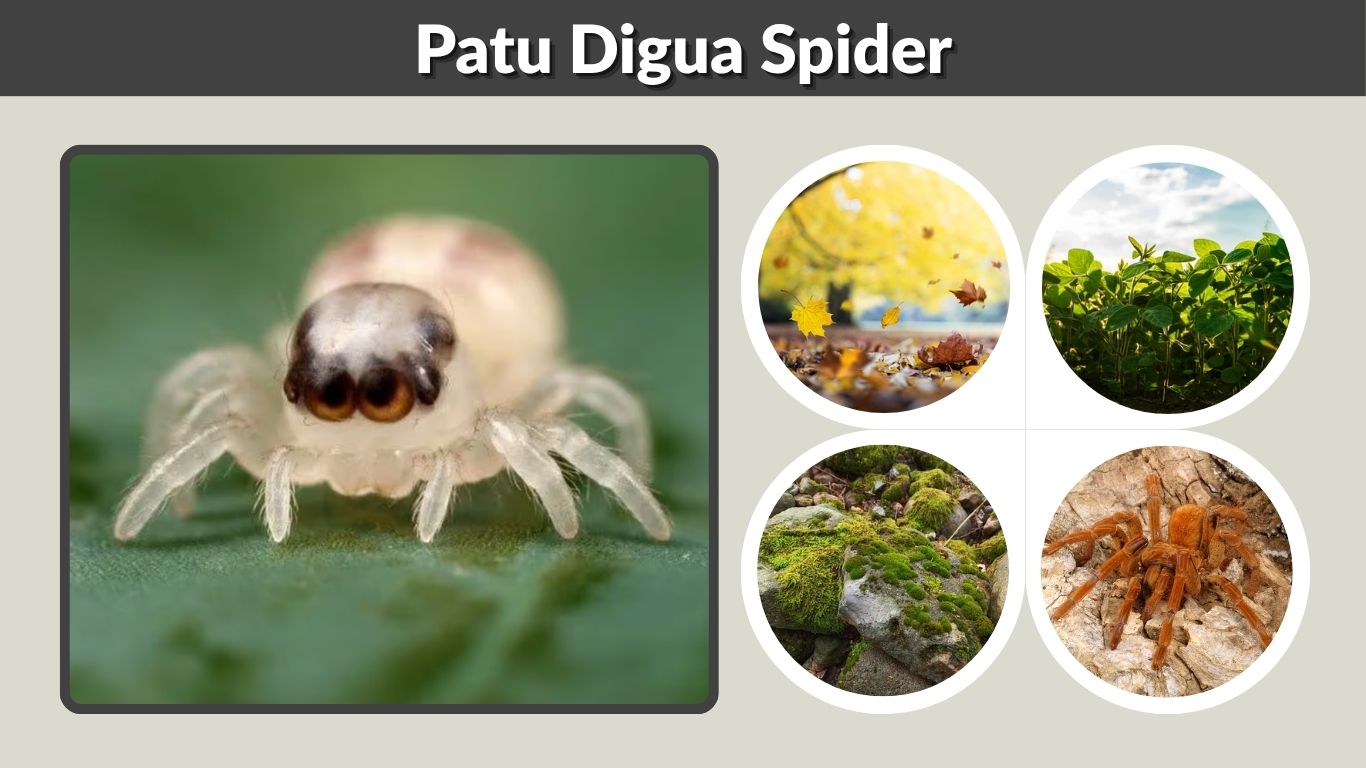
Patu digua is an extraordinarily tiny Colombian spider famous for being among the smallest spiders ever scientifically described. An adult male measures only about 0.37 millimeters in body length, making it nearly invisible without close examination. The species belongs to the family Symphytognathidae, a group of miniature orb-web-building spiders. Despite online claims about its bite, venom, and lifestyle, relatively little species-specific biology has been documented. This guide covers Patu digua size, habitat, identification, diet, web, bite risk, and its remarkable place among the world’s smallest spiders.
What Is Patu Digua?
Patu digua is a valid species in the genus Patu and family Symphytognathidae. Raymond Forster and Norman Platnick formally described it in 1977 while reviewing this unusual family of miniature spiders. The World Spider Catalog currently recognizes the species and lists its distribution as Colombia.
Scientific Classification
- Scientific name: Patu digua
- Genus: Patu
- Family: Symphytognathidae
- Order: Araneae
- Described by: Forster and Platnick
- Year described: 1977
- Known distribution: Colombia
- Type locality: Río Digua near Queremal, Valle del Cauca
The original type material included a male holotype collected near Río Digua, Colombia, along with female material used in the species description.
Does Patu Digua Have a Common Name?
There is no widely established scientific common name for Patu digua. ITIS lists the species without a common name. Informal phrases such as “smallest spider” or “tiny Colombian spider” may appear online, but Patu digua remains the most accurate name to use.
How Small Is Patu Digua?
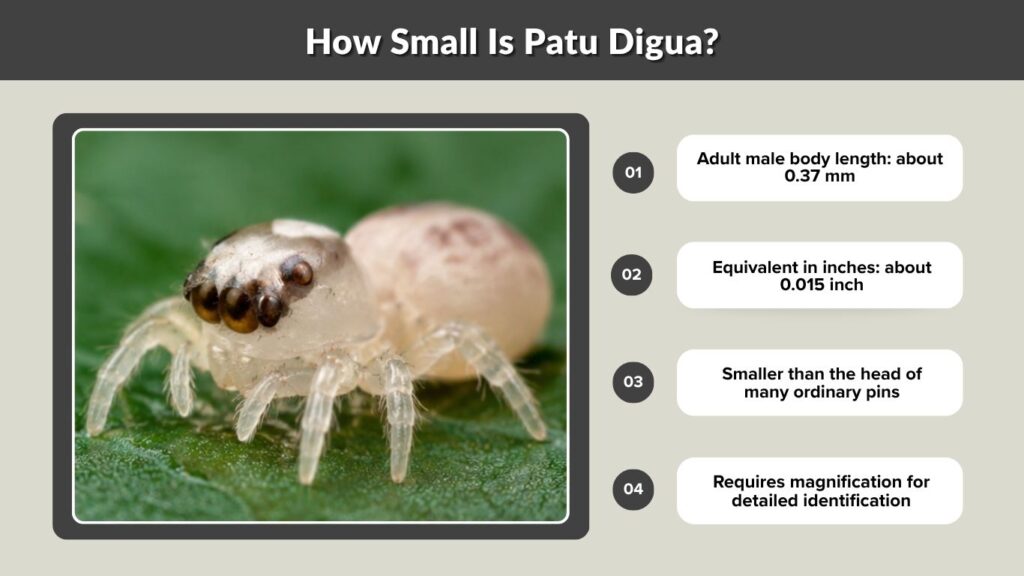
Its minute size is the main reason this species has attracted so much attention. A scientific review of record-breaking spiders identified Patu digua as the smallest adult male spider ever described, with a body length of approximately 0.37 mm, excluding the chelicerae.
Patu Digua Size
- Adult male body length: about 0.37 mm
- Equivalent in inches: about 0.015 inch
- Smaller than the head of many ordinary pins
- Belongs to a family in which adults are generally under 2 mm
- Requires magnification for detailed identification
Its body is therefore hundreds of times shorter than that of the largest spiders.
Is Patu Digua the Smallest Spider in the World?
It is more accurate to call Patu digua one of the world’s smallest spiders and the smallest described adult male in published comparisons.
Other extremely tiny spiders complicate the overall record. For example, some species are known only from females, and Patu marplesi is similarly minute. Researchers have specifically cautioned that differences in measurements and individual variation make a single absolute “smallest spider” title difficult to establish.
Where Does Patu Digua Live?
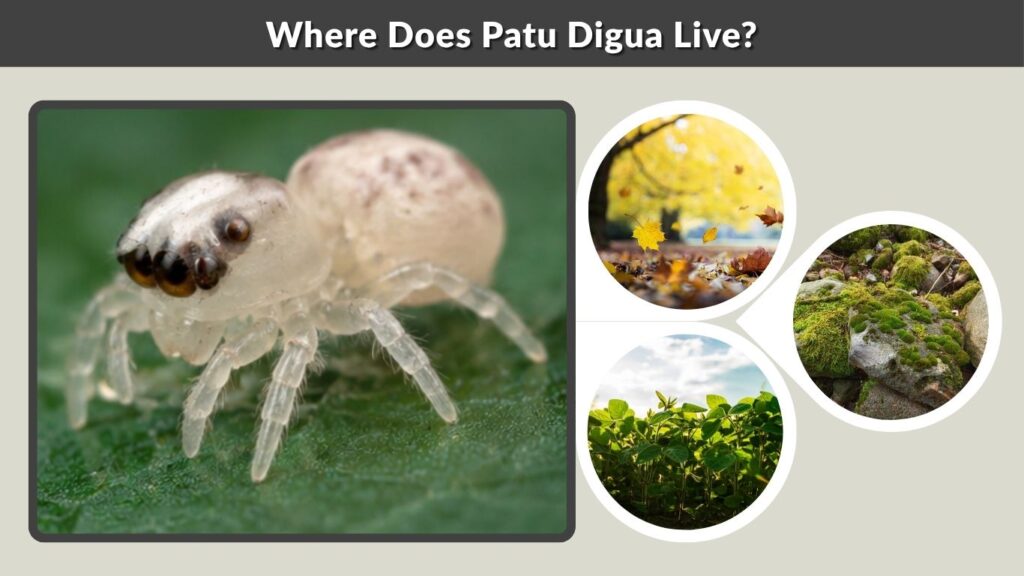
Reliable distribution records for Patu digua are remarkably limited compared with better-known spiders. The World Spider Catalog lists Colombia as its distribution, while its original specimens came from the Río Digua region near Queremal in Valle del Cauca.
Patu Digua Habitat
Detailed field studies of this species’ habitat are scarce. However, members of Symphytognathidae are generally tiny spiders associated with humid forest environments, especially the litter layer close to the ground.
The family is known for constructing miniature orb webs in forest litter, suggesting that very small spaces among leaves, moss, vegetation, and other moist ground-level material provide suitable hunting areas. This describes the family broadly and should not be treated as a detailed field study specifically of P. digua.
Is Patu Digua endemic to Colombia?
The species is currently known from Colombia, and authoritative spider catalogs list no additional countries in its distribution. Calling it “known only from Colombia” is therefore safer than assuming its complete natural range has already been discovered.
What Does Patu Digua Eat?
Because Patu digua is extremely small and rarely studied in the wild, there is little published information describing its exact prey. Claims that it eats particular insects or even smaller spiders are often repeated online without strong species-specific evidence.
Likely Feeding Behavior
Symphytognathid spiders build tiny orb webs in the forest litter. Their extremely small size means any prey must also be minute. Small arthropods moving through humid leaf litter would be potential prey for spiders of this size, but a detailed documented diet for Patu digua has not been established.
This distinction matters because information about better-studied web-building spiders should not automatically be presented as confirmed behavior for P. digua.
Does Patu Digua Make a Web?
Patu digua belongs to an orb-web-building lineage, although detailed observations of this particular species’ web are limited. Symphytognathidae generally construct extremely small orb webs close to the forest floor, often within leaf litter.
Patu Digua Web Characteristics
- Expected to be extremely small
- Associated with an orb-web-building spider family
- Likely positioned close to the substrate
- Used for capturing tiny arthropod prey
- Difficult for humans to notice without close inspection
Its web should not be imagined as a miniature version of the large garden orb webs that stretch between trees. At this scale, both the spider and its hunting structure can be exceptionally difficult to see.
Is Patu Digua Dangerous or Venomous?
There is no credible evidence that Patu digua presents a medically significant danger to humans. Published taxonomic resources primarily describe its anatomy and classification rather than human bites, and no established clinical syndrome is associated with the species.
Can Patu Digua Bite Humans?
There are no well-documented medically significant Patu digua bites in the scientific sources reviewed. At only around 0.37 mm long for the male, the entire spider is microscopic compared with a human.
It is therefore inappropriate to describe it alongside medically important species such as widow, recluse, or funnel-web spiders.
Is Patu Digua Poisonous?
“Poisonous” is not the appropriate term for a spider that delivers venom through fangs. More importantly, there is little published species-specific research on Patu digua venom.
The safest conclusion is that it is not known to be dangerous to humans, rather than making unsupported claims about the potency or composition of its venom.
Patu Digua vs Goliath Birdeater
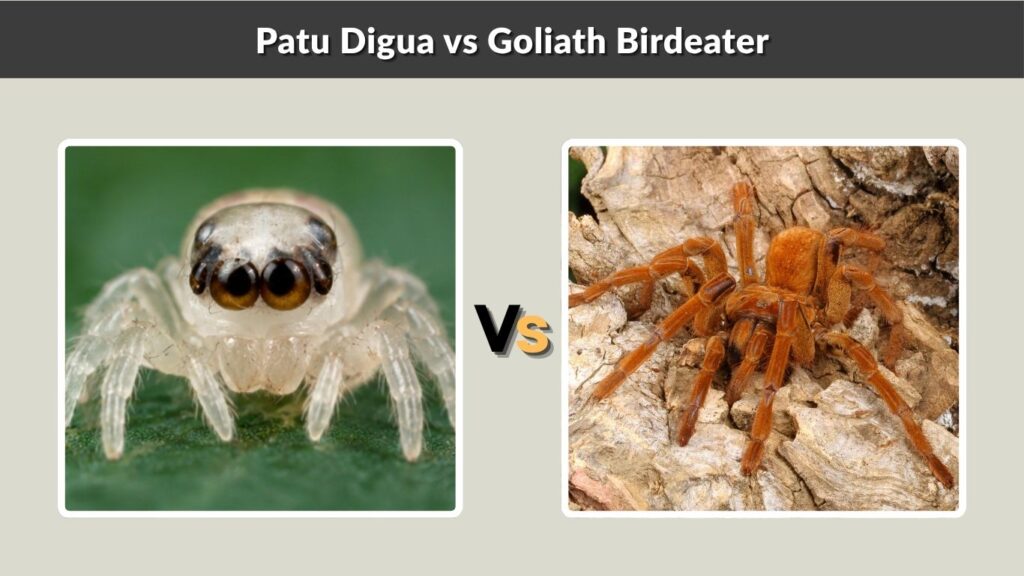
Few comparisons demonstrate spider diversity better than Patu digua versus the Goliath birdeater (Theraphosa blondi). One represents an extreme in miniature body size, while the other is among the world’s largest spiders.
Size Comparison
- Patu digua male: about 0.37 mm long
- Goliath birdeater body: up to about 12 cm
- Goliath birdeater leg span: up to about 28 cm
- Patu digua: tiny symphytognathid spider
- Goliath birdeater: massive South American tarantula
The Smithsonian reports that a Goliath birdeater can reach a 12 cm body length and 28 cm leg span. Its body alone can therefore be more than 300 times longer than a 0.37 mm male Patu digua.
Interesting Patu Digua Facts
Despite its tiny dimensions, Patu digua is important to scientists studying the physical limits of spider body size. Its existence demonstrates how dramatically spiders have diversified, from animals smaller than a millimeter to tarantulas spanning nearly a dinner plate.
Quick Facts
- It was scientifically described in 1977.
- It belongs to the family Symphytognathidae.
- The male measures approximately 0.37 mm.
- Its type locality is in Valle del Cauca, Colombia.
- It is currently recorded from Colombia.
- It is the smallest described adult male spider in a published record review.
- Its detailed diet and behavior remain poorly documented.
- It should not be confused with a jumping spider; Patu belongs to Symphytognathidae, not Salticidae.
FAQs
1. Is Patu digua the smallest spider?
Patu digua is regarded as the smallest described adult male spider, measuring approximately 0.37 mm. However, scientists avoid confidently calling it the absolute smallest spider because other extremely tiny species and measurement differences complicate the record.
2. Where does Patu digua live?
It is known from Colombia. The type locality is Río Digua near Queremal in Valle del Cauca.
3. Is Patu digua dangerous to humans?
There is no evidence that it poses a medically significant threat to people. Its extraordinarily small size and absence from the medical spider-bite literature make it very different from dangerous widow or funnel-web spiders.
4. What does Patu digua eat?
Its precise diet has not been well documented. Members of its family construct tiny orb webs in forest litter and capture very small prey, so Patu digua is expected to feed on minute arthropods appropriate to its size.
5. How do you pronounce Patu digua?
A practical English pronunciation is “PAH-too DEE-gwah.” Scientific Latin names can be pronounced differently among speakers, so there is no single universally enforced pronunciation.
