
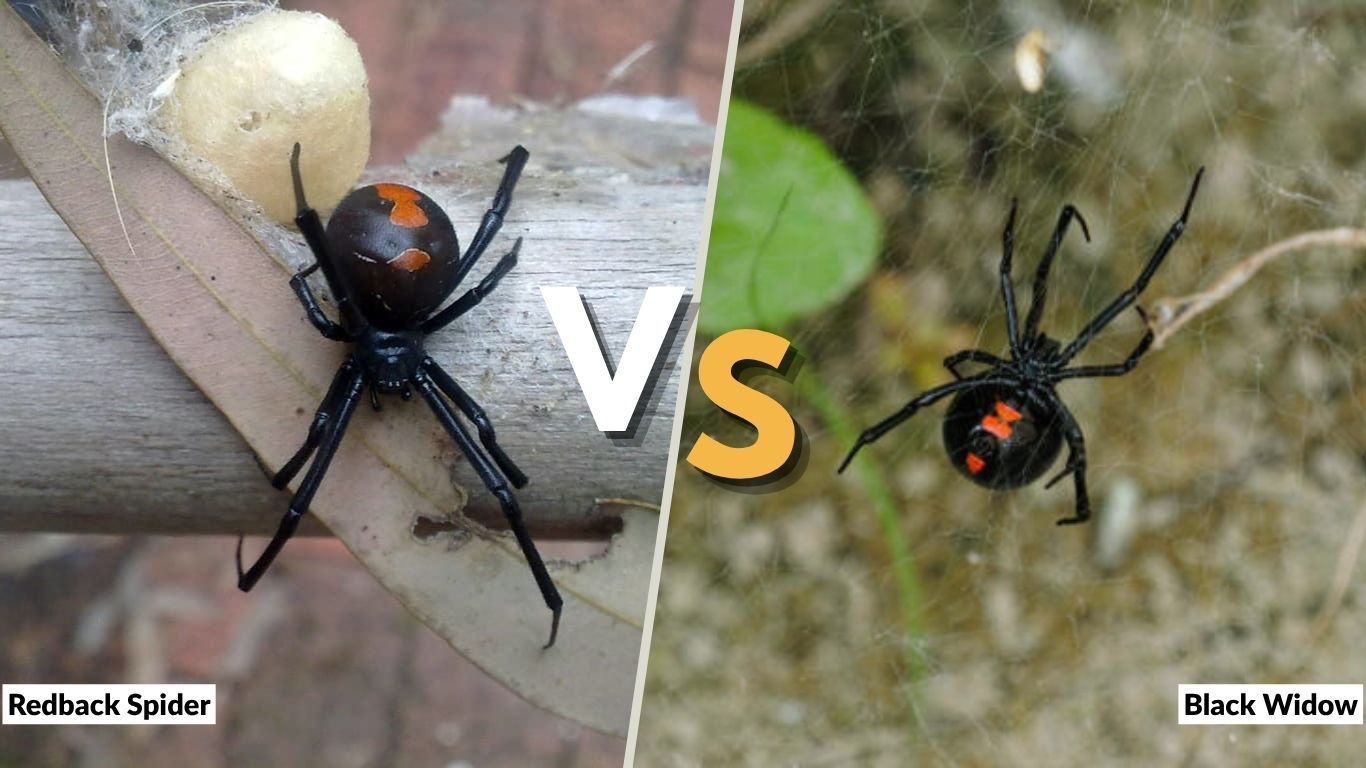
The redback spider and black widow are closely related venomous spiders that share glossy dark bodies, red markings, tangled webs, and medically significant venom. However, they are not the same spider. The Australian redback is Latrodectus hasselti, while “black widow” describes several other species in the genus Latrodectus. Their appearance, geographic range, markings, size, and reproductive behavior provide useful ways to tell them apart. This guide compares redback spiders vs black widows, including their venom, bites, habitat, behavior, and relative danger to humans.
Redback Spider vs Black Widow: Quick Comparison
Redbacks and black widows belong to the same family, Theridiidae, and the same genus, Latrodectus. That close relationship explains why they look and behave so similarly. The clearest differences are usually their geographic distribution and the placement of red markings on adult females.
| Feature | Redback Spider | Black Widow |
| Scientific identity | Latrodectus hasselti | Several Latrodectus species |
| Best-known range | Australia | Especially North America |
| Female color | Glossy black or dark brown | Usually glossy black |
| Main red marking | Stripe on upper abdomen | Usually hourglass underneath |
| Female body size | About 10 mm | Roughly 8–13 mm in southern black widow |
| Male size | About 3–4 mm | Roughly 4–6 mm in southern black widow |
| Web | Irregular, tangled | Irregular, tangled |
| Venom | Neurotoxic | Neurotoxic |
| Human risk | Medically significant | Medically significant |
Is a Redback Spider a Black Widow?
A redback is not technically a black widow, although the two are extremely close relatives. Both belong to Latrodectus, commonly known as widow spiders. The Australian Museum notes that redbacks were once considered a form of black widow but are now recognized as a distinct species.
Scientific Classification
- Redback spider: Latrodectus hasselti
- Southern black widow: Latrodectus mactans
- Family: Theridiidae
- Order: Araneae
- Both belong to the widow-spider genus Latrodectus
The term “black widow” can be confusing because it does not refer to only one species. Several related widow spiders carry that common name.
Redback vs Black Widow Appearance
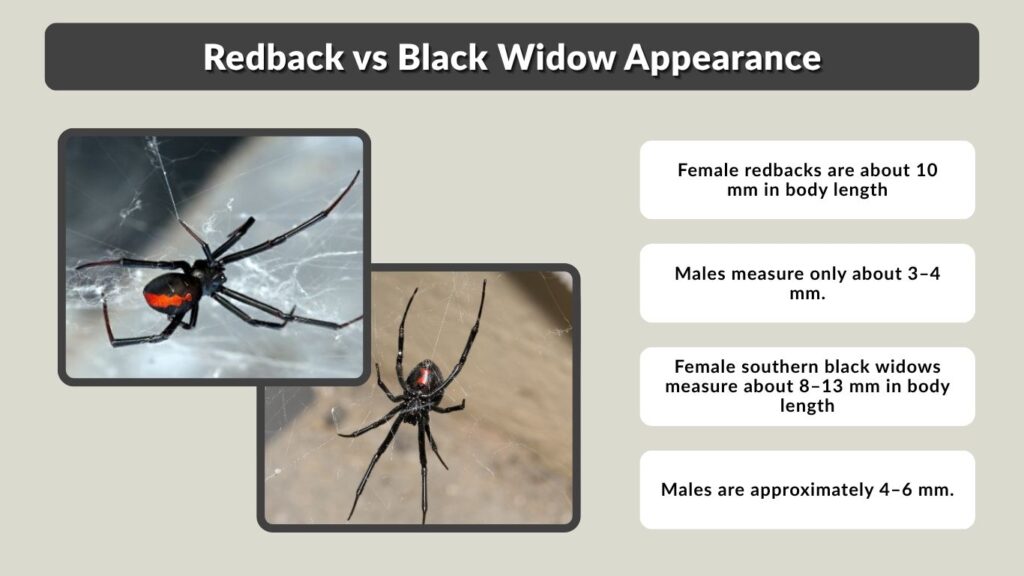
At first glance, adult females can look remarkably similar. Both usually have rounded abdomens, slender legs, and glossy dark coloration. Examining the red pattern is one of the easiest ways to distinguish a typical redback from a typical southern black widow.
Redback Spider Identification
- Female is usually glossy black or dark brown.
- A red or orange longitudinal stripe runs along the upper abdomen.
- A red-orange hourglass marking may also occur underneath.
- Juveniles often have additional pale markings.
- Males are smaller and lighter brown.
- The abdomen is round and prominent.
Female redbacks are about 10 mm in body length, while males measure only about 3–4 mm.
Black Widow Identification
Adult female southern black widows are usually glossy jet black. Their most famous feature is the orange-red or red hourglass marking on the underside of the abdomen. The upper abdomen can be completely black or have several red spots.
Female southern black widows measure about 8–13 mm in body length, while males are approximately 4–6 mm.
Redback Spider vs Black Widow Size
Neither spider is particularly large compared with many common garden or hunting spiders. Their reputation comes from their venom rather than their physical size.
Which Spider Is Bigger?
There is considerable overlap. A female redback averages around 10 mm in body length, while a female southern black widow can measure around 8–13 mm.
This means there is no reliable rule that black widows or redbacks are always larger. Size alone is not a good identification method.
Habitat and Geographic Range
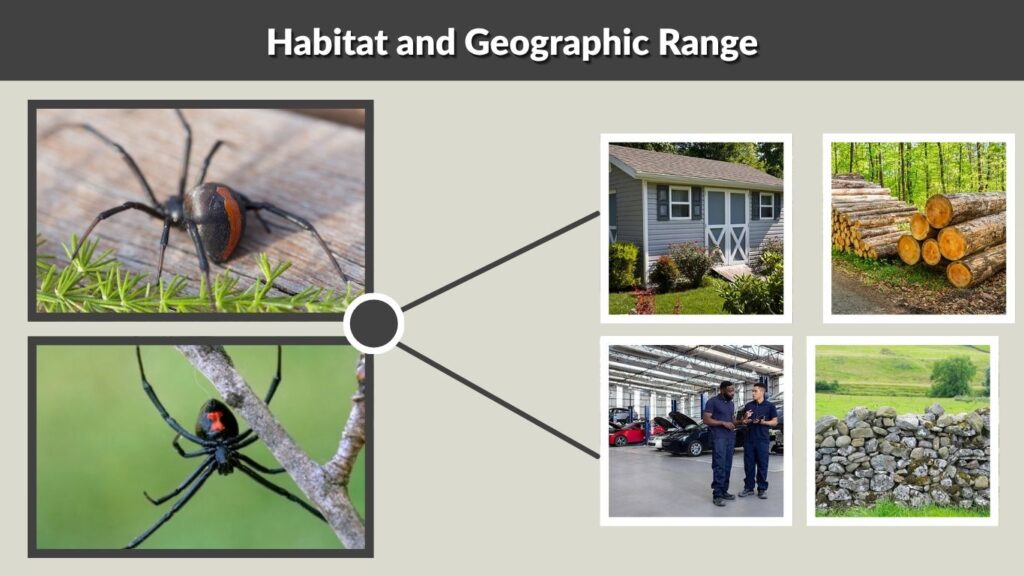
Geography is often one of the strongest clues when distinguishing these spiders. The Australian redback is widespread throughout Australia, while several species of black widow occur in North America and other parts of the world.
Where Do Redbacks Live?
Redbacks are found throughout Australia and are particularly successful around human habitation. They commonly establish webs in dry, protected places such as sheds, logs, rock piles, rubbish piles, shrubs, and outdoor structures.
Where Do Black Widows Live?
Black widow species occur across warmer regions of the world. In the United States, widow spiders are particularly associated with southern and western regions, although different species have different ranges.
They often shelter in woodpiles, garages, barns, stone walls, fences, outdoor furniture, and other relatively undisturbed areas.
Redback vs Black Widow Web
Both are cobweb spiders rather than orb-weavers. Their webs look messy and irregular compared with the symmetrical circular webs built by many garden spiders.
Web Characteristics
- Tangled and irregular construction
- Strong silk
- Usually located in sheltered places
- Often positioned relatively close to the ground
- Used to capture insects and other small animals
- Female generally remains close to the web
A redback web commonly contains a protected upper retreat connected to vertical sticky capture lines. Black widow webs are similarly described as irregular and disorganized.
Redback Spider vs Black Widow Venom
Both spiders possess neurotoxic venom associated with the widow-spider group. Their venom acts on the nervous system rather than typically producing the tissue destruction associated with recluse-spider envenomation.
Which Has Stronger Venom?
It is misleading to declare one universally “more venomous” based on simple toxicity comparisons. The medical effects of a bite depend on the species, quantity of venom injected, location of the bite, size and health of the person, and other variables.
Both can cause the syndrome known as latrodectism, characterized by pain and nervous-system effects.
Redback Bite vs Black Widow Bite
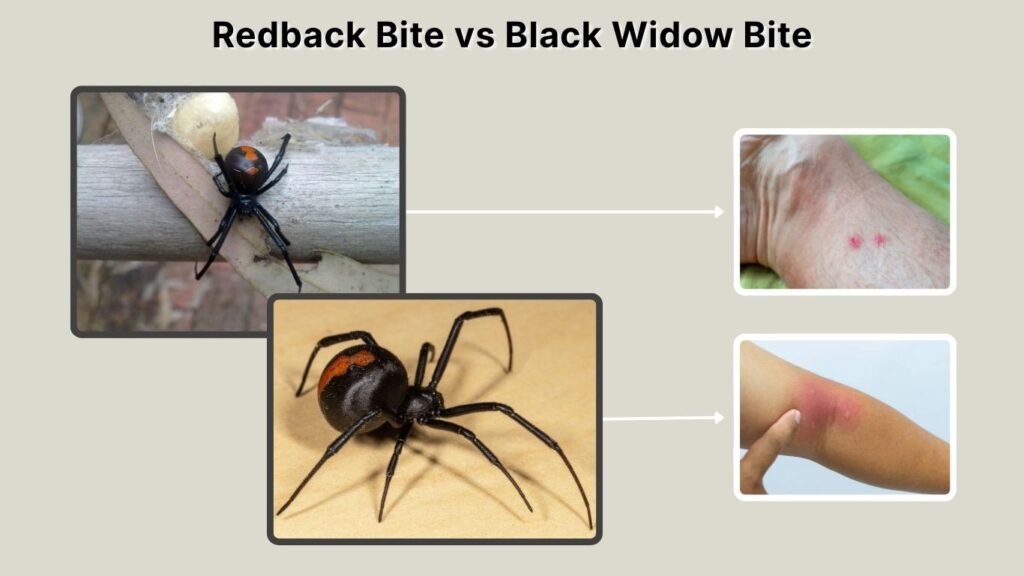
Bites from either spider can be medically significant. Fortunately, both spiders usually remain in their webs and bite people mainly when trapped, squeezed, or accidentally contacted.
Redback Spider Bite Symptoms
- Increasing pain
- Sweating around the bite
- Generalized sweating in significant cases
- Muscular weakness
- Nausea
- Vomiting
- Other systemic symptoms
The Australian Museum describes pain and local sweating as important early signs of redback envenomation.
Black Widow Bite Symptoms
- Pain at the bite site
- Muscle cramps or spasms
- Abdominal or chest pain
- Sweating
- Headache
- Nausea and vomiting
- Muscle weakness or rigidity
- Restlessness
- Increased blood pressure in some patients
Symptoms may begin locally and spread during the first hours following significant envenomation.
Which Is More Dangerous: Redback or Black Widow?
Both deserve respect, but there is no useful universal “winner.” They belong to the same venomous spider genus and can produce broadly similar neurological illness.
Risk to Humans
Healthy adults usually survive appropriately treated widow-spider bites. Severe outcomes and death are rare with modern medical care.
The Australian Museum reports no redback deaths since the introduction of antivenom, while MedlinePlus describes death from a black widow bite in a healthy person as very rare.
Children, older adults, and people with significant symptoms may require particularly careful medical assessment.
If a suspected widow or redback bite causes severe pain, muscle cramping, breathing difficulty, repeated vomiting, weakness, or worsening systemic symptoms, seek urgent medical care.
Redback vs Black Widow Mating Behavior
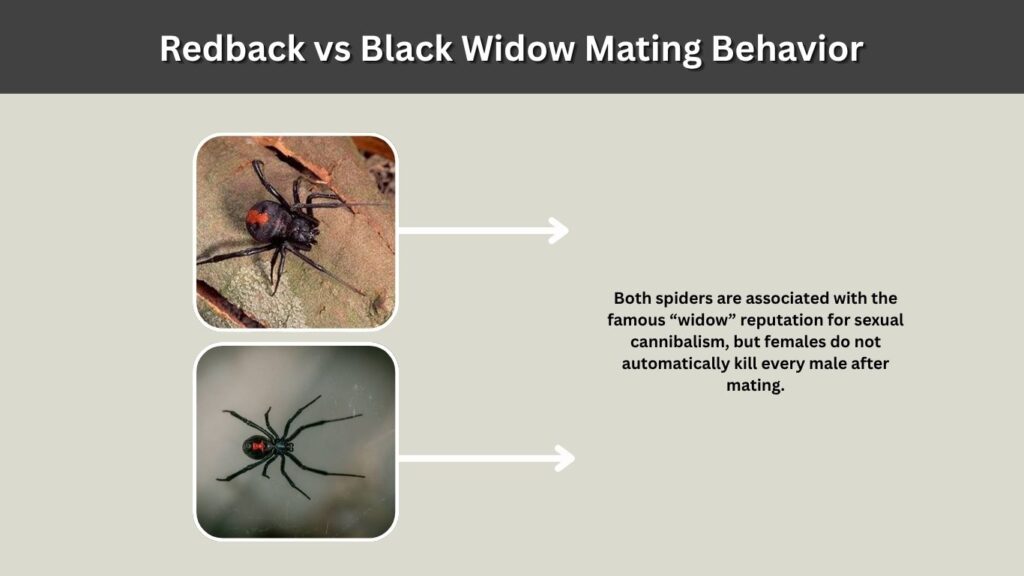
Both spiders are associated with the famous “widow” reputation for sexual cannibalism, but females do not automatically kill every male after mating.
Redback Male Sacrifice
Australian redbacks have particularly extraordinary mating behavior. The male performs a somersault-like movement that places his abdomen near the female’s mouthparts during mating. The female may begin feeding on him while mating continues, and many males do not survive.
Do Black Widows Always Eat Their Mates?
No. Although sexual cannibalism occurs in widow spiders, the popular idea that every female black widow immediately kills and eats her partner is exaggerated.
Whether cannibalism happens depends on the species and circumstances.
Redback vs Black Widow: Who Would Win?
A direct fight is not a useful biological comparison. Both spiders depend primarily on strong silk and venom to capture prey rather than fighting other widow spiders.
Factors such as individual size, sex, web ownership, and which spider successfully immobilized the other first would matter more than whether it was called a redback or black widow.
Their normal prey consists primarily of insects and other small arthropods, not each other.
FAQs
1. Are redbacks and black widows the same spider?
No. They are close relatives in the genus Latrodectus, but the Australian redback is Latrodectus hasselti. “Black widow” refers to several other species, including the southern black widow, Latrodectus mactans.
2. What is the easiest way to tell a redback from a black widow?
Adult female redbacks usually have a conspicuous red stripe on the upper abdomen. A typical adult female southern black widow is best known for the red hourglass on the underside of its abdomen.
3. Is a redback more venomous than a black widow?
There is no simple medically meaningful answer. Both have potent neurotoxic venom and can cause latrodectism. Bite severity depends on many factors beyond species alone.
4. Which is bigger, a redback or black widow?
Their sizes overlap. Female redbacks are about 10 mm in body length, while female southern black widows commonly measure around 8–13 mm.
5. Can a redback or black widow kill a human?
Fatalities are possible historically but are now very rare, particularly when appropriate medical care is available. Significant bites can still be intensely painful and should be taken seriously.
