
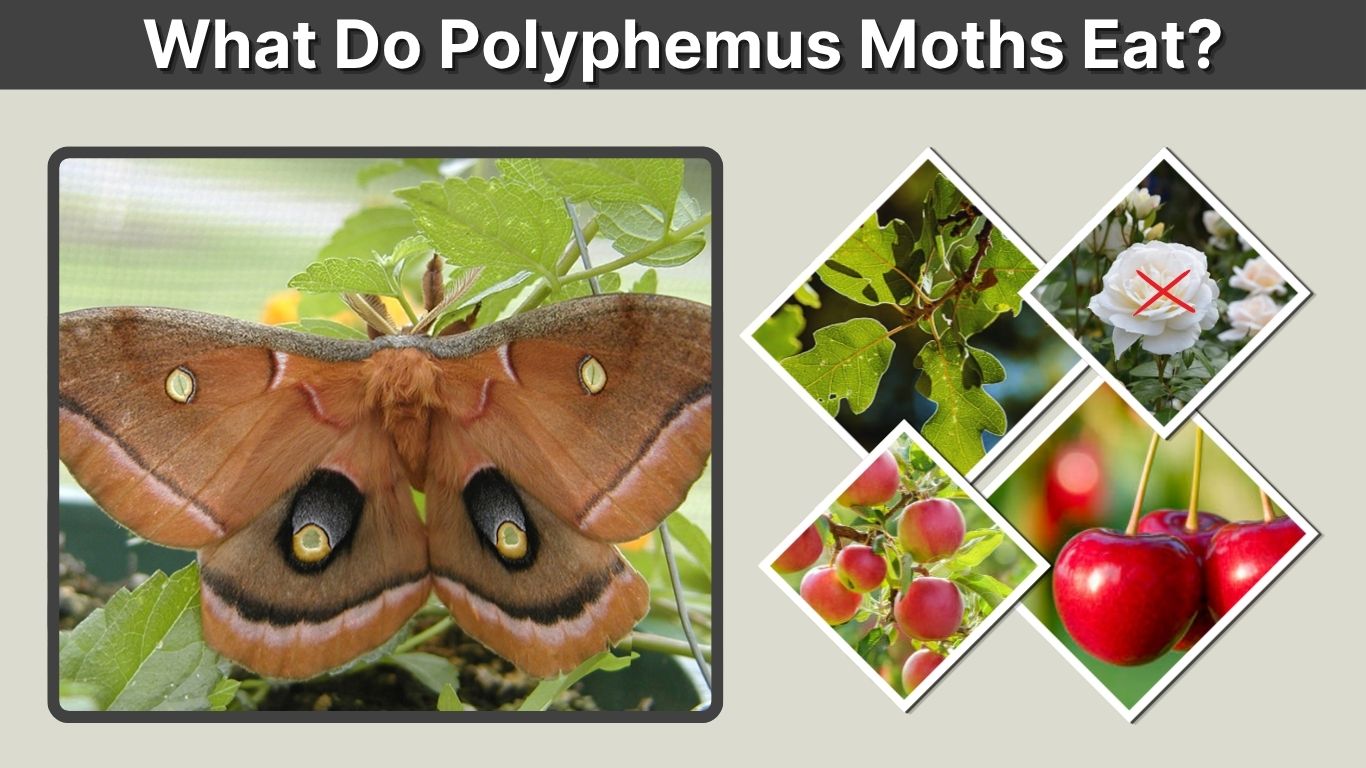
What do Polyphemus moths eat? The answer depends entirely on their life stage. Adult Polyphemus moths do not eat because their mouthparts are reduced and nonfunctional. Instead, they survive on energy stored during the caterpillar stage. Polyphemus moth caterpillars, however, are active feeders that consume leaves from many deciduous trees and shrubs. Oak, maple, birch, willow, hickory, apple, cherry, and several other plants can serve as food. Understanding this difference helps explain why the caterpillar spends so much of its life feeding and growing.
Do Adult Polyphemus Moths Eat?
Adult Polyphemus moths, scientifically known as Antheraea polyphemus, do not normally eat or drink. This may seem unusual for such a large insect, but it is common among many members of the giant silk moth family, Saturniidae.
The adult stage is designed primarily for reproduction rather than feeding.
Why Don’t Polyphemus Moths Eat?
Adult Polyphemus moths have greatly reduced mouthparts that are not functional for normal feeding.
They cannot visit flowers for nectar in the same way butterflies and many smaller moths do. They also do not feed on fruit, tree sap, leaves, or other common insect foods.
Instead, adults rely entirely on fat and energy reserves accumulated while they were caterpillars.
This stored energy powers important activities such as:
- Flying
- Searching for mates
- Producing pheromones
- Mating
- Egg development
- Egg laying
Once those reserves are depleted, the adult moth eventually dies.
How Long Can They Live Without Eating?
Adult Polyphemus moths usually live for only about a week, although the exact lifespan can vary.
Because they cannot replenish their energy, their adult lives are naturally short.
Males typically spend much of their available energy flying in search of females, while females use substantial energy producing and laying eggs.
What Do Polyphemus Moth Caterpillars Eat?
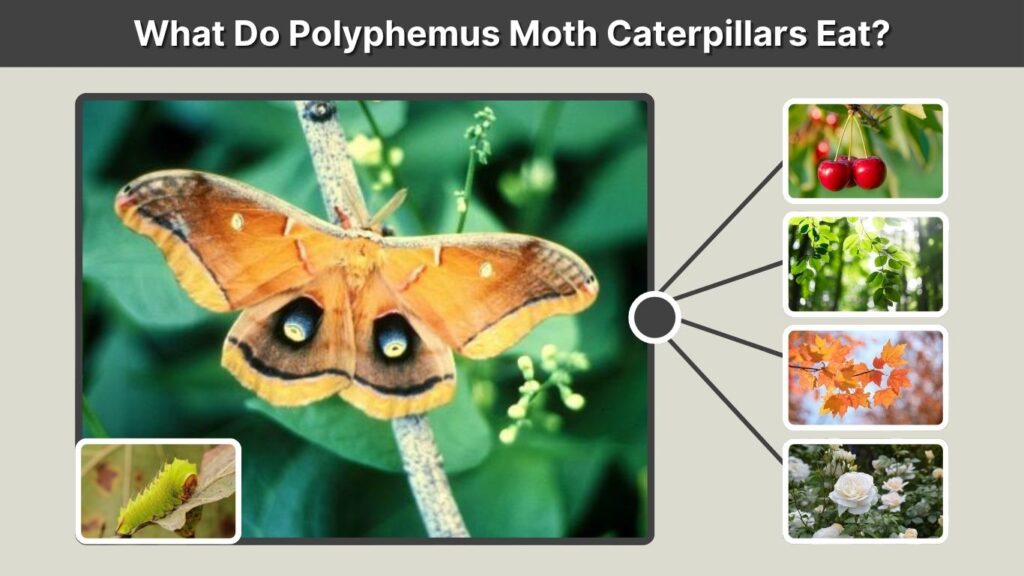
Polyphemus moth caterpillars have a very different lifestyle. Their main activity is eating.
The caterpillars feed on the leaves of numerous deciduous trees and shrubs. During their larval development, they consume enough food to support rapid growth and store the energy they will need after becoming adults.
Common Polyphemus Caterpillar Food Plants
Polyphemus moth larvae may feed on:
- Oak
- Maple
- Birch
- Willow
- Hickory
- Elm
- Beech
- Apple
- Cherry
- Plum
- Rose
- Alder
Oak is one of the commonly associated host plants, but the caterpillars are capable of using many different tree species.
The exact plants available to them vary across their large North American range.
Do They Eat the Entire Leaf?
Polyphemus caterpillars chew the soft tissues of leaves.
Small caterpillars may create relatively minor feeding damage, while mature larvae can consume much larger portions because their nutritional requirements increase dramatically.
A large caterpillar may eat considerable amounts of foliage each day as it prepares for pupation.
Despite this appetite, individual Polyphemus caterpillars are usually not considered major destructive tree pests.
What Do Baby Polyphemus Moth Caterpillars Eat?
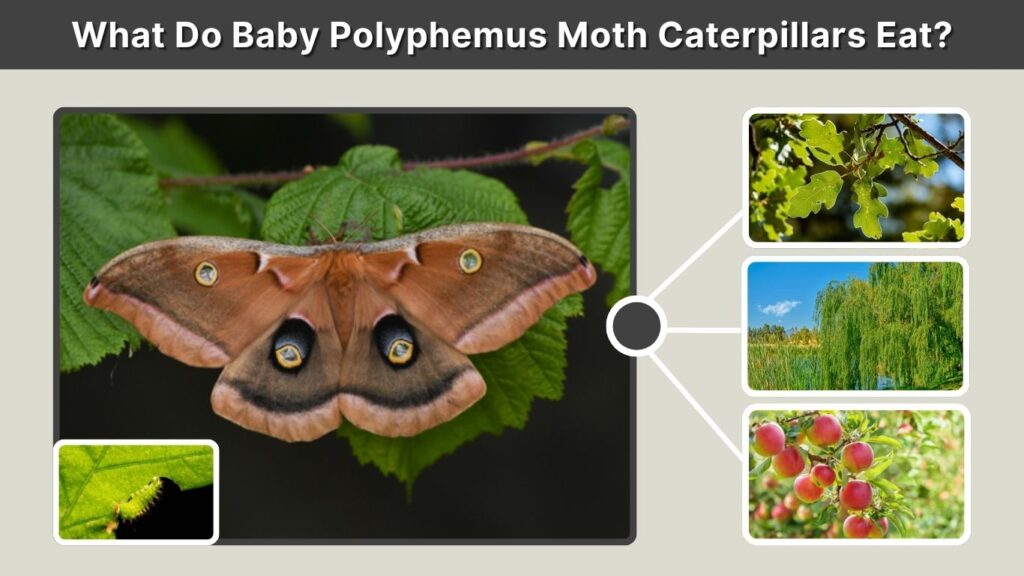
Baby Polyphemus caterpillars begin feeding soon after hatching.
They need tender, fresh leaves from an appropriate host plant. Young caterpillars are much smaller than mature larvae, so they consume relatively small portions at first.
Best Food for Newly Hatched Caterpillars
Suitable foods include fresh leaves from host trees such as:
- Oak
- Maple
- Willow
- Birch
- Apple
- Cherry
Leaves should be free from pesticides and other chemical treatments.
If a caterpillar is already feeding successfully on a particular type of plant, continuing with that host plant is generally better than constantly changing its food.
Young caterpillars may not readily accept every suitable host plant after becoming established on another species.
How Does a Polyphemus Caterpillar’s Diet Change as It Grows?
Polyphemus caterpillars pass through several developmental stages called instars.
Between instars, the caterpillar molts and becomes larger. Its appetite also increases substantially.
Early Instars
Newly hatched larvae consume small amounts of leaf tissue.
At this stage, they are relatively delicate and require fresh foliage to maintain healthy growth.
Later Instars
Older caterpillars are much larger and consume considerably more food.
The final larval stages are especially important because the caterpillar must build enough nutritional reserves for:
- Cocoon construction
- Pupation
- Metamorphosis
- Adult emergence
- Flight
- Reproduction
This explains why fully grown Polyphemus caterpillars can appear to eat almost constantly.
Polyphemus Moth Host Plants
A host plant is a plant that provides food and developmental habitat for caterpillars.
Female Polyphemus moths generally lay their eggs on plants that their offspring can eat after hatching.
Why Host Plants Matter
Adult females cannot feed their offspring. Once the eggs hatch, the tiny caterpillars must immediately locate suitable leaves.
Choosing an appropriate host plant increases their chances of survival.
Polyphemus moths are considered relatively flexible feeders compared with species whose caterpillars depend on only one or two plant types.
Their ability to use many deciduous trees helps explain their broad distribution across North America.
What Should You Feed a Polyphemus Caterpillar in Captivity?
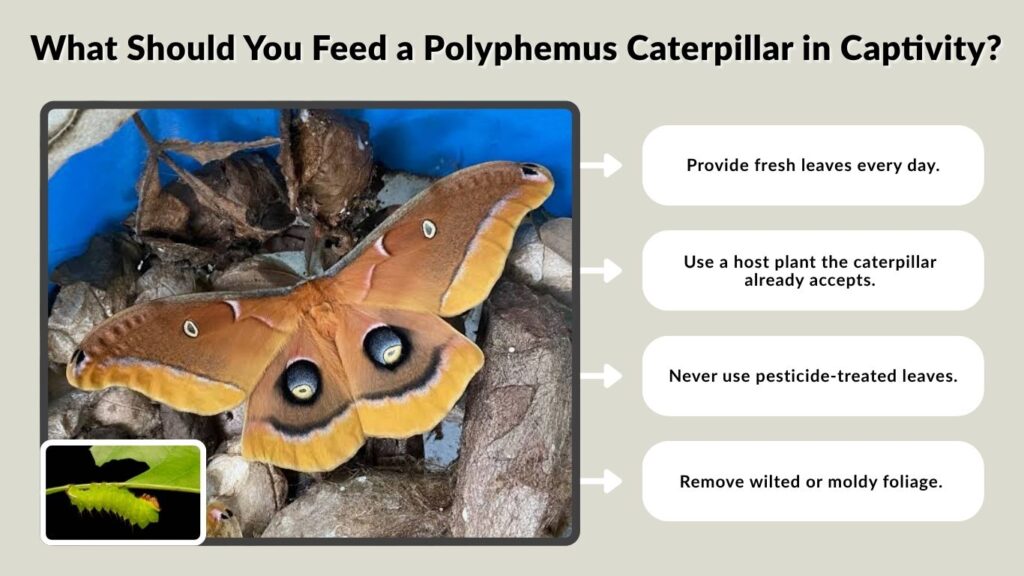
People sometimes raise Polyphemus caterpillars to observe their development into adult moths.
If one is being raised responsibly, fresh leaves from a suitable host plant are essential.
Feeding Guidelines
Keep several basic points in mind:
- Provide fresh leaves every day.
- Use a host plant the caterpillar already accepts.
- Never use pesticide-treated leaves.
- Remove wilted or moldy foliage.
- Keep the enclosure ventilated.
- Remove caterpillar droppings regularly.
- Provide increasing quantities of leaves as the caterpillar grows.
Do not assume that lettuce, vegetables, or random garden plants will work.
These caterpillars are adapted to eating foliage from specific trees and shrubs.
Do Polyphemus Moth Caterpillars Eat Oak Leaves?
Yes. Oak leaves are an important food source for Polyphemus moth caterpillars.
Several oak species may serve as host plants throughout the moth’s range.
Oak trees can provide abundant foliage during the caterpillar’s growing season, making them valuable habitat for this and many other native moth species.
However, oak is not their only food. Polyphemus caterpillars are capable of feeding on many other deciduous plants.
Do Polyphemus Moths Eat Flowers or Nectar?
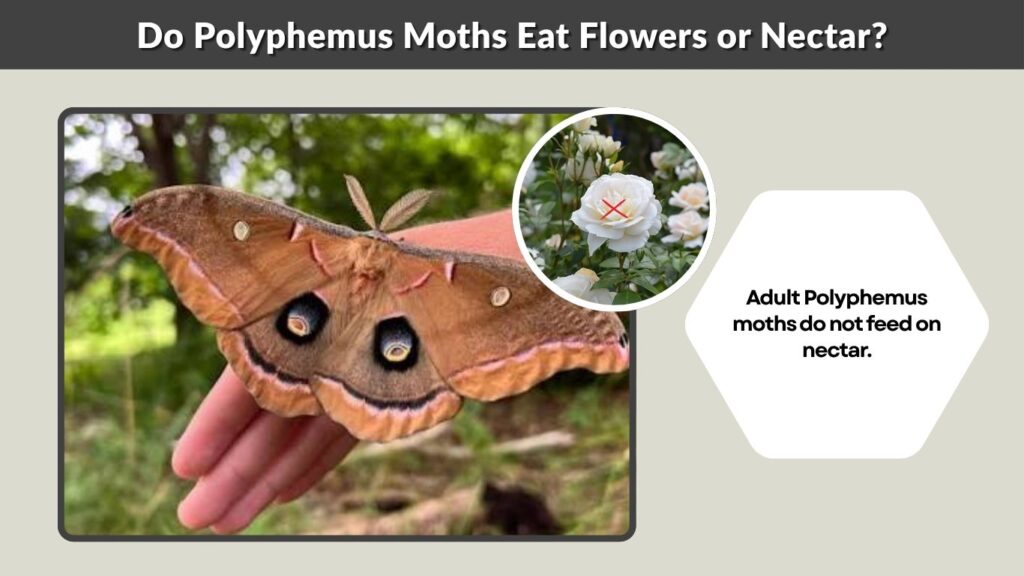
Adult Polyphemus moths do not feed on nectar.
This separates them from many butterflies and moth species that regularly visit flowers.
Their large size sometimes leads people to assume they must consume considerable amounts of food as adults. In reality, virtually all of their nutritional intake occurs during the caterpillar stage.
The adult moth’s body is essentially operating on stored energy until reproduction is complete.
Why Does the Caterpillar Eat So Much?
A mature Polyphemus caterpillar must prepare for a period when it will never eat again.
Before pupating, it needs enough stored nutrients to complete metamorphosis and support the adult moth’s entire life.
Once the caterpillar forms its cocoon, it stops feeding.
The adult that later emerges cannot replace lost energy, so successful feeding during the larval stage directly influences its ability to survive, fly, and reproduce.
FAQs
What does an adult Polyphemus moth eat?
Adult Polyphemus moths do not eat. Their mouthparts are reduced and unable to function normally for feeding. Adults survive using energy reserves accumulated while they were caterpillars. Their short adult lives are devoted mainly to finding mates and reproducing.
What do Polyphemus moth caterpillars eat?
Polyphemus moth caterpillars eat leaves from many deciduous trees and shrubs. Common host plants include oak, maple, birch, willow, hickory, elm, apple, cherry, beech, and rose. Their appetite increases substantially as they approach maturity.
Do Polyphemus caterpillars eat oak leaves?
Yes. Oak is one of the common host plants used by Polyphemus caterpillars. They can feed on leaves from several types of oak, although they are not restricted to oak and may also use numerous other deciduous trees.
What should I feed a Polyphemus caterpillar?
Provide fresh, pesticide-free leaves from a known host plant, preferably the same plant species the caterpillar was already eating. Oak, maple, willow, birch, apple, and cherry are among the possible options. Replace wilted leaves regularly.
Do Polyphemus moths drink nectar?
No. Adult Polyphemus moths do not normally drink nectar because they lack functional feeding mouthparts. Unlike many butterflies and flower-feeding moths, they receive all the nutrition needed for adulthood from food eaten during their caterpillar stage.
