
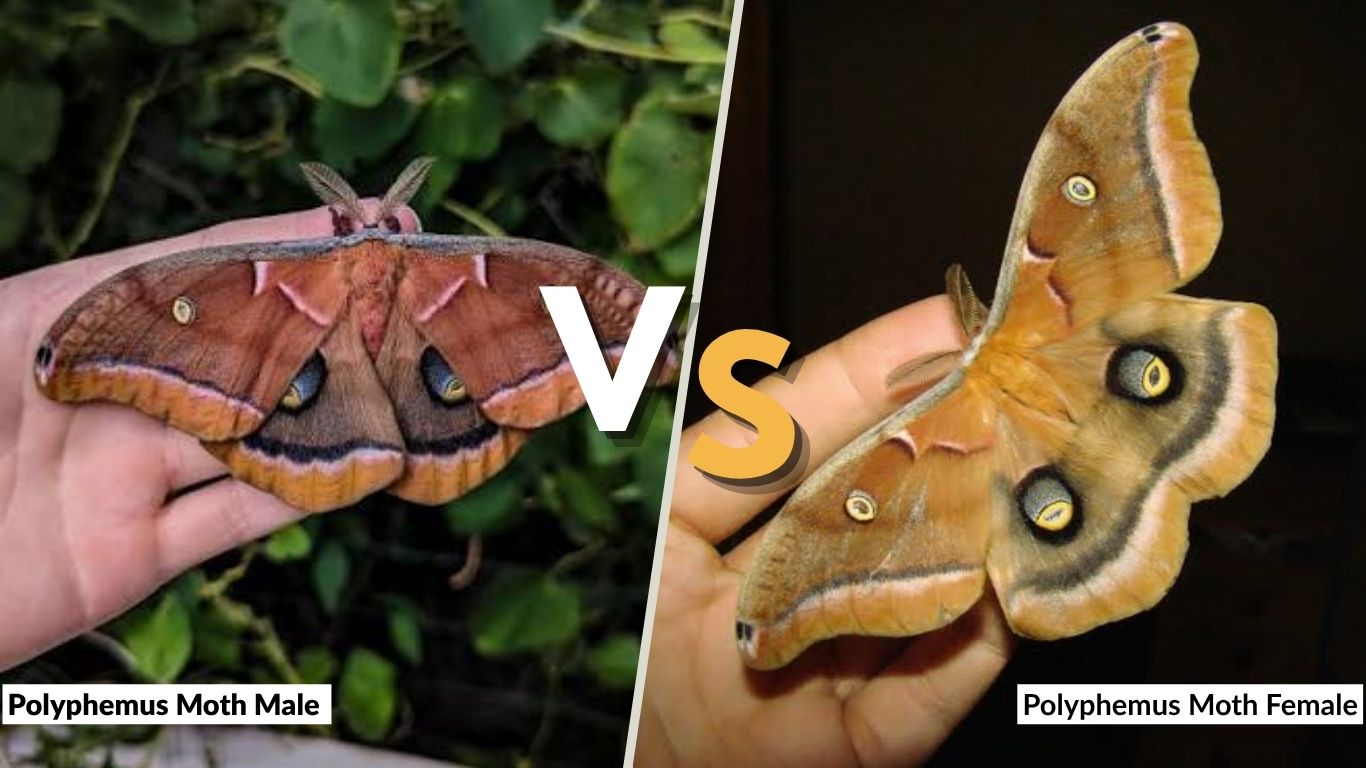
Telling a male vs female Polyphemus moth apart is fairly easy once you know which features to examine. Both sexes of Antheraea polyphemus have large tan wings, prominent hindwing eyespots, and thick furry bodies, but their antennae, abdomen shape, size, and behavior differ noticeably. Male Polyphemus moths have extremely broad, feathery antennae that help them locate females, while females usually have larger abdomens filled with eggs. These differences are especially useful when identifying adult moths outdoors or after one emerges from a cocoon.
Polyphemus Moth Male vs Female Differences
Male and female Polyphemus moths share the same basic wing pattern, so color alone is not the best way to determine sex. Instead, look closely at the antennae and abdomen.
Quick Identification Differences
The main differences include:
- Antennae: Males have much broader, more feather-like antennae.
- Abdomen: Females have thicker and rounder abdomens.
- Body size: Females are generally heavier-bodied.
- Behavior: Males commonly fly farther while searching for females.
- Eggs: Only females carry and lay eggs.
- Pheromones: Females release chemical signals that attract males.
Among these features, antenna shape is usually the easiest and most reliable characteristic to examine.
Male Polyphemus Moth
A male Polyphemus moth has exceptionally large, feathery antennae.
These structures are not simply decorative. They contain sensory receptors capable of detecting pheromones released by receptive females.
The male’s abdomen is usually narrower than the female’s because it does not need to hold eggs.
Males frequently become active after dark and may travel considerable distances while searching for a mate.
Female Polyphemus Moth
Female Polyphemus moths typically have noticeably larger abdomens.
A newly emerged female may appear particularly heavy-bodied because she carries many eggs.
Her antennae are still feathered but are considerably narrower than those of a male.
Rather than spending large amounts of energy flying long distances, females often remain relatively stationary while releasing pheromones that attract males.
Male vs Female Polyphemus Moth Antennae
The antennae provide one of the clearest visual differences between the sexes.
Both male and female Polyphemus moths have antennae designed to detect chemical signals and environmental information, but the male’s are dramatically larger.
Why Do Males Have Larger Antennae?
Male Polyphemus moths need to locate females during their very short adult lives.
Their broad antennae provide a large surface area containing many sensory receptors.
These receptors allow a male to detect tiny concentrations of female pheromones in the air and follow the chemical signal toward a potential mate.
The female does not need the same level of pheromone detection, so her antennae are much narrower.
Male vs Female Polyphemus Moth Abdomen
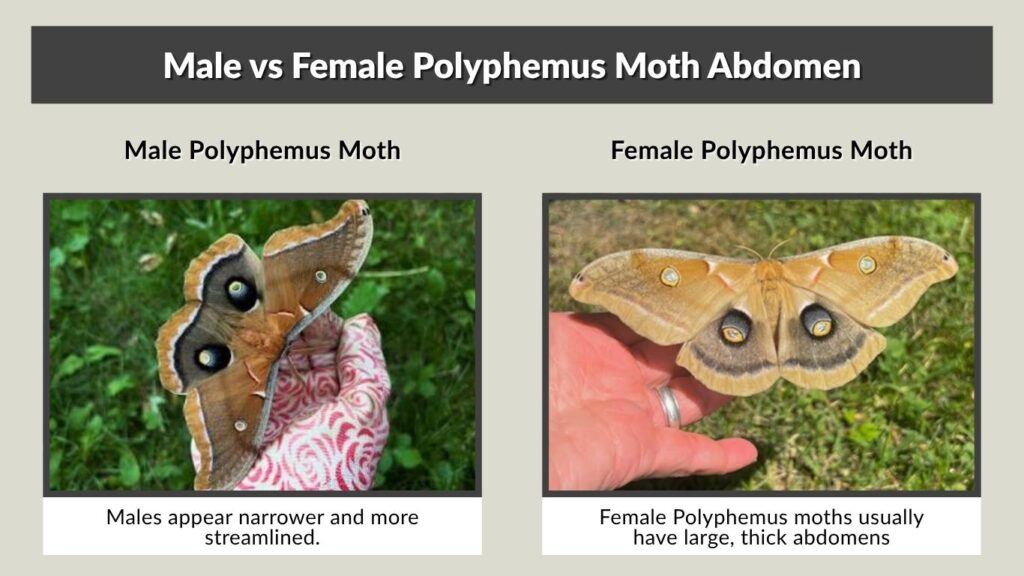
The abdomen is another useful identification feature.
Female Polyphemus moths usually have large, thick abdomens, while males appear narrower and more streamlined.
Why Are Females Larger?
A female’s abdomen contains developing eggs, which increases both its width and weight.
After mating, she deposits the eggs on or near suitable host plants where newly hatched caterpillars will have access to food.
As eggs are laid, the female’s abdomen may gradually become smaller.
Male moths lack this egg-carrying requirement and therefore tend to have thinner abdomens.
Male and Female Polyphemus Moth Behavior
Behavior can also provide clues to sex, particularly during the breeding period.
Adults do not normally feed, so their limited energy is devoted primarily to reproduction.
Male Behavior
Male Polyphemus moths tend to be active fliers.
After detecting a female’s pheromone, a male follows the scent through the air until he reaches her location.
His large antennae make this remarkable tracking ability possible.
Female Behavior
Females may remain relatively still while releasing pheromones.
After mating, a female becomes more active while searching for appropriate plants on which to lay her eggs.
Suitable host plants are important because the emerging caterpillars must immediately begin feeding.
Can You Tell a Male From a Female by Wing Color?
Wing coloration is generally not the best characteristic for sex identification.
Both sexes have tan to reddish-brown wings decorated with lighter bands and distinctive eyespots.
Individual coloration can vary, making apparent color differences unreliable.
Antennae and abdomen shape provide much stronger clues.
Polyphemus Moth vs Luna Moth
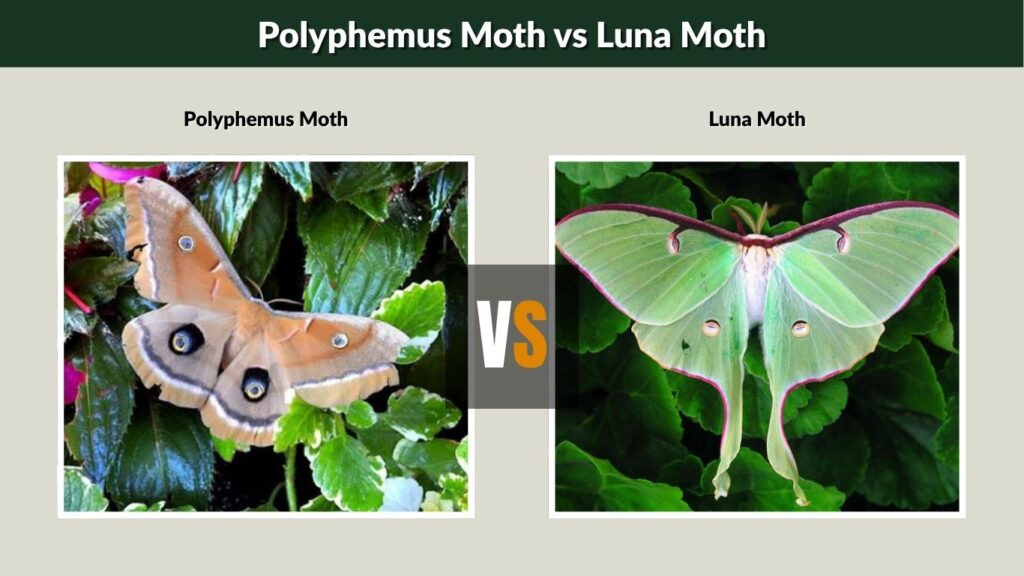
Polyphemus and Luna moths both belong to the Saturniidae family, but adult moths are easily distinguished.
The Polyphemus moth is usually tan or brown with enormous eyespots, while the Luna moth is famous for its pale green wings and long hindwing tails.
Polyphemus vs Luna Moth Identification
Polyphemus moth:
- Tan to brown wings
- Large hindwing eyespots
- No long wing tails
- Thick furry body
Luna moth:
- Pale green wings
- Long hindwing tails
- Smaller transparent eyespots
- White or pale body
Both species have strongly feathered antennae in males and broader abdomens in females.
Polyphemus Moth Caterpillar vs Luna Moth Caterpillar
The caterpillars are considerably harder to distinguish than the adults.
Both are large, green larvae belonging to the giant silk moth family.
Key Caterpillar Differences
Polyphemus caterpillars are typically thick green caterpillars with small raised tubercles and noticeable yellowish markings along their sides.
Luna moth caterpillars are also green and have rows of small tubercles that may appear reddish or orange.
Because appearance can change between larval stages, host plant and detailed body markings should be considered together rather than relying on color alone.
You also cannot reliably determine whether a caterpillar will become a male or female merely by casual external observation.
Cecropia Moth vs Polyphemus Moth
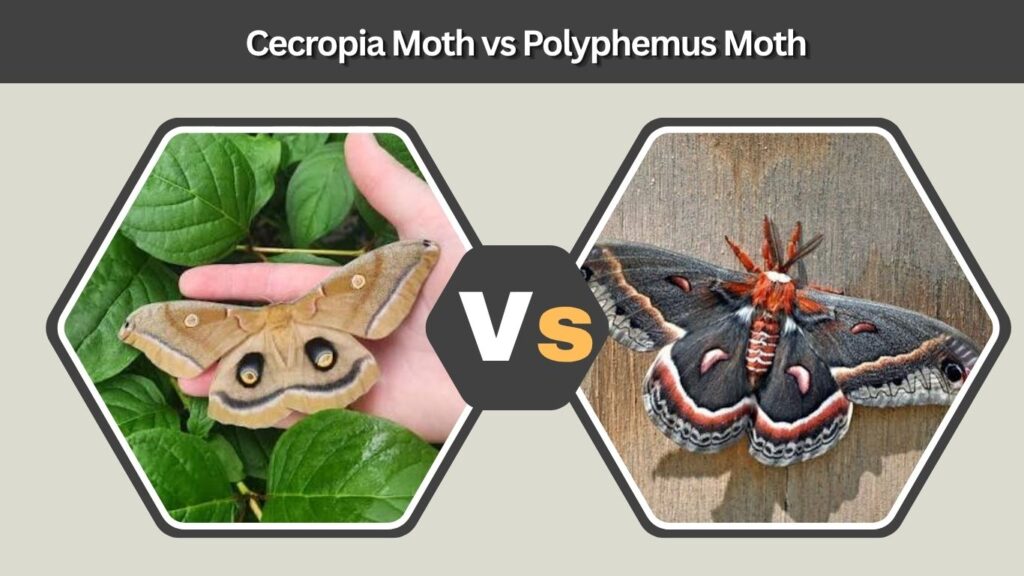
Cecropia and Polyphemus moths are both large North American silk moths, but their adult coloration is very different.
How to Tell Them Apart
A Cecropia moth has:
- Red, black, brown, and white markings
- Bold white wing bands
- Reddish body sections
- Large crescent-shaped wing markings
A Polyphemus moth has:
- Mostly tan or brown wings
- Large circular hindwing eyespots
- More subdued overall coloration
- Dark and light wavy wing lines
Both species can become very large and have noticeably feathered antennae.
Polyphemus Moth vs Atlas Moth
The Atlas moth and Polyphemus moth are both impressive giant silk moths, but they occur in different parts of the world and have very different wing patterns.
Atlas moths are considerably larger and are native to parts of Asia. Their broad reddish-brown wings have distinctive transparent patches, and their forewing tips resemble snake heads.
Polyphemus moths are native to North America and are best recognized by the large eyespots on their hindwings.
Can Male and Female Polyphemus Moths Eat?
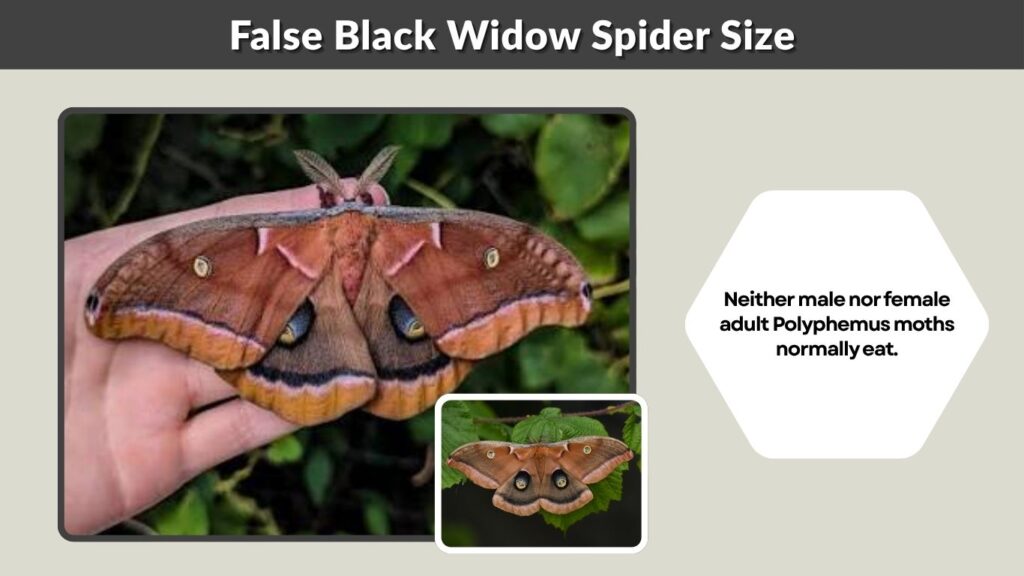
Neither male nor female adult Polyphemus moths normally eat.
Adults have greatly reduced mouthparts and survive entirely on energy stored during the caterpillar stage.
This gives them only a limited amount of time to reproduce.
Males use much of their energy searching for females, while females devote their stored resources to mating and laying eggs.
FAQs
How can you tell if a Polyphemus moth is male or female?
Examine the antennae and abdomen. Male Polyphemus moths have extremely broad, feathery antennae and relatively narrow abdomens. Females have thinner antennae and noticeably larger, rounder abdomens because they carry eggs.
Are female Polyphemus moths bigger than males?
Females generally have heavier and thicker bodies, especially around the abdomen. Their wingspan may not always be dramatically larger, but egg-carrying females usually look bulkier than males, which tend to have slimmer bodies and much broader antennae.
Why do male Polyphemus moths have large antennae?
The male’s large antennae contain highly sensitive receptors that detect pheromones released by females. This allows a male to locate a potential mate by following extremely small concentrations of chemical signals through the air.
Is a Polyphemus moth the same as a Luna moth?
No. They are different species, although both belong to the giant silk moth family. Polyphemus moths are tan or brown with large eyespots, while Luna moths are pale green and have distinctive long tails extending from their hindwings.
Can you tell if a Polyphemus caterpillar is male or female?
It is difficult to determine the sex of a Polyphemus moth during the caterpillar stage through ordinary visual inspection. Sexual differences become much easier to recognize after adulthood, particularly by comparing antenna width and abdomen shape.
