
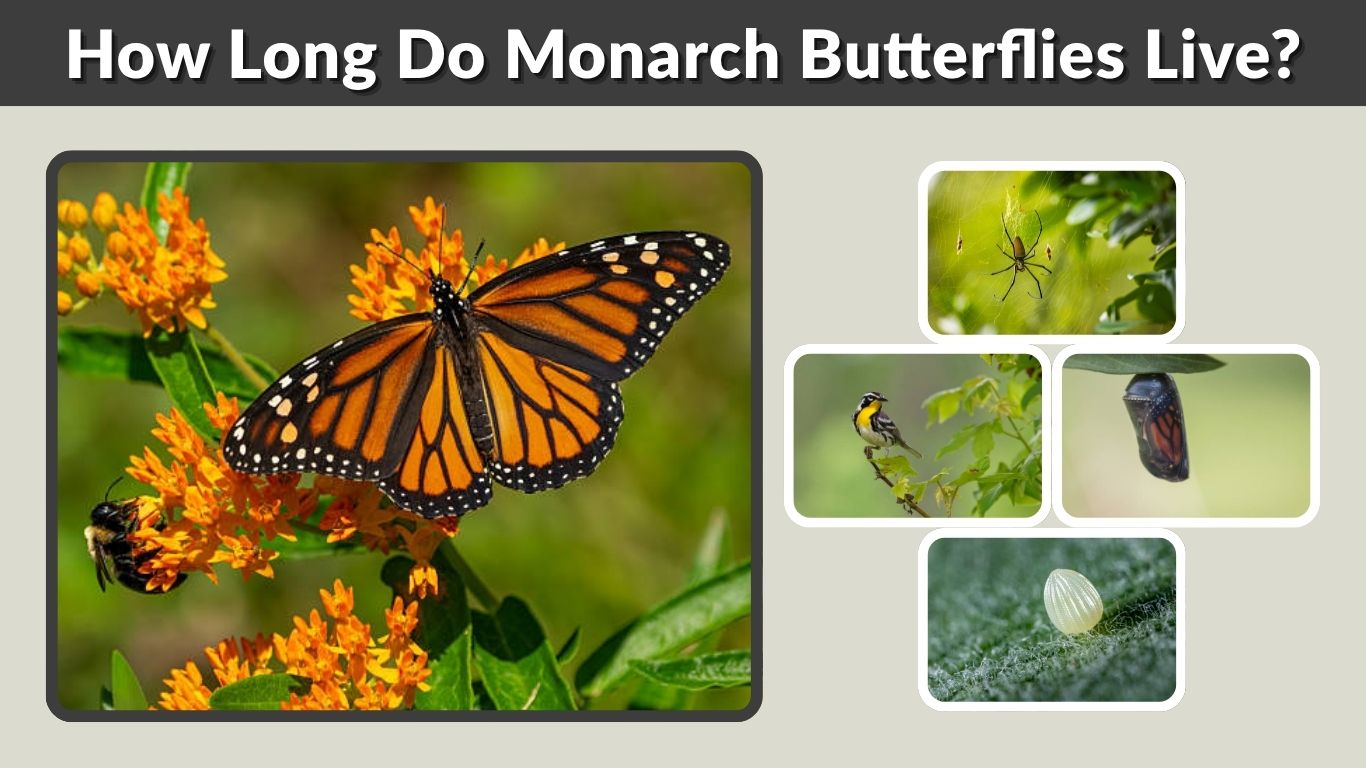
Most adult monarch butterflies live for approximately two to six weeks. However, the special generation that migrates and spends winter in protected locations can survive for six to nine months.
This major difference occurs because summer monarchs quickly reproduce, while the migratory generation delays reproduction and enters a state called reproductive diapause. Temperature, weather, food availability, predators, disease, pesticides, and migration conditions also affect how long an individual monarch survives.
Average Monarch Butterfly Lifespan
The lifespan of a monarch butterfly depends mainly on the season and generation in which it develops. Several generations may appear during spring and summer, followed by one long-lived migratory generation in late summer or fall.
| Monarch generation | Approximate adult lifespan | Main activity |
| Spring generation | 2–6 weeks | Migrates, mates, and lays eggs |
| Summer generation | 2–6 weeks | Reproduces and produces another generation |
| Migratory generation | 6–9 months | Migrates, overwinters, and reproduces in spring |
| Captive monarch | Usually 2–6 weeks | Depends heavily on care and generation |
A monarch’s complete life, from egg to death as an adult, is longer than its adult butterfly stage alone.
How Long Do Adult Monarch Butterflies Live?
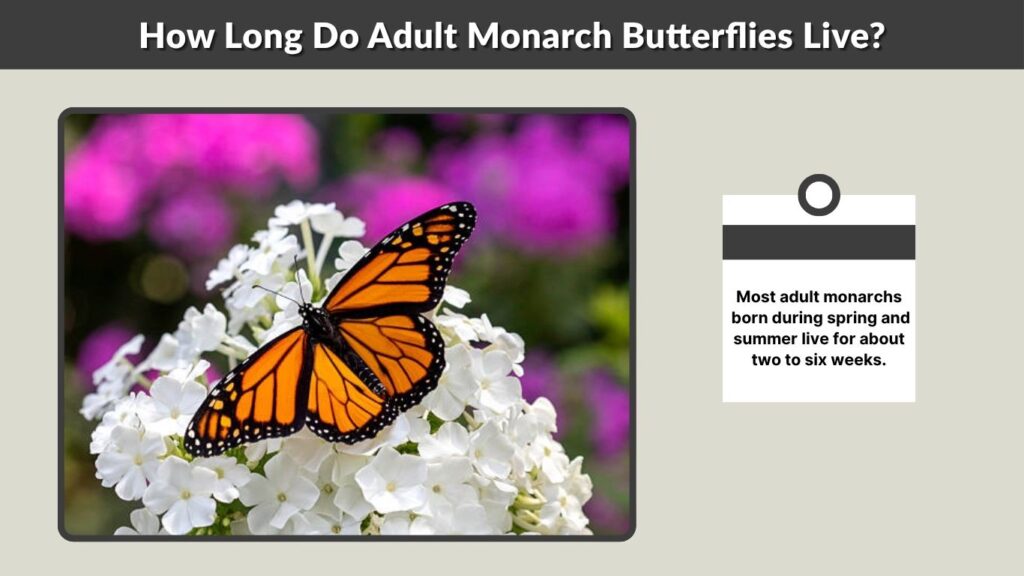
Most adult monarchs born during spring and summer live for about two to six weeks. During this short period, they must find nectar, avoid predators, mate, and reproduce.
Female monarchs search for milkweed plants and lay their eggs individually on the leaves. Males spend much of their adult lives locating females and competing for mating opportunities.
These summer generations age relatively quickly because their bodies are focused on reproduction. After mating and laying eggs, their energy reserves decrease, and they become more vulnerable to environmental stress.
Some individuals may die within days because of predators, storms, disease, or injury. Others may survive longer than six weeks when conditions are favorable.
How Long Do Migrating Monarch Butterflies Live?
Migrating monarch butterflies can live for approximately six to nine months. This long-lived generation is sometimes called the migratory, overwintering, or Methuselah generation.
These monarchs emerge during late summer or early fall. Instead of mating immediately, they delay reproductive development and conserve energy for migration and winter survival.
Why Migratory Monarchs Live Longer
Migratory monarchs live longer because they enter reproductive diapause. During this temporary condition, their reproductive organs remain inactive.
This allows the butterflies to direct more energy toward:
- Building fat reserves
- Flying long distances
- Surviving colder weather
- Resting in overwintering clusters
- Remaining alive until spring
- Beginning the return migration
Eastern monarchs may travel thousands of miles to overwintering forests in central Mexico. Many western monarchs migrate to protected coastal areas in California or Mexico.
After winter, rising temperatures and longer days help end reproductive diapause. The butterflies become reproductively active, mate, and travel northward to lay eggs. Most do not complete the entire northward journey. Their descendants continue the migration over several generations.
How Do Monarch Butterflies Live So Long in Winter?
Winter monarchs survive by slowing their activity and conserving energy. They gather in large clusters in protected trees, where the surrounding forest creates a cool and relatively stable microclimate.
Cool temperatures reduce their metabolic rate. As a result, they use stored fat more slowly than highly active summer monarchs.
On warm, sunny days, the butterflies may leave their clusters to drink water or nectar. When temperatures fall, they return to sheltered trees.
Their survival depends on a careful balance. Temperatures must remain cool enough to reduce energy use but not so cold that the butterflies freeze. Strong storms, heavy rain, extreme cold, habitat loss, and prolonged warm periods can increase winter mortality.
The Complete Monarch Butterfly Life Cycle
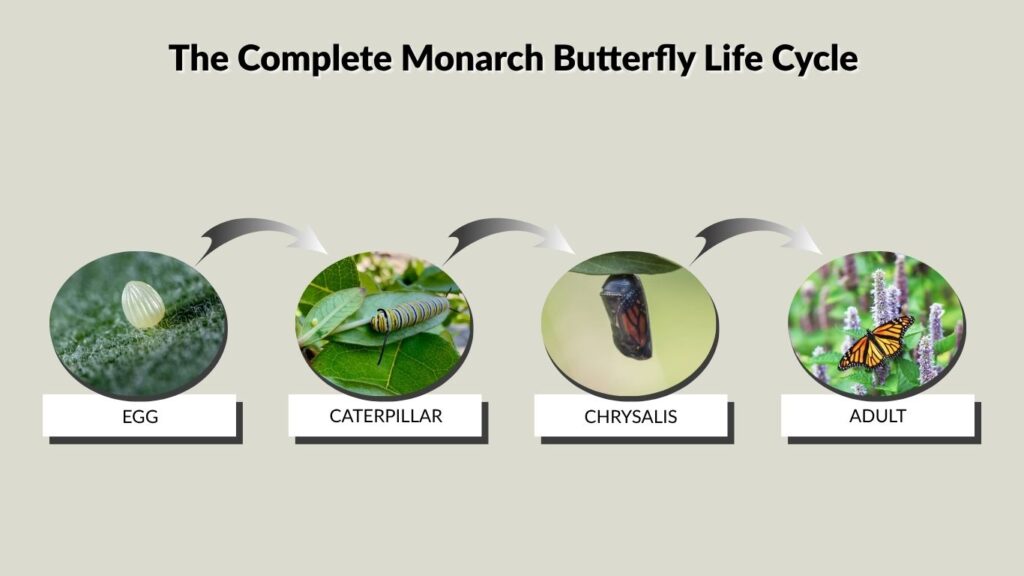
A monarch passes through four life-cycle stages: egg, caterpillar, chrysalis, and adult. Under warm conditions, development from egg to adult often takes about three to five weeks.
Egg Stage
The egg stage usually lasts approximately three to five days. A female monarch normally places each tiny egg on the underside of a milkweed leaf.
Shortly before hatching, the developing caterpillar becomes visible through the eggshell. Once it emerges, it may eat the empty shell before feeding on milkweed.
Caterpillar Stage
The caterpillar stage generally lasts around 10 to 14 days. During this period, the larva eats milkweed, grows rapidly, and sheds its skin five times.
Each stage between molts is called an instar. A fully grown monarch caterpillar is much larger and heavier than it was when it hatched.
Chrysalis Stage
The monarch remains in its chrysalis for approximately eight to 15 days. Inside, the caterpillar’s body is reorganized into an adult butterfly.
Temperature has a strong effect on development. Warm conditions can speed up the process, while cooler temperatures may delay emergence.
Adult Stage
After emerging, the adult monarch expands and dries its wings. It may begin flying and feeding within several hours.
Summer adults usually live for two to six weeks. The migratory generation may survive for up to nine months, making it unusually long-lived compared with other monarch generations.
How Long Do Monarch Butterflies Live in the Wild?
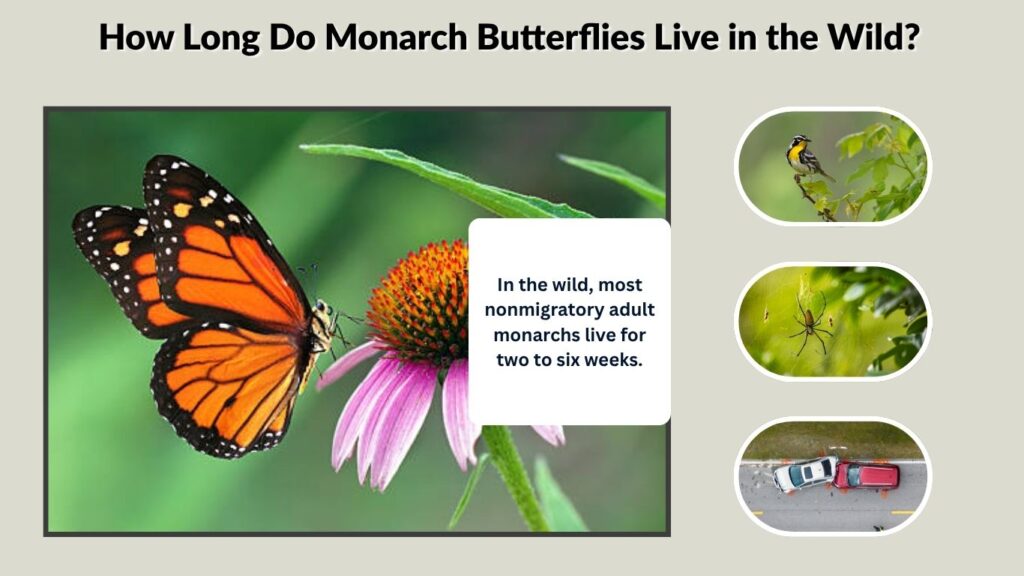
In the wild, most nonmigratory adult monarchs live for two to six weeks. However, their potential lifespan does not guarantee that they will survive that long.
Wild monarchs face numerous dangers, including:
- Birds and other predators
- Spiders and predatory insects
- Parasites and diseases
- Strong winds and storms
- Vehicle collisions
- Pesticide exposure
- Nectar shortages
- Habitat destruction
- Exhaustion during migration
Only a portion of monarch eggs survive long enough to become adult butterflies. Many are eaten or killed during the egg and caterpillar stages.
Adults that emerge healthy and find abundant nectar have a better chance of reaching their natural lifespan.
How Long Do Monarch Butterflies Live in Captivity?
Captive monarch butterflies generally live for approximately two to six weeks when they belong to a normal spring or summer generation.
Captivity does not automatically make a monarch live longer. Poor ventilation, overcrowding, unsuitable temperatures, contaminated enclosures, and insufficient food can shorten its life.
Adult monarchs need access to fresh nectar-producing flowers or an appropriate temporary food source. They also need enough space to move and fly normally.
Keeping adult monarchs confined for long periods is usually unnecessary. Healthy butterflies raised for educational purposes should normally be released when weather conditions are suitable and local regulations allow it.
Migratory monarchs may naturally have the biological ability to survive for several months. However, keeping them in captivity throughout that period requires specialized conditions and may interfere with their normal migration.
Do Male and Female Monarchs Live the Same Length?
Male and female monarch butterflies have broadly similar potential lifespans. There is no fixed rule stating that one sex always lives longer.
Their survival can differ because of behavior. Males may use energy patrolling for females, defending areas, and mating. Females use considerable energy producing and laying hundreds of eggs.
A female may travel widely while searching for healthy milkweed. A male may become injured during competition or mating activity. Environmental conditions usually have a greater effect on lifespan than sex alone.
Monarch Lifespan in Florida
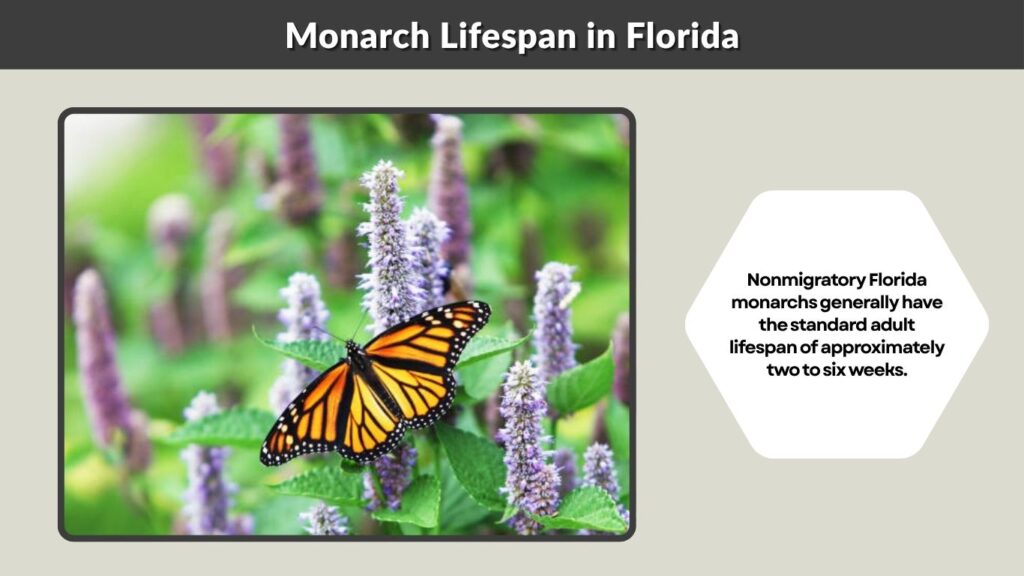
Monarch butterflies in Florida may be migratory or part of a population that remains in the region for much of the year.
Nonmigratory Florida monarchs generally have the standard adult lifespan of approximately two to six weeks. They continue mating and reproducing instead of entering the prolonged reproductive diapause associated with northern migratory monarchs.
Florida’s warm climate may allow milkweed and adult butterflies to remain active for extended periods. However, year-round breeding can increase exposure to diseases and parasites, particularly when tropical milkweed does not die back seasonally.
Monarch Lifespan in Australia and New Zealand
Monarch butterflies also live in Australia and New Zealand, where they may be called wanderer butterflies. Their exact lifespan varies with temperature, season, food availability, and local migration behavior.
Actively reproducing adults commonly live for several weeks. Butterflies that delay reproduction and form winter clusters may survive for several months.
Because local climates differ greatly, monarchs in warmer areas may reproduce through much of the year, while those in cooler regions may gather at sheltered winter sites.
Factors That Affect Monarch Butterfly Lifespan
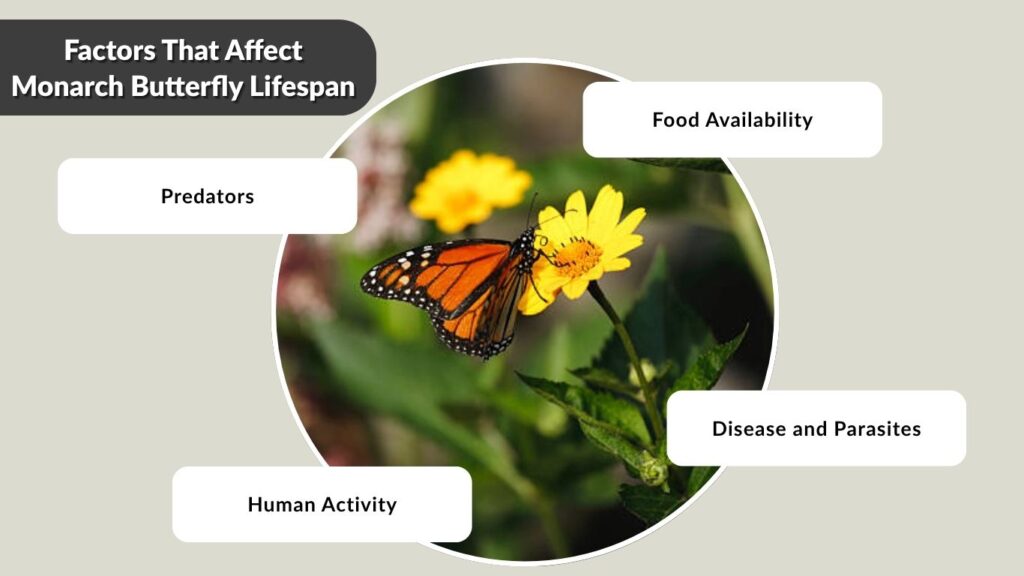
A monarch’s lifespan is controlled by both biology and its environment.
Food Availability
Adults drink nectar from many flowering plants. Nectar supplies carbohydrates needed for flight, reproduction, and migration.
Migratory monarchs require especially abundant late-blooming flowers so they can build the fat reserves needed for their journey and winter survival.
Temperature and Weather
Moderate temperatures support normal activity. Extreme heat can cause dehydration, while freezing conditions may be fatal.
Heavy rain, high winds, drought, and severe storms can reduce feeding opportunities and physically damage butterflies.
Disease and Parasites
Monarchs can be affected by viral, bacterial, fungal, and protozoan infections. One well-known parasite is Ophryocystis elektroscirrha, commonly called OE.
Infected monarchs may emerge with deformed wings, have difficulty flying, or experience shortened lifespans.
Predators
Although monarchs obtain defensive chemicals from milkweed, they are not completely protected. Some birds, mice, spiders, wasps, mantises, and other animals can eat monarchs.
Human Activity
Pesticides, disappearing milkweed, loss of flowering plants, road traffic, and destruction of overwintering habitat can reduce monarch survival.
Planting native milkweed and nectar-rich flowers without pesticides can provide food for both caterpillars and adult butterflies.
FAQs
Can a Monarch Butterfly Live for a Year?
Most monarchs do not live for an entire year. Summer adults usually survive for two to six weeks, while the longest-lived migratory generation generally lives for six to nine months. A lifespan approaching one year would be unusual.
How Long Do Monarchs Live After Hatching?
After hatching from the egg, a monarch normally spends around 10 to 14 days as a caterpillar and eight to 15 days as a chrysalis. Its adult life then lasts two to six weeks, or several months for a migratory monarch.
Why Do Summer Monarchs Die So Quickly?
Summer monarchs mature and reproduce soon after emerging. Mating, egg production, flying, and searching for milkweed require considerable energy. Their bodies are adapted to reproduce quickly rather than survive through an entire winter.
Do Monarch Butterflies Die After Laying Eggs?
Female monarchs do not necessarily die immediately after laying eggs. They may continue feeding, mating, and laying eggs over several days or weeks. However, reproduction uses significant energy and occurs near the end of their relatively short adult lives.
What Is the Longest-Living Monarch Generation?
The fall migratory generation is the longest-lived. These butterflies delay reproduction, migrate to overwintering sites, remain relatively inactive during winter, and reproduce the following spring. They can survive approximately six to nine months.
