
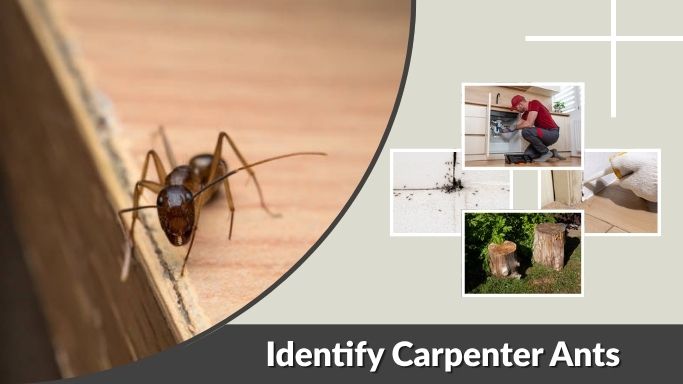
Carpenter ants are large ants that often appear around walls, windows, bathrooms, kitchens, decks, trees, and damp wood. They can be black, reddish, brown, or mixed in color, depending on the species. The easiest way to identify carpenter ants is to look for their large size, narrow waist, bent antennae, smooth rounded back, and signs of wood tunneling such as sawdust-like frass.
What Carpenter Ants Look Like
Carpenter ants are among the larger ants found around homes. Their size makes them easier to notice than tiny sugar ants or pavement ants, but color alone is not enough for identification. Some carpenter ants are black, while others are red and black or brownish.
Body Shape and Size
A carpenter ant has a clearly divided body with a narrow waist. When viewed from the side, the upper part of the body behind the head has a smooth, evenly rounded shape. The waist has one visible node between the middle body section and the abdomen.
Key body features include:
- Large ant body, often bigger than common house ants
- Narrow, pinched waist
- One node at the waist
- Smooth, rounded upper body behind the head
- Bent or elbowed antennae
- Strong jaws for chewing wood
- Workers of different sizes in the same colony
Worker carpenter ants are often about 3/8 to 1/2 inch long, though some species may be smaller. Queens and winged reproductive ants are usually larger than worker ants.
Color Is Helpful, But Not Enough
Many people think all carpenter ants are black, but that is not always true. Black carpenter ants are common, but some species have red, reddish-brown, dark brown, or mixed black-and-red bodies.
Common colors include:
- Solid black
- Black and red
- Dark brown
- Reddish brown
- Brownish black
Because color varies, you should not identify carpenter ants by color alone. Body shape, size, nesting signs, and behavior are more reliable.
How to Identify Carpenter Ants vs Black Ants
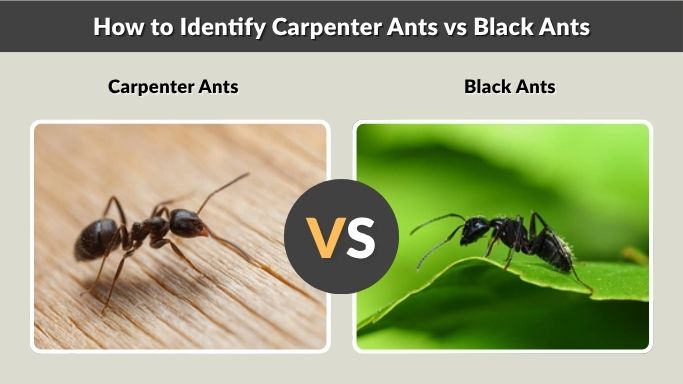
Not every black ant is a carpenter ant. Some small black ants, pavement ants, odorous house ants, and other species may enter homes for food. Carpenter ants are usually larger and more connected to wood or moisture problems.
Carpenter Ants vs Regular Black Ants
The main difference is size, body structure, and nesting behavior. Carpenter ants are usually larger and may appear near damp wood, windows, walls, or structural gaps. Regular black ants are often smaller and more likely to trail directly to food.
| Feature | Carpenter Ants | Other Black Ants |
| Size | Usually larger | Usually smaller |
| Waist | One clear node | Varies by species |
| Back shape | Smooth, rounded thorax | Often uneven or different shape |
| Nesting | Wood, wall voids, damp areas | Soil, cracks, kitchens, pavement |
| Damage risk | Can tunnel through wood | Usually less structural concern |
| Activity | Often active at night | Often active around food |
| Debris | May leave sawdust-like frass | Usually no wood debris |
If the ants are large, appear at night, and keep showing up near wood or moisture, carpenter ants are more likely.
Behavior Clues Inside the House
Carpenter ants often forage indoors while the nest remains hidden. You may see only a few ants at first. Repeated sightings in the same area are more important than a single ant.
Watch for:
- Large ants near baseboards
- Ants around windows or doors
- Ants in bathrooms or kitchens
- Activity near damp walls
- Ants coming from outlets or cracks
- Nighttime trails
- Ants near ceiling edges
- Ants around firewood stored indoors
If you see ants carrying food back toward a wall or window frame, try to follow the trail. It may lead to a hidden nest or entry point.
How to Identify a Queen Carpenter Ant
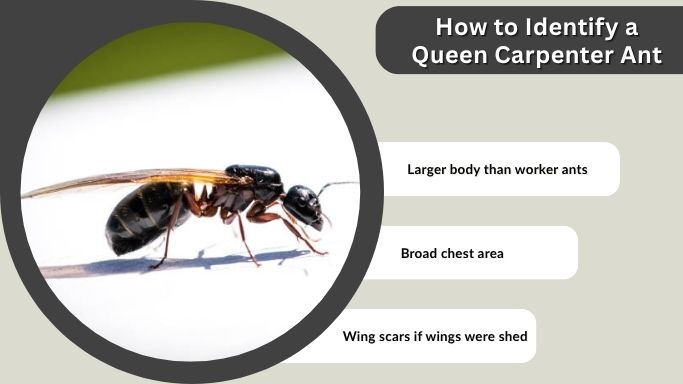
A queen carpenter ant is larger than worker ants and is responsible for laying eggs in the colony. Queens may be seen during swarming periods or if a nest is disturbed. A mature queen may have wings at first, but after mating she can shed them.
Queen Carpenter Ant Features
A queen carpenter ant has the same general body shape as other carpenter ants but is larger and more robust. She may look bulky compared with workers.
A queen may have:
- Larger body than worker ants
- Broad chest area
- Wing scars if wings were shed
- Dark or reddish coloring depending on species
- Slow movement compared with workers
- Thick abdomen
- Bent antennae
- Narrow waist
Winged queens may appear indoors during swarming season. Seeing a winged carpenter ant indoors can suggest an indoor nest or a nearby mature colony.
Queen vs Winged Male Carpenter Ant
Winged male carpenter ants are also part of the reproductive swarm, but they are not queens. Males are usually smaller and more slender than queens. Queens are bulkier because they are built for egg production and colony founding.
If you see multiple winged ants indoors, collect one safely in a small container for identification. Do not crush it if you need to compare body shape and wings.
How to Identify Carpenter Ant Damage
Carpenter ants do not eat wood like termites. They chew through wood to create tunnels and nesting galleries. The damage is often connected to damp or softened wood, but carpenter ants may also expand into drier areas once a colony is established.
Signs of Carpenter Ant Damage
Damage is often hidden inside walls, frames, ceilings, decks, or crawl spaces. You may not see the tunnels at first, but the ants often leave clues around the area.
Common signs include:
- Sawdust-like frass near wood
- Small wood shavings under baseboards
- Ants entering cracks in wood
- Hollow-sounding wood trim
- Rustling sounds inside walls
- Damaged window or door frames
- Winged ants indoors
- Repeated ants near damp spots
- Smooth tunnels inside damaged wood
The sawdust-like material may include tiny wood particles and insect fragments. It is often pushed out of the nest as carpenter ants clean their tunnels.
Where Damage Usually Starts
Carpenter ants often begin in wood that is already weakened by moisture. This is why they are common around leaks, damp basements, wet decks, and old tree stumps.
Check these areas carefully:
- Window frames
- Door frames
- Bathroom walls
- Kitchen sink areas
- Laundry rooms
- Roof eaves
- Attics
- Crawl spaces
- Deck posts
- Porch supports
- Firewood piles
- Tree stumps
If you find carpenter ant activity near damaged wood, you should also look for the moisture source. Killing ants without fixing moisture may not solve the problem.
How to Identify a Carpenter Ant Nest
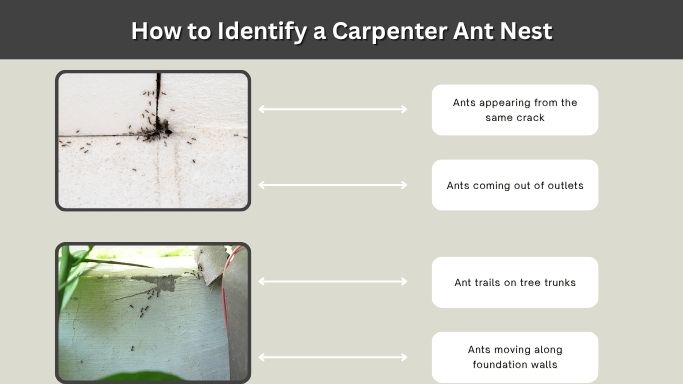
Finding the nest is one of the most important steps in confirming carpenter ants. The visible ants may be workers traveling between food and the colony. The actual nest may be indoors, outdoors, or both.
Indoor Nest Signs
Indoor nests are often hidden in wall voids, ceilings, insulation spaces, or damp framing. You may not see the nest directly, but repeated activity around one area can help you locate it.
Signs of an indoor nest include:
- Ants appearing from the same crack
- Ants coming out of outlets
- Rustling sounds in walls
- Fresh frass piles
- Ants near moisture stains
- Winged ants indoors
- Activity during winter
- Ant trails at night
Seeing winged carpenter ants indoors in late winter or spring can be a strong clue that a nest is inside or very close to the home.
Outdoor Nest Signs
Outdoor colonies often live in dead wood, damp logs, tree cavities, old stumps, fences, decks, or mulch. These nests may send workers indoors for food.
Outdoor signs include:
- Ant trails on tree trunks
- Ants moving along foundation walls
- Activity in rotten logs
- Ants around stumps
- Trails from trees to the roof
- Ants in firewood piles
- Activity under deck boards
- Wood debris near outdoor nesting areas
At night, use a flashlight and follow the ants. Carpenter ants often travel in clear trails once they find a good food source.
How to Identify Carpenter Ants vs Termites
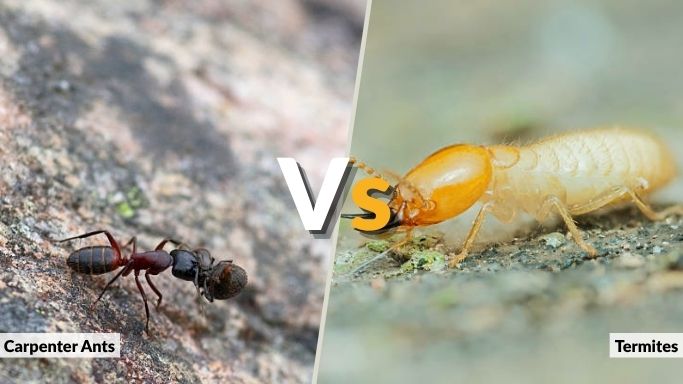
Carpenter ants and termites are often confused because both can be found around wood and both may produce winged swarmers. Correct identification matters because their treatment methods are different.
Body Differences
Carpenter ants have a narrow waist and bent antennae. Termites have a more uniform body shape with a broad waist and straight antennae. Winged carpenter ants usually have front wings that are longer than the back wings, while termite wings are usually equal in length.
| Feature | Carpenter Ants | Termites |
| Waist | Narrow and pinched | Broad and thick |
| Antennae | Bent or elbowed | Straight |
| Wings | Front wings longer than back wings | Wings equal size |
| Body color | Black, red, brown, mixed | Often pale, brown, or dark swarmers |
| Wood behavior | Tunnels through wood | Eats wood |
| Debris | Sawdust-like frass | Mud tubes or droppings |
| Visibility | Workers often seen foraging | Workers often stay hidden |
If you see pale, soft-bodied insects inside damaged wood, termites may be more likely. If you see large black or reddish ants walking in trails, carpenter ants are more likely.
Damage Differences
Carpenter ant galleries are usually smooth and clean because they remove debris from the tunnels. Termite damage often contains mud, soil, or rough material. Subterranean termites may also build mud tubes to travel between soil and wood.
Carpenter ant damage usually points to moisture-damaged wood. Termite damage can be more aggressive and may affect hidden structural areas before insects are noticed.
How to Identify Carpenter Ant Infestation Early
Early identification can prevent the colony from becoming more established. Carpenter ants may be present for some time before major damage is visible.
Early Warning Signs
The first signs are often small and easy to ignore. A few ants in spring or summer may seem normal, but repeated activity deserves attention.
Early warning signs include:
- Seeing large ants indoors more than once
- Ants active near windows or walls
- Ants appearing at night
- Frass near wood or trim
- Winged ants inside the house
- Damp wood near ant activity
- Rustling sounds in wall voids
- Ant trails leading outdoors
- Activity near roof leaks or plumbing
If the ants are only seen near food, they may be foraging from outside. If they are coming from walls, ceilings, or wood gaps, an indoor nest is more likely.
How to Confirm Your Suspicion
You can observe the ants before treating. Follow trails with a flashlight at night and check where they disappear. Look behind appliances, around sinks, near window frames, and along baseboards.
Helpful confirmation steps:
- Collect one ant in a clear container.
- Compare its size and body shape.
- Look for a narrow waist and bent antennae.
- Check for one waist node.
- Inspect for frass near wood.
- Follow trails to entry points.
- Look for moisture damage nearby.
- Compare with termite signs.
If you cannot identify the pest confidently, contact a local extension office or pest professional with a clear photo or sample.
What to Do After Identifying Carpenter Ants
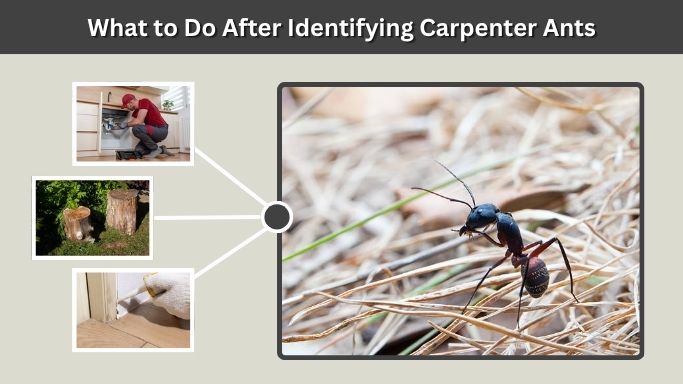
Once you confirm carpenter ants, the next step is to locate the nest and remove the conditions that support it. Killing a few visible workers is rarely enough.
First Steps After Identification
Start with inspection and moisture control. Then use bait or targeted treatment based on where the colony is located.
Important steps include:
- Follow ant trails to the nest.
- Look for indoor and outdoor colonies.
- Fix plumbing or roof leaks.
- Replace rotten wood.
- Remove stumps and old logs.
- Store firewood away from the house.
- Seal cracks and entry points.
- Use carpenter ant bait near trails.
- Avoid spraying near bait.
If ants are nesting inside walls or structural wood, professional help may be needed. Hidden nests can be difficult to treat without proper tools.
FAQs
How can I tell if an ant is a carpenter ant?
Look for a large ant with a narrow waist, bent antennae, one waist node, and a smooth rounded back behind the head. Carpenter ants are often black, red, brown, or mixed in color. Repeated indoor sightings near wood or moisture also support the identification.
How do I identify carpenter ants vs black ants?
Carpenter ants are usually larger than common black ants and are more connected to damp wood, wall voids, and structural areas. Other black ants are often smaller and more focused on food trails. Sawdust-like frass, nighttime trails, and activity near wood are stronger carpenter ant clues.
What does carpenter ant damage look like?
Carpenter ant damage may include smooth tunnels inside wood, small piles of sawdust-like frass, hollow-sounding trim, and ants entering wood cracks. Damage is often hidden behind walls, windows, doors, decks, or damp framing. Moisture problems are commonly found near active areas.
How do I identify a carpenter ant queen?
A carpenter ant queen is larger and bulkier than worker ants. She may have wings during swarming season or wing scars after mating. Queens have the same bent antennae and narrow waist as workers but a larger chest and abdomen. Finding one indoors may suggest a nearby colony.
How do I know if I have carpenter ants or termites?
Carpenter ants have bent antennae, narrow waists, and front wings longer than back wings. Termites have straight antennae, broad waists, and equal-sized wings. Carpenter ants leave clean tunnels and sawdust-like frass, while termites often leave mud tubes or rough, soil-filled wood damage.
