

Yellow jacket wasps are social insects with a fascinating but short-lived colony cycle that runs for only one season. Unlike honeybees that maintain perennial hives, yellow jackets start fresh each spring with a single queen and end in winter with the colony’s collapse. Understanding their life cycle not only explains their behavior but also reveals why they become more aggressive in late summer. From the queen’s emergence to the colony’s decline, each stage plays a vital role in the survival of the species.
Overview of the Yellow Jacket Life Cycle

The life cycle of a yellow jacket colony is annual and seasonal. Each year, the cycle begins with an overwintered, fertilized queen who survived the cold months in hibernation. She is the foundation of a new colony, responsible for starting the nest, producing the first workers, and setting the colony into motion. As summer progresses, the colony population grows, peaking in late summer or early fall, before eventually collapsing as winter arrives. Only newly fertilized queens survive to restart the cycle the following spring.
Spring – Emergence of the Queen

The first stage of the yellow jacket life cycle begins in early spring, when temperatures rise and fertilized queens emerge from their winter shelters. These overwintered queens spend the cold months hidden in tree bark, soil cavities, leaf litter, or man-made structures like attics.
Once awake, the queen’s first task is to find a suitable nesting site. She typically chooses an abandoned rodent burrow, hollow tree stump, or a sheltered cavity in walls or shrubs. After locating a safe spot, she begins chewing wood fibers mixed with saliva to form a papery material. With this, she constructs the first few cells of the nest.
The queen then lays her initial batch of eggs inside these cells. Over the next several days, she feeds the larvae with chewed-up insects and nectar, nurturing them until they pupate and develop into the first workers. During this period, the queen performs all the roles—builder, hunter, feeder, and caretaker—until the workers emerge to take over.
Early Summer – Worker Development
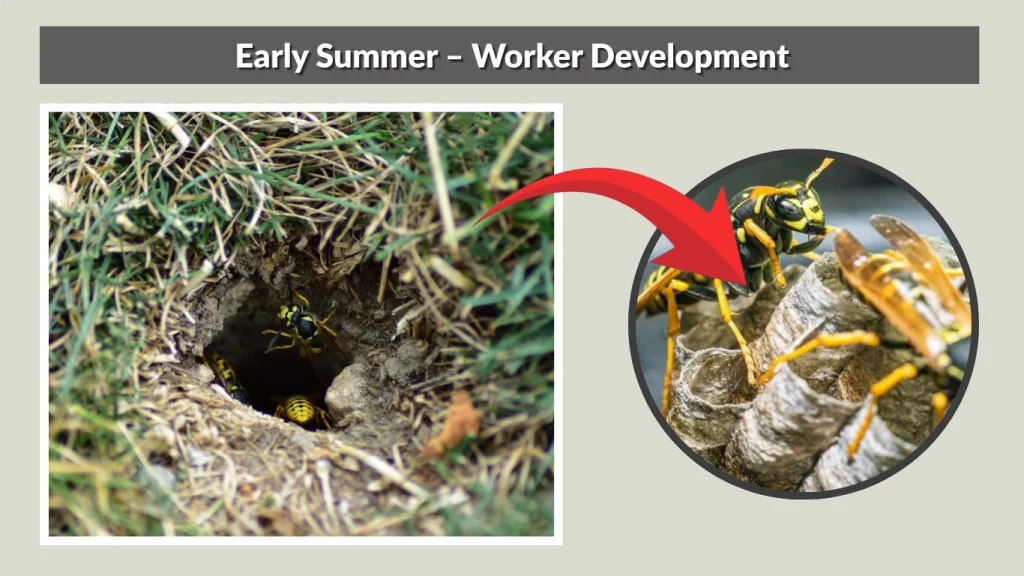
By early summer, the first generation of worker wasps has emerged. These workers are sterile females whose sole purpose is to sustain and expand the colony. They take on the queen’s earlier duties, including foraging for food, enlarging the nest, and feeding new larvae.
Their diet typically includes sugary substances like nectar and fruits, which fuel their energy, as well as protein from other insects that they chew up and feed to the developing larvae. Workers also continue to expand the papery nest, adding multiple layers of hexagonal cells to accommodate the growing population.
Once workers assume their roles, the queen no longer leaves the nest. She devotes her energy entirely to laying eggs, ensuring a continuous supply of new workers to replace older ones. By late summer, this relentless cycle of egg-laying and worker activity allows the colony to grow rapidly, sometimes reaching thousands of individuals.
Mid to Late Summer – Colony Expansion
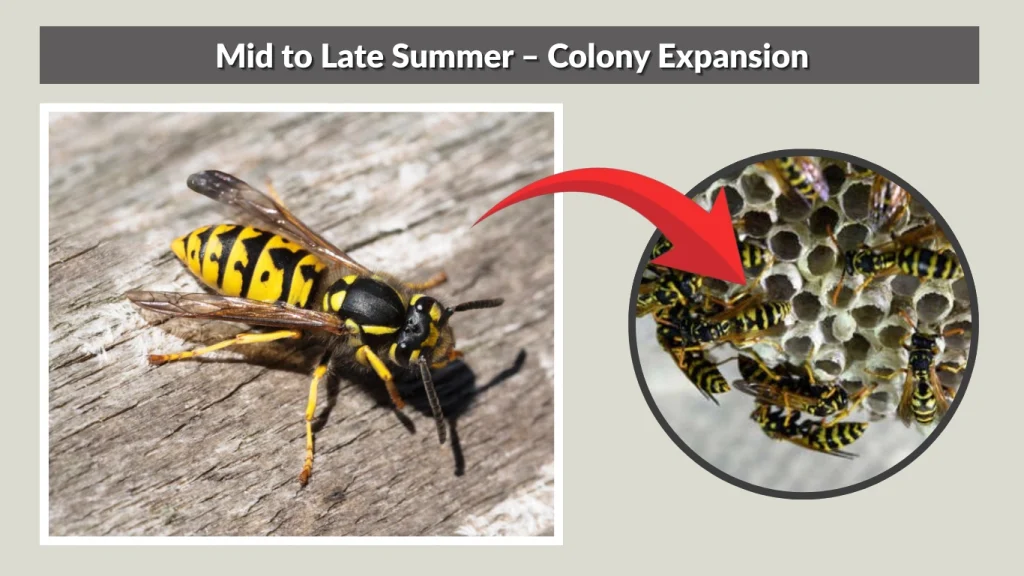
By mid-summer, the yellow jacket colony enters its peak growth stage. The nest, once small and queen-built, now contains thousands of workers tending to the queen, feeding larvae, and expanding the papery structure into a multi-layered sphere. Colonies can range from a few hundred to over 5,000 individuals depending on the species and conditions.
Workers become increasingly active during this period, foraging for insects, carrion, fruit, and sugary substances. Because food demand is so high, yellow jackets often become more visible around human activity, scavenging at picnics, trash bins, and outdoor events. Their defensive behavior also intensifies, as they aggressively protect their large and valuable nest from intruders.
Late Summer to Early Fall – Reproductive Phase
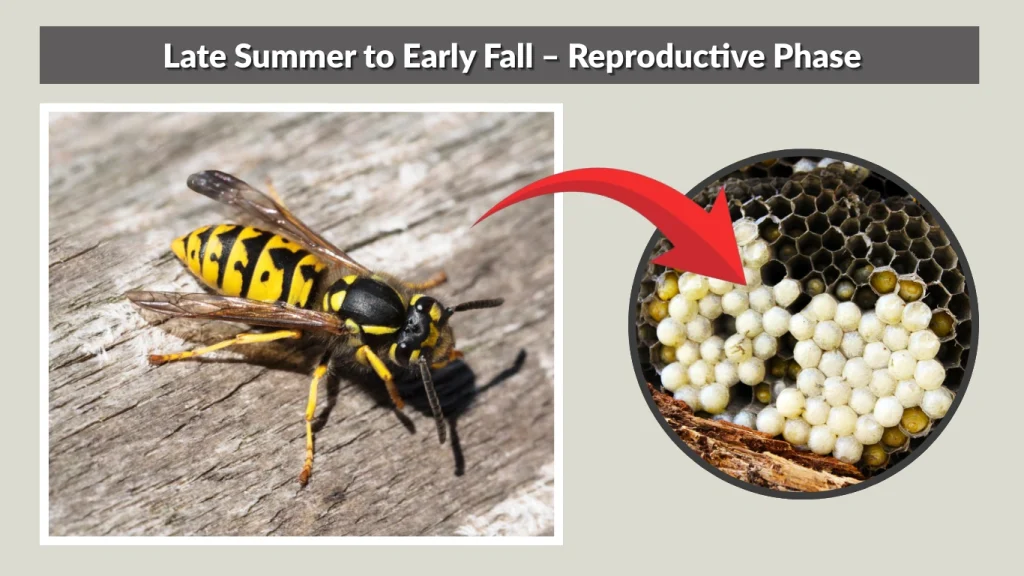
As the warm season continues, the colony transitions into its reproductive stage. The queen begins laying reproductive eggs instead of worker eggs. These eggs hatch into new queens and male drones, signaling the last major phase of the colony’s life.
Once mature, the new queens leave the nest to mate with males from other colonies. After mating, the males die shortly afterward, while the fertilized queens prepare to overwinter. At this point, the old founding queen weakens and eventually dies, her work completed.
Autumn – Colony Decline
With the death of the original queen and the shift to producing reproductives, the colony starts to collapse. Worker wasps, deprived of purpose and leadership, become more aggressive in searching for food. This explains why yellow jackets are particularly bothersome in late summer and fall—they are hungrier, more defensive, and in greater contact with humans.
As temperatures drop, workers and males die off naturally. By the time winter arrives, the once-thriving nest is abandoned and left to deteriorate. Unlike honeybees, yellow jackets do not reuse their nests the following year.
Winter – Survival of the Queens

The only survivors of the cycle are the newly mated queens. After mating, they seek sheltered spots to overwinter, such as under tree bark, in soil cavities, or in protected human-made structures. In these refuges, they remain dormant throughout the cold months, conserving energy until spring returns.
When conditions warm again, these queens emerge to start new colonies, repeating the cycle from the beginning. Each queen represents the potential foundation of a completely new colony, ensuring the survival of the species despite the annual death of thousands of workers.
Why the Yellow Jacket Life Cycle Matters
Understanding the life cycle of yellow jackets helps explain their seasonal behavior. In spring, colonies are small and less aggressive. By summer, they expand rapidly, and in late summer to fall, their aggression peaks as food becomes scarce and the colony nears its end.
This knowledge is important for pest management as well. Targeting nests in early summer is far easier than attempting removal in late summer, when colonies are larger and more dangerous. From an ecological perspective, recognizing their life cycle also highlights their role in ecosystems as both predators of pest insects and opportunistic pollinators.
FAQs
How long do yellow jacket wasps live?
Workers live for only a few weeks during summer, while queens can survive up to a year, from one spring to the next.
When do yellow jacket colonies die off?
Most colonies collapse in autumn as the founding queen and workers die. Only the newly fertilized queens survive into winter.
Do yellow jacket queens live longer than workers?
Yes. While workers survive only for a short summer season, queens can live for nearly 12 months, carrying the species through winter.
Why are yellow jackets more aggressive in late summer?
As colonies decline, food becomes scarce, and workers become more desperate. This leads to increased aggression, especially around humans and food sources.
Do yellow jackets reuse their nests the next year?
No. Each colony lasts for only one season. Abandoned nests are never reused; new queens build entirely fresh nests every spring.
