

Bumble bees are fascinating insects admired for their fuzzy appearance and essential role in pollination. They help plants reproduce by transferring pollen, ensuring food crops and flowers continue to thrive. To understand these hardworking insects better, it’s helpful to know how long they live, where they build their nests, and how their colonies function throughout the year. Each part of their life cycle reveals how well-adapted they are to nature’s rhythms.
Lifespan of Bumble Bees

Bumble bees have relatively short lifespans compared to other bee species. Their longevity depends on their role in the colony and environmental conditions. Worker bees typically live between 2 and 6 weeks, spending their days collecting nectar and pollen. Males, or drones, often live for a similar period but usually die shortly after mating.
The queen bumble bee, however, lives significantly longer. She can survive up to a year because her life includes overwintering — a hibernation period that protects her from harsh weather. Once spring returns, the queen emerges to establish a new nest and lay eggs that start a new generation.
Queen Bumble Bee Lifespan
The queen’s extended lifespan makes her vital to the species’ survival. After mating in late summer, she finds a safe, sheltered spot underground or under leaf litter to spend the winter. During this time, her metabolism slows down to conserve energy.
When the temperature rises again in early spring, the queen awakens, feeds on early-blooming flowers, and begins building a new nest. This annual cycle of dormancy and renewal allows her to maintain the continuity of her species year after year.
Habitat and Living Places

Bumble bees live in environments that provide both shelter and access to food sources. They prefer grassy fields, meadows, hedgerows, and gardens — especially those rich in wildflowers. Unlike honeybees, they don’t produce wax comb hives in tree cavities. Instead, bumble bees select hidden or abandoned spaces to stay protected from predators and the elements.
Their ideal homes are dry, dark, and well-insulated, offering safety for raising larvae. Abandoned mouse burrows, hollow logs, and even compost piles are common nesting choices. This flexibility allows them to adapt to both rural and suburban landscapes.
Ground-Nesting Bumble Bees

Common Ground Dwellers
A large number of bumble bee species are ground nesters, meaning they live beneath the soil’s surface. They often occupy abandoned rodent burrows or small underground chambers where they can build wax cells for eggs and store pollen.
- The soil provides natural insulation against heat and cold.
- Underground nests maintain humidity levels suitable for larvae.
- Queens choose spots that are well-drained but secure from flooding.
These ground-based nests are usually hard to spot, as only a small entrance hole marks the colony’s location. Once active, worker bees constantly move in and out, gathering resources to support the colony.
Underground and Soil Dwellers
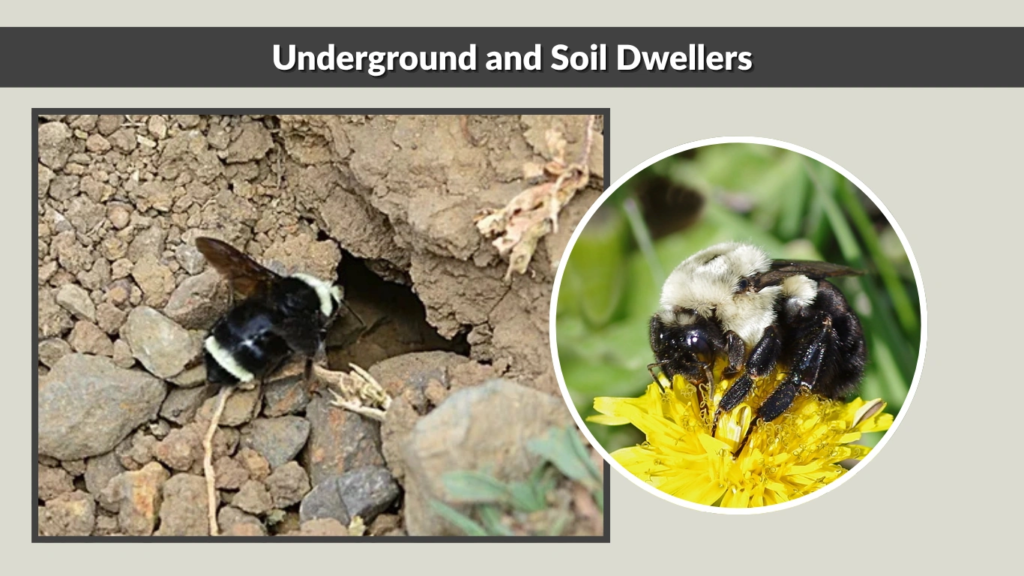
Bumble bees that prefer underground homes have developed behaviors suited to soil environments. The buff-tailed bumble bee (Bombus terrestris) and similar species use deep burrows, protecting their brood chambers from extreme weather. The constant soil temperature creates a safe, stable nursery for developing young.
These underground colonies typically contain several dozen to a few hundred bees. The queen remains at the center of the nest, laying eggs, while workers forage and defend the entrance. Their underground lifestyle reduces exposure to predators like birds and wasps, improving their survival chances.
Hive and Colony Life
Bumble bees are social insects that live in structured colonies, though their nests are much smaller than those of honeybees. A full colony often has 50 to 400 individuals, depending on the species and conditions.
The queen starts the nest by laying her first batch of eggs, which develop into worker bees. These workers then take over foraging duties and caring for new eggs, allowing the queen to focus solely on reproduction.
Unlike honeybees, bumble bees don’t build large combs or produce excess honey. Their nests are temporary — lasting only for a single season. Once winter arrives, most of the bees die off, leaving only new queens to hibernate and restart the cycle.
Nests and Togetherness

Social Structure
Bumble bees display remarkable cooperation within their colonies. Their nests are built from wax secreted by the queen and used to form cells for eggs and food storage. Inside, every bee has a role — from foraging and caring for larvae to maintaining nest temperature.
- Workers: Collect nectar, build wax cells, and feed larvae.
- Males (Drones): Mate with queens and then die shortly afterward.
- Queen: Controls egg production and colony growth.
Some bumble bee species exhibit partial social behavior, where individuals may live independently once the season ends. These solitary bees still contribute to pollination but do not form complex colonies.
Seasonal Living and Survival
The life of a bumble bee follows the changing seasons. During spring, the queen emerges to begin a new colony. Summer is the peak of activity, with workers gathering nectar to support larvae. As autumn approaches, males and new queens are produced. After mating, the old colony members die, and only fertilized queens survive.
In winter, hibernating queens rest beneath the soil or leaf litter until the warmth of spring awakens them again. This seasonal rhythm ensures the species’ survival despite short individual lifespans.
Alternative Habitats
While most bumble bees prefer underground nests, some choose above-ground shelters when suitable spots are available. These alternative habitats often include wooden cavities, bird boxes, compost bins, or spaces inside garden walls. These sites are typically warmer and drier than soil-based nests, offering safety from ground moisture and predators.
Wood-nesting species often adapt their wax structures to fit tight spaces. They build small chambers for eggs and food storage, ensuring the nest remains organized and functional. Bumble bees living in walls or wood cavities play an equally important role in pollination, thriving even in urban environments where soil space is limited.
Co-Living and Interactions
Bumble bees sometimes share their surroundings with other animals. It’s not uncommon to find them nesting near groundhogs, mice, or voles, since they often reuse abandoned burrows. Although they coexist in the same area, they rarely interact directly with these creatures.
In gardens, bumble bees may also forage alongside honeybees. However, they don’t share hives or mix colonies, as their social structures and communication systems differ. Each species maintains its own nest, food supply, and reproductive cycles, ensuring harmony in shared environments without competition.
Geographical Distribution
Bumble bees are found across temperate regions of the world, thriving in cool and mild climates. They are especially abundant in countries such as the United Kingdom, New Zealand, Canada, and parts of Europe. Each region hosts unique species that have adapted to local conditions:
- UK & Northern Europe: Home to the common carder and buff-tailed bumble bees.
- New Zealand: Populations introduced for crop pollination in greenhouses.
- North America: Dozens of native species inhabit prairies and woodland areas.
- Asia and Russia: Mountainous regions support high-altitude bumble bee species.
Some species, like the black or blue bumble bees, are adapted to warmer environments, while larger and fuzzier bees thrive in colder zones. This adaptability ensures their survival across a wide range of habitats and climates.
After-Sting Survival and Biology
One of the most interesting facts about bumble bees is that they can sting multiple times and live afterward. Unlike honeybees, their stingers are smooth, not barbed, which allows them to sting without getting trapped or injured. However, bumble bees are not aggressive and sting only when defending themselves or their nest.
After stinging, the bee can continue foraging and protecting its colony as usual. This ability gives them an advantage in survival, especially when predators like wasps or birds threaten the nest. Still, their main defense remains avoidance — they prefer to fly away rather than fight.
FAQs
How long do bumble bees live?
Bumble bees usually live between two weeks and two months, depending on their role. Worker bees have shorter lifespans, while queens live up to a year due to hibernation. Environmental conditions and food availability also affect their overall longevity.
Where do bumble bees live?
Bumble bees live in underground burrows, grassy fields, hedgerows, and wooden cavities. They prefer dark, dry, and sheltered spots that protect them from predators and bad weather. Many species reuse old rodent burrows or make nests under piles of leaves or compost.
Do bumble bees live in colonies or alone?
Most bumble bees live in small colonies with a queen, workers, and drones. However, at the end of the season, new queens go into hibernation alone while the rest of the colony dies off. Some species may also adopt solitary habits depending on their environment.
Do bumble bees live in the ground?
Yes, many bumble bees build nests beneath the soil, especially in abandoned animal holes. These underground nests offer insulation from weather extremes and protection from predators. They’re often hidden, with only a small entrance visible on the surface.
Can bumble bees live after stinging?
Unlike honeybees, bumble bees can sting more than once and survive. Their stinger lacks barbs, allowing them to pull it out safely. They use this defense sparingly, mainly when their nest or themselves are directly threatened.
