
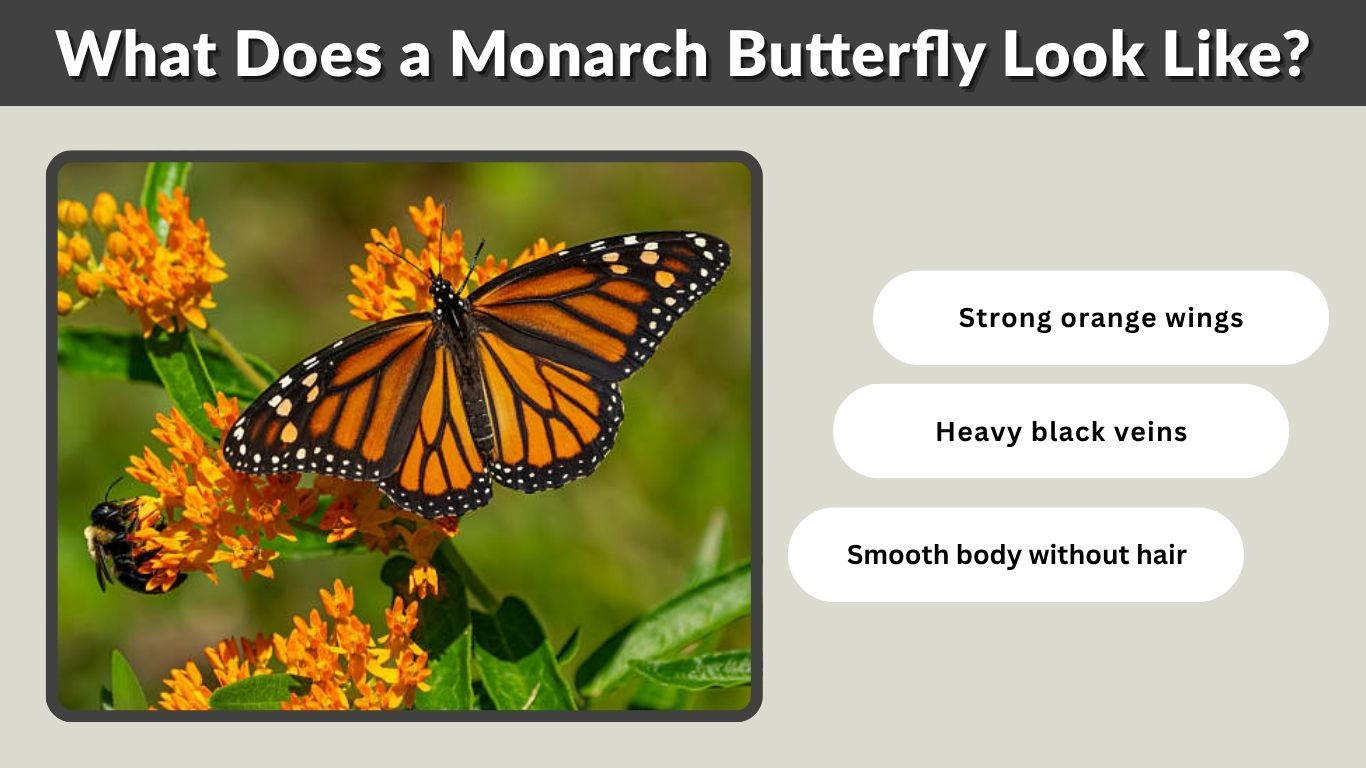
The monarch butterfly is famous for its bright orange wings, bold black veins, and white-spotted borders. However, several butterflies resemble monarchs, while young caterpillars, eggs, and chrysalises can also be difficult to identify. This guide explains the monarch’s appearance at every life stage and shows how to separate it from common lookalikes, including viceroy, queen, soldier, and other orange butterflies.
What Does a Monarch Butterfly Look Like?
An adult monarch butterfly, Danaus plexippus, has large orange wings divided by prominent black veins. A broad black border surrounds each wing and contains two rows of small white spots.
The underside is similar but usually appears paler and more muted. Monarchs have black bodies covered with white spots, long club-shaped antennae, and a wingspan generally measuring around 3.5–4 inches.
Main Identification Features
- Bright orange upper wings
- Thick black veins crossing the wings
- Wide black wing borders
- Two rows of white border spots
- Black body with white dots
- Long, club-tipped antennae
- Slow, floating flight mixed with gliding
- Wingspan of approximately 3.5–4 inches
Fresh adults usually have vivid orange wings. Older butterflies may look faded, scratched, or missing small pieces of their wings after long-distance travel.
Male vs Female Monarch Butterfly
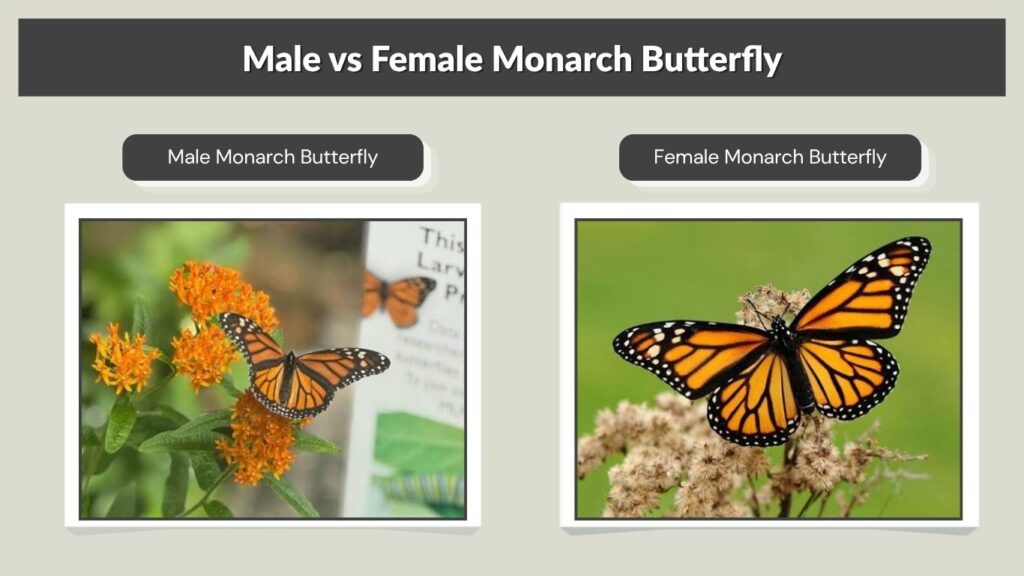
Male and female monarchs share the same overall orange-and-black pattern, but two features help distinguish them.
| Feature | Male Monarch | Female Monarch |
| Black wing veins | Usually thinner | Usually thicker |
| Dark scent spots | One on each hindwing | Absent |
| Abdomen | Often slimmer | Generally broader |
| Overall color | May appear slightly brighter | Often slightly darker |
The male’s scent spots look like small black ovals on the hindwings. They are located along veins close to the center of each hindwing.
What Does a Monarch Caterpillar Look Like?
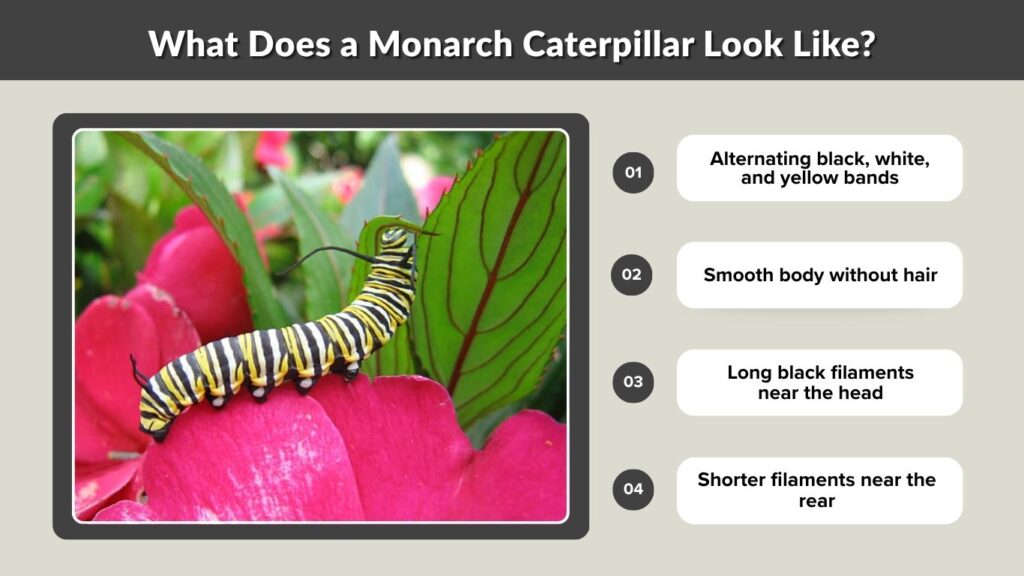
A mature monarch caterpillar has bold horizontal bands of black, white, and yellow. Its body is smooth and cylindrical, without hair, spines, or a horn.
It also has two pairs of flexible black filaments. One pair projects from near the head, while the shorter pair extends from the rear. These structures may resemble antennae, but they are not true antennae and do not sting.
Monarch Caterpillar Identification
- Alternating black, white, and yellow bands
- Smooth body without hair
- Long black filaments near the head
- Shorter filaments near the rear
- Black head with pale markings
- Usually found eating milkweed
- Up to roughly 2 inches long when mature
A newly hatched caterpillar looks very different. It begins extremely small and pale, with weak markings. The familiar striped pattern becomes clearer as it grows and passes through five developmental stages called instars.
What Do Monarch Caterpillars Eat?
Monarch caterpillars feed primarily on milkweed plants. They may eat the leaves, flowers, seedpods, and sometimes tender stems.
Finding a striped caterpillar on milkweed strongly supports monarch identification, but the plant alone is not conclusive. Queen and soldier butterfly caterpillars also use milkweed and may resemble monarch larvae.
Monarch Caterpillar Lookalikes
Several caterpillars have black, white, and yellow patterns. The number and location of their filaments offer useful identification clues.
| Caterpillar | Main Difference |
| Monarch | Two pairs of filaments |
| Queen butterfly | Three pairs of filaments |
| Soldier butterfly | Three pairs of filaments |
| Black swallowtail | Green with black bands and yellow-orange dots |
| Milkweed tussock moth | Covered with long tufts of hair |
Queen Butterfly Caterpillar
Queen caterpillars look similar to monarch caterpillars but usually have three pairs of long filaments rather than two. One pair is near the head, another is around the middle, and the last pair is near the rear.
Their stripes may also appear less evenly arranged than those of monarch caterpillars.
Black Swallowtail Caterpillar
A mature black swallowtail caterpillar is green with black bands containing yellow or orange dots. It has no long black filaments.
Black swallowtails usually feed on plants in the carrot family, including parsley, dill, fennel, and Queen Anne’s lace, rather than milkweed.
Milkweed Tussock Moth Caterpillar
The milkweed tussock moth caterpillar also eats milkweed and has black, white, and orange coloration. However, it is covered with thick tufts of hair.
A monarch caterpillar is smooth and clearly striped, making the two relatively easy to separate at later stages.
What Do Monarch Butterfly Eggs Look Like?
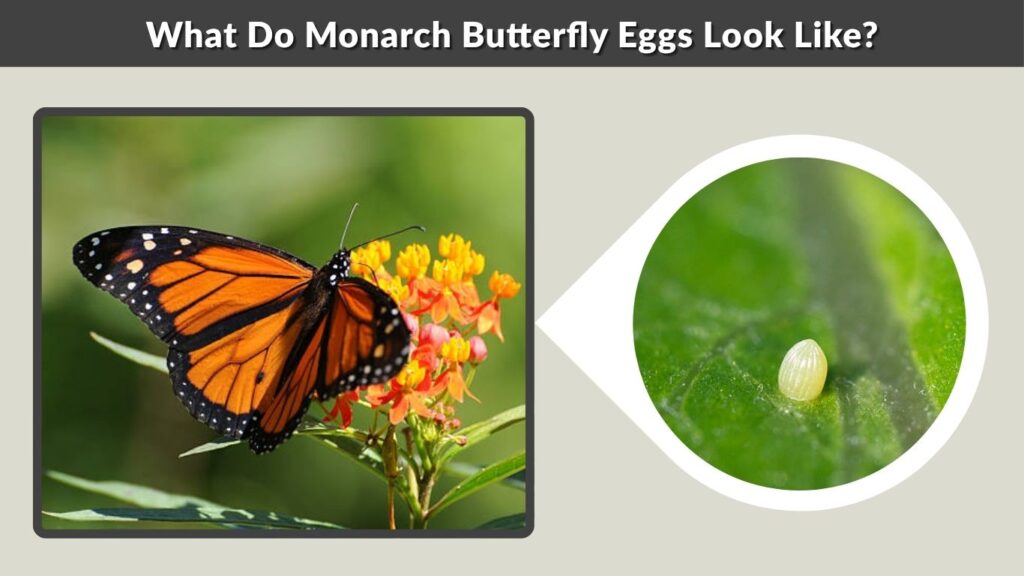
A monarch egg is tiny, pale cream, and roughly shaped like a dome or miniature football. Fine vertical ridges run from the base toward the top.
Female monarchs usually place eggs individually on milkweed, often on the underside of a leaf. An egg is much smaller than a grain of rice and can easily be mistaken for plant material or dried milkweed sap.
Egg vs Milkweed Sap
Milkweed sap may dry into irregular white or cream-colored spots. A true monarch egg has:
- A symmetrical shape
- A rounded base
- A slightly pointed or flattened top
- Fine vertical ridges
- A firm attachment to the leaf
As hatching approaches, the egg may darken because the caterpillar’s head becomes visible through the shell.
What Does a Monarch Chrysalis Look Like?
Monarch butterflies do not form fuzzy cocoons. Instead, the caterpillar creates a smooth, uncovered chrysalis.
A fresh monarch chrysalis is jade green with a shining gold-and-black band near the top. Several small gold dots are also visible on its surface. It hangs upside down from a small black attachment called a cremaster.
Changes Before Emergence
The chrysalis remains green for most of its development. Shortly before the adult emerges, it becomes dark and then transparent. At this stage, the monarch’s orange-and-black wings can be seen through the outer covering.
A healthy dark chrysalis usually reveals a clear wing pattern. A uniformly black chrysalis that remains opaque or develops an unpleasant smell may indicate that development has failed.
Butterflies That Look Like Monarchs
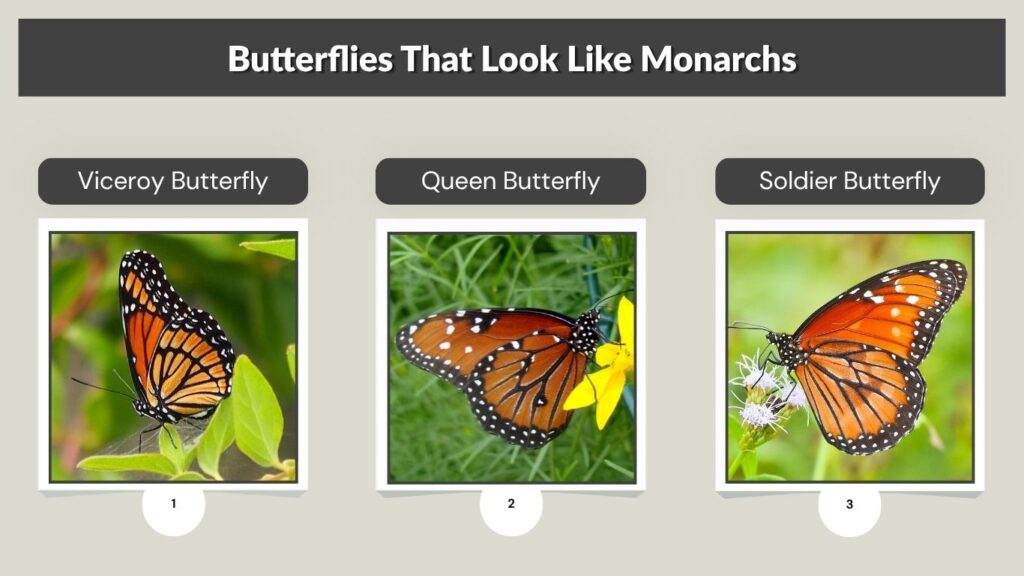
Monarchs are most often confused with other orange-and-black butterflies. Wing veins, bands, spots, size, and geographic range help separate them.
Viceroy Butterfly
The viceroy is the best-known monarch lookalike. It has orange wings with black veins and white-spotted borders, but a dark curved line crosses each hindwing.
The viceroy is usually smaller and often flies with quicker, more frequent wingbeats. The black hindwing line is the most dependable visible difference.
Queen Butterfly
The queen butterfly is closely related to the monarch. Its wings are dark reddish-brown rather than bright orange, and the black wing veins are less prominent.
Queens often have many small white spots across the forewings. They are particularly common in warmer parts of the southern United States.
Soldier Butterfly
The soldier butterfly also resembles both the monarch and queen. It has orange-brown wings with more noticeable dark veins than a queen but generally appears darker than a monarch.
The wing pattern may vary geographically, so identifying it may require examining several markings rather than relying on color alone.
Painted Lady
The painted lady has orange, black, and white wings but lacks the monarch’s heavy black vein pattern. Its hindwings contain a row of small eyespots, especially visible from below.
Painted ladies are generally smaller and fly more rapidly than monarchs.
Gulf Fritillary
A gulf fritillary is bright orange above but has elongated forewings and fewer heavy black veins. The underside displays large, reflective silver spots, making it easy to distinguish when its wings are closed.
Moths That Look Like Monarch Butterflies
Some orange-and-black moths may be mistaken for small monarchs at a distance. However, most lack the monarch’s broad wings, strong black veins, and white-spotted borders.
Moths often have thicker or feathered antennae instead of the monarch’s clearly clubbed antennae. Many also rest with their wings folded roof-like over the body rather than held upright or spread flat.
Yellow Butterflies That Look Like Monarchs
A yellow butterfly with black markings is unlikely to be a monarch. Possible examples include tiger swallowtails, clouded sulphurs, orange sulphurs, and female dimorphic species.
Tiger swallowtails are much larger and usually have four dark stripes on each forewing, along with tail-like projections on their hindwings. Sulphur butterflies are generally smaller, with simpler yellow or orange wing patterns and few prominent veins.
Quick Monarch Identification Checklist
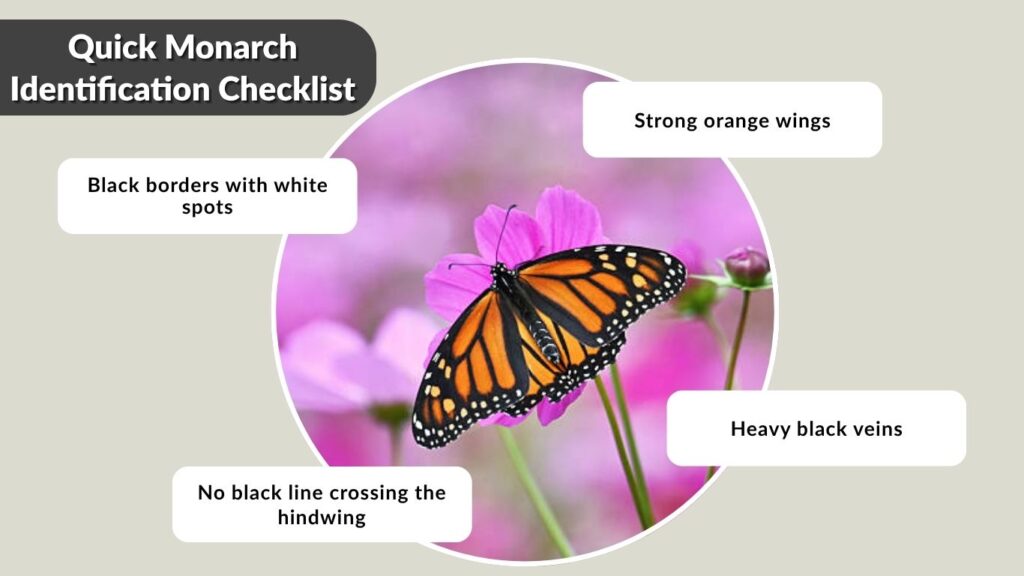
An adult is likely a monarch when it has:
- Strong orange wings
- Heavy black veins
- Black borders with white spots
- No black line crossing the hindwing
- Club-shaped antennae
- A wingspan near four inches
A caterpillar is likely a monarch when it is smooth, striped black-white-yellow, has two pairs of filaments, and is feeding on milkweed.
FAQs
What butterfly looks most like a monarch?
The viceroy is the closest and most frequently confused lookalike. It has a similar orange-and-black pattern but is usually smaller and has a distinctive black curved line crossing each hindwing.
What does a baby monarch caterpillar look like?
A newly hatched monarch caterpillar is tiny, pale, and only weakly marked. As it feeds and molts, it develops the bold black, white, and yellow bands and two pairs of black filaments associated with mature larvae.
Is there a moth that looks like a monarch butterfly?
Some orange-and-black moths may resemble monarchs from a distance, but they usually lack the monarch’s heavy black veins and white-spotted borders. Antenna shape and resting posture can also help separate moths from monarch butterflies.
What do monarch eggs look like on milkweed?
Monarch eggs are tiny, cream-colored, dome-shaped structures with fine vertical ridges. They are usually laid individually on the underside of milkweed leaves rather than in large clusters.
What is a small butterfly that looks like a monarch?
A small monarch-looking butterfly may be a viceroy. It has a similar orange-and-black appearance but typically shows a dark line across each hindwing. Painted ladies may also seem similar, although their markings are less strongly veined.
