
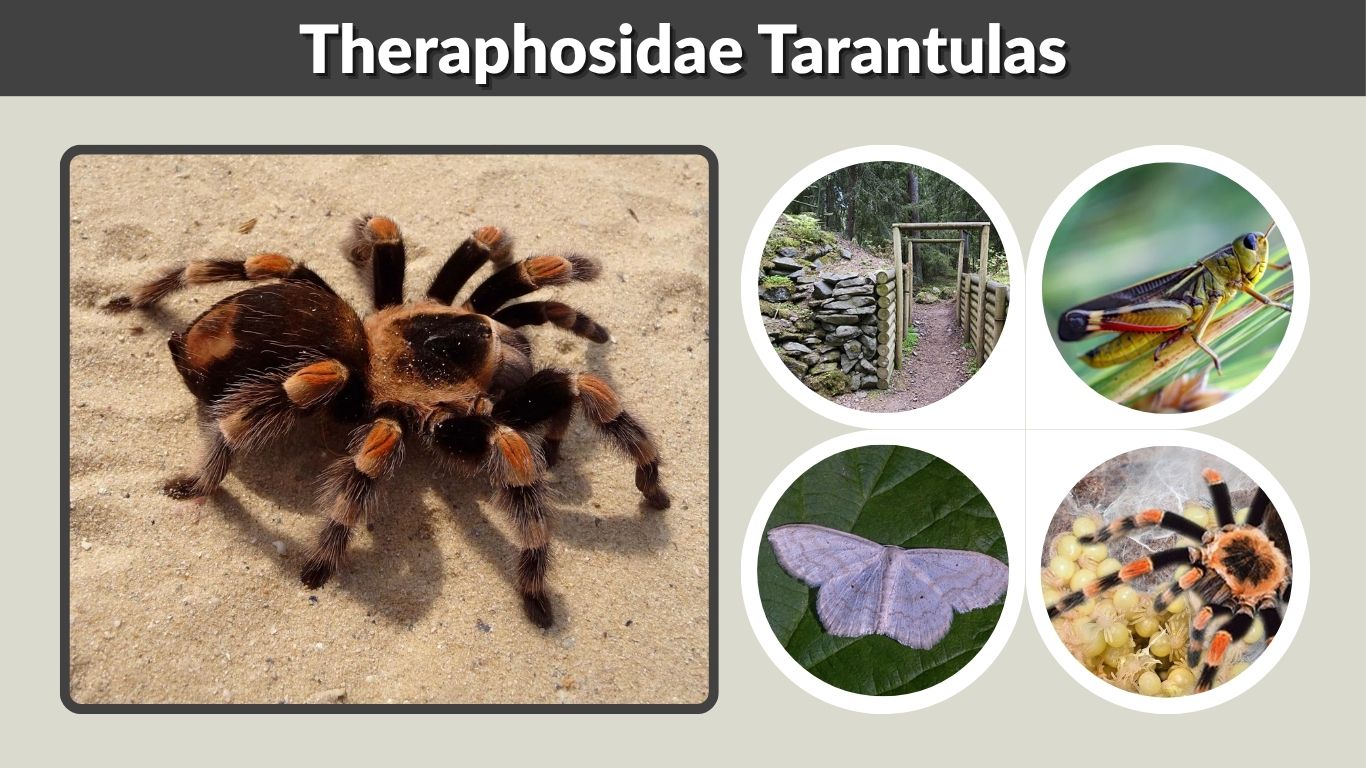
Theraphosidae is the spider family that contains the animals commonly known as tarantulas. These large, often hairy spiders occur across tropical, subtropical, and some warmer temperate regions and include terrestrial, burrowing, and tree-dwelling species. Although their intimidating size and large fangs give them a fearsome reputation, most tarantulas avoid confrontation whenever possible. The family contains more than 1,000 described species and shows remarkable diversity in size, coloration, behavior, defensive strategies, and habitat preferences.
What Is a Theraphosidae Tarantula?
Theraphosidae is a family within the Mygalomorphae, an ancient group of spiders characterized by powerful downward-moving fangs. Members of Theraphosidae range from relatively small tarantulas to some of the largest spiders on Earth.
Unlike many web-building spiders, tarantulas usually use silk to reinforce shelters, construct retreats, protect eggs, or detect vibrations rather than making large aerial webs for catching prey.
Identification
Common characteristics of Theraphosidae tarantulas include:
- Large, heavy-bodied appearance
- Eight thick, powerful legs
- Dense covering of hairs or setae
- Two prominent downward-pointing fangs
- Two main body sections: cephalothorax and abdomen
- Small clusters of eyes on the upper cephalothorax
- Strong pedipalps near the mouth
- Well-developed spinnerets at the rear of the abdomen
Some New World species also possess specialized urticating setae, which can be released as a defense against predators. These microscopic hairs may irritate skin, eyes, and mucous membranes.
Where Do Theraphosidae Tarantulas Live?
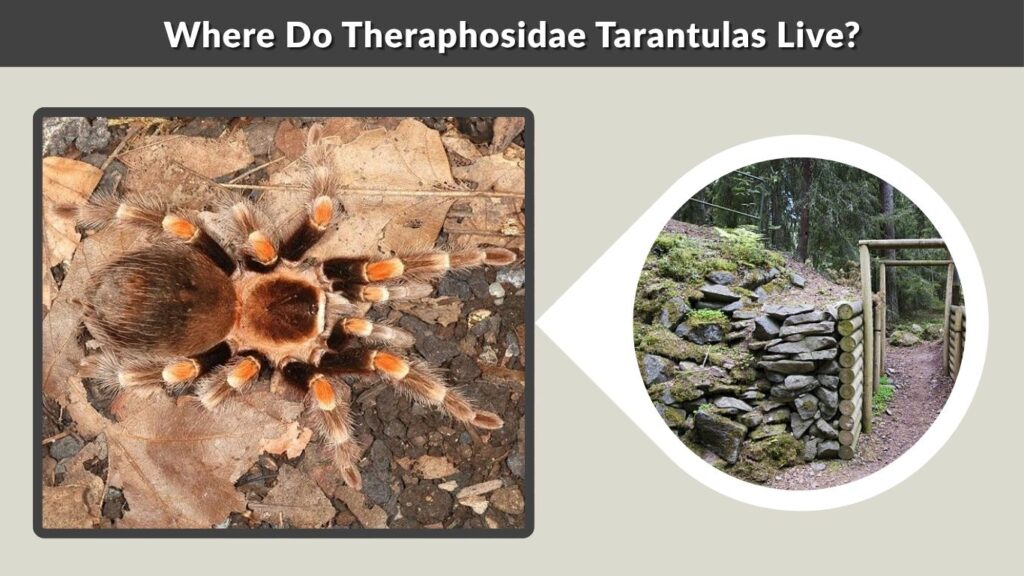
Theraphosidae tarantulas occupy an impressive variety of environments. Different species have evolved for life on the ground, underground, or in trees.
They are particularly diverse in the Americas, Africa, Asia, and parts of Oceania. Their specific environmental requirements vary considerably between species.
Terrestrial Tarantulas
Terrestrial species spend most of their time on the ground. They often shelter beneath logs, stones, roots, or vegetation and may enlarge naturally occurring cavities.
These tarantulas generally have robust bodies and strong legs suited to walking over the ground rather than climbing extensively.
Burrowing Tarantulas
Many Theraphosidae species construct deep burrows.
The spider may line the entrance and internal walls with silk. The burrow provides protection from predators while helping maintain favorable temperature and humidity conditions.
A tarantula can remain near its retreat and detect vibrations produced by insects walking nearby.
Arboreal Tarantulas
Arboreal tarantulas spend much of their lives above ground in trees, hollow trunks, bark crevices, and vegetation.
Compared with heavily built terrestrial species, many arboreal tarantulas have longer legs and relatively streamlined bodies that help them navigate vertical surfaces.
What Do Theraphosidae Tarantulas Eat?
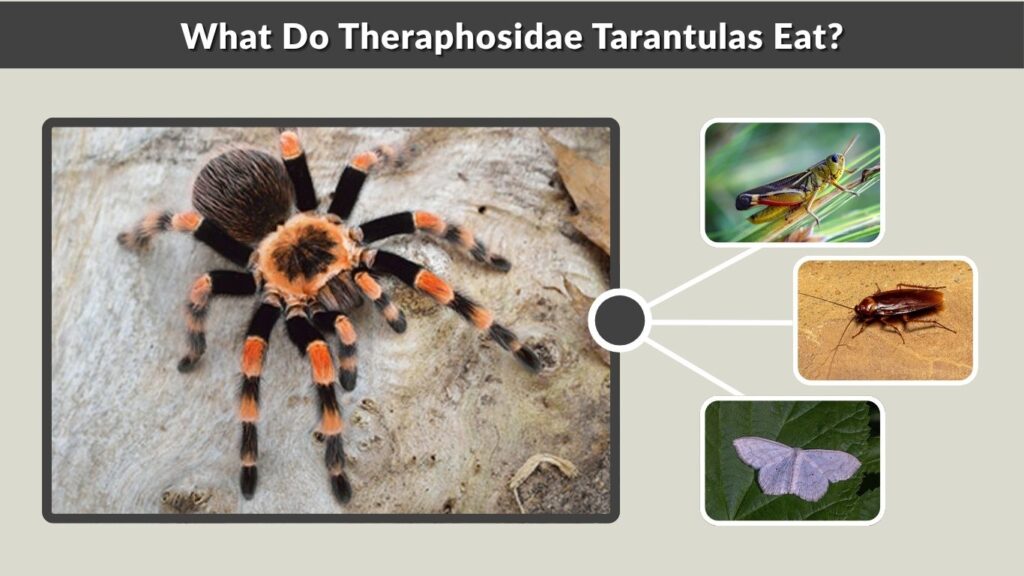
Theraphosidae tarantulas are predators that primarily hunt animals they can overpower safely. Diet varies depending on the spider’s size, habitat, and availability of prey.
Most do not chase prey over great distances. Instead, they depend heavily on vibration detection and ambush hunting.
Common Prey
Typical foods include:
- Crickets
- Grasshoppers
- Cockroaches
- Beetles
- Moths
- Caterpillars
- Other spiders
- Various small arthropods
Very large tarantulas may occasionally capture small vertebrates such as frogs, lizards, or rodents when opportunities arise. However, the popular image of tarantulas routinely hunting birds is misleading; insects and other arthropods make up the more typical prey.
How Tarantulas Hunt
A tarantula often waits inside or close to its retreat until vibrations signal nearby prey.
It rapidly strikes and secures the animal with its fangs. Venom helps immobilize prey while digestive fluids begin breaking down its tissues.
Because spiders cannot chew solid food in the way mammals do, the liquefied material is gradually consumed.
Theraphosidae Behavior and Defense
Despite their appearance, tarantulas generally prefer avoiding unnecessary conflicts. Their response to danger depends heavily on species, geographic origin, and individual temperament.
Some retreat immediately, while others may display defensive behaviors.
Defensive Behavior
When threatened, a Theraphosidae tarantula may:
- Run toward a nearby retreat
- Raise its front legs
- Display its fangs
- Strike defensively
- Release urticating hairs in species that possess them
- Produce defensive movements or sounds in some species
A defensive posture should be interpreted as a warning rather than aggressive hunting behavior toward humans.
Are Theraphosidae Tarantulas Dangerous?
Tarantulas possess venom because it is important for subduing prey. However, the medical importance of bites varies between species.
Even where venom effects are limited, the spider’s large fangs can cause a painful puncture wound. Anyone experiencing significant symptoms after a bite should seek appropriate medical care.
The urticating hairs of some New World species can also be troublesome, particularly if they enter the eyes.
Theraphosidae Tarantula Reproduction
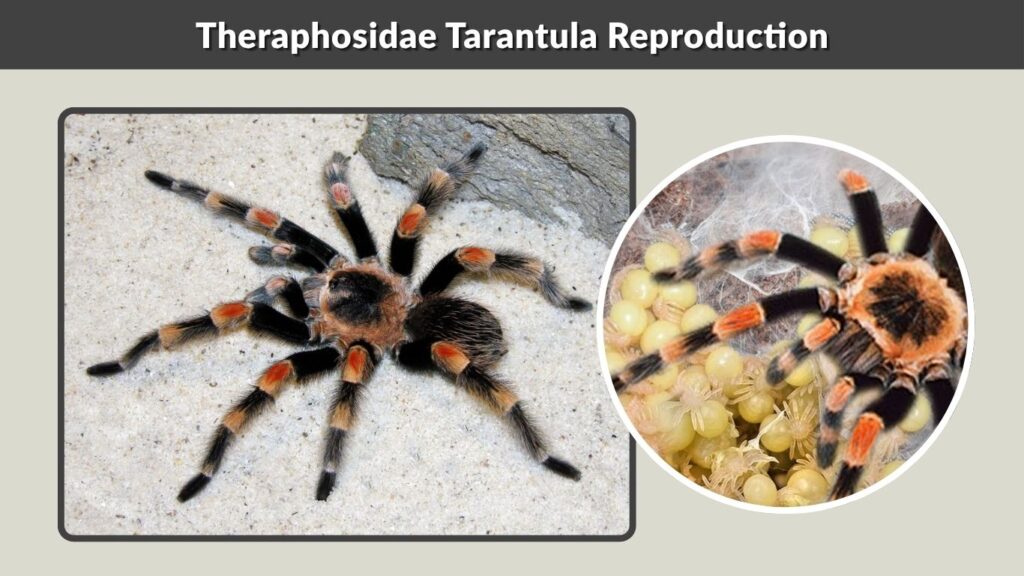
Tarantula reproduction involves specialized behaviors that allow the male to approach a potentially defensive female while reducing the risk of being mistaken for prey.
Mature males often become considerably more active as they search for females.
Courtship and Mating
Adult males produce sperm and transfer it to specialized structures on their pedipalps.
When a male locates a female’s retreat, he may use rhythmic tapping or vibration patterns to announce his presence. These signals can help the female distinguish a potential mate from prey.
During mating, the male transfers sperm using his pedipalps. He normally attempts to leave soon afterward because remaining near the female can be dangerous.
Research into North American Theraphosidae has shown that reproductive behavior and mating strategies can vary considerably among species.
Eggs and Spiderlings
After successful mating, the female can produce an egg sac containing numerous eggs.
She guards and frequently manipulates the sac while the young develop. Eventually, tiny spiderlings emerge and gradually become independent.
Young tarantulas grow by repeatedly shedding their exoskeleton in a process called molting.
How Long Do Theraphosidae Tarantulas Live?
One remarkable feature of tarantulas is their potential longevity, especially among females.
Female tarantulas of some species can survive for many years under favorable conditions. Males generally have shorter adult lifespans because their biology becomes strongly focused on reproduction after reaching maturity.
Molting
Tarantulas must molt to grow.
Before molting, a tarantula may stop eating, become less active, and spend more time inside its retreat. During a molt, the old exoskeleton separates and the spider carefully pulls itself free.
A freshly molted tarantula is soft and vulnerable until the new exoskeleton and fangs harden.
Dyskinetic Syndrome in Theraphosidae Tarantulas
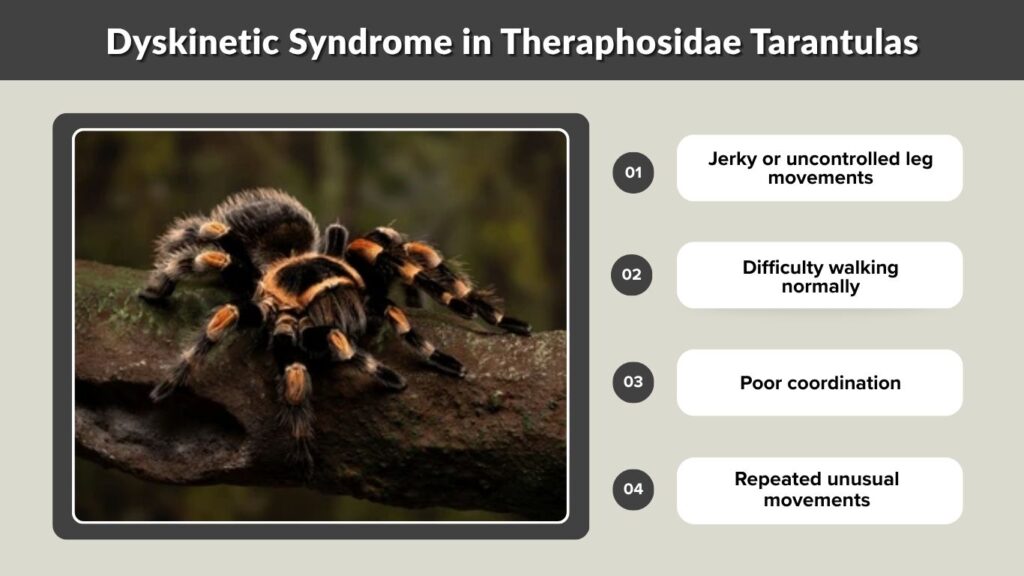
Dyskinetic syndrome, sometimes abbreviated as DKS, is a term used for a poorly understood condition reported in captive tarantulas.
Affected spiders may develop abnormal or poorly controlled movements. Published veterinary literature has described signs such as erratic movement and ataxia, sometimes followed by death. Importantly, dyskinetic syndrome describes a group of symptoms rather than a clearly established single disease.
Possible Signs
Reported abnormalities may include:
- Jerky or uncontrolled leg movements
- Difficulty walking normally
- Poor coordination
- Repeated unusual movements
- Trouble maintaining a normal posture
- Increasing weakness
The underlying cause remains uncertain, and proposed explanations have not established one universally accepted cause or treatment. Early veterinary literature specifically noted that knowledge of both causation and treatment was still limited.
A tarantula showing serious neurological or movement abnormalities should therefore be evaluated by a veterinarian experienced with exotic animals rather than treated using unverified home remedies.
Old World vs. New World Theraphosidae
Tarantulas are often informally separated into Old World and New World groups.
New World Tarantulas
New World species originate primarily from North, Central, and South America.
Many possess urticating hairs that provide an additional defensive mechanism. Popular genera include Aphonopelma, Grammostola, Tliltocatl, and Theraphosa.
Old World Tarantulas
Old World tarantulas occur across regions of Africa and Asia.
They generally lack the abdominal urticating hairs characteristic of many American species. Consequently, some rely more heavily on rapid movement, threat displays, and biting as defensive strategies.
However, behavior varies significantly between individual species.
Why Are Theraphosidae Important?
Tarantulas are significant predators within many ecosystems. By consuming insects and other small animals, they form part of complex food webs while themselves serving as prey for various vertebrates and specialized predators.
They are also scientifically valuable for research into spider evolution, venom, behavior, anatomy, biogeography, and taxonomy.
Theraphosidae classification continues to develop as researchers combine traditional anatomical studies with molecular and phylogenetic evidence. Modern research has confirmed the family as an exceptionally diverse lineage while also resulting in changes to the classification of individual genera and subfamilies.
FAQs
1. Is Theraphosidae the same as a tarantula?
Theraphosidae is the scientific family containing the spiders commonly called tarantulas. Therefore, true tarantulas belong to the family Theraphosidae.
2. Are Theraphosidae tarantulas venomous?
Yes. Tarantulas use venom primarily to immobilize prey. The effects and medical significance of bites can vary among species.
3. Where are Theraphosidae tarantulas found?
They occur mainly in tropical, subtropical, and warmer regions across the Americas, Africa, Asia, and Oceania. Different species occupy forests, grasslands, scrublands, deserts, burrows, and trees.
4. What do Theraphosidae tarantulas eat?
Most feed primarily on insects and other arthropods such as crickets, cockroaches, beetles, grasshoppers, moths, and other spiders. Large species can occasionally capture small vertebrates.
5. What is dyskinetic syndrome in tarantulas?
Dyskinetic syndrome is a term used for abnormal movement and coordination problems reported in some captive tarantulas. Its exact cause remains unclear, and there is currently no single scientifically established treatment for all cases.
