

The tawny mining bee (Andrena fulva) is a fascinating solitary bee that brightens up gardens and landscapes each spring. Recognized for its vivid orange-red fur, this bee is often mistaken for a small bumblebee, though its behavior and lifestyle are quite different. Far from being a threat, the tawny mining bee plays an important role in pollination, especially for fruit trees and wildflowers. With increasing awareness of pollinators, interest in this species has grown, particularly in the UK where it is commonly seen.
What is the Tawny Mining Bee?
The tawny mining bee belongs to the family Andrenidae and is scientifically known as Andrena fulva. It is one of the early-emerging solitary bees, appearing in March when spring flowers begin to bloom. Unlike honeybees or bumblebees, it does not live in colonies. Each female works independently to build and provision her nest, ensuring the survival of the next generation.
Males are smaller and less striking than females, but both contribute to pollination. Their short but active lifecycle makes them a seasonal highlight in parks, gardens, and meadows. Their presence signals a healthy ecosystem and plenty of floral resources.
Tawny Mining Bee Sting: Are They Dangerous?

One of the most common questions asked about these bees is whether they sting. The short answer is yes, females are capable of stinging, but they are non-aggressive. Tawny mining bees are not defensive like honeybees protecting a hive. Because they are solitary, there is no colony or honey store to guard, which means they rarely feel the need to sting.
Males cannot sting at all, while females will only use their sting if they are handled roughly or threatened. For gardeners, children, and pets, they pose little to no risk. Their docile nature makes them a pollinator to welcome rather than fear.
Life Cycle and Behavior

The life cycle of the tawny mining bee is short but fascinating.
- Emergence: Adults begin to appear in March or April, depending on climate conditions.
- Mating: Soon after emergence, males and females mate. Males then die within a few weeks, having completed their purpose.
- Nesting: Fertilized females start to dig burrows in soil, creating a network of tunnels leading to brood chambers.
- Provisioning: Inside each chamber, the female deposits a mixture of nectar and pollen, forming a food ball. She then lays a single egg on this supply.
- Development: The egg hatches into a larva, which consumes the food ball, grows, and eventually pupates.
- Next Generation: By late summer, new adults develop but remain underground through autumn and winter, emerging the following spring.
This cycle ensures that tawny mining bees are only visible for a few months each year, yet their contribution to pollination during that brief window is significant.
Nests and Ground Nesting Habits

Tawny mining bees are ground nesters, preferring bare soil, sandy banks, or lawns with loose earth. The nests often look like small volcano-shaped mounds of soil with a central hole, which can appear in clusters when many females nest in the same area.
Each female excavates her own burrow, sometimes digging up to 20–30 cm deep. Within the burrow, she creates several brood cells where the next generation will develop. Despite appearances, these clusters are not colonies; each female is working independently, even if the entrances are close together.
Gardeners sometimes worry about these soil mounds on lawns, but they are harmless. Unlike wasp nests or ant colonies, these burrows do not cause long-term damage to turf. In fact, they help aerate the soil and indicate a healthy environment.
Habitat and Distribution

The tawny mining bee is widespread across the UK and much of Europe, often spotted in gardens, parks, and hedgerows. Its preferred habitats are sunny, sandy, or well-drained soils where digging is easy. Urban green spaces can provide excellent nesting areas, as long as there are plenty of flowering plants nearby.
In the UK, sightings are especially common from southern England to the Midlands, though populations extend further north. Some references to tawny mining bees in Alberta, Canada, suggest confusion with similar Andrena species, as Andrena fulva is native to Europe rather than North America.
Their presence in early spring is tied closely to the blooming of fruit trees such as apple, cherry, and pear. This seasonal overlap makes them valuable pollinators for orchards and gardens. By disappearing by June, they avoid competition with later-flying species and maintain their unique ecological niche.
Queen and Size Differences
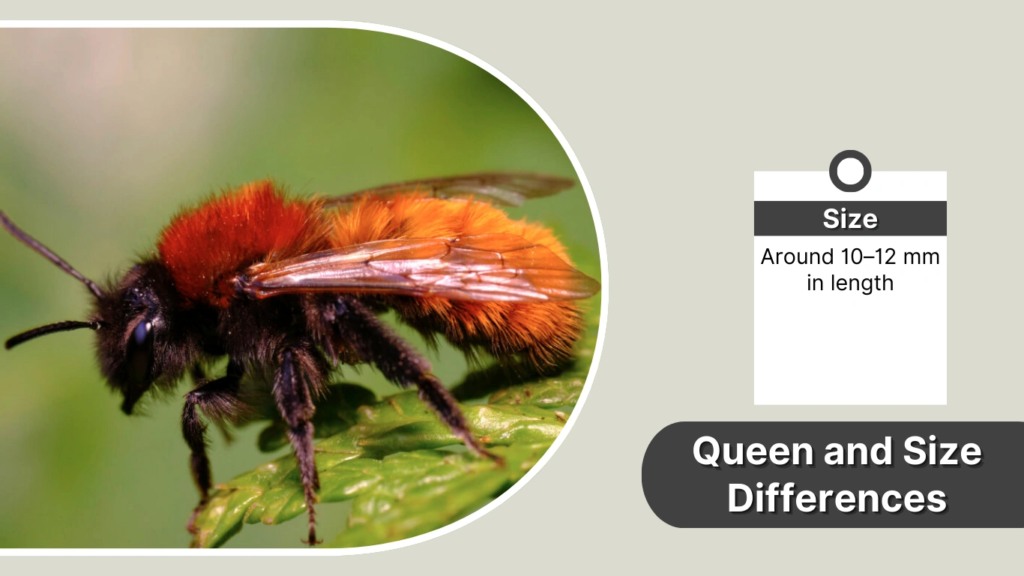
Unlike honeybees, tawny mining bees do not have a social structure with a queen, workers, and drones. Every female bee functions independently and carries out the role of nest-builder, egg-layer, and provider. This solitary lifestyle is what makes them fundamentally different from the social honeybee.
When it comes to size, females are generally larger than males. A typical female measures around 10–12 mm in length and is more robust in appearance. Her vibrant orange-red fur also makes her stand out more than the males, which are smaller (8–10 mm), thinner, and less brightly colored. The difference in size is linked to their roles—males focus on mating, while females take on the heavy task of digging burrows and provisioning food.
Importance in the Ecosystem
Tawny mining bees are highly effective pollinators, playing an important role in both wild and cultivated ecosystems. Their activity coincides with the blooming of fruit trees such as apple, plum, and cherry. Because they emerge so early in spring, they provide vital pollination services when other insects may still be scarce.
In gardens, they help fertilize flowering plants and support biodiversity. Their preference for nectar and pollen from a wide range of flowers makes them excellent generalist pollinators. For orchard owners and gardeners, their presence often translates into better fruit yields.
Importantly, tawny mining bees are not pests. They do not damage plants, wood, or soil structures, nor do they invade homes like wasps. Instead, they enrich the local ecosystem while posing almost no risk to humans. Encouraging their presence can be as simple as leaving some patches of bare soil or planting spring-blooming flowers.
Facts & Identification Tips
Identifying the tawny mining bee is straightforward once you know what to look for.
- Appearance: Females have a striking, fluffy orange coat with a black underside, while males are smaller and lighter in color.
- Flight period: They are active from March to June, disappearing during the summer months.
- Nesting signs: Small soil mounds with central holes in lawns or flowerbeds signal their presence.
- Behavior: They fly low to the ground when searching for nesting spots and often hover near soil surfaces.
- Similar species: They can be confused with bumblebees or the ivy bee (Colletes hederae), but the early spring timing and bright orange fur help distinguish them.
These features make the tawny mining bee one of the easier solitary bees to identify in gardens.
FAQs
What does a tawny mining bee look like?
The female has bright orange-red fur with a black underside, while the male is smaller, slimmer, and paler. Both are often seen flying low over soil in spring.
Do tawny mining bees sting?
Yes, females can sting, but they are non-aggressive and very unlikely to do so unless handled. Males do not sting at all.
Where can tawny mining bees be found in the UK?
They are widely distributed across gardens, parks, and countryside areas, especially in southern and central England, though they can also be spotted further north.
What time of year do tawny mining bees appear?
They emerge in March and remain active until early June, making them one of the earliest solitary bees to appear in spring.
How are they different from honeybees or bumblebees?
Unlike social bees, tawny mining bees are solitary nesters. Each female builds her own nest without a colony structure or a queen. Their bright orange fur also makes them easier to identify.
