
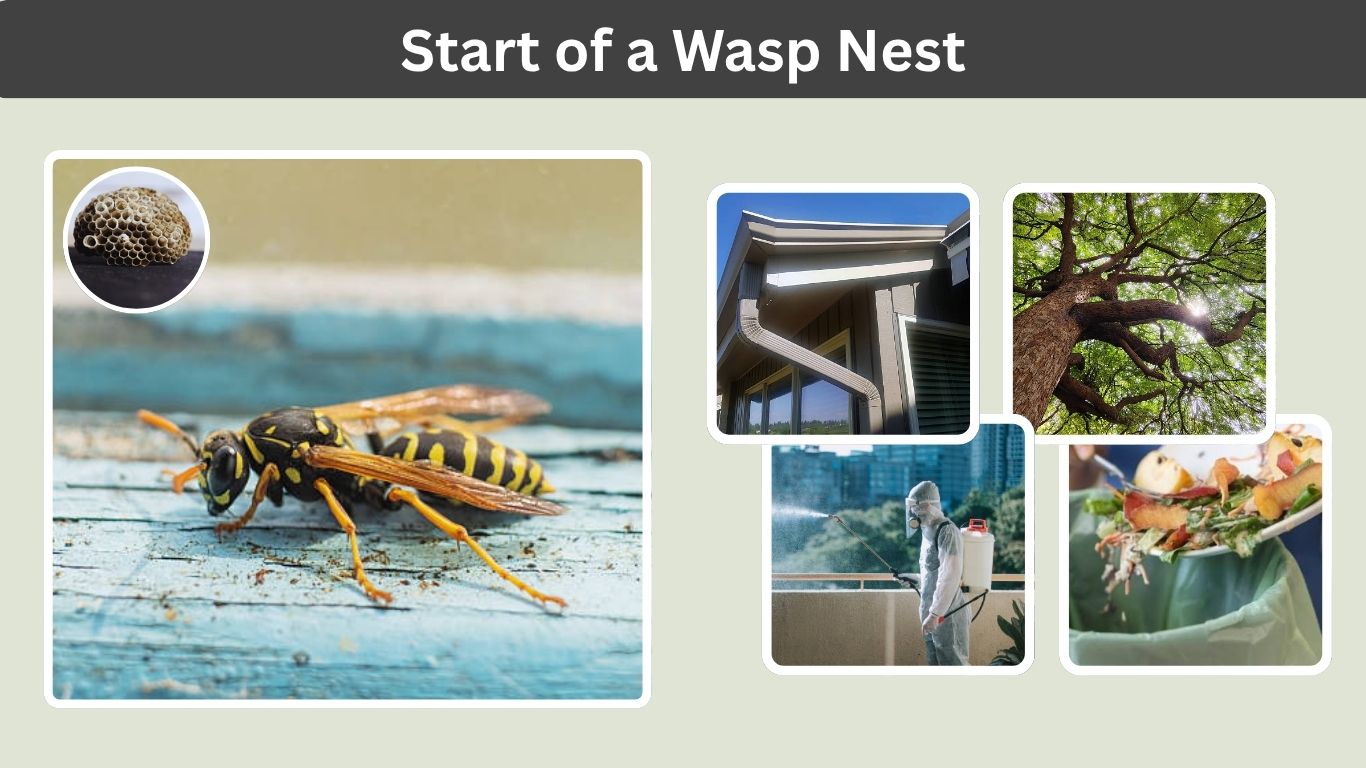
The start of a wasp nest can be surprisingly small and easy to overlook. What begins as a tiny paper structure or a few hexagonal cells may eventually develop into a large colony containing hundreds of wasps. Recognizing an early nest helps homeowners identify potential problems before the colony expands. Different wasp species build different types of nests, making identification important. This guide explains what a new wasp nest looks like, how it develops, where wasps commonly build, and how to handle early nests safely.
What Does the Start of a Wasp Nest Look Like?
A newly formed wasp nest often looks like a small, grayish paper structure attached to a sheltered surface. Depending on the species, it may resemble a miniature umbrella, a cluster of honeycomb cells, or a tiny enclosed ball. Some nests remain hidden underground or inside structural cavities, making their earliest stages difficult to observe.
Start of a Paper Wasp Nest
The start of a paper wasp nest usually consists of several open, hexagonal cells arranged in a small cluster. These cells are made from chewed wood fibers mixed with saliva, creating a lightweight, paper-like material.
Early paper wasp nests have several recognizable characteristics:
- Color: Light gray, brown, or grayish tan.
- Shape: Small, umbrella-shaped structure with exposed cells.
- Size: Initially only a few cells, often spanning a couple of centimeters or less.
- Attachment: Connected to a surface by a narrow stalk.
- Activity: One founding queen, or occasionally several females, may be visible.
Unlike many other social wasps, paper wasps do not cover their honeycomb with an outer paper envelope.
Start of a Yellowjacket or Hornet Nest
Yellowjackets and many hornets build enclosed nests that look different from those of paper wasps. The founding queen begins constructing small brood cells and a protective paper covering.
An exposed early aerial nest may resemble a tiny gray paper ball with a small entrance. As construction continues, additional paper layers protect the developing colony.
However, many yellowjackets establish nests underground, inside wall cavities, or in other concealed spaces. In these situations, homeowners may notice a queen repeatedly entering the same opening rather than seeing the nest itself.
Early Mud Dauber Wasp Nests
Mud dauber wasps construct nests using mud instead of paper. Their early nests often resemble small clay tubes, rounded mud cells, or irregular lumps attached to walls.
These solitary wasps generally do not form defensive colonies. Their nests are commonly found beneath roofs, along walls, and inside sheltered structures.
How Does a Wasp Nest Start?
The beginning of a wasp nest involves selecting a suitable location, collecting building materials, and creating chambers for developing offspring. Among social wasps in temperate regions, this commonly begins in spring when overwintered queens become active. Nest-building seasons can differ in warmer climates.
Queen Wasp Begins Building
A fertilized queen emerges from her overwintering shelter and searches for a protected nesting site. After selecting a location, she starts collecting weathered wood fibers.
The queen chews these fibers and combines them with saliva to produce the paper-like building material. She then constructs the first cells and deposits eggs inside them.
During this early period, the queen performs most of the work, including building, hunting, and feeding developing larvae.
First Workers and Nest Expansion
Once the eggs hatch, the larvae develop inside their cells and receive food from the queen. Eventually, the first adult female workers emerge.
These workers take over much of the responsibility for collecting food, expanding the nest, and defending the colony.
The queen increasingly focuses on reproduction while additional cells are constructed. This process allows the colony to grow considerably faster.
Where Do Wasps Start Building Their Nests?
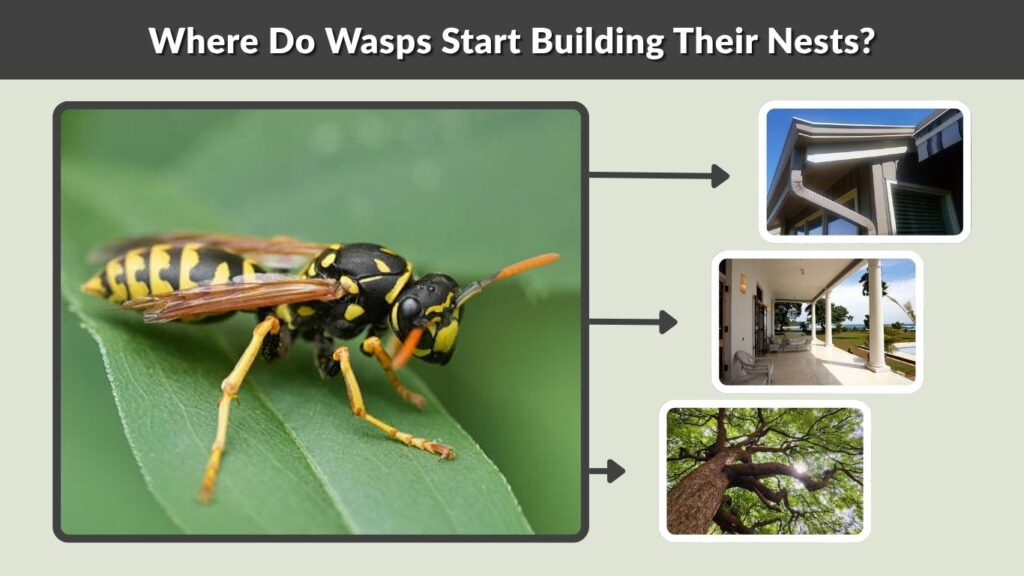
Wasps usually choose locations that provide shelter from harsh weather and disturbances. The exact nesting site depends on the species, surrounding environment, and availability of suitable spaces.
Common Early Nesting Locations
Homeowners should examine the following areas from a safe distance:
- Roof eaves: Protected surfaces beneath roof edges.
- Porch ceilings: Sheltered overhead areas near entrances.
- Sheds and garages: Quiet corners and structural openings.
- Tree branches: Suitable attachment points for aerial nests.
- Window frames: Narrow, protected corners around buildings.
- Wall cavities: Hidden spaces accessible through small gaps.
- Underground holes: Abandoned animal burrows and other cavities.
Repeated wasp activity around one location may indicate nest construction, even when the structure is not visible.
Stages of Early Wasp Nest Development
A social wasp nest passes through several developmental stages before reaching its mature size. Understanding these stages helps explain why a small structure can become much more active later in the season.
Four Main Nest Development Stages
- Foundation stage: A queen selects a nesting location and constructs the first cells.
- Egg and larval stage: Eggs hatch, and the queen feeds the developing larvae.
- Worker emergence: The first adult workers begin helping with construction and food collection.
- Colony expansion: Worker numbers increase, additional cells are built, and the nest becomes larger.
The time required for each stage varies with species, temperature, food availability, and environmental conditions.
In temperate climates, colonies commonly expand throughout the warmer months before declining during autumn or winter.
How to Remove the Start of a Wasp Nest Safely
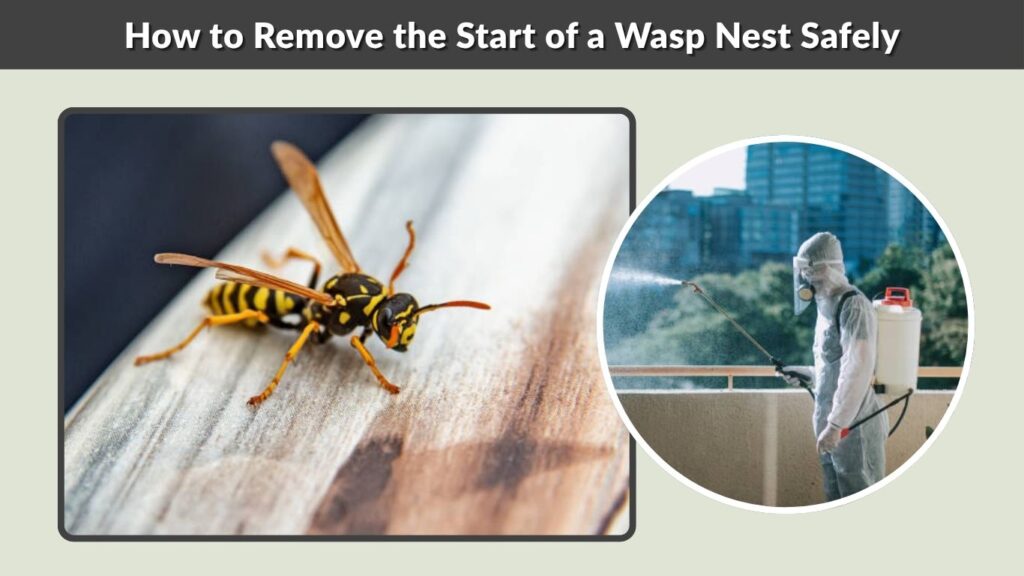
Finding a small wasp nest does not automatically mean it must be removed. Wasps help control other insects and contribute to pollination. However, nests near frequently used entrances or other busy areas can create a sting risk as colonies grow.
The safest approach depends on the nest’s location, species, activity, and accessibility.
When Should You Leave a Nest Alone?
A small nest located far from people may be safely left undisturbed. Wasps generally become defensive when they perceive threats near their nesting area.
Avoid touching, shaking, or approaching an active nest unnecessarily.
Many temperate-region social wasp colonies naturally decline after the growing season. Their old nests generally are not reused the following year, although new queens may establish nests nearby.
When Is Professional Removal Necessary?
Professional pest control is particularly appropriate when a nest is difficult to identify, already contains multiple workers, or occupies a potentially dangerous location.
Seek professional assistance when:
- The nest is inside a wall, attic, or roof cavity.
- Wasps are entering an underground opening.
- Removing it would require climbing a ladder.
- Someone nearby has a serious wasp-sting allergy.
- The colony displays defensive behavior.
Do not seal an active nest entrance, burn the nest, or attempt to knock it down. These actions can provoke defensive wasps or drive them into occupied spaces.
For a small, accessible nest, consult local pest-control guidance before considering treatment. If using a registered wasp-control product, follow its label exactly and do not approach without appropriate precautions.
How to Prevent Wasps From Starting New Nests
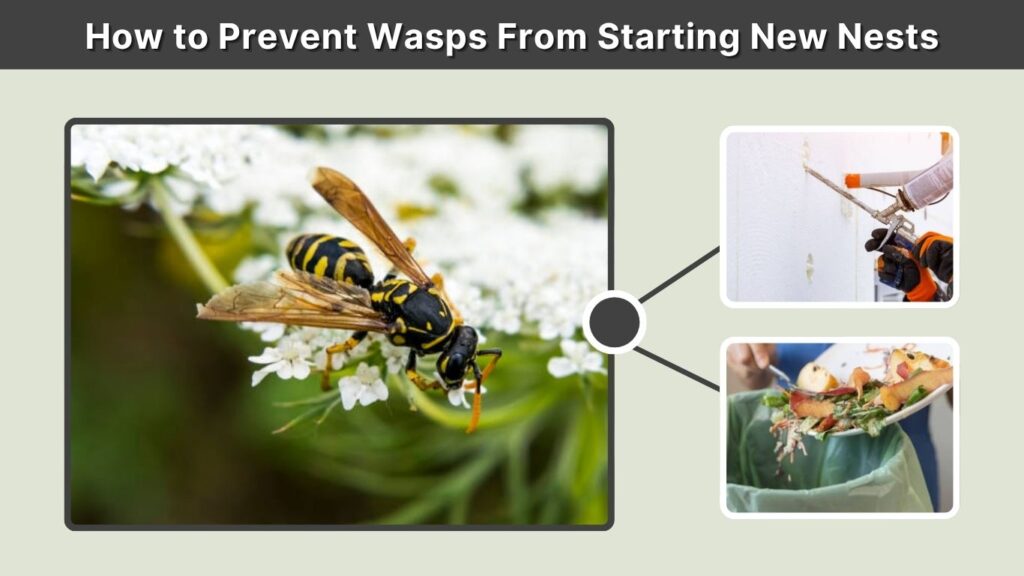
Early prevention focuses on reducing accessible nesting spaces and detecting new activity before a colony becomes established. Regular inspections are particularly useful during the beginning of the local nesting season.
Practical Wasp Nest Prevention Tips
- Inspect eaves regularly: Watch for small paper combs or repeated wasp visits.
- Seal structural gaps: Close openings in siding and around building fixtures after confirming they are unoccupied.
- Maintain outdoor structures: Inspect sheds, garages, and sheltered corners.
- Manage food waste: Keep garbage containers closed and clean up food spills.
- Monitor recurring activity: Observe possible nesting sites from a safe distance.
Although these measures can reduce attractive nesting opportunities, they cannot guarantee that wasps will avoid a property entirely.
FAQs
1. What does a wasp nest look like when it first starts?
An early paper wasp nest looks like a tiny cluster of gray or brown hexagonal cells. Yellowjacket and hornet nests may begin as small enclosed paper structures, while underground nests can remain completely hidden.
2. How small is the start of a paper wasp nest?
A newly started paper wasp nest may contain only a few cells and measure around a centimeter or two across. Its exact dimensions depend on how long the queen has been building.
3. How quickly does a wasp nest grow?
Growth rates vary by species, weather, and food availability. Development is initially slow while the queen works alone, but expansion accelerates after the first workers emerge.
4. Can you remove a wasp nest when it is just starting?
Small nests may be easier to manage than established colonies, but even a founding queen can sting. Removal should be considered only after identifying the nest and assessing the risks. Professional help is safest when the location is difficult to access or the species is uncertain.
5. Will wasps return after their nest is removed?
Wasps may investigate the same sheltered location again, and new queens can establish separate nests nearby. In most temperate-region social wasp species, an old nest is not reused by a new colony.
