
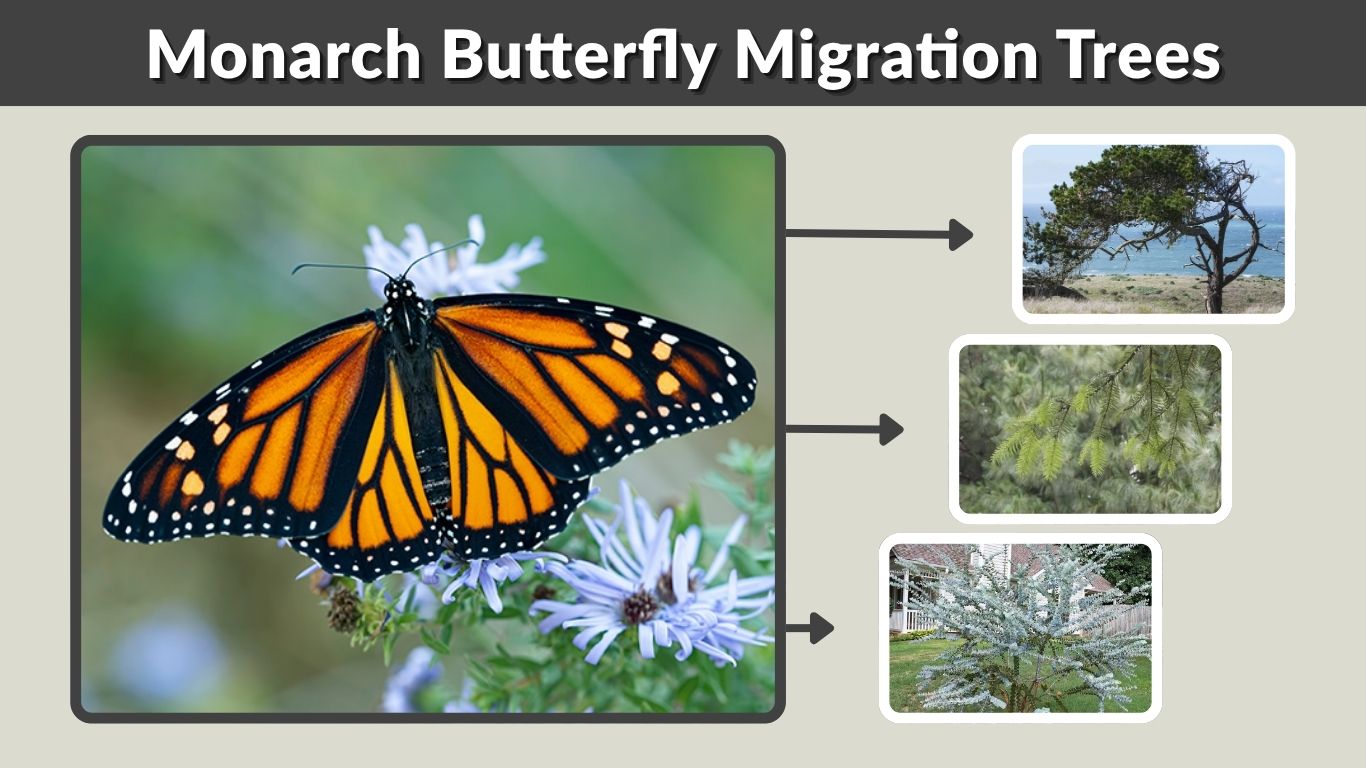
A monarch butterfly migration tree is a tree used by migrating or overwintering monarchs for shelter and communal roosting. The most famous are the oyamel fir trees (Abies religiosa) of central Mexico, where eastern North American monarchs gather in enormous winter colonies. Western monarchs use different trees along coastal California, particularly eucalyptus, Monterey pine, and Monterey cypress. These trees are primarily shelter rather than food—adult monarchs obtain energy from flower nectar, while caterpillars depend entirely on milkweed.
What Trees Do Monarch Butterflies Use During Migration?
Monarchs use different kinds of trees depending on where they are in their migration. During migration itself, groups may temporarily gather on trees and shrubs at night before continuing their journey the following day. At their winter destinations, however, they form much larger and longer-lasting clusters.
The two major North American overwintering patterns are very different.
| Region | Important Monarch Trees | Main Purpose |
| Central Mexico | Oyamel fir | Winter shelter and clustering |
| Coastal California | Eucalyptus | Winter roosting |
| Coastal California | Monterey pine | Winter roosting |
| Coastal California | Monterey cypress | Winter roosting |
| Migration route | Many available trees/shrubs | Temporary resting sites |
Eastern North American monarchs overwhelmingly winter in the mountainous oyamel forests of central Mexico, while western monarchs primarily use coastal California groves.
Monarch Butterfly Trees in Mexico
The tree most strongly associated with monarch migration is the oyamel fir, scientifically known as Abies religiosa.
Millions of migrating monarchs can concentrate within high-elevation forests in central Mexico, particularly within and around the Monarch Butterfly Biosphere Reserve. U.S. Fish and Wildlife Service information places these overwintering forests roughly 2,400–3,600 meters (8,000–nearly 12,000 feet) above sea level.
Why Do Monarchs Choose Oyamel Fir Trees?
Oyamel forests produce the special microclimate monarchs need to survive winter.
The dense forest acts somewhat like both a blanket and an umbrella. Tree cover protects butterflies from extreme cold, precipitation, and rapid temperature changes while maintaining cool conditions that reduce their energy use.
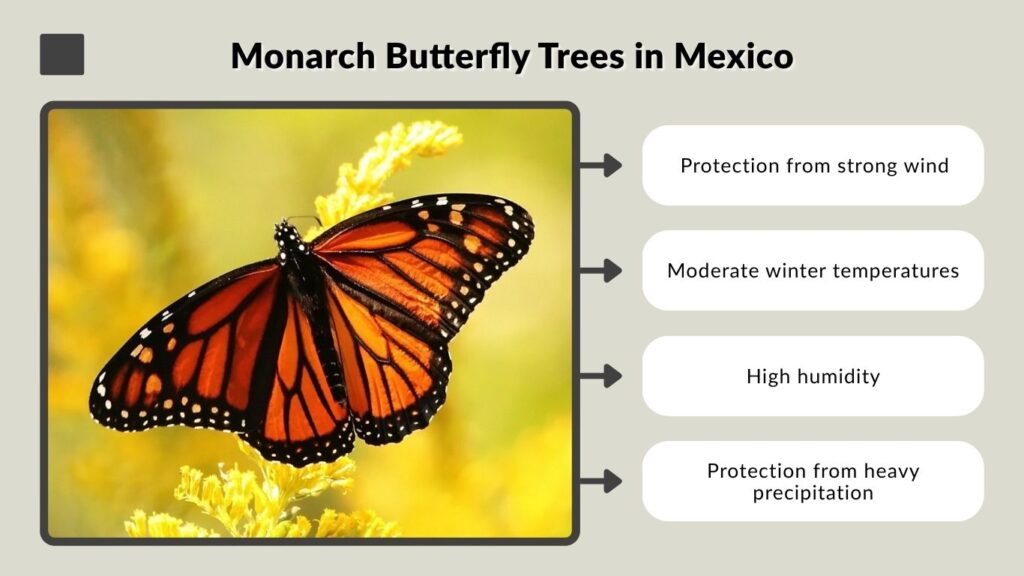
Important conditions include:
- Protection from strong wind
- Moderate winter temperatures
- High humidity
- Protection from heavy precipitation
- Dense overhead canopy
- Access to moisture
- Cool conditions that conserve stored energy
Monarch Joint Venture notes that overwintering colonies occur around 3,000 meters in mountainous Mexico, where fog and clouds also provide moisture important to winter survival.
Why Are Trees Covered With Monarch Butterflies in Mexico?
During cold periods, thousands of monarchs cluster tightly together on branches and trunks.
With their wings closed, large groups can make branches appear brown or orange rather than covered in individual butterflies. As sunlight warms the forest, butterflies may open their wings or leave their clusters and begin flying.
Nearly all migratory monarchs breeding across eastern North America ultimately concentrate in these relatively small Mexican overwintering areas. Their migration from northern breeding grounds can extend up to about 3,000 miles.
Do Monarch Butterflies Eat Oyamel Fir Trees?
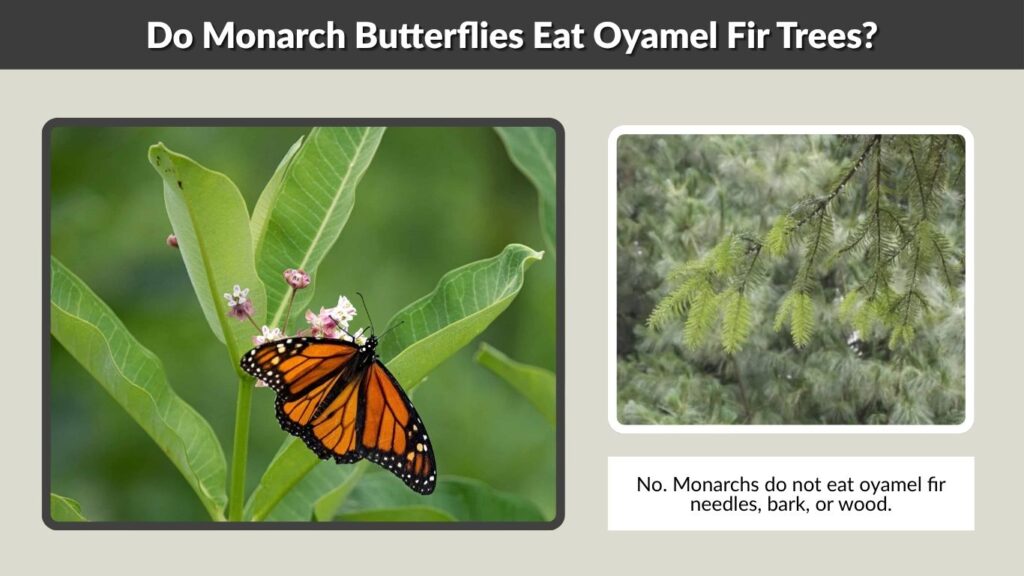
No. Monarchs do not eat oyamel fir needles, bark, or wood.
The trees primarily provide a protected winter habitat. Adult monarch butterflies obtain energy by drinking nectar from flowers.
Monarch caterpillars have an even more specialized relationship with plants: they can eat only milkweed. Female monarchs also lay their eggs on milkweed plants rather than on oyamel firs, pines, maples, oaks, or other ordinary trees.
So the roles are different:
Milkweed → eggs and caterpillar food
Flowers → adult butterfly nectar
Oyamel fir → winter shelter
Monarch Butterfly Trees in California
Western monarchs generally do not depend on Mexico’s oyamel forests in the same way as the major eastern population.
Many western monarchs migrate toward the Pacific Coast and overwinter in protected groves in California. Their commonly used roost trees include:
- Blue gum eucalyptus (Eucalyptus globulus)
- Monterey pine (Pinus radiata)
- Monterey cypress
- Other suitable trees within protected coastal groves
U.S. Fish and Wildlife Service identifies eucalyptus, Monterey pine, and Monterey cypress as important western monarch overwintering trees.
Eucalyptus Trees and Monarch Butterflies
Eucalyptus has become particularly associated with monarch wintering sites in California.
Monarchs may form hanging clusters beneath branches where the surrounding grove shields them from wind and creates stable temperatures. At Pismo State Beach, for example, tall eucalyptus and Monterey cypress provide shelter and canopy conditions needed by overwintering monarchs.
Eucalyptus is not the monarch caterpillar’s host plant. Even where adult butterflies use eucalyptus groves for shelter, caterpillars still require milkweed.
What Trees Do Monarch Butterflies Like?
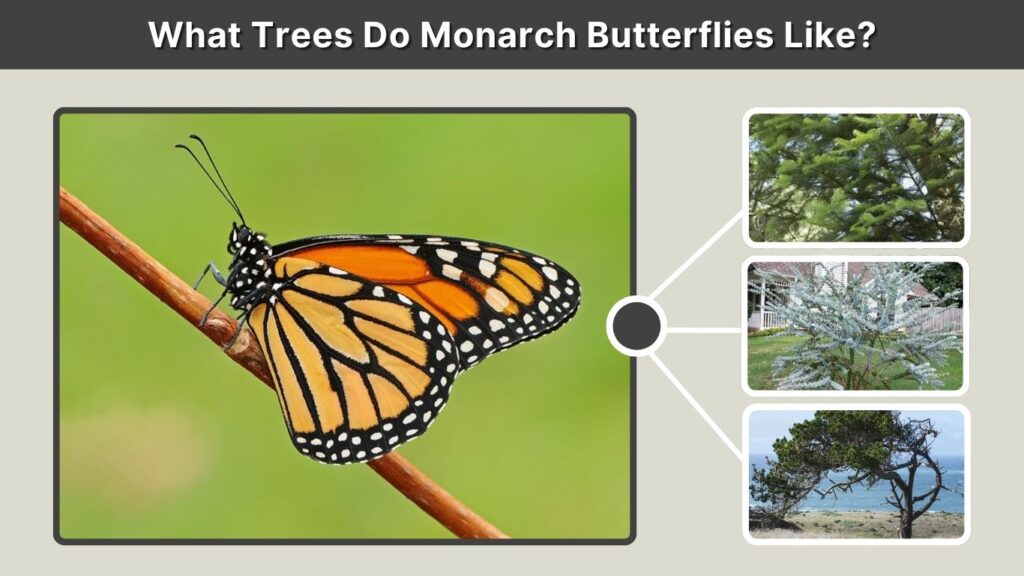
There is no single tree that monarchs use everywhere.
Their choice depends on whether they need winter shelter, a temporary migration roost, or food nearby.
Trees for Winter Shelter
The most important examples are:
Oyamel fir: Essential to the major eastern population’s Mexican winter colonies.
Eucalyptus: Frequently used at western overwintering locations in California.
Monterey pine: Another important California roosting tree.
Monterey cypress: Used extensively at several California coastal overwintering sites.
Trees and Plants for Food
A tree is useful as a food source only when its flowers provide accessible nectar. Monarch adults are opportunistic nectar feeders and visit many blooming plants throughout migration.
For a monarch-friendly garden, providing pesticide-free native nectar plants over a long flowering season is generally more useful than searching for one particular “monarch tree.”
Do Monarch Butterflies Live in Trees?
Monarch butterflies do not permanently live in trees throughout their entire lives.
Trees become particularly important during nighttime roosting and overwintering. Migrating monarchs can gather temporarily in trees while traveling, and winter colonies can remain associated with protected forest groves for months.
Their breeding cycle is different. Females search for milkweed, lay individual eggs on it, and the emerging caterpillars remain dependent on milkweed until they pupate.
Why Do Monarchs Form Huge Tree Clusters?
Clustering helps overwintering monarchs occupy a protective forest microclimate while remaining relatively inactive during cold weather.
The trees and surrounding forest help protect them from freezing temperatures and precipitation. When forests are degraded and the canopy becomes more open, the altered microclimate can expose monarchs to more dangerous winter conditions.
This is why protecting individual roost trees alone is not necessarily enough—the surrounding forest structure matters too.
Do Monarchs Return to the Same Tree Every Year?
The famous migration is unusual because the butterflies returning south in fall are generally not the same individuals that left the overwintering grounds the previous spring.
The long-lived migratory generation survives winter and starts moving north in spring, but subsequent shorter-lived generations continue the journey. Eventually, a later generation makes the long southward migration again.
Monarchs can therefore return repeatedly to the same general overwintering forests and groves even though different individual butterflies are making the journey.
Can You Plant a Tree to Attract Monarch Butterflies?

A flowering tree can provide useful nectar, but creating monarch habitat requires more than planting a single tree.
For breeding monarchs, native milkweed appropriate to your region is essential because it is the only food source for monarch caterpillars. Adult butterflies also need nectar-rich flowers across spring, summer, and fall.
A useful monarch habitat therefore combines:
- Regionally appropriate native milkweed
- Native nectar flowers
- Continuous blooms through the season
- Shelter from strong wind
- Pesticide-free gardening practices
For overwintering sites in coastal California, tree-grove structure is especially important because the canopy provides moisture, shelter, and protection from extreme temperatures.
FAQs
What tree do monarch butterflies use in Mexico?
Monarch butterflies primarily use oyamel fir trees (Abies religiosa) in the high mountains of central Mexico. The dense forests create the cool, moist, protected microclimate needed by the eastern migratory population during winter.
Why do monarch butterflies cover trees in Mexico?
Monarchs cluster together on trunks and branches while overwintering. The surrounding oyamel forest protects them from extreme cold, precipitation, and rapid temperature changes, allowing them to conserve the energy required for their spring migration.
Do monarch butterflies eat oyamel fir trees?
No. Oyamel firs provide shelter rather than food. Adult monarchs drink flower nectar, while monarch caterpillars feed exclusively on milkweed leaves.
What trees do monarch butterflies use in California?
Western monarchs commonly overwinter on blue gum eucalyptus, Monterey pine, and Monterey cypress in protected groves along the California coast. The trees help maintain suitable winter temperatures and shelter the butterflies from severe weather.
Will monarch butterflies lay eggs on trees?
Normally, no. Female monarchs lay their eggs on milkweed plants, which provide the food their caterpillars need after hatching. Trees such as oyamel fir, eucalyptus, oak, maple, and pine may provide shelter, but they are not monarch larval host plants.
