
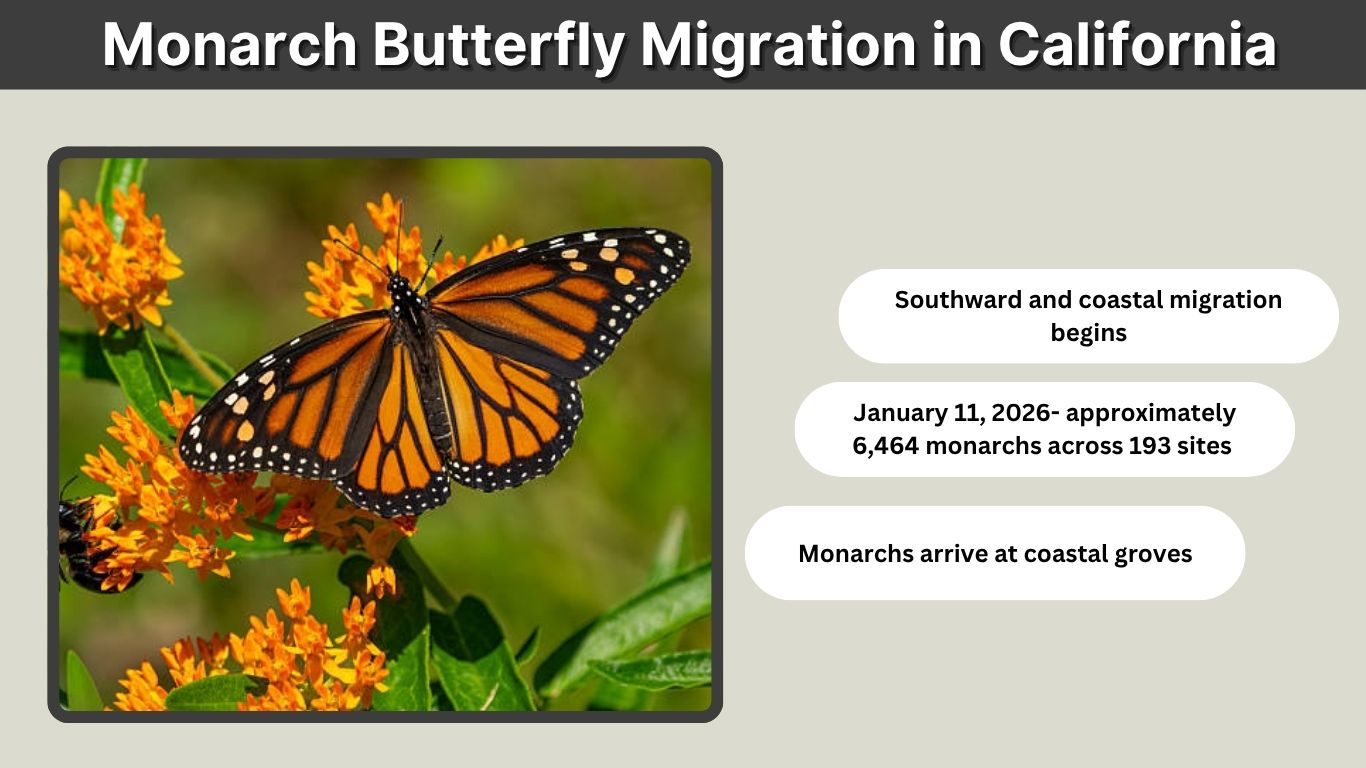
California’s monarch butterfly migration brings thousands of orange-and-black butterflies to sheltered coastal groves each fall and winter. These western monarchs travel from breeding areas across the western United States before gathering in trees along the California coast and northern Baja California. Visitors can observe them at protected sites such as Pacific Grove, Natural Bridges State Beach, and Pismo State Beach.
How Monarch Butterfly Migration Works in California
Western monarch butterflies generally live and breed west of the Rocky Mountains. During late summer and fall, a long-lived migratory generation travels approximately 300 to 1,000 miles toward protected coastal overwintering sites.
Instead of continuing to central Mexico like most eastern monarchs, many western monarchs settle in hundreds of groves along coastal California and northern Baja California. These sites offer moderate temperatures and protection from strong winds, storms, and freezing weather.
California Monarch Migration Route
Monarchs may arrive from California’s inland valleys and mountain regions, as well as Nevada, Oregon, Washington, Idaho, Utah, and other western areas. Their routes are not represented by one narrow pathway. Butterflies move through a broad network of breeding, feeding, and resting habitats.
Once they reach the coast, they cluster in trees such as:
- Monterey pine
- Monterey cypress
- Eucalyptus
- Other trees that create sheltered groves
These dense clusters help the butterflies conserve energy and remain protected during cool, wet, or windy weather.
When Is Monarch Butterfly Season in California?
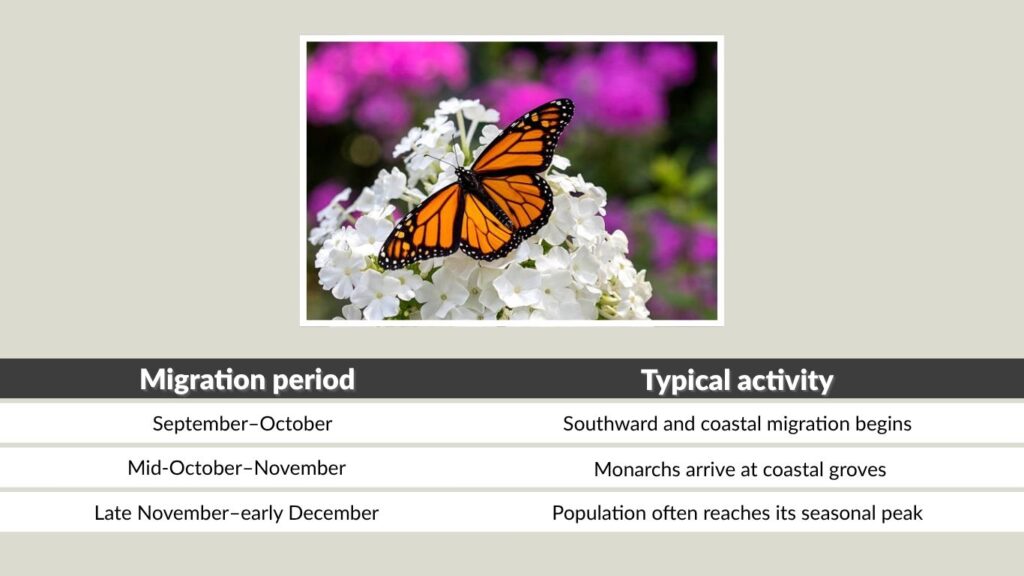
The main California monarch season runs from October through February. Arrival dates and butterfly numbers differ every year because migration is affected by temperature, drought, storms, food availability, and breeding success.
| Migration period | Typical activity |
| September–October | Southward and coastal migration begins |
| Mid-October–November | Monarchs arrive at coastal groves |
| Late November–early December | Population often reaches its seasonal peak |
| December–January | Butterflies remain clustered at overwintering sites |
| February–March | Monarchs disperse inland and northward |
Pacific Grove usually receives monarchs beginning in October, while the official Pismo State Beach viewing season runs from November through February. At Natural Bridges State Beach, monarchs normally arrive around mid-October and leave by mid-February.
Best Time to See Monarchs
Late October through early December is generally the most dependable viewing period. California State Parks identifies late October and November as especially favorable at Natural Bridges, while the Western Monarch Count conducts its peak survey from late November through early December.
Cool mornings are useful for seeing tightly grouped clusters because the butterflies are less active. On sunny afternoons, they may open their wings, drink nectar, or fly around the grove. Numbers can change quickly, so visitors should check with the park or sanctuary before traveling.
Best Places to See Monarch Butterflies in California
California contains more than 200 known coastal overwintering sites, but not every location holds large numbers annually. The following public sites are among the most recognized.
Pacific Grove Monarch Butterfly Sanctuary
Pacific Grove in Monterey County is one of California’s most famous monarch destinations. Butterflies generally arrive in October and remain through February, clustering in the sanctuary’s pine, cypress, and eucalyptus trees.
The sanctuary offers seasonal educational programs, and its location near Monterey makes it convenient for Central Coast visitors. However, yearly numbers can vary significantly.
Natural Bridges State Beach
Natural Bridges State Beach in Santa Cruz protects an important monarch grove inside a sheltered canyon. The park’s eucalyptus trees reduce exposure to wind and provide winter nectar.
Monarchs normally arrive in mid-October and leave by mid-February. Late October and November are often the best months for viewing. Natural Bridges contains California’s only State Monarch Preserve.
Pismo State Beach Monarch Butterfly Grove
The Pismo State Beach grove is a protected public overwintering site in San Luis Obispo County. Its official season runs from November through February.
Visitors can observe monarchs from designated paths without entering or disturbing the trees where they cluster. Population numbers vary greatly, so a historically productive grove may contain fewer butterflies during a poor migration year.
Other California Overwintering Areas
Monarch overwintering sites occur from the San Francisco Bay Area south toward San Diego. Additional locations have included Lighthouse Field State Beach, coastal Santa Barbara County, Gaviota State Beach, Ellwood Mesa, and several smaller public or privately managed groves.
The Western Monarch Count’s interactive map is useful for locating documented sites. However, a map listing does not guarantee that butterflies are currently present.
California Monarch Butterfly Population
Western monarch numbers were historically measured in the millions, but the population has declined dramatically since the 1980s. Habitat loss, pesticide exposure, drought, climate change, reduced nectar availability, and damage to overwintering groves are among the major concerns.
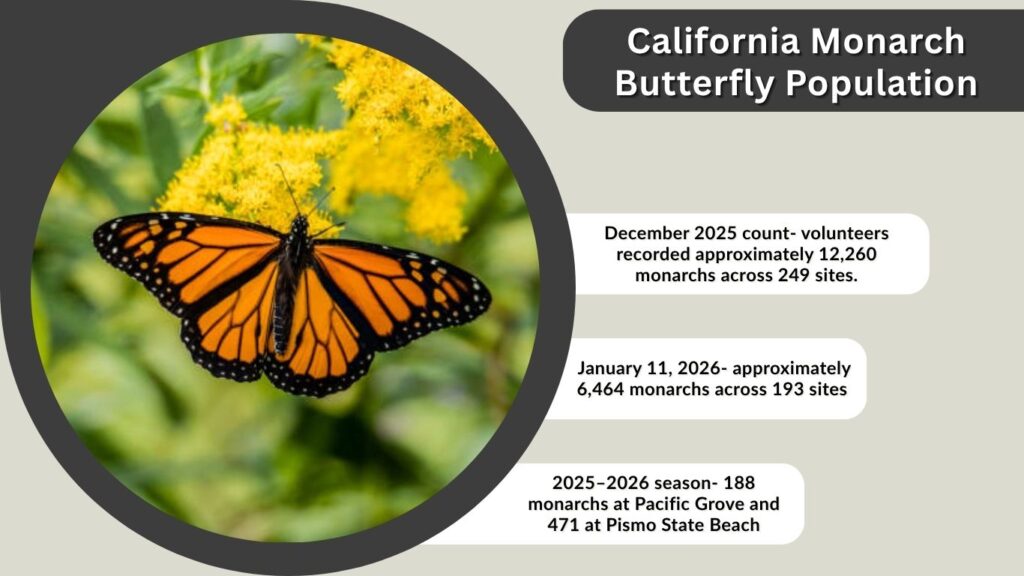
During the late-November and early-December 2025 count, volunteers recorded approximately 12,260 monarchs across 249 sites. This was the third-lowest peak total since systematic counting began in 1997.
By the final survey period ending January 11, 2026, approximately 6,464 monarchs across 193 sites remained. Seasonal declines are expected, but these totals show that the western migratory population continues to face serious risks.
Local numbers were also low during the 2025–2026 season. The mid-season count recorded approximately 188 monarchs at Pacific Grove and 471 at Pismo State Beach. Visitors should therefore avoid expecting the enormous clusters shown in historical photographs.
Are Monarch Butterflies Native to California?
Yes. Monarch butterflies are native migratory insects in California. They naturally breed, feed, migrate, and overwinter within the state.
However, some monarchs now remain in parts of coastal California throughout the year, often where nonnative tropical milkweed continues growing during winter. Year-round breeding may interfere with normal migration and increase exposure to disease.
How to Help California Monarchs
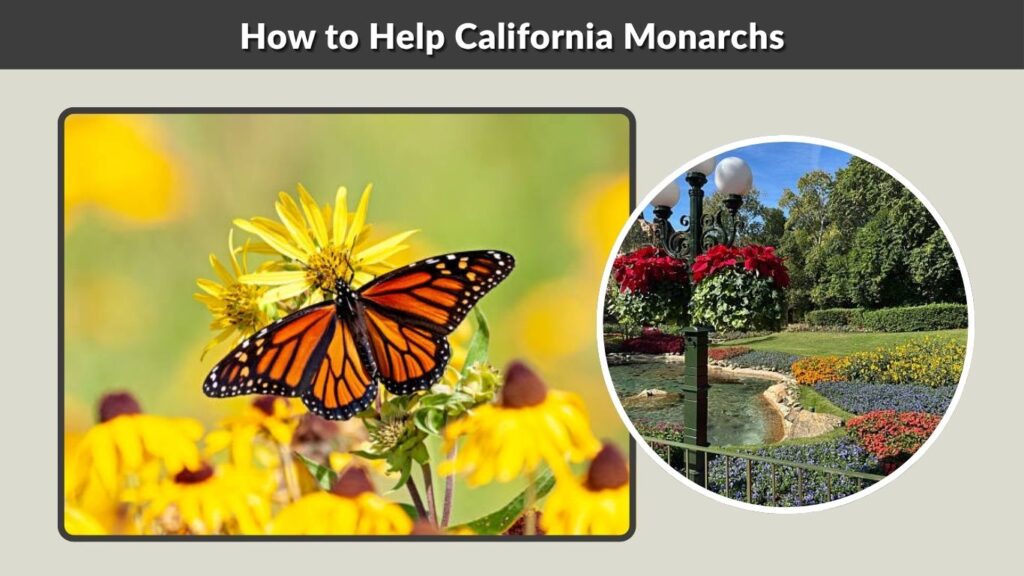
Planting appropriate habitat is generally more beneficial than capturing and raising butterflies.
Create a Monarch-Friendly Garden
Gardeners can provide pesticide-free native flowers that bloom during spring and fall migration. Native milkweed may also be planted where it naturally belongs because monarch caterpillars cannot develop without milkweed.
Suitable species depend on the region and may include California milkweed, heartleaf milkweed, desert milkweed, woolly milkweed, narrowleaf milkweed, and showy milkweed. Avoid tropical milkweed and purchase plants that have not been treated with systemic insecticides.
Milkweed should not be planted beside coastal overwintering groves. Xerces recommends avoiding it within five miles of the coast north of Santa Barbara and within one mile of the coast south of Santa Barbara. In these areas, winter-blooming native nectar plants are more appropriate.
Is Raising Monarch Butterflies Illegal in California?
California requires a Scientific Collecting Permit to take or possess monarchs for scientific, educational, or propagation purposes. This includes handling wild monarchs and captive rearing for those purposes.
Observing monarchs naturally in a garden does not require capturing them. California wildlife officials recommend habitat-based education and conservation rather than buying caterpillars, collecting eggs, or raising monarchs indoors without authorization.
At the federal level, the monarch was still classified as proposed threatened, rather than formally listed, as of April 2026. Federal protections under the proposed rule would not begin unless and until a final rule takes effect.
Responsible Monarch Viewing
Remain on designated paths and avoid shaking branches or touching clusters. Do not capture butterflies, move individuals for photographs, or approach roosting trees with drones.
Binoculars can provide a better view without disturbing the insects. Dogs should be controlled, children should be supervised, and visitors should follow all sanctuary or park instructions.
FAQs
When Do Monarch Butterflies Migrate to California?
Western monarchs generally begin reaching California’s coastal groves in October. Large seasonal gatherings may develop during November, and butterflies typically remain through January or February before dispersing toward inland and northern breeding habitats.
Where Is the Best Place to See Monarchs in California?
Pacific Grove, Natural Bridges State Beach, and Pismo State Beach are the best-known public viewing locations. No site is guaranteed to hold large numbers every year, so visitors should check recent reports before making a special trip.
Are There Monarch Butterflies in Southern California?
Yes. Monarchs migrate through and overwinter in parts of Southern California. Coastal sites extend toward San Diego, although the number of butterflies and the locations they use can change considerably from one winter to another.
When Do Monarch Butterflies Leave California’s Coast?
Most overwintering monarchs begin leaving coastal groves during February and March as temperatures rise. They move inland and northward, searching for nectar and emerging native milkweed on which females can lay eggs.
Can I Release Purchased Monarch Butterflies in California?
Releasing commercially raised monarchs is discouraged because captive butterflies may carry diseases, originate from inappropriate populations, or be poorly prepared for migration. California also regulates taking, possessing, and rearing monarchs for propagation or educational purposes.
