
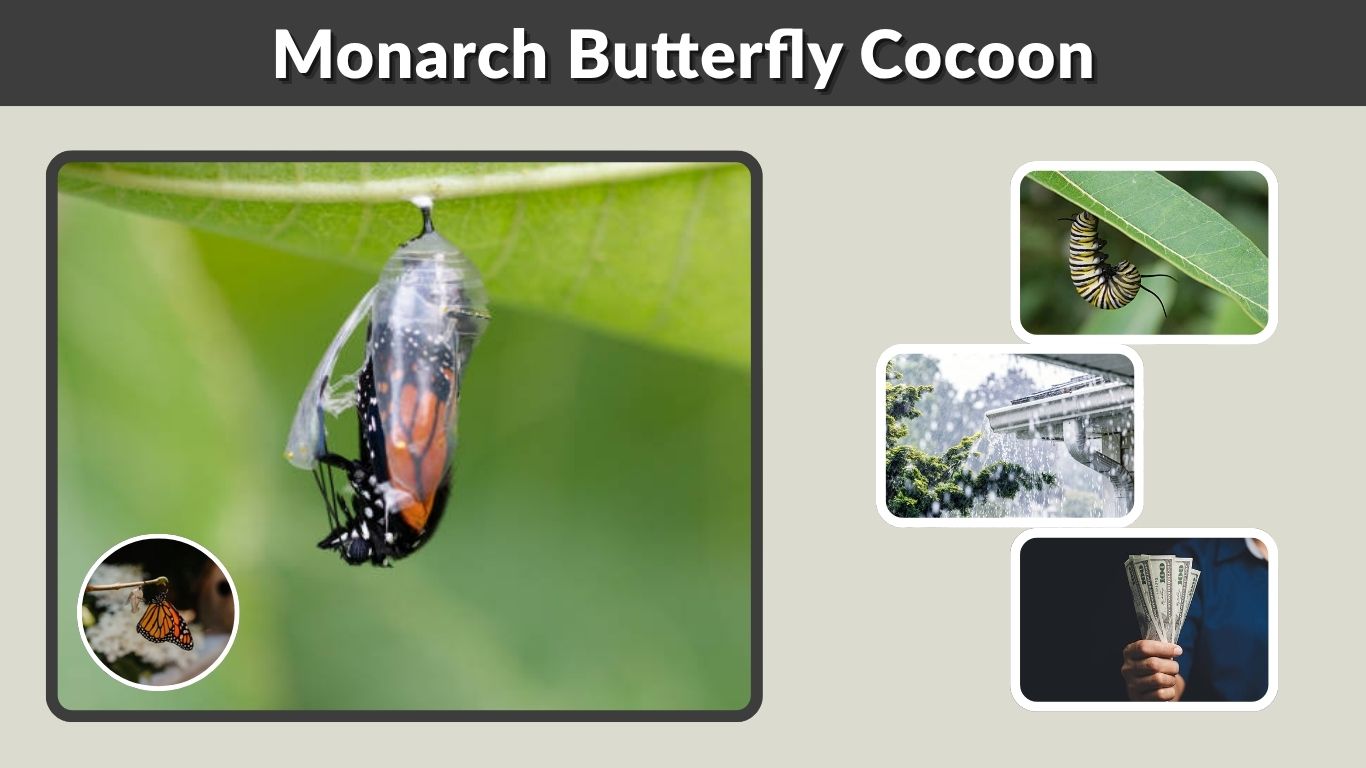
A monarch butterfly “cocoon” is one of nature’s most recognizable transformations. The smooth green case, decorated with metallic-looking gold dots, protects the developing butterfly until it emerges with orange-and-black wings. However, monarchs do not technically make cocoons. Their pupal case is called a chrysalis. Understanding its appearance, development time, color changes, and care can help you observe the process without harming the butterfly.
Is It a Monarch Cocoon or Chrysalis?
The correct term is monarch chrysalis. Butterflies generally form an exposed pupa called a chrysalis, while many moth caterpillars surround their pupae with silk to create cocoons.
A monarch caterpillar produces only a small silk pad that attaches it to a leaf, branch, wall, or another firm surface. It does not spin a silk covering around its entire body. After hanging upside down, the caterpillar sheds its skin and reveals the green chrysalis underneath.
| Term | Meaning |
| Chrysalis | The exposed pupal stage of a butterfly |
| Cocoon | A silk covering surrounding the pupa of many moths |
| Pupa | The developmental stage between caterpillar and adult |
| Eclosion | The adult butterfly’s emergence from the chrysalis |
Although “monarch butterfly cocoon” is widely used, “monarch chrysalis” is biologically accurate.
What Does a Monarch Chrysalis Look Like?
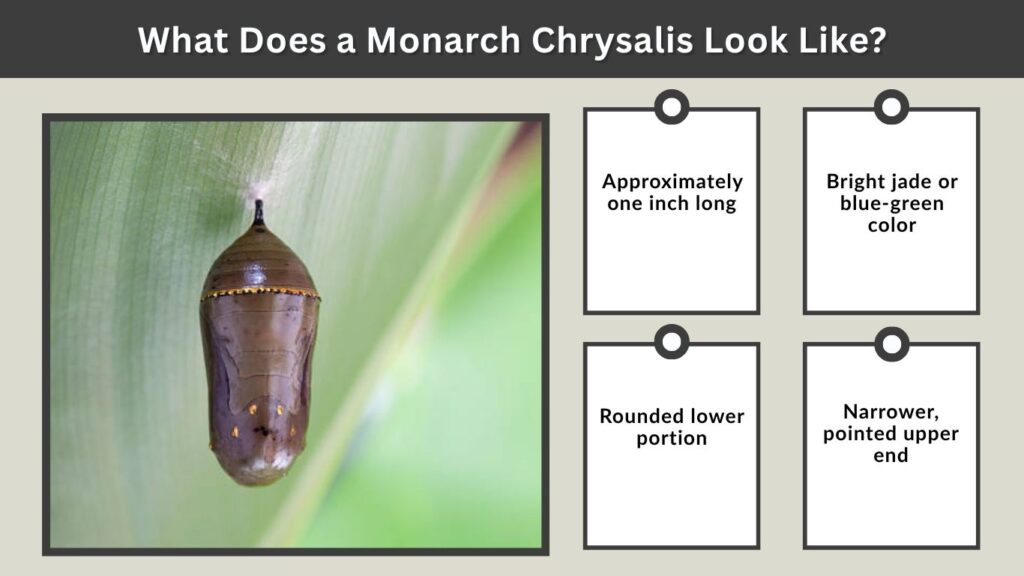
A healthy monarch chrysalis is usually jade green with a smooth, rounded surface. It hangs vertically from a small black stem called the cremaster.
Identification Features
- Approximately one inch long
- Bright jade or blue-green color
- Rounded lower portion
- Narrower, pointed upper end
- Black attachment point at the top
- Shiny gold dots and a gold-and-black band
- Smooth surface without a silk covering
- Increasing transparency before emergence
The gold spots are not painted markings or pieces of metal. They are structural features of the chrysalis that reflect light, producing their metallic appearance. Researchers have proposed several possible functions, but their exact biological role is not completely understood.
Monarch Butterfly Chrysalis Stages
The transition from caterpillar to butterfly involves several visible stages. Much of the internal transformation cannot be seen, but the chrysalis changes noticeably as development progresses.
1. Searching for a Pupation Site
After completing its fifth and final larval stage, the caterpillar stops eating and usually leaves the milkweed plant. It may travel a considerable distance before choosing a sheltered location.
Suitable sites include the underside of leaves, branches, fences, porch rails, walls, garden furniture, and enclosure roofs. Therefore, a monarch chrysalis is not always found directly on milkweed.
2. Forming the Silk Pad
The caterpillar produces a small silk pad and anchors its rear prolegs to it. It then releases its other feet and hangs upside down.
Its body gradually curves into a distinctive J shape. The caterpillar may remain in this position for several hours while preparing for its final molt.
3. Becoming a Chrysalis
The caterpillar’s skin splits near its head and moves upward as the animal wriggles. A soft green pupa appears beneath the striped skin.
The new chrysalis twists until it securely attaches its cremaster to the silk pad. Its surface initially looks soft and irregular but soon becomes smooth and firm. Avoid touching or moving it during this vulnerable period.
4. Developing Inside the Chrysalis
The green chrysalis appears quiet, but extensive metamorphosis is happening inside. Larval tissues are reorganized as the adult’s wings, legs, eyes, antennae, reproductive organs, and other structures develop.
The case normally remains green through most of this period. Slight changes in its shape and shade can occur without indicating a problem.
5. Becoming Dark and Transparent
Shortly before emergence, the chrysalis darkens and becomes transparent. The monarch’s black, orange, and white wing patterns become visible through the pupal case.
A uniformly dark chrysalis with clearly visible wings usually means a healthy adult will emerge soon. This normal darkening often begins during the final day or two.
6. The Butterfly Emerges
During eclosion, the chrysalis splits near the bottom, and the butterfly pushes itself out. The new adult has a swollen abdomen and small, wrinkled wings.
It hangs from the empty case and pumps fluid from its abdomen into its wings. The wings gradually expand, flatten, and harden. A monarch generally needs at least one to two hours before its wings are firm enough for flight.
How Long Does a Monarch Stay in Its Chrysalis?
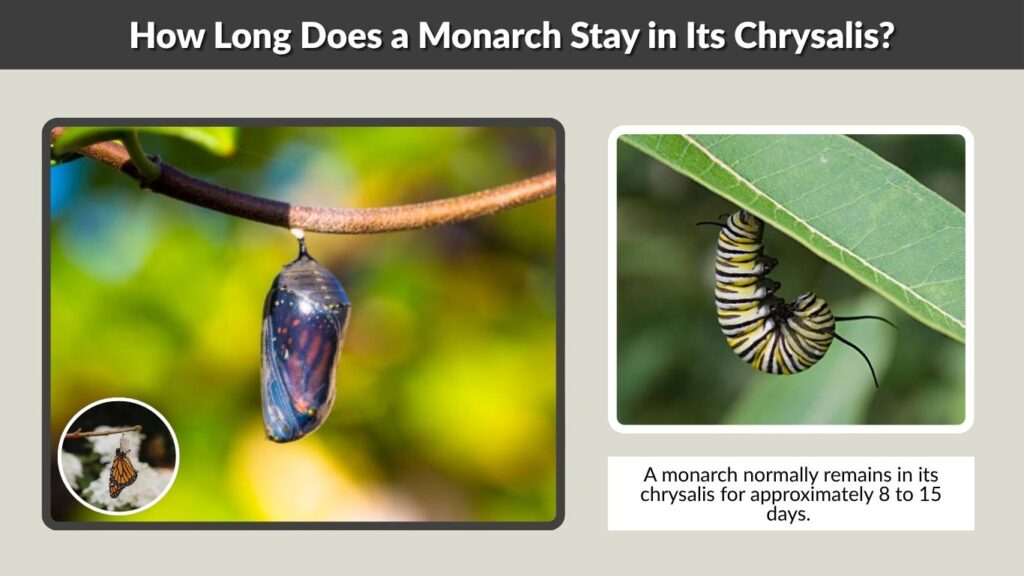
A monarch normally remains in its chrysalis for approximately 8 to 15 days. Around 10 to 14 days is common under typical room or summer temperatures.
| Condition | Likely effect |
| Warm, suitable temperatures | Faster development |
| Cooler temperatures | Slower development |
| Extreme heat | Stress or delayed development |
| Normal summer conditions | Usually 8–15 days |
Temperature affects the timeline, so not every monarch emerges on exactly the tenth day. Development may take closer to two weeks during cooler weather. The complete journey from egg to adult can take about three to five weeks, depending on environmental conditions.
Why Did the Monarch Chrysalis Turn Black?
A chrysalis turning dark is not automatically dying. The timing, appearance, and texture provide important clues.
Normal Darkening
Darkening is normal when:
- It occurs near the expected emergence date
- The orange-and-black wings are visible
- The case becomes transparent rather than cloudy
- The chrysalis retains its normal shape
- The butterfly emerges within roughly a day
Possible Signs of a Problem
A chrysalis may be unhealthy when it:
- Turns black unusually early
- Develops spreading brown or black patches
- Becomes soft, wrinkled, or badly misshapen
- Leaks dark or foul-smelling liquid
- Remains dark for several days without emergence
- Produces small larvae or flies
- Fails to develop recognizable wing patterns
Bacterial disease, parasites, genetic problems, pesticides, and other environmental hazards can prevent successful development. A suspicious chrysalis should be separated from healthy monarchs because some infections can spread in crowded rearing conditions.
How to Care for a Monarch Chrysalis
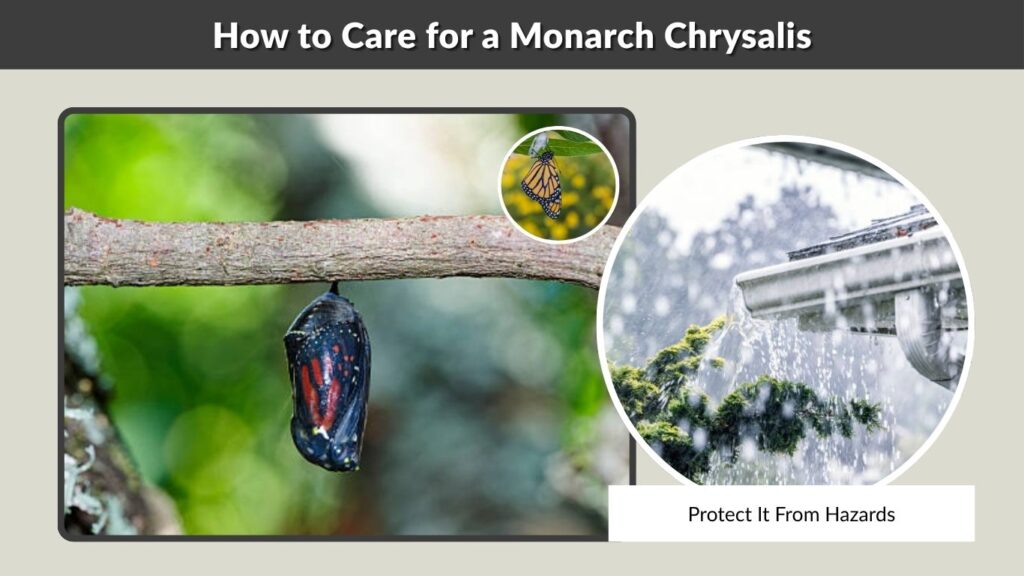
A wild chrysalis in a safe location usually needs no help. Avoid touching, spraying, turning, or repeatedly disturbing it.
Provide Enough Emergence Space
The butterfly must hang vertically after emerging so its wings can expand properly. Keep at least several inches of clear space beneath the chrysalis. The surrounding area should also provide a rough surface that the butterfly can grip if it falls.
Protect It From Hazards
Keep captive chrysalises away from direct midday sun, heavy rain, pesticides, ants, curious pets, and poorly ventilated containers. Do not keep them in airtight jars.
Avoid misting the chrysalis excessively. Ordinary outdoor humidity is normally sufficient, while constant dampness may encourage mold.
Do Not Help the Butterfly Emerge
Emergence may look difficult, but manually pulling a butterfly from its chrysalis can damage its soft body and wings. Allow the process to happen naturally unless guidance is provided by a qualified wildlife rehabilitator or insect specialist.
Can You Move a Monarch Chrysalis?
A chrysalis can be moved when it is in immediate danger, but it should not be disturbed while freshly formed. Wait approximately 24–48 hours for the case to harden.
The silk pad can then be carefully removed with forceps and attached in a safe vertical position. Another option is to place an undamaged fallen chrysalis on a rough surface inside a spacious enclosure. After emerging, the butterfly must be able to climb upward and hang while expanding its wings.
Buying Monarch Cocoons or Kits
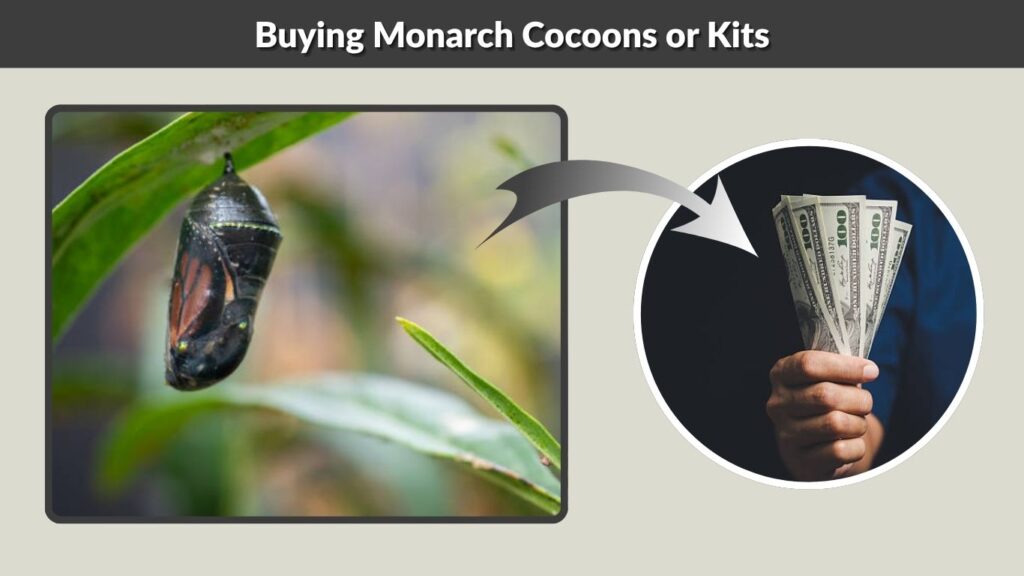
Commercial monarch kits and chrysalises may be available, but purchasing and releasing captive butterflies can introduce disease or mix monarchs from different geographic populations. Regulations governing monarch collection, transport, rearing, and release also vary by location.
Before purchasing, check local wildlife rules and choose an educational program that follows responsible disease-prevention practices. Never collect large numbers of wild caterpillars or chrysalises for sale. In some locations, handling monarchs may require authorization.
FAQs
Where Do Monarch Butterflies Make Their Cocoons?
Monarch caterpillars form chrysalises beneath leaves, branches, fences, walls, outdoor furniture, and other protected surfaces. They often leave milkweed before pupating, so the chrysalis may be located several yards away from the plant on which the caterpillar fed.
Why Does a Monarch Chrysalis Have Gold Dots?
The gold dots are reflective structures in the chrysalis rather than actual metal. They create a beautiful metallic appearance when light strikes them. Scientists have investigated their purpose, but no single explanation for all the markings has been conclusively established.
When Will a Monarch Emerge After the Chrysalis Turns Black?
A healthy monarch commonly emerges within about 24 hours after the chrysalis becomes transparent and its orange-and-black wings are clearly visible. Temperature can affect the exact timing. An opaque black chrysalis that remains unchanged may indicate disease or death.
Does a Monarch Caterpillar Build Its Chrysalis on Milkweed?
Sometimes, but not always. A mature caterpillar usually leaves its feeding area and searches for a secure pupation site. It may choose another plant, a branch, fence, wall, porch, container lid, or garden structure rather than forming its chrysalis on milkweed.
How Long Does It Take From Chrysalis to Monarch Butterfly?
The chrysalis stage generally lasts 8–15 days, with 10–14 days common under ordinary conditions. Warm temperatures usually speed development, while cool temperatures slow it. The adult then needs additional time after emergence to expand and harden its wings.
