
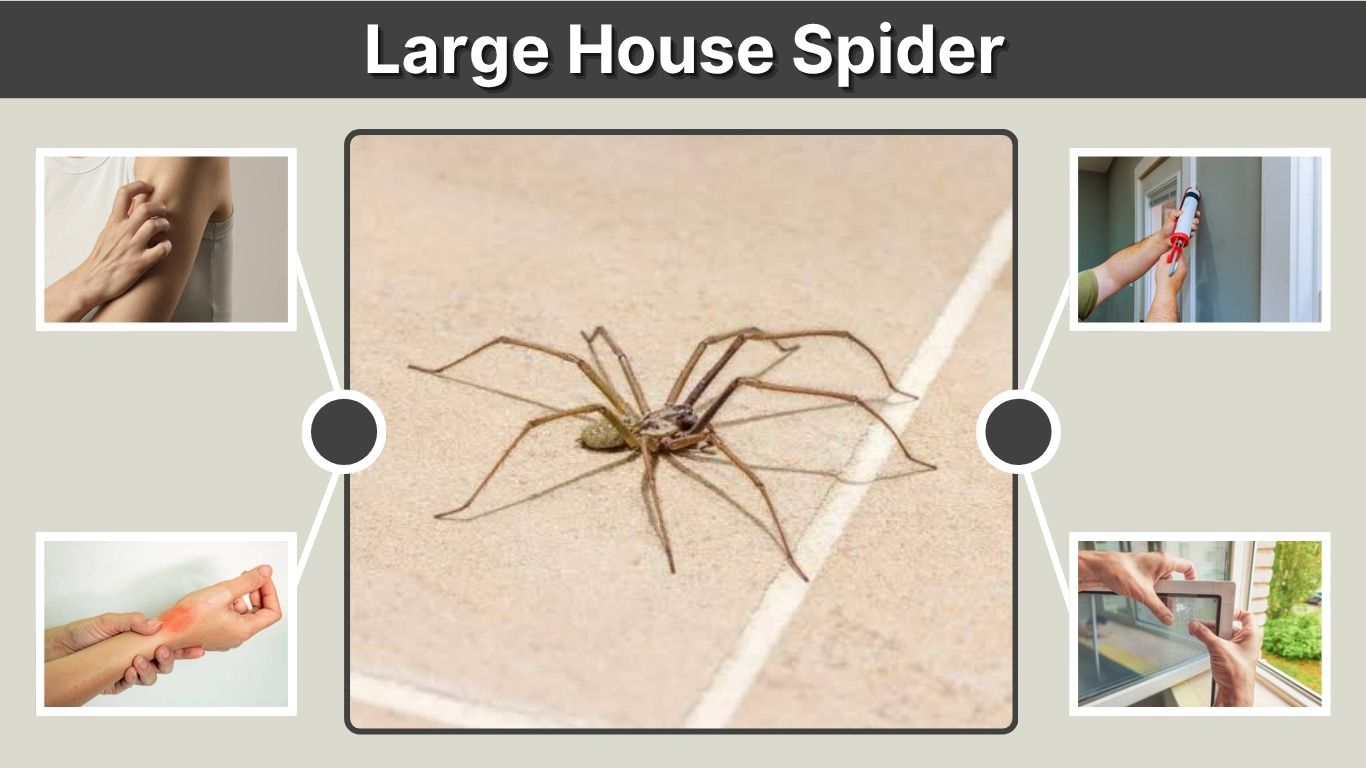
A large house spider running across a floor or sitting near a window can look intimidating, but the name does not identify one particular species. Depending on where you live, a large spider indoors could be a Giant House Spider, wolf spider, Black House Spider, huntsman spider, or another harmless visitor. In the UK, some Tegenaria and Eratigena house spiders can have impressive leg spans, while Australian homes commonly host dark Black House Spiders. Most large household spiders prefer escaping from people rather than biting and often help control insects.
What Is a Large House Spider?
“Large house spider” is a general description rather than an official scientific name.
In Britain and parts of North America, people often use the term for long-legged funnel weavers belonging to Tegenaria and Eratigena. The Natural History Museum notes that several species regularly occur around homes, garages, sheds, lofts, and cavity walls.
Other spiders can easily receive the same name when discovered indoors.
Common Identification Features
A large indoor spider may have:
- Brown, black, or gray coloration
- Long legs
- Hairy or bristly legs
- Patterned abdomen
- Two obvious body sections
- Eight legs
- Fast running behavior
- A sheet, funnel, lace, or irregular web depending on species
Color alone is not enough for reliable identification. Location, body shape, web type, eye arrangement, and markings are much more useful.
How Big Can a House Spider Get?
Some house spiders are surprisingly large when measured from leg tip to leg tip.
The Natural History Museum reports that British house spiders can reach about 12 cm across including the legs, with some especially large Tegenaria species reaching even greater leg spans.
Their bodies are much smaller than their total span. Long legs make these spiders appear considerably larger than they really are.
Why Do Some House Spiders Look Huge?
Adult males often have particularly long legs.
During late summer and autumn, males leave their webs and wander in search of females. This is why a seemingly enormous brown spider may suddenly dash across a living-room floor or become trapped in a bathtub.
Large Brown House Spider
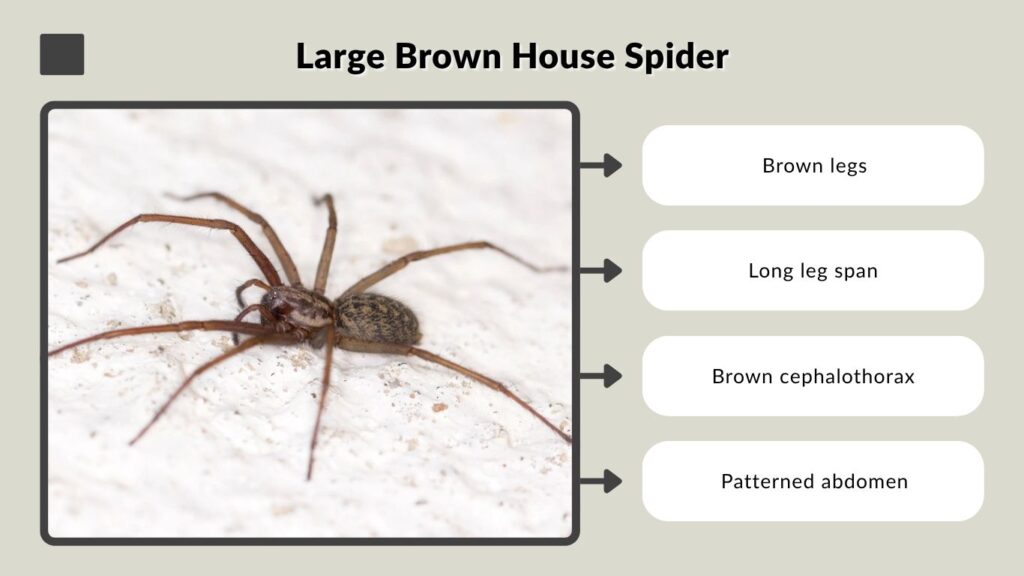
A large, quick brown spider indoors in the UK, Pacific Northwest, or parts of Europe may be a Giant House Spider or related funnel weaver.
Giant house spiders generally have:
- Brown legs
- Long leg span
- Brown cephalothorax
- Patterned abdomen
- Darker chevron or herringbone-like markings
- Very fast movement
House spiders in the Tegenaria and Eratigena groups construct sheet-like webs ending in a funnel-shaped retreat.
Giant House Spider Web
Their web is not the classic circular web associated with orb weavers.
Instead, it consists of a broad horizontal or slightly curved sheet leading into a silk tube or funnel where the spider hides.
Common locations include garages, sheds, basements, lofts, wall cavities, and other quiet spaces.
Large Black House Spider
In Australia, the name Black House Spider commonly refers to Badumna insignis.
This is a real species rather than simply a dark-colored house spider.
Females measure approximately 12–18 mm in body length, while males are generally about 9–15 mm. Their legs and carapace are dark brown to almost black, and the abdomen is charcoal gray with pale markings that may sometimes be difficult to see.
Black House Spider Identification
Look for:
- Dark brown or black legs
- Robust body
- Charcoal-gray abdomen
- Gray hairs on the front body
- Pale abdominal pattern
- Web around windows or wall cracks
- Funnel-like retreat within the web
Black House Spiders often live around window frames because lights attract moths, beetles, and other insects that become caught in their webs.
They should not be confused with Australian funnel-web spiders, which are different spiders with different behavior and medical importance.
Large Gray House Spider
A gray spider indoors may belong to several different groups.
In Australia and some introduced populations elsewhere, the Brown House Spider (Badumna longinqua) may appear gray-brown. The Australian Museum notes that this species is sometimes called the Gray House Spider overseas.
Wolf spiders can also appear gray, especially under indoor lighting.
For this reason, identification should not be based on gray coloration alone.
Giant House Spider vs Wolf Spider
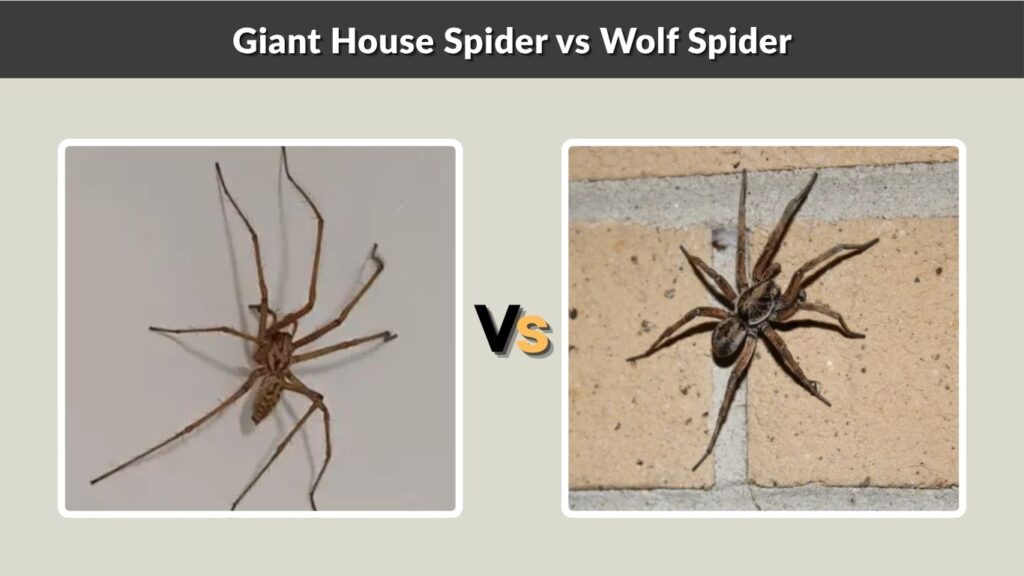
Wolf spiders and Giant House Spiders can both be large, brown, fast, and hairy.
Their lifestyles provide one of the easiest distinctions.
| Feature | Giant House Spider | Wolf Spider |
| Main hunting style | Waits around funnel web | Actively hunts |
| Web | Large sheet with funnel | No prey-catching web |
| Legs | Very long and slender | Stronger and more robust |
| Body | Relatively elongated | Stockier |
| Indoor behavior | Often linked to buildings | Frequently wanders indoors |
| Movement | Very fast | Very fast |
If a large brown spider repeatedly returns to a sheet-like web with a funnel retreat, a house funnel weaver is more likely.
A spider running freely across the ground with no associated web may instead be a wolf spider.
Large House Spider vs Hobo Spider
Hobo spiders and Giant House Spiders belong to related funnel-weaver groups and can be difficult to distinguish visually.
Both can have:
- Brown coloration
- Long legs
- Chevron-like abdominal patterns
- Funnel-shaped webs
Trying to identify them from size or color alone is unreliable.
Detailed examination of anatomical structures is often needed for confident species-level identification.
If identification matters, a clear photograph of the upper and lower body is far more useful than simply describing the spider as “large and brown.”
Are Large House Spiders Dangerous?
Most large spiders encountered in houses are not dangerous to humans.
Large size does not automatically mean strong or medically significant venom.
House spiders generally prefer retreating when disturbed.
The UK Natural History Museum recommends simply putting wandering house spiders outside rather than treating them as dangerous pests.
Australian Black House Spiders are also described as timid, and bites are infrequent.
What Happens If a Large House Spider Bites?
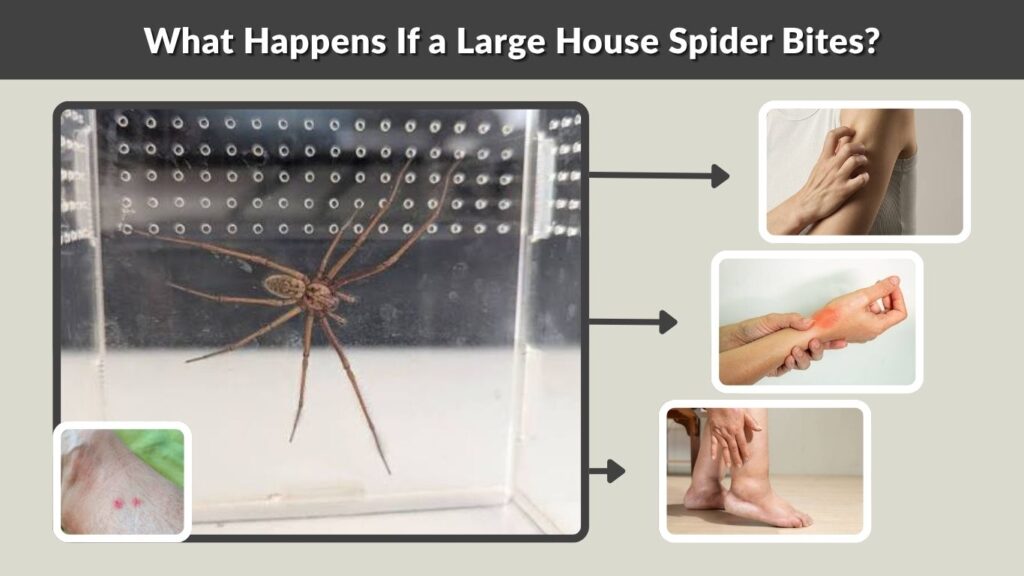
Most house-spider bites occur when the spider becomes trapped against the skin or is deliberately handled.
Possible localized symptoms include:
- Pain
- Redness
- Swelling
- Tenderness
- Itching
Black House Spider bites can be painful and may occasionally produce symptoms such as nausea, sweating, vomiting, or dizziness, although bites are uncommon.
Seek medical attention for severe pain, spreading symptoms, breathing difficulty, significant illness, or a suspected bite from a medically important species.
Avoid assuming an unexplained skin lesion is a spider bite unless a spider was actually observed biting.
Why Is There a Large Spider in My House?
A large spider indoors may simply have wandered through an opening.
House spiders commonly enter through:
- Open windows
- Gaps beneath doors
- Cracks around frames
- Chimneys
- Garages
- Utility openings
In the UK, male house spiders become particularly noticeable from August through October when they wander in search of females.
Their appearance indoors does not necessarily mean your home has a spider infestation.
Why Do Large House Spiders Have Big Abdomens?
A large abdomen may be normal for a mature female.
Female spiders typically have broader abdomens than males because the abdomen contains much of the digestive and reproductive system.
A particularly swollen female may also be carrying developing eggs.
However, abdomen shape varies greatly among species, so a large abdomen by itself cannot identify the spider.
How Long Do Large House Spiders Live?
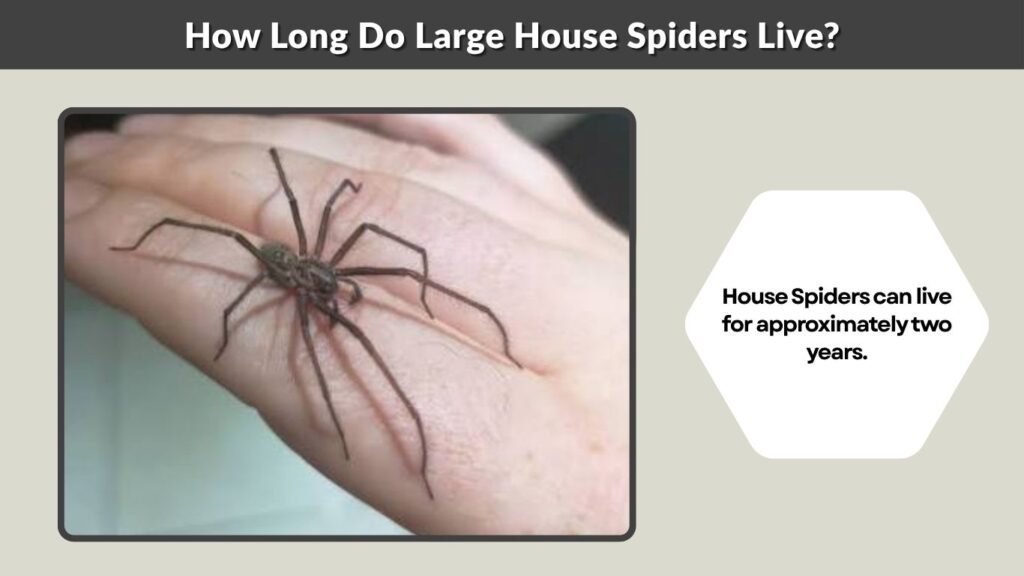
Lifespan depends on species and sex.
In common UK house spiders, young spiders can reach maturity within about a year. Adult males often die after mating in autumn, while many females survive into the following year and produce egg sacs.
Australian Black House Spiders can live for approximately two years. Females remain closely associated with their webs and may produce several egg sacs.
What Should You Do With a Large Spider in Your House?
If the spider is not medically significant and you can approach it safely, killing it is usually unnecessary.
Safe Removal
Place a large container over the spider, slide stiff cardboard underneath, and carry it away from the room.
For a very fast spider, a broom can gently encourage it toward an exit. The Australian Museum recommends dealing with wandering wolf and huntsman spiders individually rather than treating them as aggressive household pests.
Never grab an unidentified large spider with bare hands.
How to Keep Large Spiders Out
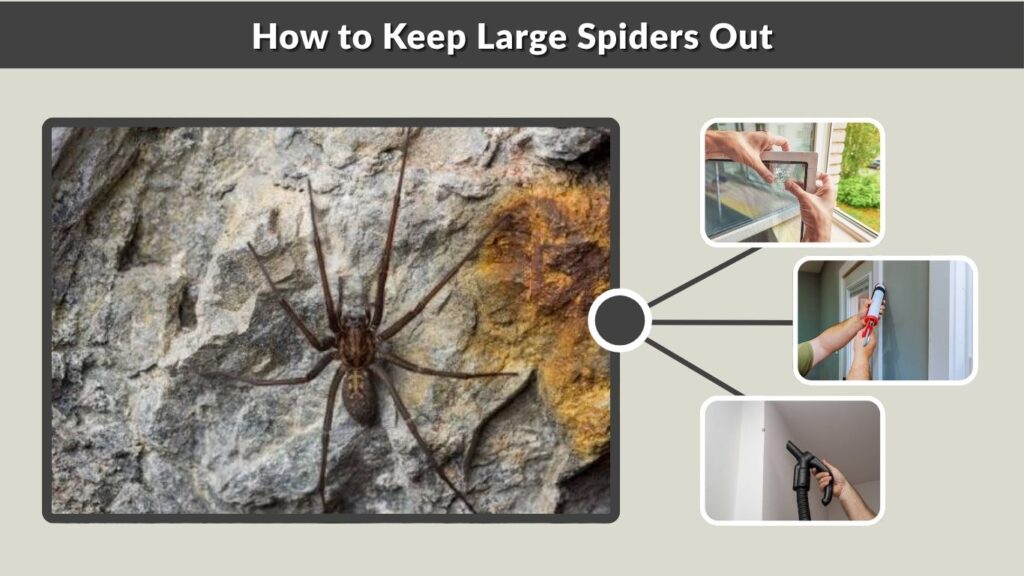
House spiders are attracted primarily by shelter and available prey rather than by people.
Reduce future encounters by:
- Installing door sweeps
- Repairing screens
- Sealing cracks around windows
- Closing gaps around pipes
- Removing indoor webs
- Reducing insect prey
- Clearing clutter from garages and basements
- Keeping exterior doors closed
- Sealing gaps around foundations
The Natural History Museum recommends physical exclusion such as screens, draught excluders, and sealing openings as the practical way to reduce house spider entry.
Large House Spiders by Region
Different spiders are likely depending on location.
UK and Ireland: Large Tegenaria and Eratigena house spiders are common possibilities.
Washington and Oregon: Introduced Giant House Spiders are frequently encountered around buildings.
Australia: Black House Spiders, huntsman spiders, and wolf spiders may all be encountered around homes. Black House Spiders are especially associated with window frames and permanent webs.
Florida, Texas, and other warm U.S. states: Large indoor spiders may include wolf spiders, huntsman-type spiders, fishing spiders, and various web-building species.
Because many unrelated spiders share brown or black coloration, geographic location should always be considered during identification.
FAQs
1. What is the most common large house spider?
It depends on location. In Britain, Tegenaria and Eratigena species are typical large house spiders. In Australia, Black House Spiders are common around buildings.
2. How big can a house spider get?
Some British house spiders reach roughly 12 cm across including their legs, while particularly large species can exceed that span.
3. Are large black house spiders poisonous?
Spiders are venomous rather than poisonous. Most dark house spiders are not medically dangerous, although identification matters because different regions contain different species.
4. Why do large house spiders suddenly appear?
Adult males often wander while searching for females, especially during mating season. Others accidentally enter through doors, windows, and cracks.
5. Should I kill a large spider in my house?
Usually not. If the spider can be safely identified as harmless, capture and relocation are sufficient. Avoid bare-hand handling of unidentified spiders.
