

Ground-nesting bees are a diverse group of pollinators that build their nests in soil or underground cavities. They include both solitary and social species, each with unique adaptations for survival. From bumble bees and mining bees to cuckoo bees, their nesting strategies support efficient reproduction. These bees play a vital role in pollinating crops and wild plants, making them indispensable for ecosystem health and agricultural sustainability.
1. Bumble Bees

Overview
Bumble bees (Bombus spp.) are robust, ground-nesting pollinators found across temperate regions. They play a vital role in ecosystems and agriculture due to their ability to pollinate crops through buzz pollination. Their social colonies are smaller than those of honey bees but exhibit complex organization, seasonal cycles, and cooperative behavior.
Identification
- Large, fuzzy bodies with dense hair
- Distinct black and yellow banding (species vary)
- Broad wings that beat rapidly
- Noticeable buzzing sound during flight
- Typically larger than most solitary ground-nesting bees
Lifecycle
Bumble bee colonies follow an annual lifecycle. In early spring, mated queens emerge from hibernation, search for suitable ground cavities, and begin laying eggs. Worker bees hatch first, assuming foraging and nest-maintenance duties. By late summer, new queens and drones are produced. Colonies naturally decline in autumn, and only fertilized queens overwinter.
Preferred Habitat
Bumble bees thrive in temperate climates with abundant flowering plants. They prefer meadows, grasslands, and gardens, particularly where undisturbed soil and organic matter provide natural cavities. Their adaptability allows them to inhabit agricultural fields, forest edges, and suburban landscapes.
Nesting Behavior
Unlike tree-nesting honey bees, bumble bees favor underground burrows, abandoned rodent holes, or grassy tussocks. Nests are small—usually 50–400 individuals—and lined with wax secreted by the queen. Colonies are insulated using plant fibers, moss, or animal fur, ensuring thermal regulation for brood development.
Reproduction and Colony Dynamics
Reproduction begins when queens produce male drones and fertile females in late summer. Mating occurs outside the nest, after which newly mated queens seek overwintering sites. The existing colony dies off, completing the annual reproductive cycle. This ground-nesting reproduction strategy ensures genetic diversity and population renewal each year, making bumble bees resilient yet dependent on stable habitats.
2. Mining Bees (Andrena)

Overview
Mining bees (Andrena spp.) are solitary ground-nesting bees that play an essential role in early spring pollination. They are among the largest genera of bees, with over 1,500 species worldwide. Known for excavating underground tunnels, they are highly efficient pollinators of fruit trees, wildflowers, and crops.
Identification
- Medium-sized bees with slender bodies
- Often covered in dense hair, varying in color
- Females possess strong mandibles for digging
- Distinct pollen-carrying hairs (scopa) on hind legs
- Flight occurs mostly in spring months
Lifecycle
Mining bees are solitary, meaning each female builds and provisions her own nest. In spring, females emerge, mate, and begin digging burrows in sandy or loose soil. Eggs are laid in separate chambers, each stocked with nectar and pollen. Larvae feed on these provisions, pupate underground, and overwinter in the soil, emerging as adults the following year.
Preferred Habitat
These bees favor well-drained, sandy or loamy soils in open, sunny locations. Common habitats include gardens, lawns, orchards, forest edges, and grasslands. They often form nesting aggregations, where many females build nests close together, though each operates independently.
Nesting Behavior
Mining bees excavate tunnels with multiple brood cells branching off. Each cell is carefully sealed after provisioning with pollen and nectar. The tunnel entrances are often marked by small soil mounds, resembling ant hills but larger and less organized. Nest density can be high in suitable soil patches, creating large nesting aggregations.
Reproduction and Colony Dynamics
After mating, females complete all nest-building and provisioning alone. Males typically die shortly after mating. The reproductive cycle is univoltine—producing one generation per year. Larvae develop within sealed brood cells, remain dormant through winter, and emerge as adults the following spring, continuing the ground-nesting reproductive cycle.
3. Sweat Bees (Halictidae)

Overview
Sweat bees (family Halictidae) are diverse ground-nesting bees, named for their attraction to human perspiration due to the salts. They range from solitary to primitively social species, and their adaptability allows them to thrive in various habitats. Sweat bees are important pollinators of wildflowers, crops, and garden plants.
Identification
- Small to medium size (4–12 mm)
- Metallic green, blue, or black coloration in many species
- Slender bodies with narrow abdomens
- Females carry pollen on hind legs or underside of abdomen
- Characteristic attraction to sweat and moisture
Lifecycle
Sweat bees exhibit variable social behavior. Many are solitary, while others form small colonies with a rudimentary caste system. Mated females (or queens in social species) dig burrows in spring and lay eggs in brood chambers. Larvae develop underground, pupate, and emerge as adults within weeks. Some species produce multiple generations per season (bivoltine or multivoltine).
Preferred Habitat
These bees prefer bare or sparsely vegetated soils, including sunny lawns, garden edges, meadows, and field margins. They tolerate a range of soil types but favor well-drained, loose ground. Sweat bees often nest in aggregations, where hundreds of females may construct burrows close together.
Nesting Behavior
Sweat bees dig vertical tunnels with lateral brood cells. Each chamber is stocked with pollen and nectar, then sealed. In social species, one female assumes reproductive duties while others serve as workers. Nest entrances are often inconspicuous, making them difficult to spot without careful observation.
Reproduction and Colony Dynamics
Reproduction varies by species. Solitary species complete their cycle within one season, while social species may maintain colonies through multiple generations in summer. Males generally emerge later in the season for mating flights. Fertilized females overwinter in soil, ensuring continuity of the ground-nesting reproductive cycle each year.
4. Leafcutter Bees (Megachile)

Overview
Leafcutter bees (Megachile spp.) are solitary ground- and cavity-nesting bees, best known for cutting circular leaf pieces to construct their brood cells. They are vital pollinators of wild plants and crops, particularly legumes. Their efficient pollination method makes them highly valued in managed agriculture.
Identification
- Medium-sized bees with robust bodies
- Black or dark brown coloration, often with pale hair bands
- Females carry pollen on specialized abdominal hairs (scopa) rather than hind legs
- Characteristic behavior of cutting smooth, circular leaf or petal fragments
- Strong mandibles adapted for cutting vegetation
Lifecycle
Leafcutter bees have a solitary lifecycle. In summer, females mate and begin nest construction using leaf fragments. Eggs are laid in individual cells, each provisioned with pollen and nectar. Larvae feed, spin protective cocoons, and pupate within the leaf cells. Most species overwinter as larvae or pupae, emerging as adults in the following spring or summer.
Preferred Habitat
These bees thrive in open areas with flowering plants and suitable nesting substrates. While many species utilize pre-existing cavities, some also burrow into soft soil or rotting wood. They are often found in gardens, meadows, orchards, and farmlands where both leaves and flowers are abundant.
Nesting Behavior
Nests consist of lined tunnels, either in soil, wood, or hollow stems. Females meticulously cut leaf or petal discs to line the walls and seal brood cells. Each cell is filled with pollen and nectar before being capped with circular leaf pieces. The distinctive “plugged” entrances are a clear sign of their nesting activity.
Reproduction and Colony Dynamics
Reproduction is strictly solitary—each female constructs, provisions, and seals her own nest. Males emerge earlier to await mating opportunities. Fertilized females continue nesting until late summer. Their ground- and cavity-nesting reproduction strategy provides protection for offspring and ensures successful population renewal annually.
5. Alkali Bees (Nomia melanderi)
Overview
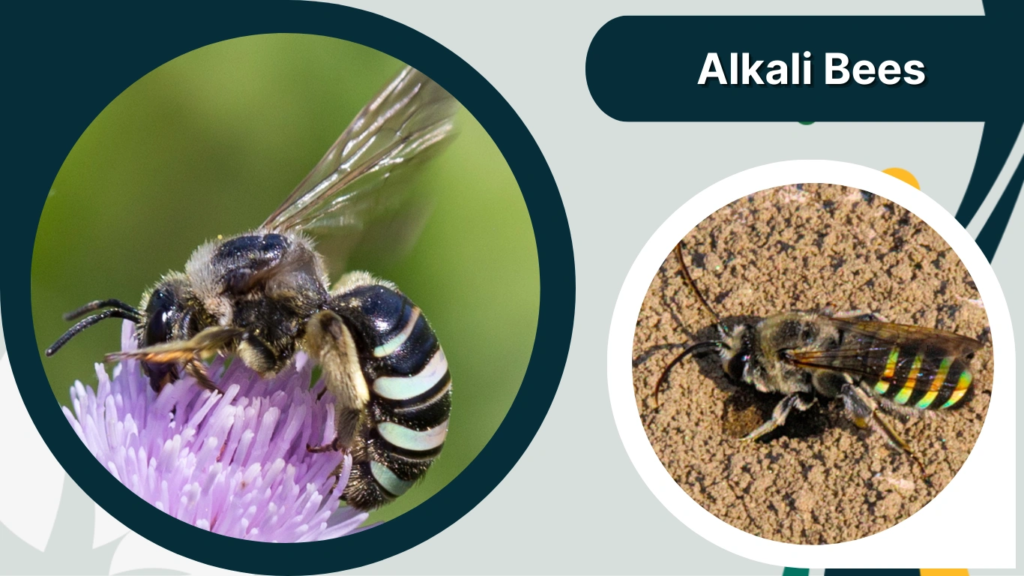
Alkali bees (Nomia melanderi) are specialized ground-nesting bees native to western North America. They are highly valued for their exceptional efficiency in pollinating alfalfa, making them one of the few wild bees managed on a large scale for agriculture. Their preference for alkaline soils gives them their common name.
Identification
- Medium-sized bees (about 10–12 mm)
- Distinctive black bodies with bright yellow or cream-colored abdominal bands
- Wings are transparent with slight iridescence
- Females carry pollen on dense scopal hairs on hind legs
- Strong resemblance to sweat bees, but slightly larger and more robust
Lifecycle
Alkali bees are solitary yet gregarious nesters. Mated females emerge in late spring to early summer and excavate burrows in alkaline, moist soils. Each female provisions brood cells with pollen and nectar for her offspring. Larvae develop underground, overwinter as prepupae, and emerge the following summer.
Preferred Habitat
These bees thrive in alkaline, moist, and well-drained soils, especially in arid or semi-arid regions. Naturally, they prefer desert basins and alkali flats. Today, they are often found in managed nesting beds created by farmers to support alfalfa seed production.
Nesting Behavior
Females dig vertical shafts with lateral brood cells, often in dense aggregations containing thousands of nests. Soil moisture is crucial to maintaining tunnel stability. Nest entrances appear as small holes clustered closely together, creating extensive nesting grounds in favorable soils.
Reproduction and Colony Dynamics
Reproduction is solitary—each female independently provisions her brood. Males patrol nest sites in search of emerging females to mate. After mating, females focus entirely on provisioning nests. This annual reproductive cycle produces a single generation each year, tightly synchronized with alfalfa bloom, ensuring maximum pollination efficiency.
6. Digger Bees (Anthophora)

Overview
Digger bees (Anthophora spp.) are solitary ground-nesting bees widely distributed across temperate and arid regions. They are fast-flying pollinators, often resembling bumble bees in size and hairiness. Their strong digging ability allows them to establish nests in compact soils and earthen banks.
Identification
- Medium to large bees, often robust and hairy
- Black or brown bodies with pale or yellow hair bands
- Long tongues adapted for deep flowers
- Females equipped with strong legs for excavation
- Rapid, darting flight similar to bumble bees
Lifecycle
Digger bees are solitary and univoltine, producing one generation per year. In spring or early summer, mated females excavate burrows and construct brood cells. Each cell is provisioned with nectar and pollen before the egg is laid. Larvae develop underground, overwinter as pupae, and emerge as adults the following season.
Preferred Habitat
These bees prefer dry, sandy, or compact soils, often selecting sloping banks, roadside cuts, or exposed ground. They are commonly found in deserts, grasslands, orchards, and open woodlands where nesting sites and floral resources coincide.
Nesting Behavior
Nests are burrows with lateral brood chambers, typically clustered in aggregations. Females line brood cells with a waterproof secretion, protecting provisions from desiccation. Nest entrances are often visible as small holes surrounded by loose soil. Aggregations can contain dozens to hundreds of nests.
Reproduction and Colony Dynamics
Reproduction is solitary, with no worker caste. Males emerge first and patrol floral patches or nest sites to mate with females. After mating, females independently complete all nesting tasks. The ground-nesting reproductive cycle ensures larvae remain protected until emergence, maintaining population stability year after year.
7. Plasterer Bees (Colletidae)

Overview
Plasterer bees (family Colletidae) are solitary ground-nesting bees named for their unique habit of lining brood cells with a cellophane-like secretion. This waterproof and antifungal coating protects the developing larvae and sets them apart from other ground-nesting bees. They are key pollinators of native plants and wildflowers.
Identification
- Small to medium size, usually slender-bodied
- Often black, brown, or metallic with sparse hair
- Females have a short tongue compared to other bees
- Carry pollen on hind legs or abdominal hairs
- Distinguished by their glossy, smooth brood cell linings
Lifecycle
Plasterer bees are solitary and univoltine, producing one generation annually. Females emerge in spring or summer, mate, and then excavate burrows in soil. Each brood cell is lined with a protective secretion before being stocked with pollen and nectar. Larvae feed and develop inside sealed cells, overwinter as prepupae, and emerge the following year.
Preferred Habitat
They thrive in loose or sandy soils, including open fields, grasslands, and garden edges. Some species also nest in clay-rich soils or soft banks. They prefer sunny, undisturbed areas with nearby floral resources.
Nesting Behavior
Nests consist of tunnels with side chambers for brood cells. The defining feature is the cellophane-like lining, secreted from a gland in the female’s abdomen. This layer waterproofs the brood cells and prevents microbial growth, ensuring larval survival. Nest entrances are usually inconspicuous, marked only by small soil mounds.
Reproduction and Colony Dynamics
Reproduction is solitary, with females independently completing all tasks. After mating, males die, while females continue provisioning nests. The ground-nesting reproductive cycle ensures offspring remain safe through winter dormancy, contributing to stable population renewal each spring.
8. Cuckoo Bees (Nomada)

Overview
Cuckoo bees (Nomada spp.) are cleptoparasitic ground-nesting bees, meaning they do not build their own nests. Instead, they invade the nests of other solitary bees, particularly Andrena (mining bees), and lay their eggs inside. Their lifecycle depends entirely on the labor of host species, making them vital participants in the balance of bee populations.
Identification
- Small to medium-sized with slender bodies
- Often wasp-like in appearance, with black, red, and yellow markings
- Sparse body hair (unlike most pollen-collecting bees)
- Lack of pollen-carrying structures (no scopa)
- Fast, agile fliers that patrol nesting areas of host bees
Lifecycle
Cuckoo bees are obligate brood parasites. Females locate active nests of host bees, slip inside, and deposit their eggs in provisioned brood cells. The cuckoo larva hatches and either consumes the host egg/larva or monopolizes the food stores. They complete development within the host’s nest, overwinter underground, and emerge as adults the following spring.
Preferred Habitat
Since their survival depends on hosts, cuckoo bees are found in the same habitats as their nesting hosts—sandy soils, meadows, grasslands, forest edges, and gardens. They require landscapes rich in wildflowers to sustain host populations.
Nesting Behavior
Cuckoo bees do not build or provision nests. Instead, females specialize in stealth and timing to infiltrate host burrows. Their parasitic strategy bypasses the energetic costs of nest construction and provisioning, relying entirely on the host’s reproductive efforts.
Reproduction and Colony Dynamics
Reproduction is entirely parasitic. After mating, females search for suitable host nests to exploit. Males patrol flowers and nesting aggregations to find mates. This parasitic reproductive cycle regulates host bee populations, maintaining ecological balance, while cuckoo bees perpetuate themselves without direct nesting investment.
FAQs
1. Why are ground-nesting bees important for agriculture?
Ground-nesting bees provide efficient pollination for crops like alfalfa, fruit trees, and legumes. Their natural behavior increases seed and fruit yield, reducing reliance on managed honey bees.
2. Are ground-nesting bees aggressive toward humans?
Most ground-nesting bees are non-aggressive. Solitary species rarely sting unless handled, while social species like bumble bees defend their colonies only if directly threatened.
3. How can I identify a ground-nesting bee nest in my garden?
Look for small soil mounds or burrow entrances resembling tiny holes in bare or sandy ground. Nesting aggregations may appear as clusters of these openings.
4. Do ground-nesting bees live in colonies like honey bees?
Some, like bumble bees, form small seasonal colonies. However, most ground-nesting bees are solitary, with each female independently constructing and provisioning her nest.
5. How can I support ground-nesting bees in my yard?
Provide areas of bare or sandy soil, avoid pesticides, and plant diverse native flowers. These conditions help create suitable nesting and foraging habitats.
