
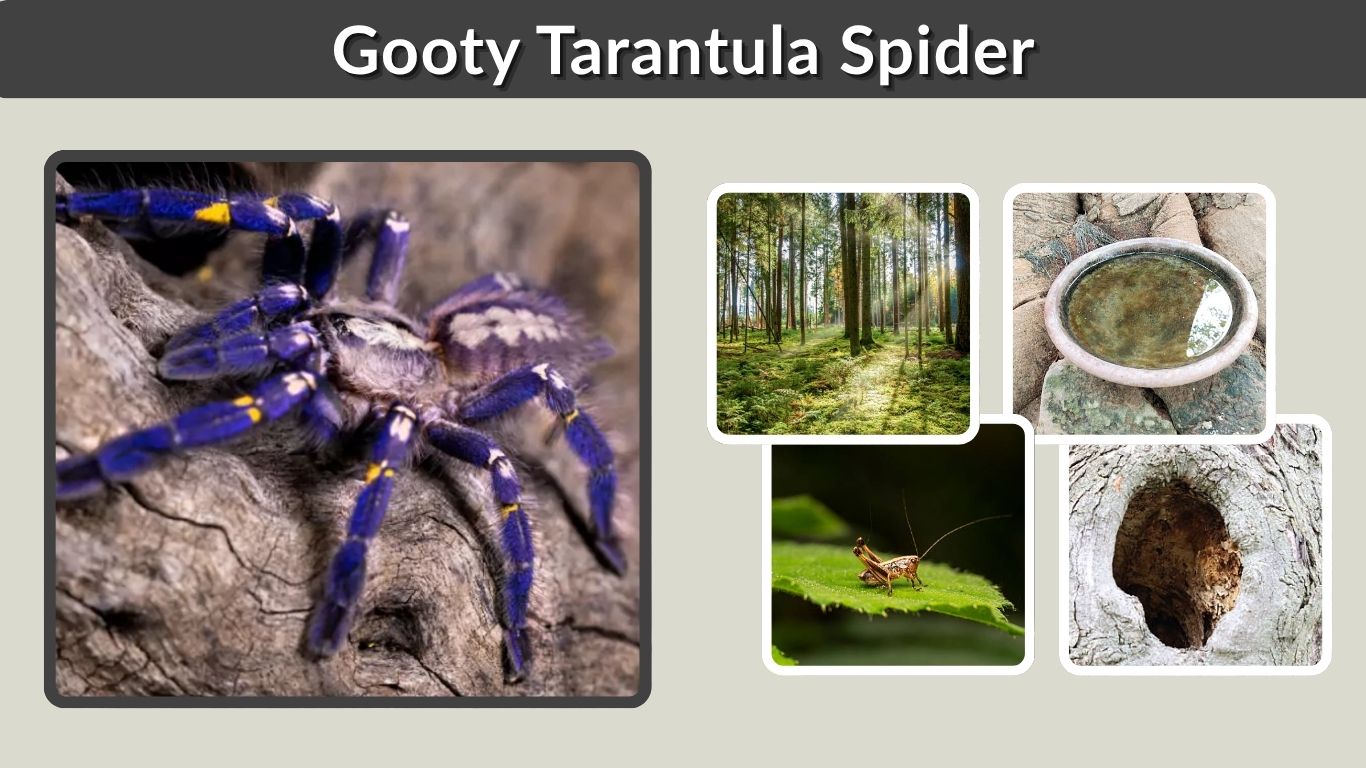
The Gooty tarantula spider is one of the most striking tarantulas in the world, instantly recognizable by its brilliant metallic-blue legs and contrasting white and yellow markings. Scientifically known as Poecilotheria metallica, it is also called the Gooty sapphire ornamental tarantula, peacock tarantula, and peacock parachute spider. Native to India, this fast-moving, tree-dwelling species is admired by experienced tarantula keepers but is not considered a good beginner pet because of its speed and medically significant venom.
What Is a Gooty Tarantula Spider?
The Gooty tarantula belongs to the family Theraphosidae and the ornamental tarantula genus Poecilotheria. Unlike terrestrial tarantulas that spend most of their lives on the ground, this species is primarily arboreal and uses cavities in trees for shelter.
Its intense blue coloration makes it particularly distinctive. It is currently listed as Critically Endangered on the IUCN Red List, and wild populations face threats that include habitat loss and collection for the pet trade.
Gooty Tarantula Identification
- Scientific name: Poecilotheria metallica
- Common names: Gooty tarantula, Gooty sapphire ornamental, peacock tarantula
- Family: Theraphosidae
- Type: Arboreal tarantula
- Native country: India
- Primary color: Metallic blue
- Markings: White, cream, black, and yellow
- Adult leg span: Approximately 6–7 inches
- Behavior: Fast and generally shy but potentially defensive
- Venom: Medically significant
The intricate pattern across the abdomen is typical of Poecilotheria, while the strong blue coloration makes P. metallica especially recognizable.
Gooty Tarantula Size
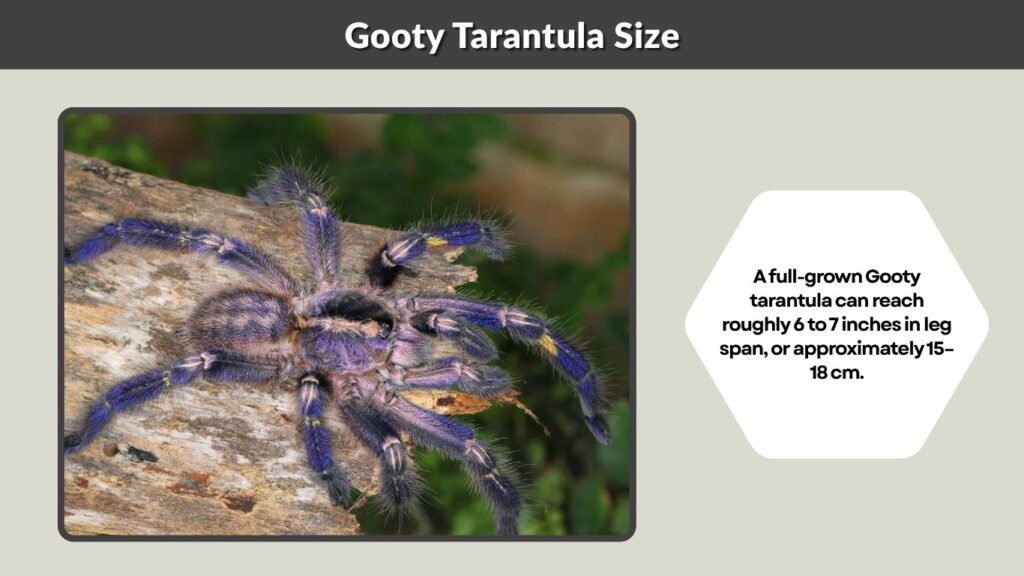
A full-grown Gooty tarantula can reach roughly 6 to 7 inches in leg span, or approximately 15–18 cm.
Females typically develop heavier bodies, while mature males become thinner and leggier. Like many tarantulas, females are also considerably longer-lived.
Spiderlings start small but can grow relatively quickly when temperatures, food, and other conditions are appropriate.
Male vs Female
Adult females generally have:
- Larger, heavier abdomens
- More robust bodies
- Longer potential lifespans
Mature males generally become more slender and develop reproductive structures on their pedipalps.
Examining a shed molt is usually a more reliable way of determining sex than simply looking at body shape.
Where Does the Gooty Tarantula Live?
The Gooty tarantula is native to India, particularly forest areas of the Eastern Ghats. Its known natural distribution is limited compared with many other tarantulas.
Recent conservation work has focused on populations in Andhra Pradesh, including areas associated with the Nandyal and Giddalur forest divisions and the Nagarjunasagar-Srisailam Tiger Reserve region.
Interestingly, the name “Gooty” comes from the locality associated with the specimen originally described by science. However, the known natural range is not centered on the town of Gooty, and the original specimen may have been transported there with timber.
Gooty Tarantula Natural Habitat
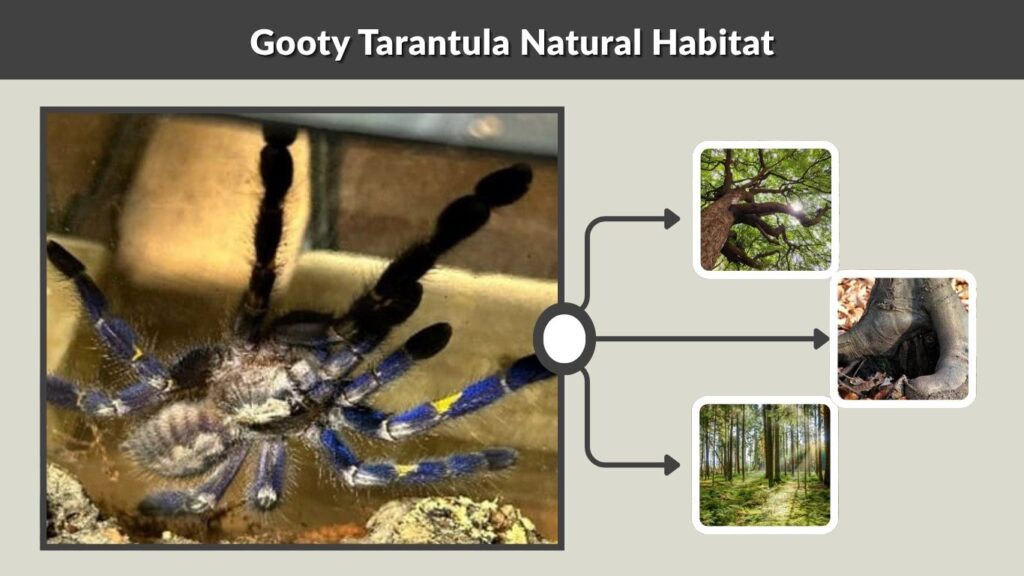
The peacock parachute spider lives primarily in forest environments where mature trees provide cavities and protected retreats.
Rather than making a deep ground burrow, adults typically shelter inside tree holes, beneath loose bark, and within other vertical crevices.
They may create web-lined retreats that provide protection during the day.
Natural Habitat Features
Their habitat includes:
- Mature trees
- Tree cavities
- Bark crevices
- Forest vegetation
- Warm seasonal conditions
- Abundant insect prey
Because the species depends heavily on suitable trees, logging and degradation of forest habitat are major conservation concerns.
Why Is the Gooty Tarantula Blue?
The remarkable blue appearance of the Gooty tarantula is not produced simply by blue pigment.
Much of the color comes from microscopic structures in the spider’s hairs that manipulate reflected light. This phenomenon is known as structural coloration.
Depending on lighting and viewing angle, a Gooty tarantula may appear deep navy, sapphire blue, or bright metallic blue.
Its legs also contain pale and yellow markings that become especially noticeable when the spider assumes a defensive posture.
What Does a Gooty Tarantula Eat?
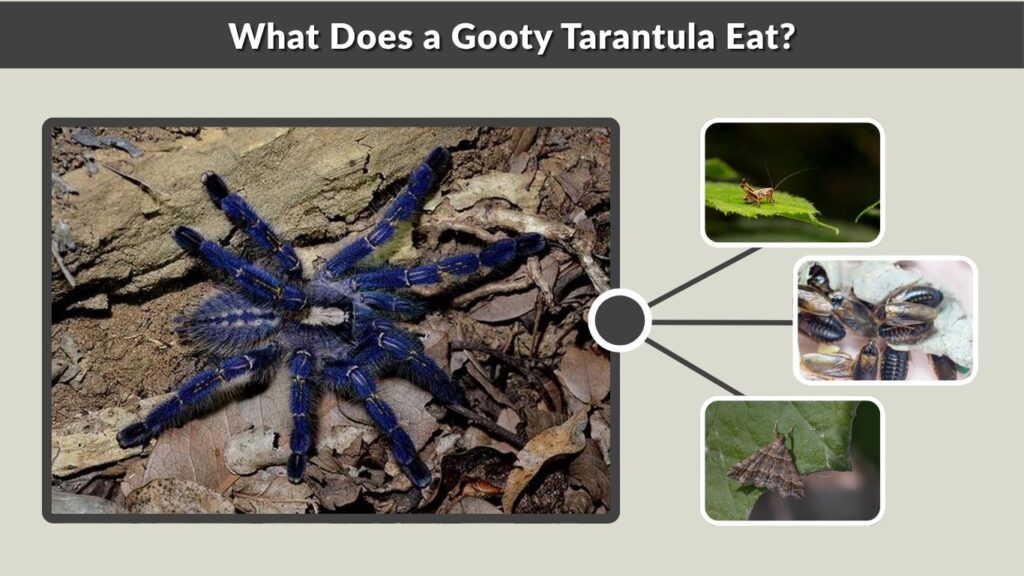
Gooty tarantulas are carnivorous predators that primarily feed on insects and other small animals.
As arboreal hunters, they can detect vibrations from potential prey approaching their retreat and move remarkably quickly when capturing it.
Gooty Tarantula Diet
Captive specimens commonly eat:
- Crickets
- Dubia roaches
- Red runner roaches
- Grasshoppers
- Moths
- Other appropriately sized feeder insects
Spiderlings can eat tiny cricket or roach nymphs.
Large vertebrate prey is unnecessary for captive Gooty tarantulas. Appropriately sized captive-bred insects provide a safer and more practical diet.
Is the Gooty Tarantula Venomous?
Yes. Like other tarantulas, the Gooty tarantula is venomous and uses venom to immobilize prey.
Unlike many New World tarantulas, Poecilotheria metallica does not rely on urticating abdominal hairs as its primary defensive mechanism. When trapped and unable to escape, it can defend itself with its fangs.
Bites from Poecilotheria species are considered medically significant and may cause substantial pain and other symptoms.
Possible Bite Symptoms
Reported effects from Poecilotheria bites can include:
- Intense localized pain
- Swelling
- Muscle cramps
- Sweating
- Headache
- Increased heart rate
- General discomfort
Symptoms can occasionally persist for several days.
A suspected bite from a Gooty tarantula should therefore be taken seriously, particularly if significant or worsening symptoms develop.
Is a Gooty Tarantula Aggressive?
The Gooty tarantula is better described as fast and defensive rather than naturally aggressive toward humans.
Its first response to disturbance is often to retreat rapidly into its hiding place. However, when cornered, it may raise its front legs, display its fangs, and bite if the threat continues.
Its extreme speed is one reason beginners may find the species difficult to manage.
Routine handling should be avoided completely.
Gooty Tarantula Enclosure
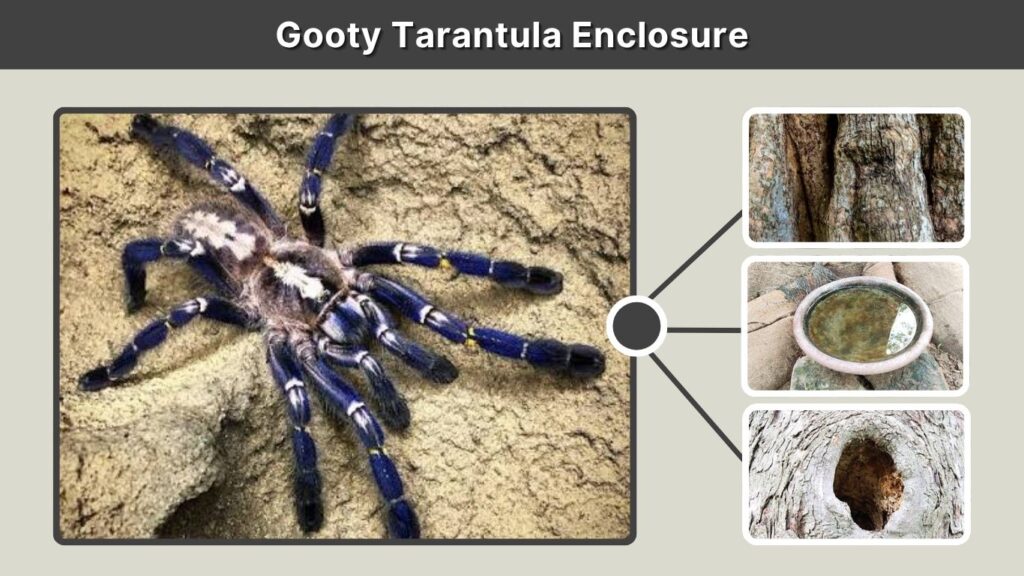
Because it is an arboreal species, the Gooty tarantula requires a taller enclosure than terrestrial species such as curly hair or rose hair tarantulas.
Vertical climbing surfaces and a secure retreat are essential.
Basic Enclosure Setup
- Tall, escape-proof enclosure
- Vertical cork bark
- Hollow bark or tube-shaped retreat
- Good cross-ventilation
- Water dish
- Moisture-retaining substrate
- Secure locking lid
- Adequate climbing space
The enclosure should allow the tarantula to hide behind or inside vertical cork bark.
Escape prevention is especially important because Poecilotheria species can move extremely quickly.
Temperature and Moisture
Gooty tarantulas are generally kept in warm conditions similar to comfortable indoor temperatures.
Around 72–80°F (22–27°C) is suitable for many captive specimens.
The enclosure should not remain waterlogged. Providing fresh water, occasional substrate moisture, and strong ventilation generally creates a safer balance than maintaining continuously wet conditions.
Stagnant, excessively humid enclosures can encourage mold.
Gooty Tarantula Lifespan
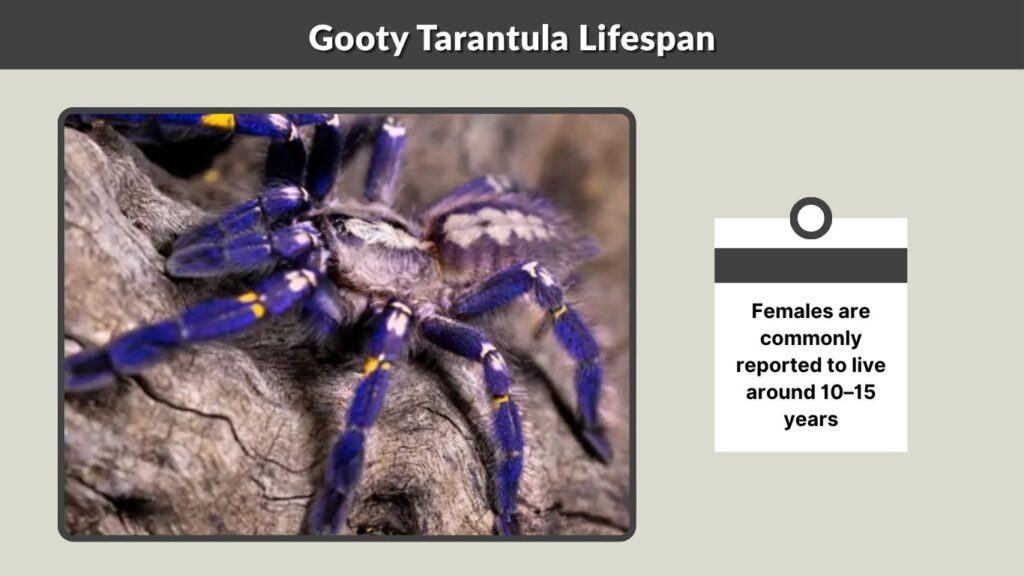
Female Gooty tarantulas can live considerably longer than males.
Females are commonly reported to live around 10–15 years, while males typically have much shorter lifespans and may live only several years after reaching maturity.
Exact lifespan varies with sex, genetics, growth rate, environmental conditions, and husbandry.
Peacock Parachute Spider or Gooty Tarantula?
The peacock parachute spider and Gooty tarantula are common names for the same species, Poecilotheria metallica.
Other names include:
- Gooty sapphire ornamental
- Gooty ornamental
- Peacock tarantula
- Metallic tarantula
- Gooty sapphire tarantula
Using the scientific name is the most reliable method of identification because common names vary among breeders and countries.
Is the Gooty Tarantula a Good Pet?
It can be an impressive captive species for experienced tarantula keepers, but it is generally not recommended for beginners.
Its combination of exceptional speed, arboreal behavior, defensive potential, and medically significant venom requires careful enclosure design and confident maintenance techniques.
It is best treated as a display animal rather than a spider that should ever be handled.
Because wild populations are threatened, anyone obtaining this species should choose a reputable source offering legally obtained, captive-bred specimens.
FAQs
How Big Does a Gooty Tarantula Spider Get?
Adults generally reach around 6–7 inches in leg span, although individual size varies.
Is a Gooty Tarantula Dangerous?
Its bite can cause significant pain and other symptoms. It should be considered a medically significant species and should never be handled casually.
Is the Peacock Parachute Spider the Same as the Gooty Tarantula?
Yes. Peacock parachute spider, Gooty tarantula, and Gooty sapphire ornamental are common names for Poecilotheria metallica.
Where Are Gooty Tarantulas Found?
They are native to India and have a restricted distribution associated with forest habitats of the Eastern Ghats.
Why Is the Gooty Tarantula Endangered?
Habitat degradation and loss, along with collection pressure associated with the pet trade, have contributed to conservation concerns. The species is currently classified as Critically Endangered.
