
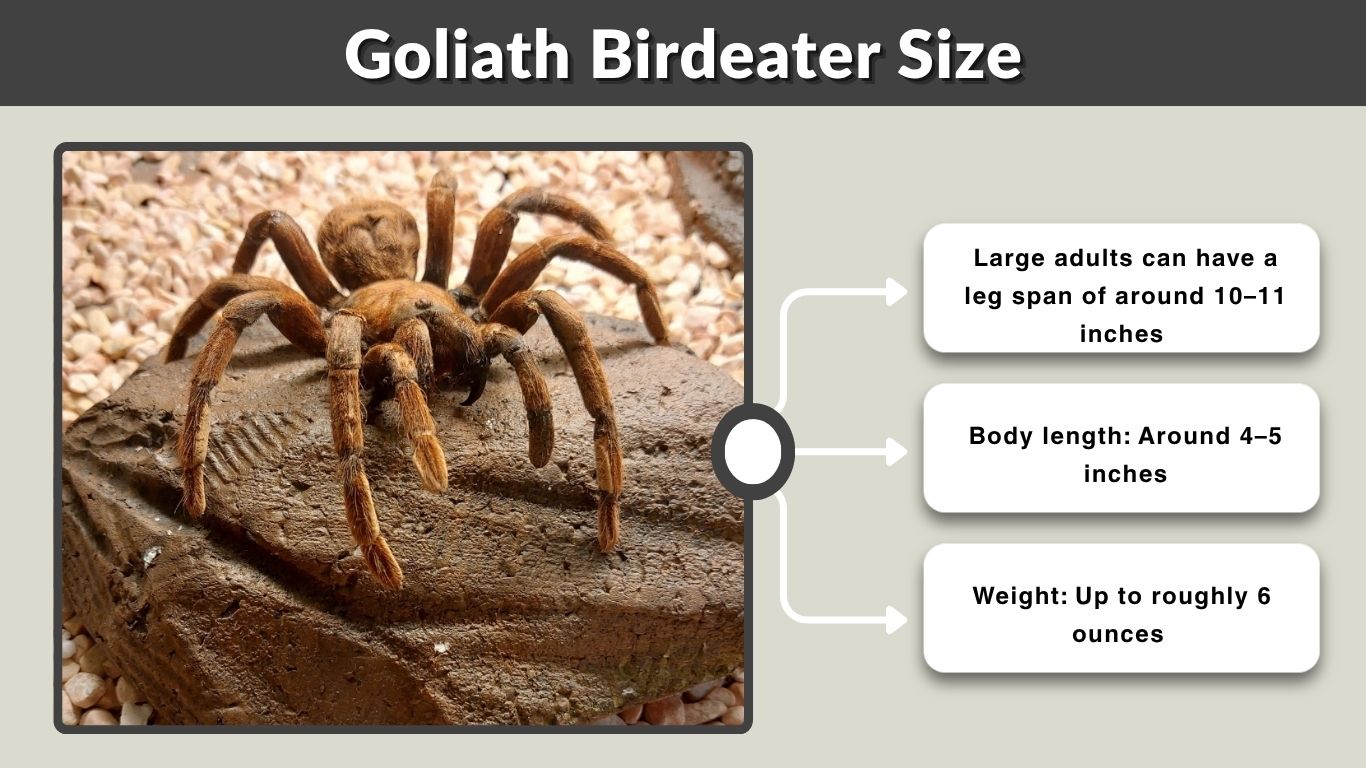
The Goliath birdeater is famous for its enormous size and is widely considered the heaviest living spider in the world. A fully grown individual can reach nearly a foot across when its legs are extended, making it dramatically larger than most household spiders. However, its actual body is much smaller than its full leg span suggests. Below, you’ll learn the Goliath birdeater’s size in inches, weight, male and female differences, human size comparison, and how it compares with other giant spiders.
How Big Is a Goliath Birdeater?
The Goliath birdeater (Theraphosa blondi) is a massive terrestrial tarantula native to northern South America. Large adults can have a leg span of around 10–11 inches (25–28 cm). Their bodies are thick and heavy, which is why this species can outweigh spiders with slightly longer legs.
Goliath Birdeater Size in Inches
A large adult Goliath birdeater typically measures:
- Leg span: Up to about 10–11 inches
- Body length: Around 4–5 inches
- Weight: Up to roughly 6 ounces (170 grams)
- Fang length: Around 0.75–1 inch in very large individuals
The measurement most often used when describing tarantula size is diagonal leg span. This means measuring from the tip of one front leg to the opposite rear leg when the spider is naturally extended.
An 11-inch leg span makes a very large Goliath birdeater roughly the width of a standard dinner plate.
Is Every Goliath Birdeater 11 Inches?
No. The often-mentioned 11-inch measurement represents exceptionally large adults rather than the size of every individual.
Young tarantulas are naturally much smaller. Adult size also varies according to sex, genetics, diet, age, and environmental conditions.
A mature specimen may therefore measure somewhat below the maximum while still being an impressively large tarantula.
Goliath Birdeater Size Compared to a Human
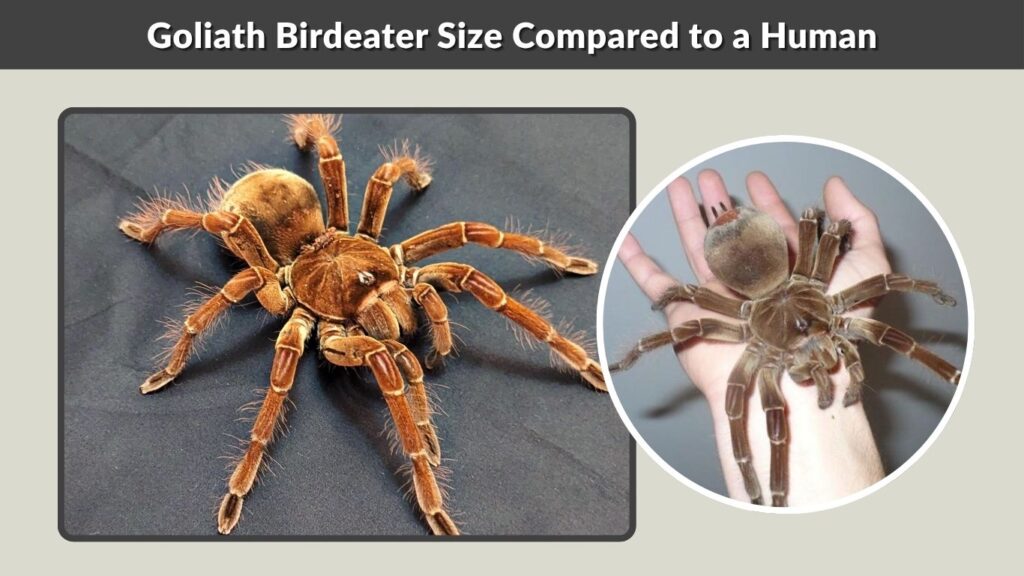
Seeing the measurements on paper does not always communicate how large this spider appears. Comparing it with familiar human objects provides a much clearer picture.
Its legs can cover much of an adult person’s hand, and an exceptionally large specimen can spread considerably beyond the fingers when placed over the palm.
Goliath Birdeater vs Human Hand
A typical adult human hand is approximately 7–8 inches long from the wrist to the tip of the middle finger.
A huge Goliath birdeater may have a leg span approaching 11 inches.
That means:
- Its entire leg span can be longer than an adult hand.
- Its body can be several inches long.
- Its extended legs may cover both the palm and fingers.
- Its overall width may resemble a large dinner plate.
Although photographs sometimes make these spiders look much larger, their real dimensions are still extraordinary for an arachnid.
Goliath Birdeater Compared to a Human Body
Despite dramatic photographs, a Goliath birdeater is tiny compared with a person.
An average adult human may stand around 5–6 feet tall, while even a record-sized Goliath birdeater has a leg span of less than one foot.
Its reputation as a “giant spider” therefore refers to its size relative to other spiders—not animals in general.
Goliath Birdeater Size Comparison With Everyday Objects
Comparing the Goliath birdeater with familiar objects makes its dimensions easier to visualize. A very large adult is surprisingly broad when its eight legs are spread across the ground.
Common Size Comparisons
A large Goliath birdeater can be compared with:
- Dinner plate: Similar overall width
- Adult human hand: Wider than many hands
- Sheet of printer paper: Nearly as wide as the short side
- Large smartphone: Body considerably shorter, but leg span much wider
- Baseball: Abdomen and body together can appear similarly bulky
- Small puppy: Not actually puppy-sized despite exaggerated descriptions online
The “size of a puppy” description is misleading. Even the world’s largest tarantulas are nowhere near the overall body mass of most puppies.
Male vs Female Goliath Birdeater Size
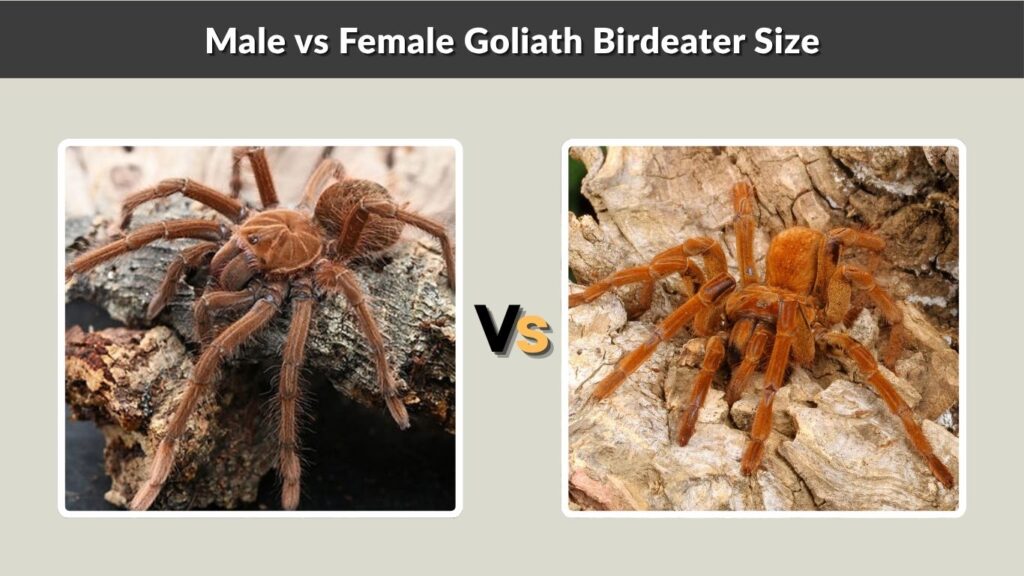
Male and female Goliath birdeaters can both become enormous, although females generally have bulkier bodies. Males tend to develop proportionally longer legs after reaching maturity, while females retain heavier abdomens and more robust overall builds.
Female Goliath Birdeater Size
Adult females commonly appear heavier and more muscular than males.
Typical female characteristics include:
- Thick abdomen
- Heavy body structure
- Strong, substantial legs
- Large overall body mass
Females are especially impressive because their body weight contributes significantly to the species’ reputation as the world’s heaviest spider.
Male Goliath Birdeater Size
Adult males may develop long legs but generally have slimmer abdomens than females.
After reaching maturity, males devote more energy to searching for females, while mature females remain more heavily built and spend much of their time around their burrows.
Because of these differences, two spiders with similar leg spans can look dramatically different in overall body size.
Burgundy Goliath Birdeater Size
The Burgundy Goliath birdeater usually refers to Theraphosa stirmi, another enormous South American tarantula closely related to the Goliath birdeater.
It can also attain an impressive leg span approaching approximately 10–11 inches in exceptionally large specimens.
Goliath Birdeater vs Burgundy Goliath
Both species are giants, so their maximum dimensions can overlap.
The main size comparison is:
- Theraphosa blondi: Up to around 11 inches
- Theraphosa stirmi: Often around 9–10 inches, with large specimens approaching similar dimensions
- Body build: Both are extremely heavy and robust
- Females: Usually bulkier than adult males
Because individual sizes vary, identifying these tarantulas based on size alone is unreliable.
Giant Huntsman Spider vs Goliath Birdeater Size
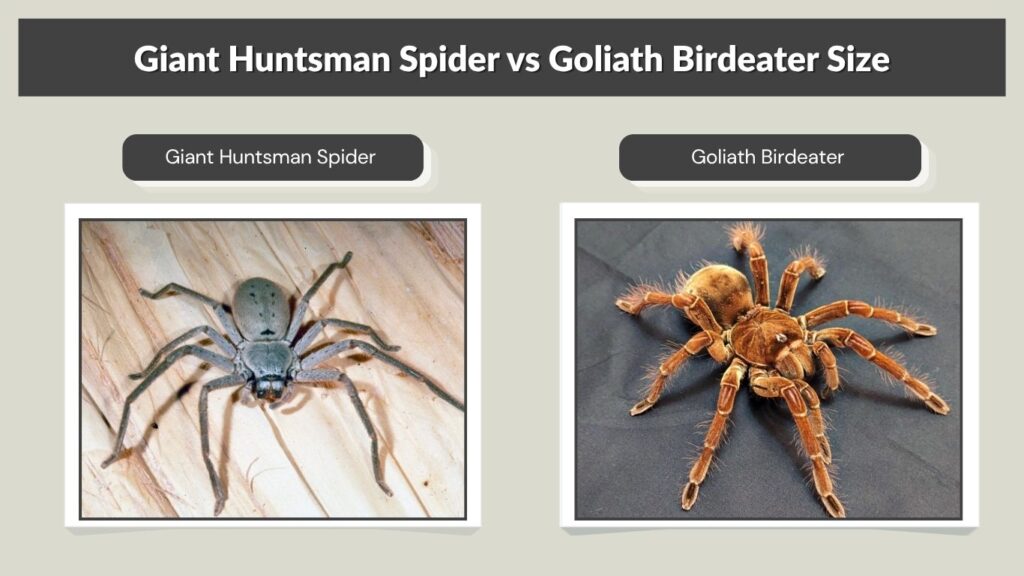
The giant huntsman spider and Goliath birdeater are often compared because both can reach extraordinary dimensions. However, each qualifies as “largest” in a different way.
The giant huntsman is famous for its extremely long legs, while the Goliath birdeater has a much heavier body.
Which Spider Is Bigger?
The comparison generally looks like this:
- Goliath birdeater: Up to roughly 11 inches in leg span
- Giant huntsman: Can reach approximately 12 inches in leg span
- Heaviest spider: Goliath birdeater
- Longest leg span: Giant huntsman
So, a giant huntsman can be wider from leg tip to leg tip, but the Goliath birdeater has a substantially more massive and muscular body.
If both were viewed side by side, the huntsman would look flatter and more spread out, while the Goliath birdeater would appear much thicker and heavier.
Why Does the Goliath Birdeater Grow So Large?
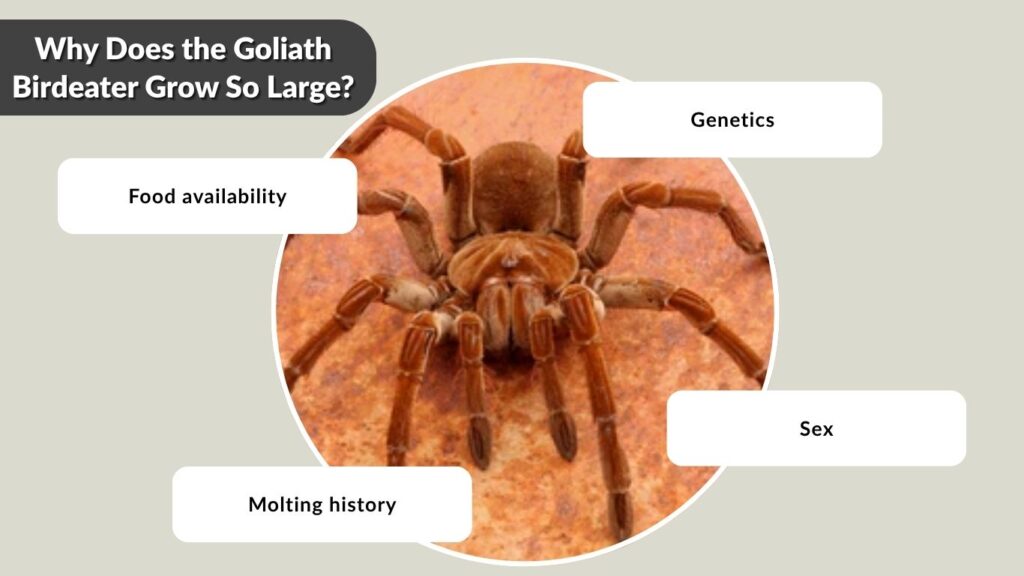
Its large size is partly connected with its terrestrial predatory lifestyle and tropical environment. Goliath birdeaters spend much of their lives on or beneath the humid rainforest floor, where they hunt a variety of relatively large prey.
Factors Affecting Size
Several factors influence how large an individual becomes:
- Genetics
- Sex
- Age
- Food availability
- Molting history
- Temperature
- Humidity
- Overall health
Tarantulas grow by molting their exoskeleton. Juveniles undergo repeated molts as their legs and bodies gradually become larger.
Once males mature, their growth slows dramatically. Females may continue molting throughout their much longer lives and can maintain a large, heavy body for many years.
Is the Goliath Birdeater the Largest Spider in the World?
The answer depends on how “largest” is measured.
The Goliath birdeater is commonly regarded as the largest spider by body mass, while the giant huntsman spider can surpass it in overall leg span.
Largest by Weight vs Leg Span
If spider size is measured by weight and overall body bulk, the Goliath birdeater holds the advantage.
If the measurement is based entirely on the distance between opposite leg tips, the giant huntsman can be wider.
This distinction explains why both spiders are sometimes described as the world’s largest.
FAQs
1. How big is a full-grown Goliath birdeater?
A very large adult can reach approximately 10–11 inches in leg span, with a body around 4–5 inches long.
2. How big is a Goliath birdeater compared to a human hand?
Its extended legs can be wider and longer than an average adult hand. A huge specimen may cover the palm and extend beyond the fingertips.
3. How much does a Goliath birdeater weigh?
Large individuals can weigh approximately 6 ounces or around 170 grams, although most specimens are lighter.
4. Is a Goliath birdeater really the size of a puppy?
No. This description exaggerates its size. A large specimen may be about as wide as a dinner plate, but its body mass is far smaller than that of even a small puppy.
5. Is the giant huntsman bigger than the Goliath birdeater?
The giant huntsman can have a slightly longer leg span, reaching around 12 inches. However, the Goliath birdeater has a much heavier and bulkier body, making it the larger spider by mass.
