
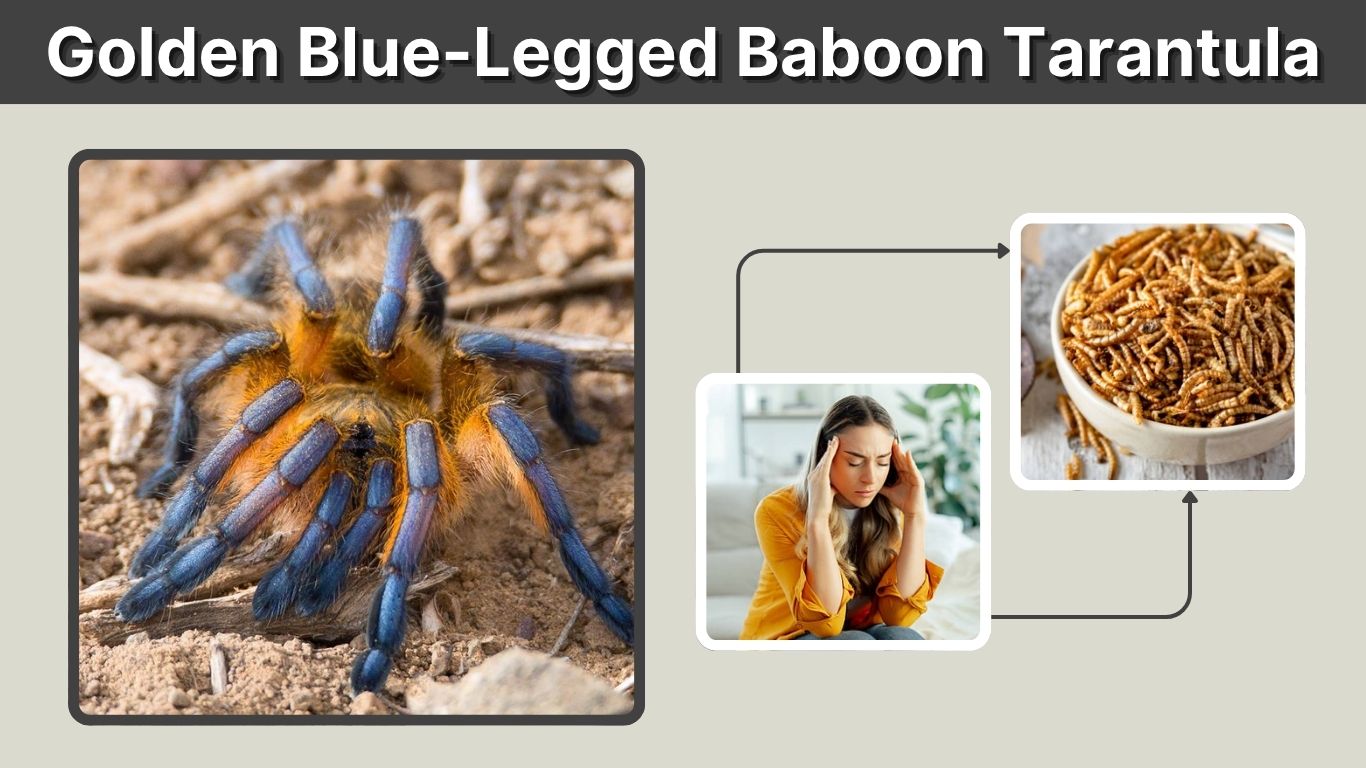
The golden blue-legged baboon tarantula (Harpactira pulchripes) is a striking South African species with metallic blue legs, a golden carapace, and bold abdominal markings. This Old World tarantula spends much of its life in a silk-lined burrow, emerging to hunt and expand its webbing. Although it is considered calmer than some African baboon spiders, it remains extremely fast and venomous. Deep substrate, a secure enclosure, moderate warmth, limited moisture, and careful maintenance are essential for keeping it safely.
Golden Blue-Legged Baboon Identification
The golden blue-legged baboon is one of the most recognizable African tarantulas in the pet trade. Its combination of blue legs and a golden-yellow body is unusual among burrowing species. “Golden blue leg” and “golden blue-legged baboon” are different common-name variations for the same tarantula.
Identifying Features
- Scientific name: Harpactira pulchripes
- Family: Theraphosidae
- Common name: Golden blue-legged baboon tarantula
- Native country: South Africa
- Type: Fossorial or burrowing
- Adult leg span: Approximately 4.5–5.5 inches
- Growth rate: Moderate
- Primary colors: Metallic blue, gold, orange, and black
- Urticating hairs: Absent
- Experience level: Intermediate to advanced
- Handling: Strongly discouraged
The legs appear metallic blue, while the carapace is golden, yellow, or orange. Dark markings radiate across the carapace, and the abdomen typically displays a black pattern over a golden background. Colors are particularly vivid after molting.
The World Spider Catalog recognizes Harpactira pulchripes as a valid species from South Africa. It was scientifically described by R. I. Pocock in 1901.
Why Is It Called a Baboon Tarantula?
“Baboon spider” is a common regional term for African tarantulas. The name may refer to the thick, padded ends of their legs, which were thought to resemble a baboon’s fingers.
It does not mean the spider has any biological relationship with baboons. Golden blue-legged baboons are Old World tarantulas belonging to the African subfamily Harpactirinae.
Golden Blue-Legged Baboon Habitat and Distribution
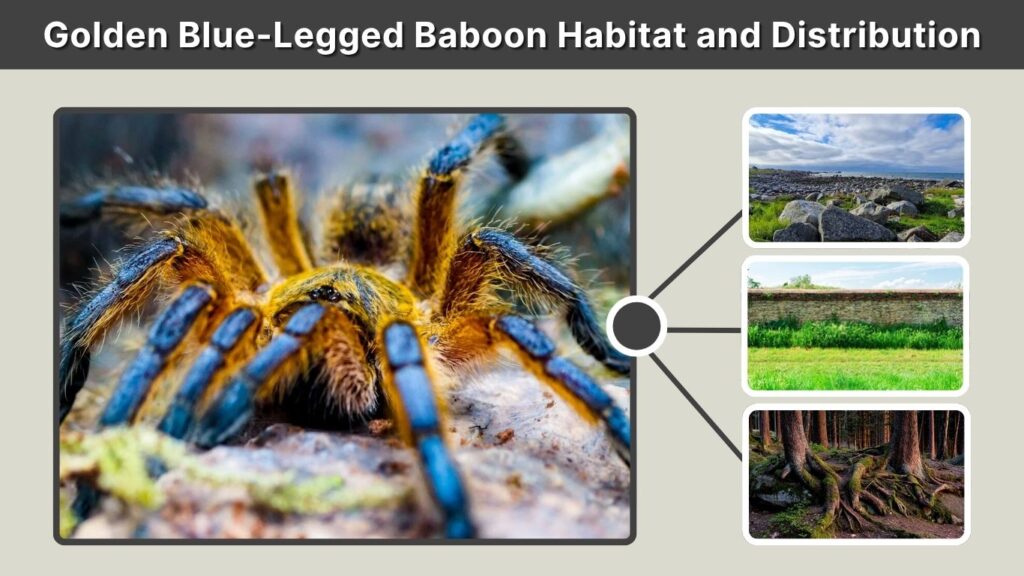
This species is native to South Africa, where it occupies dry grassland, scrubland, and other seasonally arid environments. It avoids harsh surface conditions by constructing deep underground retreats. The burrow protects the tarantula from temperature changes, predators, and moisture loss.
Natural Habitat
The golden blue-legged baboon excavates a burrow in compact soil and lines the walls with silk. It may also create webbed entrances beneath rocks, roots, grasses, or other stable structures.
Inside the burrow, temperature and moisture remain more stable than on the exposed ground. The tarantula normally waits close to the entrance at night and rushes out when it detects the vibrations of passing prey.
Burrowing and Webbing
This species is an enthusiastic digger and can produce considerable webbing. Its silk may cover the burrow entrance, substrate, pieces of bark, plants, and enclosure walls.
The tarantula uses silk to:
- Reinforce its underground tunnel
- Detect approaching prey
- Stabilize loose substrate
- Create a secure feeding area
- Seal the retreat before molting
- Protect itself from disturbances
Its webbing should not be removed during ordinary maintenance. Destroying the retreat can expose the spider and cause unnecessary stress.
Behavior and Temperament
Golden blue-legged baboons are often described as calmer than orange baboon tarantulas and several other African species. However, “calmer” is relative. They remain fast, reactive Old World tarantulas with no urticating hairs to use as a long-distance defense.
Defensive Behavior
When disturbed, the tarantula usually retreats into its burrow. A cornered or exposed specimen may:
- Sprint suddenly
- Raise its front legs
- Display its fangs
- Slap the ground
- Stridulate
- Strike repeatedly
- Deliver a defensive bite
Individual temperament varies. One spider may remain hidden whenever the enclosure opens, while another may stand its ground near the burrow entrance.
Handling
Handling should never be attempted. This species can move rapidly and may bite when trapped against skin or clothing. Its heavy abdomen could also rupture if the spider falls.
Use long feeding tongs, a catch cup, and a soft paintbrush during maintenance or rehousing. Transfers should take place inside a larger controlled container or another escape-resistant area.
Golden Blue-Legged Baboon Care
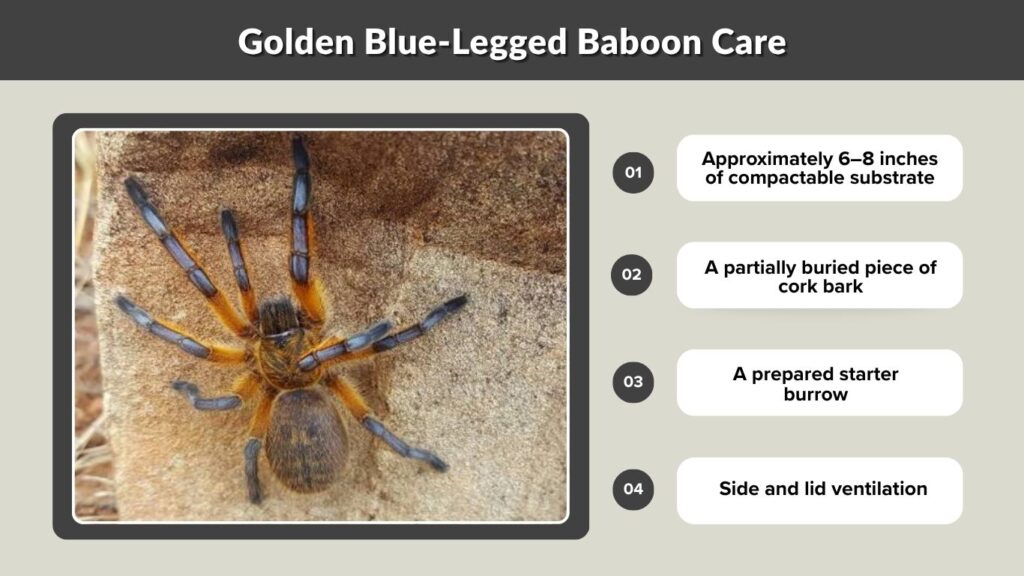
A proper setup should emphasize substrate depth rather than climbing space. The enclosure must allow extensive excavation while limiting the distance between the substrate and lid. Secure access is especially important because the tarantula may hide underneath webbing or rush unexpectedly.
Enclosure Setup
An adult enclosure may be approximately 10–12 inches long and wide, with enough height for deep substrate. Include:
- Approximately 6–8 inches of compactable substrate
- A partially buried piece of cork bark
- A prepared starter burrow
- Side and lid ventilation
- A shallow water dish
- Dried leaves or artificial plants
- Stable web-anchoring points
- A tightly secured lid
Fill approximately one-half to two-thirds of the enclosure with substrate. This provides digging depth while reducing the danger of a fall.
Juveniles and spiderlings should be housed in proportionately smaller containers. Their ventilation holes must be small enough to prevent escape.
Suitable Substrate
A mixture of pesticide-free topsoil and coconut fiber is suitable. Additional clay-based excavator soil may help the substrate maintain tunnel structure, but it should not become extremely hard.
Pack the lower layers firmly enough to support a burrow. Avoid gravel, sand-only mixtures, wood chips, fertilizer, calcium sand, and sharp decorative materials.
Temperature and Moisture
Maintain a temperature of approximately 72–80°F (22–27°C). Most warm homes remain within this range without additional heating. Avoid direct sunlight, heat lamps, and unregulated heat mats.
Keep most of an adult enclosure relatively dry while providing a clean water dish. Occasionally moisten one corner or overflow the water dish slightly, then allow that section to dry gradually.
Spiderlings require somewhat more consistent moisture because they are vulnerable to dehydration. However, their substrate should never be swampy, and their containers need adequate ventilation.
Golden Blue-Legged Baboon Feeding and Growth
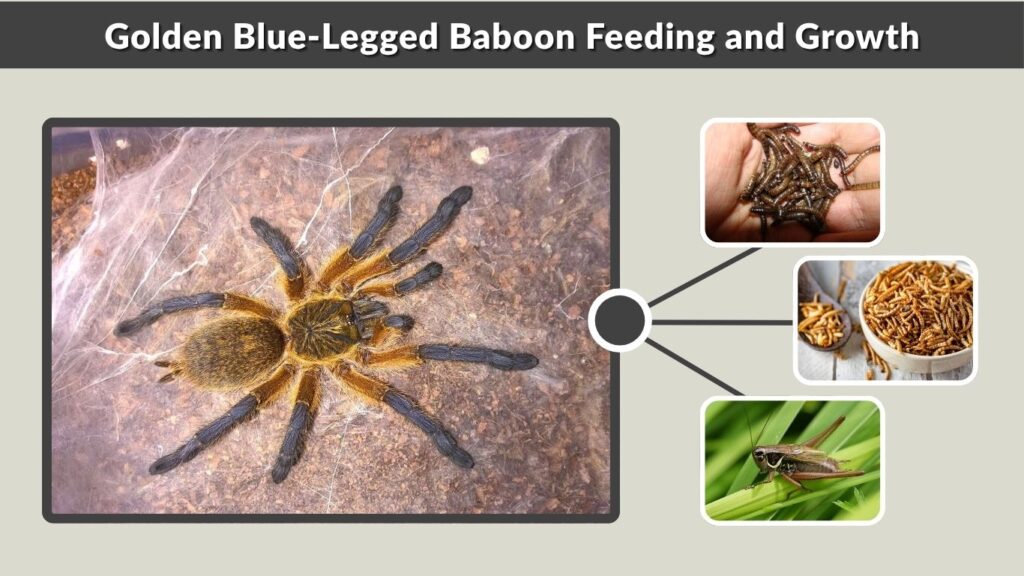
The golden blue-legged baboon has a strong feeding response and may rapidly attack prey near its retreat. Feeding tools should not be left close to the entrance longer than necessary because the spider may strike at vibrations.
Suitable Foods
- Crickets
- Dubia roaches
- Red runner roaches
- Locusts where legally available
- Mealworms
- Superworms
- Small pre-killed insects for tiny spiderlings
Offer spiderlings one or two small meals weekly. Juveniles can usually eat approximately once a week, while adults may receive suitable prey every 7–14 days.
Adjust feeding according to the abdomen’s size rather than following a rigid schedule. Remove uneaten prey within 24 hours, particularly if the tarantula begins refusing food.
Molting
Premolt signs may include:
- Refusing food
- Remaining inside the burrow
- Increased webbing
- Sealing the retreat
- Reduced activity
- Darker coloration
- Lying on the back
Do not open a sealed burrow simply to check the tarantula. It may remain hidden for several weeks during premolt and recovery. Keep the water dish filled and allow the spider to reopen its retreat naturally.
Wait approximately one week before feeding a juvenile after molting. A large adult may need 10–14 days for its new fangs and exoskeleton to harden.
Golden Blue-Legged Baboon Size and Lifespan
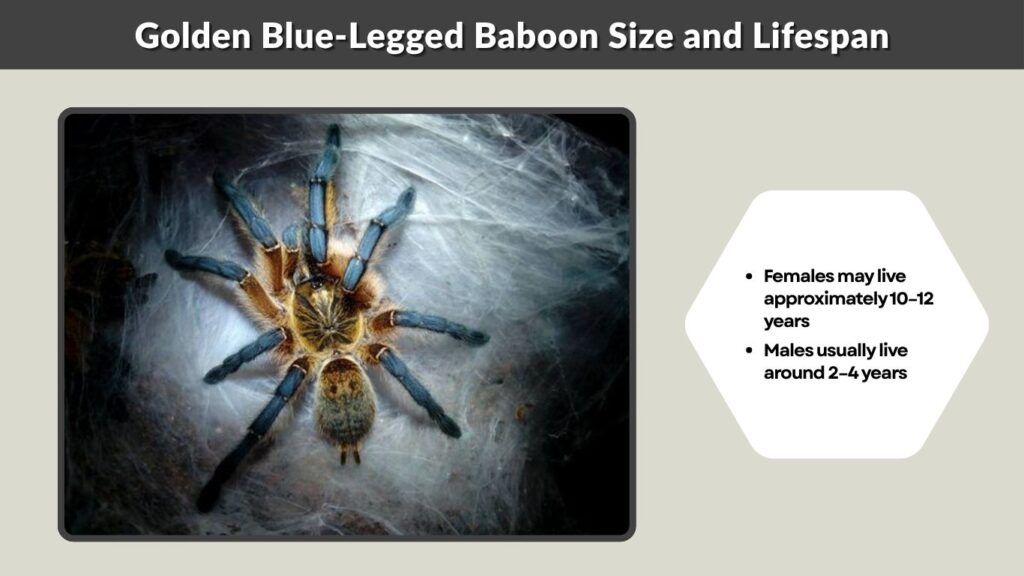
This is a medium-sized tarantula rather than a true giant. Its vivid coloration and broad resting posture can make it appear larger in photographs. Growth is moderately fast compared with many long-lived Mexican terrestrial tarantulas.
Adult Size
Adult females commonly reach approximately 5 inches in diagonal leg span, with large individuals approaching 5.5 inches. Mature males are generally smaller-bodied but may appear leggier.
Descriptions of “giant” golden blue-legged baboons are usually marketing language. There is no officially recognized giant form of Harpactira pulchripes.
Lifespan
Females may live approximately 10–12 years in captivity. Males usually live around 2–4 years in total, depending on temperature, feeding, and the speed at which they reach maturity.
These figures are estimates. Individual lifespan can vary according to genetics and husbandry conditions.
Male vs Female
Females retain a stockier body and stronger coloration. Mature males become slimmer and leggier, and their colors may appear duller. They also develop emboli on the ends of their pedipalps and reproductive structures on the front legs.
Examining the inside of a suitable molt is the most reliable method for sexing juveniles. External photographs may provide an estimate but are not always conclusive.
Golden Blue-Legged Baboon Bite and Venom
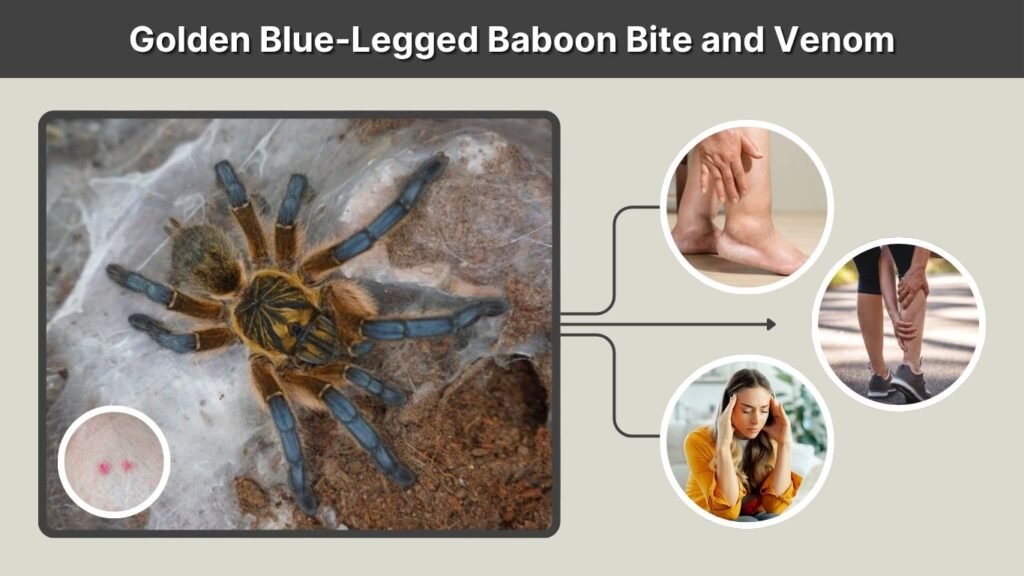
The golden blue-legged baboon is venomous, not poisonous. It injects venom through its fangs to subdue prey. Because it lacks urticating hairs, it relies on speed, threat displays, and biting when escape is impossible.
How Dangerous Is the Bite?
Reliable clinical information specifically concerning Harpactira pulchripes bites is limited. As an Old World baboon tarantula, its bite should be treated as potentially medically significant rather than compared with a mild bee sting.
Possible effects include:
- Immediate severe pain
- Puncture wounds
- Redness and swelling
- Burning or throbbing
- Muscle pain or cramping
- Nausea
- Headache
- Allergic symptoms
Wash the bite with soap and water and contact a medical professional or poison-control service. Provide the scientific name, Harpactira pulchripes. Seek urgent care for breathing difficulty, facial swelling, faintness, severe muscle cramps, vomiting, or worsening pain.
Buying a Golden Blue-Legged Baboon
Price depends on country, age, size, sex, availability, and shipping costs. Confirmed adult females generally command higher prices because they are larger and live longer. Spiderlings are usually more affordable but cannot always be reliably sexed.
Select a captive-bred specimen from a reputable breeder. Confirm its scientific name, approximate size, feeding record, last molt, sexing method, and legal origin. Buyers in the UK or other countries should check current exotic-animal, import, and shipping regulations before ordering.
FAQs
Is the golden blue-legged baboon good for beginners?
No. Its speed, Old World venom, defensive potential, and lack of urticating hairs make it more appropriate for experienced keepers.
How large does it grow?
Adults generally reach around 4.5–5.5 inches in diagonal leg span. Females usually have heavier bodies than males.
Is this tarantula aggressive?
It is typically reclusive and may retreat before defending itself. However, a cornered individual can threaten, strike, or bite.
Does it make a lot of webbing?
Yes. It frequently builds extensive silk-lined burrows and webs surrounding objects near the entrance.
How long does a golden blue-legged baboon live?
Females may live approximately 10–12 years. Males usually have a shorter lifespan of around 2–4 years.
