
Have you ever spotted a black flying bug that looks like a wasp but isn’t one? Many insects, including flies, beetles, moths, and bees, share similar body shapes, dark wings, and unusual markings. Some are large and intimidating, while others are small and harmless. Identifying these black wasp-like insects can help you understand their behavior and whether they pose any danger. In this guide, we’ll explore 15 black flying insects that resemble wasps, along with their identification features, habitats, diets, and life cycles.
1. Black Soldier Fly (Hermetia illucens)
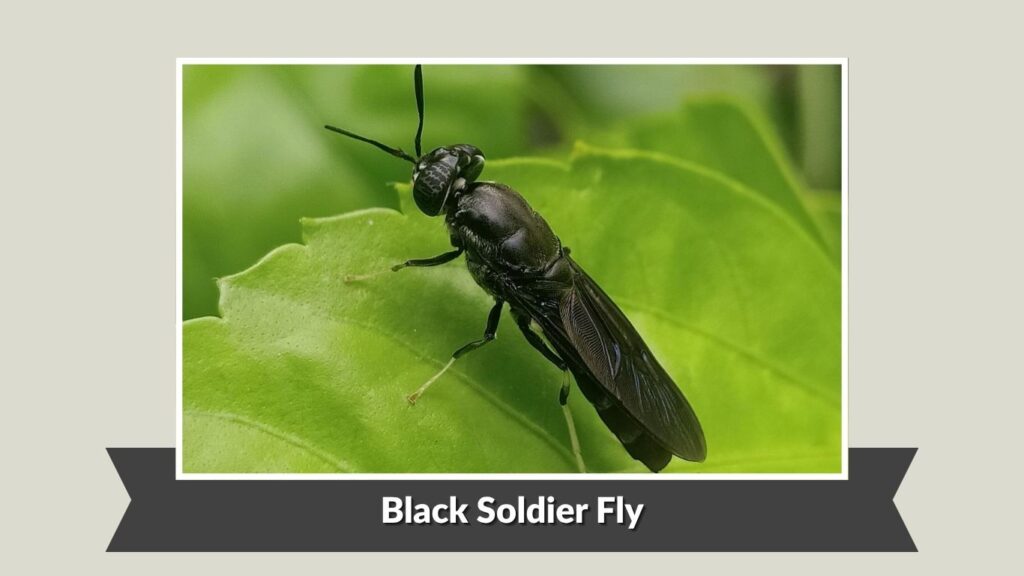
The Black Soldier Fly is a black flying bug that looks like a wasp but is actually a harmless fly belonging to the Stratiomyidae family. Its slender body, dark wings, and wasp-like appearance often cause people to mistake it for a stinging insect. Commonly found around gardens, compost bins, and decaying organic materials, this species plays an important role in breaking down waste.
Identification
The Black Soldier Fly has several distinctive physical characteristics that help distinguish it from actual wasps.
- Size: Adults typically measure 15–20 mm (0.6–0.8 inches) long.
- Body Color: Mostly shiny black with occasional metallic blue or green reflections.
- Wings: Dark, smoky wings that rest flat over the body when not flying.
- Body Shape: Long, narrow body with a wasp-like appearance.
- Antennae: Relatively long, segmented antennae that differ from those of typical houseflies.
- Distinctive Markings: Two small translucent patches near the base of the abdomen.
- Stinger: No stinger, making this insect harmless to humans.
Habitat and Distribution
Black Soldier Flies are widespread in warm and temperate regions, including much of the United States. They commonly inhabit gardens, farms, composting facilities, and areas containing decomposing organic matter.
Adult flies are frequently observed resting on vegetation, fences, and walls near breeding locations. During warmer months, they become more noticeable around compost bins and outdoor waste containers.
Behavior and Diet
Unlike aggressive stinging insects, Black Soldier Flies do not bite or sting humans. Adults generally consume little or no food and rely primarily on energy reserves accumulated during their larval stage.
Their larvae feed on decomposing food scraps, animal manure, and other organic materials. This feeding behavior makes them valuable decomposers in natural ecosystems and commercial composting operations.
Lifespan and Life Cycle
The Black Soldier Fly develops through four stages: egg, larva, pupa, and adult. Females lay clusters of eggs in dry crevices close to suitable organic material.
After hatching, larvae consume decomposing matter before entering the pupal stage. Adults typically survive around 5–8 days, although longevity varies with environmental conditions.
2. Black Mydas Fly (Mydas clavatus)
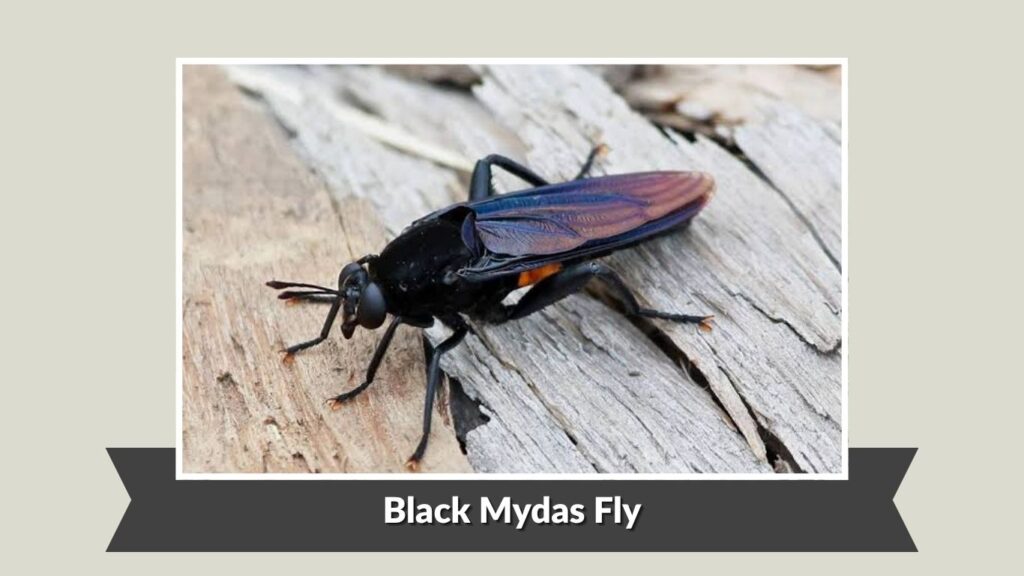
The Black Mydas Fly is a large black flying insect that looks like a wasp but belongs to the Mydidae family. Its elongated body, smoky wings, and orange markings create a striking resemblance to a large stinging wasp. Despite its intimidating appearance, this fly is harmless to humans and commonly appears in gardens, grasslands, and wooded areas during warmer months.
Identification
The Black Mydas Fly has several distinctive characteristics that help separate it from actual wasps.
- Size: Adults typically measure 25–38 mm (1–1.5 inches) long.
- Body Color: Predominantly glossy black with an orange or reddish band on the abdomen.
- Wings: Dark, smoky wings with a slightly bluish appearance.
- Body Shape: Long, robust body with a narrow connection between the thorax and abdomen.
- Antennae: Club-shaped antennae with noticeably thickened tips.
- Legs: Long, black legs that contribute to its wasp-like appearance.
- Stinger: No stinger, making it harmless to humans.
Habitat and Distribution
Black Mydas Flies occur mainly in eastern and central North America. They prefer open woodlands, meadows, grasslands, and gardens where suitable breeding conditions exist.
Adults are often observed resting on leaves, flowers, or exposed vegetation during sunny weather. They are particularly noticeable during summer, when their large size and dark appearance attract attention.
Behavior and Diet
Unlike aggressive stinging insects, Black Mydas Flies do not attack people. Adults are sometimes seen visiting flowers, although their feeding habits are not completely understood.
Their larvae develop in soil and decaying wood, where they prey on other insect larvae, including beetle grubs. This predatory behavior helps regulate populations of certain soil-dwelling insects.
Lifespan and Life Cycle
The Black Mydas Fly undergoes complete metamorphosis through egg, larva, pupa, and adult stages. Females deposit eggs in soil or suitable decaying material.
The larvae develop underground or within decomposing wood before pupating. Adults emerge during warmer months and live for a relatively short period focused on reproduction.
3. Black Horse Fly (Tabanus atratus)
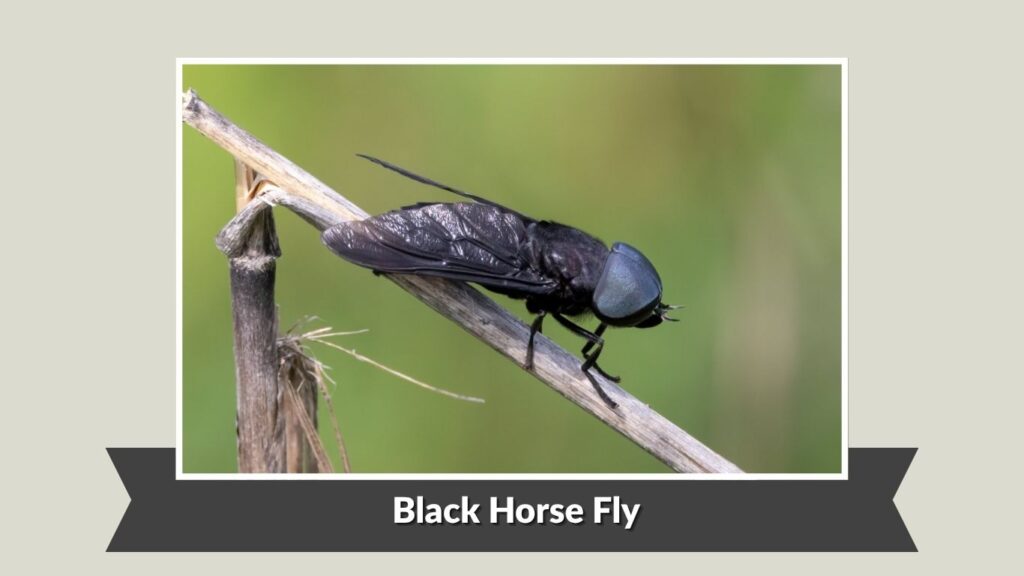
The Black Horse Fly is a big black flying bug that looks like a wasp because of its large body, dark wings, and powerful flight. Unlike harmless wasp-mimicking flies, female Black Horse Flies can deliver painful bites. This species belongs to the Tabanidae family and is commonly found around wetlands, farms, forests, and areas containing livestock.
Identification
Black Horse Flies have several recognizable characteristics that distinguish them from wasps and other large black flying insects.
- Size: Adults generally measure 20–28 mm (0.8–1.1 inches) long.
- Body Color: Mostly solid black with a dark, slightly glossy appearance.
- Wings: Broad, dark wings that create a noticeable buzzing sound during flight.
- Eyes: Large compound eyes that occupy much of the head.
- Body Shape: Robust, thick-bodied appearance without a narrow wasp waist.
- Antennae: Short antennae compared with many wasp species.
- Mouthparts: Females possess cutting mouthparts for feeding on blood.
Habitat and Distribution
Black Horse Flies are widely distributed across eastern North America. They commonly inhabit wooded wetlands, marshes, riverbanks, and areas with standing water.
These insects are particularly abundant during warm and humid summer months. Adults frequently appear around cattle, horses, deer, and other large mammals.
Behavior and Diet
Female Black Horse Flies feed on blood to obtain nutrients needed for egg development. Their bites can be painful because they cut the skin rather than puncturing it with a needle-like structure.
Male Black Horse Flies do not bite and primarily consume nectar and other plant-derived sugars.
Unlike social wasps, these flies do not build communal nests or defend colonies. However, females may repeatedly approach humans or animals when searching for blood meals.
Lifespan and Life Cycle
Black Horse Flies develop through egg, larva, pupa, and adult stages. Females deposit egg masses on vegetation near water or moist soil.
After hatching, larvae enter wet habitats, where they feed on small organisms. Larval development may last several months or longer, depending on environmental conditions.
Adults emerge during warmer seasons, completing the reproductive cycle.
4. Black Hoverfly (Cheilosia spp.)
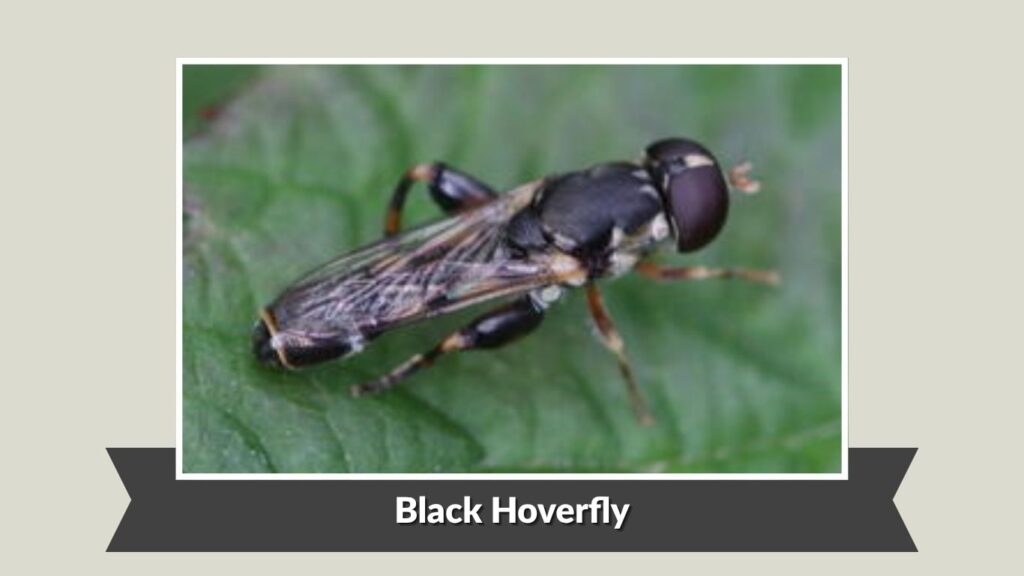
The Black Hoverfly is a small black wasp-like insect commonly seen around flowers, gardens, and woodland edges. Although many hoverflies have yellow and black stripes, some species in the genus Cheilosia are predominantly black. Their dark bodies and quick movements can cause people to mistake them for small wasps or bees. However, hoverflies belong to the Syrphidae family and cannot sting.
Identification
Black Hoverflies have several physical features that help distinguish them from actual wasps.
- Size: Depending on the species, adults commonly measure approximately 5–12 mm long.
- Body Color: Predominantly black, sometimes with metallic green or bronze reflections.
- Wings: One pair of transparent wings, unlike wasps, which have two pairs.
- Body Shape: Compact or elongated body without a distinctly narrow wasp waist.
- Eyes: Large compound eyes positioned prominently on the head.
- Antennae: Relatively short antennae compared with those of many wasps.
- Stinger: Completely absent, making these flies harmless to humans.
Habitat and Distribution
Black Hoverflies occur in many parts of Europe, Asia, and North America, although individual species have different geographic ranges.
They commonly inhabit gardens, meadows, grasslands, woodland edges, and areas containing flowering plants.
Adults frequently rest on leaves or hover around flowers while searching for nectar and pollen.
Behavior and Diet
Black Hoverflies are generally peaceful insects that do not bite or sting humans. Their ability to hover in place makes them easy to recognize.
Adults primarily feed on nectar and pollen, contributing to plant pollination.
Depending on the species, their larvae may develop in living plant tissues, fungi, or decaying organic material. Some species have highly specialized relationships with particular host plants.
Lifespan and Life Cycle
Black Hoverflies undergo complete metamorphosis, beginning as eggs before developing into larvae, pupae, and adults.
Females usually lay eggs near suitable larval food sources. After hatching, larvae feed and grow before pupating.
Their development time and adult lifespan vary considerably among species and environmental conditions.
5. Black Robber Fly (Promachus spp.)
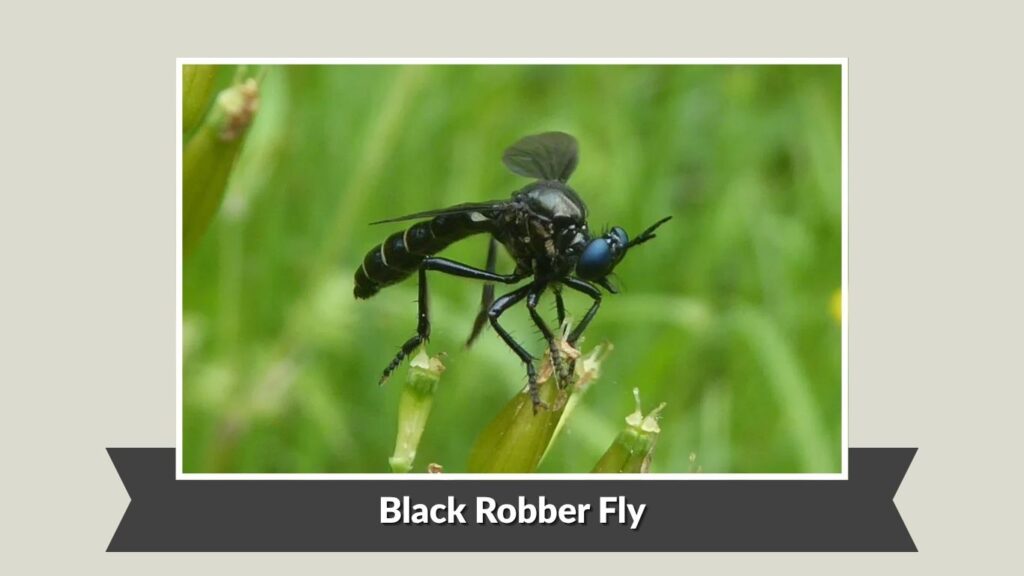
The Black Robber Fly is a large black flying bug that looks like a wasp because of its powerful body, long legs, and fast flight. These predatory insects belong to the Asilidae family and are frequently mistaken for black wasps. Although their appearance can be intimidating, robber flies generally avoid humans and play an important role in controlling other insect populations.
Identification
Black Robber Flies have several recognizable physical features that distinguish them from wasps.
- Size: Many larger species measure approximately 20–35 mm long.
- Body Color: Dark brown to black, sometimes covered with gray or pale hairs.
- Wings: One pair of transparent or smoky wings.
- Body Shape: Long, muscular body with a relatively narrow abdomen.
- Eyes: Large compound eyes separated by a noticeable depression on the head.
- Legs: Strong, spiny legs designed for capturing flying prey.
- Mouthparts: Short, pointed proboscis used to pierce prey and consume liquefied tissues.
Habitat and Distribution
Black Robber Flies occur in many regions worldwide, including North America. They commonly inhabit grasslands, forests, gardens, agricultural fields, and sunny woodland openings.
These insects frequently perch on branches, fences, and exposed vegetation while watching for passing prey.
Behavior and Diet
Robber flies are active hunters that capture other insects during flight. Their diet includes flies, beetles, moths, bees, and occasionally wasps.
They use their powerful legs to grab prey and their piercing mouthparts to inject saliva containing substances that help immobilize and digest it.
Although robber flies do not sting, they can deliver a painful bite if handled or trapped against the skin.
Lifespan and Life Cycle
Robber flies undergo complete metamorphosis through egg, larva, pupa, and adult stages.
Females deposit eggs in soil, vegetation, or suitable organic material, depending on the species. Their larvae often develop in soil or decaying wood, feeding on other small organisms.
Larval development may take several months or longer. Adults emerge during warmer seasons and spend their time hunting and reproducing.
6. Thick-Headed Fly (Conopidae Family)
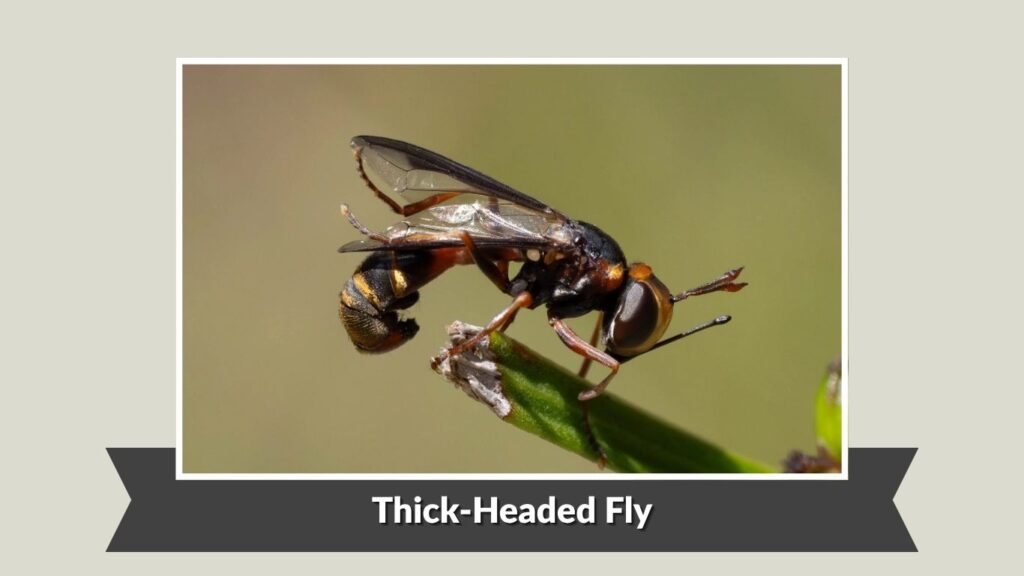
The Thick-Headed Fly is a small, slender insect that often resembles a black wasp because of its narrow body, dark markings, and unusual shape. Some species display black, red, orange, or yellow patterns that closely imitate stinging insects. Despite their wasp-like appearance, thick-headed flies belong to the Conopidae family and cannot sting humans.
Identification
Thick-Headed Flies have several distinctive characteristics that help separate them from actual wasps.
- Size: Adults generally measure approximately 3–20 mm long, depending on the species.
- Body Color: Black, brown, reddish, or yellowish, often with contrasting markings.
- Wings: One pair of clear or slightly tinted wings.
- Body Shape: Slender, sometimes with a noticeably narrow waist-like abdominal base.
- Head: Relatively large, rounded head with prominent compound eyes.
- Antennae: Often elongated or distinctly shaped, depending on the species.
- Mouthparts: Many species have an elongated proboscis adapted for feeding on nectar.
Habitat and Distribution
Thick-Headed Flies occur throughout many parts of the world, including North America, Europe, and Asia.
They commonly inhabit meadows, gardens, grasslands, woodland edges, and areas containing abundant flowering plants.
Adults are frequently seen resting on flowers or flying among vegetation during warm, sunny weather.
Behavior and Diet
Adult Thick-Headed Flies primarily feed on nectar, making them occasional pollinators.
However, their larvae have an unusual lifestyle. Many species are internal parasites of bees and wasps. Females deposit eggs on or inside suitable host insects.
After hatching, the larvae develop inside the host, consuming its resources and eventually causing its death.
Despite this parasitic relationship, adult Thick-Headed Flies are not dangerous to humans.
Lifespan and Life Cycle
Thick-Headed Flies develop through four stages: egg, larva, pupa, and adult.
The female locates an appropriate insect host and deposits an egg. The developing larva feeds internally before pupating, often within the host’s body.
7. Black-and-Yellow Longhorn Beetle (Rutpela maculata)
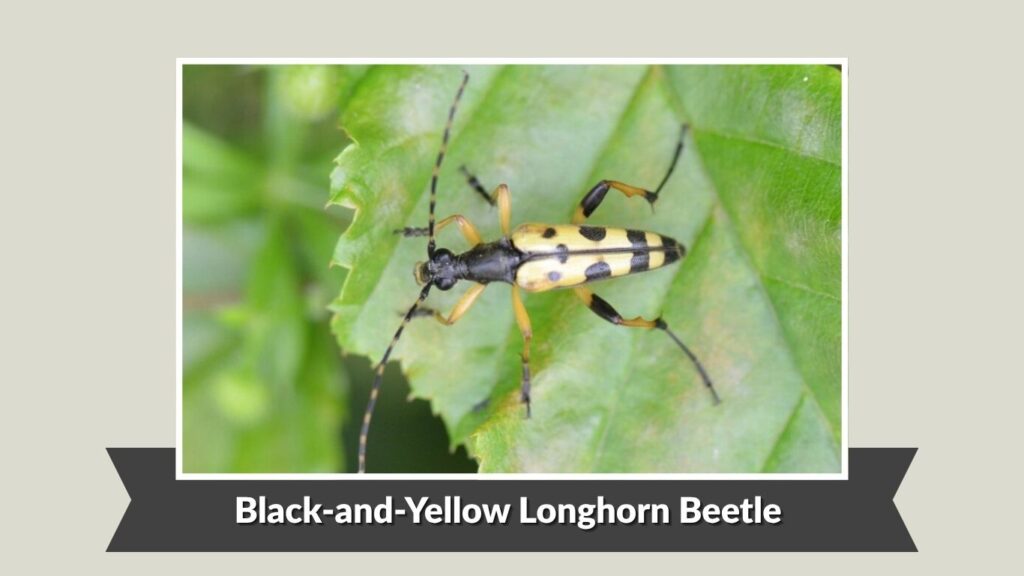
The Black-and-Yellow Longhorn Beetle is a flying insect that looks like a wasp because of its striped body, elongated shape, and long antennae. Unlike actual wasps, this species belongs to the Cerambycidae family and cannot sting. Its distinctive black-and-yellow markings help discourage predators by making it resemble a potentially dangerous insect.
Identification
The Black-and-Yellow Longhorn Beetle has several recognizable physical characteristics that distinguish it from actual wasps.
- Size: Adults typically measure 14–20 mm (0.55–0.8 inches) long.
- Body Color: Yellowish body with irregular black spots and bands.
- Wings: Hardened yellow wing covers decorated with dark markings.
- Body Shape: Slender, elongated body that narrows toward the rear.
- Antennae: Long, segmented antennae that often approach the body length.
- Legs: Relatively long, usually yellowish or orange with darker sections.
- Stinger: No stinger, making this beetle harmless to humans.
Habitat and Distribution
Black-and-Yellow Longhorn Beetles are widely distributed throughout Europe and parts of Asia. They commonly inhabit woodland edges, meadows, gardens, and areas containing flowering plants.
Adults are especially noticeable during summer, when they visit wildflowers and shrubs in sunny locations.
Behavior and Diet
Adult beetles primarily feed on pollen and nectar. Their movements between flowers may contribute to pollination.
The larvae feed inside decaying wood, particularly in dead or deteriorating branches and tree trunks. Their feeding supports the natural breakdown of woody material.
Despite looking like a black-and-yellow wasp-like insect, this beetle does not possess venom or a stinger.
Lifespan and Life Cycle
The Black-and-Yellow Longhorn Beetle undergoes complete metamorphosis through egg, larva, pupa, and adult stages.
Females deposit eggs in suitable dead or decaying wood. After hatching, larvae tunnel through the wood and feed while developing.
Larval development generally takes multiple years, depending on environmental conditions. Adults emerge during warmer months and spend their relatively short adult lives feeding and reproducing.
8. Black-and-Red Longhorn Beetle (Necydalis mellita)
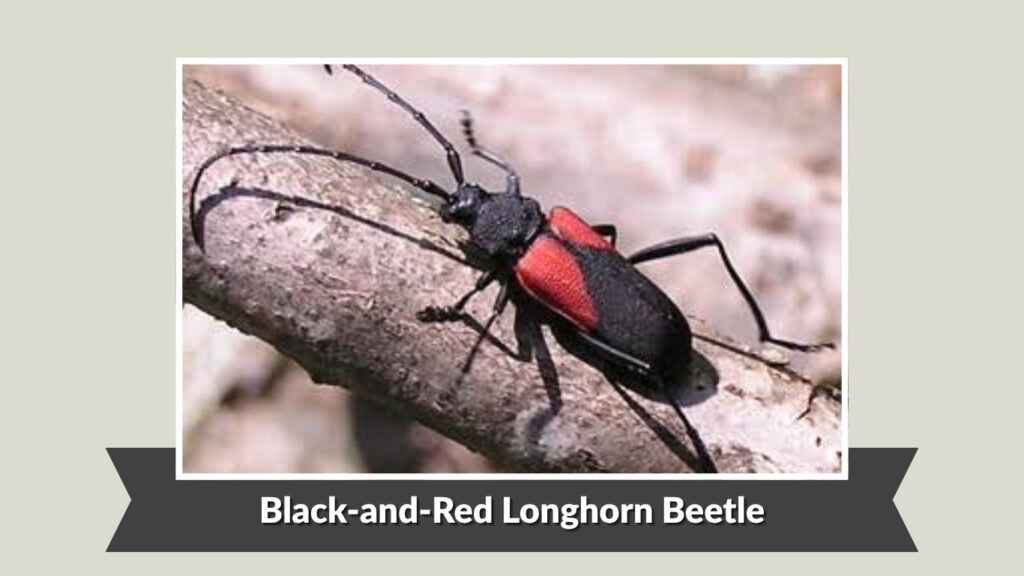
The Black-and-Red Longhorn Beetle is a slender flying insect that resembles a wasp because of its narrow body, exposed wings, and contrasting black and reddish coloration. Belonging to the Cerambycidae family, this species is a remarkable example of insect mimicry. Although its appearance may resemble a red-and-black wasp-like insect, it is a beetle without a venomous stinger.
Identification
The Black-and-Red Longhorn Beetle has several distinctive characteristics that make it recognizable.
- Size: Adults measure approximately 20 mm (0.8 inches) long.
- Body Color: Combination of black and reddish or orange-brown sections.
- Wings: Unusually short hardened wing covers, leaving much of the abdomen exposed.
- Body Shape: Long, narrow body with a wasp-like silhouette.
- Antennae: Long, slender antennae that can exceed the body length.
- Legs: Thin, elongated legs that contribute to its wasp-like appearance.
- Stinger: Absent, making it incapable of stinging humans.
Habitat and Distribution
This longhorn beetle occurs in parts of North America, particularly around wooded habitats where suitable dead or deteriorating trees are available.
Adults may be encountered near forest edges, fallen branches, or decaying hardwood material.
Because they are less frequently observed than many common beetles, their unusual appearance can attract considerable attention.
Behavior and Diet
The Black-and-Red Longhorn Beetle uses its resemblance to stinging insects as a defensive adaptation against predators.
Its shortened wing covers expose the functional flight wings, creating an appearance similar to that of certain wasps.
The larvae develop in dead or deteriorating wood, where they obtain nutrients while tunneling through woody material.
Adults are not aggressive toward humans, although they may fly rapidly when disturbed.
Lifespan and Life Cycle
Like other longhorn beetles, this species develops through egg, larva, pupa, and adult stages.
Females lay eggs in suitable woody material. The larvae tunnel through the wood, feeding and growing before eventually pupating.
Development may extend over more than one season, depending on environmental conditions. Adults emerge to reproduce and locate suitable habitats for the next generation.
9. Black Firefly (Lucidota atra)
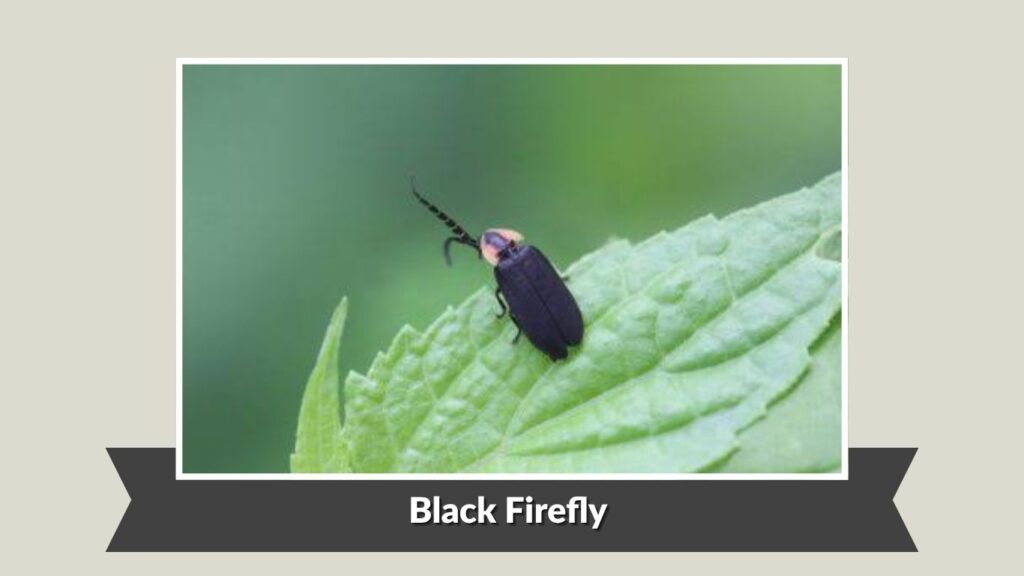
The Black Firefly is a small black flying bug that may occasionally be mistaken for a wasp because of its dark body and flying behavior. However, it belongs to the Lampyridae family and is actually a beetle. Unlike many familiar fireflies, adult Black Fireflies generally do not produce flashing light signals. These insects are commonly encountered in wooded areas and gardens across eastern North America.
Identification
The Black Firefly has several distinctive physical characteristics that help distinguish it from wasps.
- Size: Adults typically measure 7.5–13 mm (0.3–0.5 inches) long.
- Body Color: Predominantly black with a yellowish or orange pronotum.
- Wings: Dark, hardened wing covers that protect the flight wings underneath.
- Body Shape: Elongated, somewhat flattened body.
- Head: Partially concealed beneath a shield-like pronotum.
- Distinctive Markings: Dark central markings on the pronotum, sometimes surrounded by reddish coloration.
- Stinger: No stinger, although adults possess defensive chemical secretions.
Habitat and Distribution
Black Fireflies occur throughout much of eastern North America, extending into parts of central North America.
They commonly inhabit open woodlands, forest edges, gardens, and moist environments containing leaf litter and decaying vegetation.
Adults are often observed resting on leaves, tree trunks, and other vegetation during daylight hours.
Behavior and Diet
Unlike many nighttime fireflies, Black Fireflies are active during the day and rely primarily on chemical signals to locate mates.
They generally fly slowly through shaded vegetation. Adults are not aggressive toward humans and do not sting.
Their larvae live in moist soil, leaf litter, and decaying wood, where they feed on small invertebrates.
Lifespan and Life Cycle
The Black Firefly undergoes complete metamorphosis through egg, larva, pupa, and adult stages.
Females deposit eggs in suitable moist environments. After hatching, larvae develop among soil particles, leaf litter, and decomposing organic material.
The immature stages account for most of the life cycle. Adults emerge seasonally and concentrate on mating and reproduction.
10. Black Clearwing Moth (Grape Root Borer, Vitacea polistiformis)
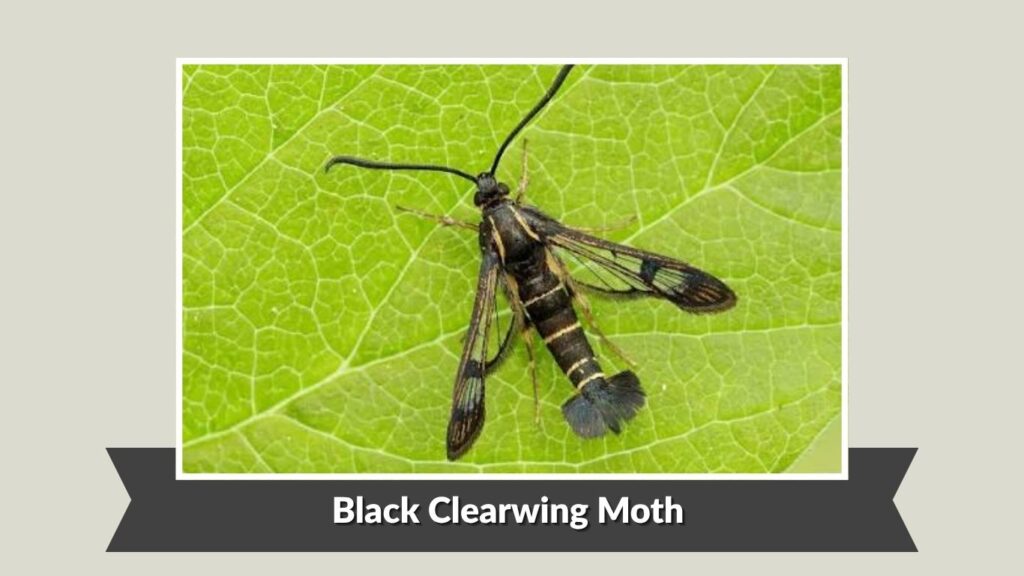
The Grape Root Borer is a dark clearwing moth that closely resembles a black wasp because of its narrow body, transparent wings, and distinctive markings. This insect belongs to the Sesiidae family and is sometimes mistaken for a large wasp flying around gardens or vineyards. Although adults cannot sting, their larvae can cause significant damage to grapevine roots.
Identification
The Grape Root Borer has several distinctive characteristics that help distinguish it from actual wasps.
- Size: Adults have a wingspan of approximately 26–42 mm (1–1.7 inches).
- Body Color: Mostly dark brown or black, with contrasting yellow or orange markings.
- Wings: Primarily transparent wings with darker borders and veins.
- Body Shape: Long, narrow body resembling a wasp.
- Antennae: Dark antennae that are thicker toward their tips.
- Abdomen: Elongated with noticeable markings and a tufted tip.
- Stinger: Absent, making adults incapable of stinging humans.
Habitat and Distribution
Grape Root Borers occur in eastern and central parts of North America, particularly in regions where wild or cultivated grapevines grow.
They commonly inhabit vineyards, woodland edges, gardens, and areas containing grape plants.
Adults are most noticeable during warmer months when they emerge from underground developmental sites and search for mates.
Behavior and Diet
Adult Grape Root Borers imitate the appearance and flight behavior of wasps, which may help protect them from predators.
Unlike actual wasps, they do not build nests or hunt other insects.
Their larvae feed inside grapevine roots, tunneling through plant tissues and interfering with nutrient and water movement.
Heavy infestations can weaken grapevines, reduce productivity, and contribute to plant decline.
Lifespan and Life Cycle
Grape Root Borers undergo complete metamorphosis through egg, larva, pupa, and adult stages.
Females deposit eggs around grapevines. Newly hatched larvae move into the soil and enter the roots, where they feed and develop.
Larval development typically takes one to two years, depending on geographic location and environmental conditions.
11. Virginia Ctenucha Moth (Ctenucha virginica)
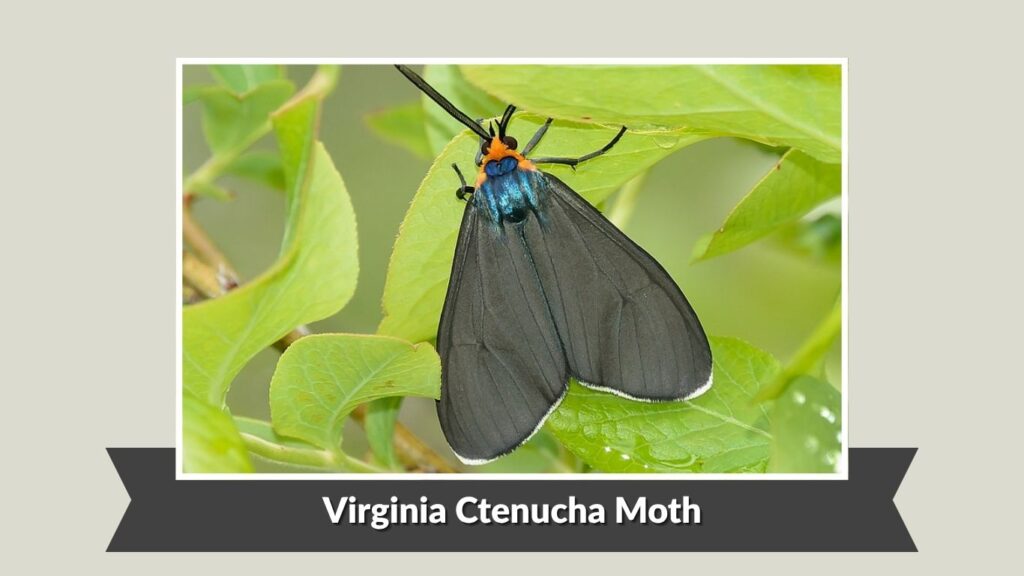
The Virginia Ctenucha Moth is a black and blue flying insect that looks like a wasp because of its dark wings, slender body, and bright orange markings. This species belongs to the Erebidae family and is among the larger ctenuchine moths found in eastern North America. Despite its wasp-like appearance, it is a harmless moth that commonly visits flowers and grassy habitats.
Identification
The Virginia Ctenucha Moth has several recognizable physical characteristics that help distinguish it from wasps.
- Size: Adults typically have a wingspan of approximately 40–50 mm (1.6–2 inches).
- Body Color: Metallic blue-black body with contrasting orange markings.
- Wings: Long, dark wings with narrow pale fringes.
- Head: Bright orange or yellow-orange coloration.
- Body Shape: Slender, elongated body resembling certain wasp species.
- Antennae: Dark, finely comb-like antennae.
- Stinger: No stinger, making this moth harmless to humans.
Habitat and Distribution
Virginia Ctenucha Moths are commonly found across eastern North America, particularly in Canada and the northeastern United States.
They inhabit meadows, wetlands, woodland edges, grassy clearings, and gardens containing flowering vegetation.
Adults are frequently observed flying during daylight hours, although they may also be active at other times.
Behavior and Diet
Unlike many moths that remain primarily active at night, Virginia Ctenucha Moths are often active during the day.
Adults visit flowers to obtain nectar and may contribute to pollination.
Their dark wings and orange head create a distinctive appearance that can resemble certain black-and-orange wasp-like insects.
The caterpillars primarily feed on grasses, sedges, and some other herbaceous plants.
Lifespan and Life Cycle
The Virginia Ctenucha Moth develops through egg, caterpillar, pupa, and adult stages.
Females deposit eggs on or near suitable host plants. After hatching, caterpillars feed on vegetation and gradually increase in size through successive molts.
The caterpillars are hairy and may overwinter before completing development.
12. Yellow-Collared Scape Moth (Cisseps fulvicollis)
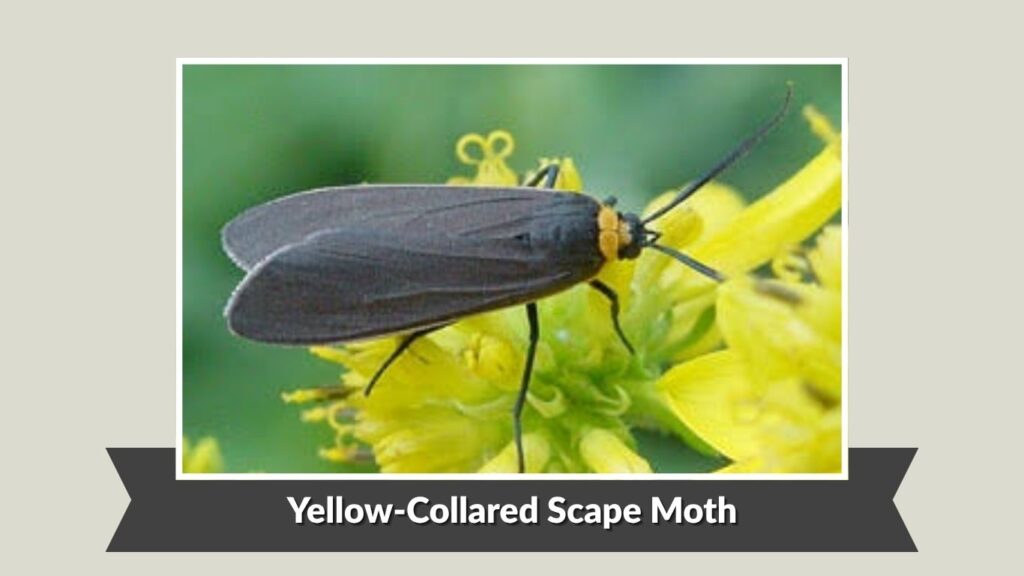
The Yellow-Collared Scape Moth is a small black flying insect that looks like a wasp because of its slender body, dark wings, and bright yellow-orange collar. This species belongs to the Erebidae family and is commonly found in grassy habitats throughout eastern North America. Despite its resemblance to a small black wasp-like insect, it is a harmless moth that cannot sting humans.
Identification
The Yellow-Collared Scape Moth has several recognizable physical characteristics that help distinguish it from actual wasps.
- Size: Adults typically have a wingspan of 25–37 mm (1–1.5 inches).
- Body Color: Mostly black with a distinctive yellow or orange collar behind the head.
- Wings: Narrow, dark brown or black wings that may appear slightly translucent.
- Body Shape: Slender, elongated body resembling a small wasp.
- Head: Dark head with contrasting yellow-orange coloration around the thorax.
- Antennae: Thin, dark antennae.
- Stinger: Absent, making this moth incapable of stinging humans.
Habitat and Distribution
Yellow-Collared Scape Moths occur across much of eastern North America, extending into parts of central North America.
They commonly inhabit meadows, grasslands, woodland edges, gardens, and open fields containing grasses and flowering plants.
Adults are particularly noticeable during summer when they fly among vegetation and visit wildflowers.
Behavior and Diet
Unlike actual wasps, Yellow-Collared Scape Moths do not hunt insects or build nests.
Adults visit flowers for nectar and may help transfer pollen between plants.
Their dark coloration and contrasting orange collar can make them resemble certain black-and-orange wasp-like insects.
The caterpillars primarily feed on grasses and other low-growing vegetation. Adults are often active during daylight hours.
Lifespan and Life Cycle
The Yellow-Collared Scape Moth undergoes complete metamorphosis through egg, caterpillar, pupa, and adult stages.
Females lay eggs on or near suitable host plants. After hatching, caterpillars feed on grasses and gradually develop through several molts.
The immature stages may survive colder periods before completing development.
Adults emerge during warmer months, when they feed, mate, and reproduce.
13. Black Carpenter Bee (Xylocopa spp.)
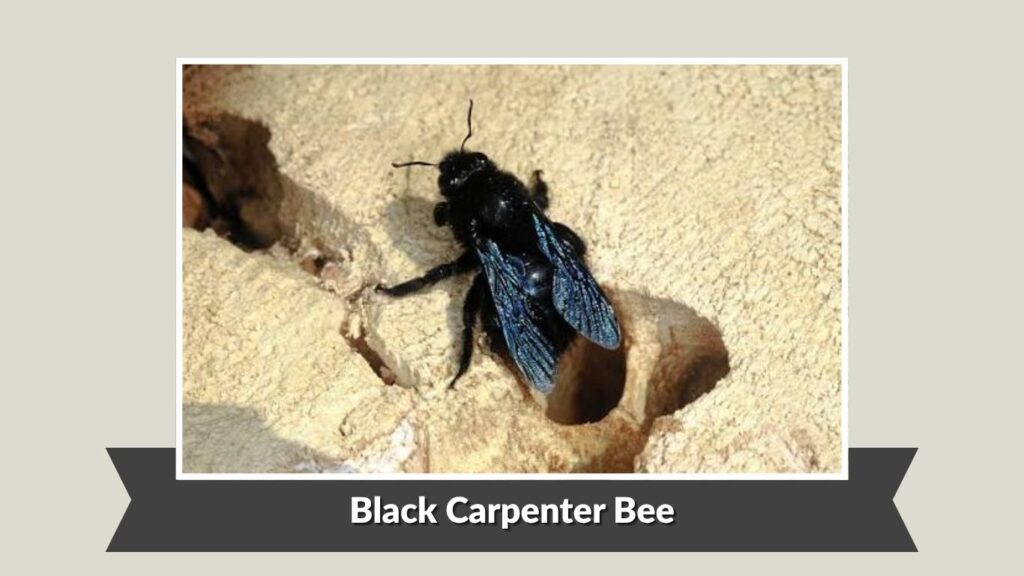
The Black Carpenter Bee is a large black flying bug that looks like a wasp because of its robust body, dark wings, and loud buzzing sound. These bees belong to the Apidae family and are commonly observed around gardens, wooden structures, and flowering plants. Some species have entirely black bodies with metallic blue or purple reflections, making them resemble large black wasps.
Identification
Black Carpenter Bees have several distinctive physical characteristics that help distinguish them from wasps.
- Size: Many larger species measure approximately 15–30 mm (0.6–1.2 inches) long.
- Body Color: Mostly black, sometimes with metallic blue, purple, or green reflections.
- Wings: Dark, smoky wings that may appear bluish or violet in sunlight.
- Body Shape: Large, robust body with a relatively broad connection between the thorax and abdomen.
- Abdomen: Often smooth, shiny, and less hairy than a bumblebee’s abdomen.
- Antennae: Short, segmented antennae.
- Stinger: Females possess stingers, while males cannot sting.
Habitat and Distribution
Black Carpenter Bees occur in many parts of the world, including Asia, Africa, Europe, and North America, depending on the species.
They commonly inhabit forests, gardens, orchards, and residential areas containing suitable wooden nesting surfaces.
Many species excavate tunnels in dead wood, bamboo, or wooden structures to construct nesting chambers.
Behavior and Diet
Black Carpenter Bees primarily feed on flower nectar and pollen. They are important pollinators for many flowering plants.
Female bees construct nesting tunnels and provide pollen and nectar mixtures for their developing offspring.
Males may hover near people or defend territories against other insects, but they cannot sting.
Females are generally nonaggressive unless threatened or handled.
Lifespan and Life Cycle
Black Carpenter Bees develop through egg, larva, pupa, and adult stages.
Females lay eggs inside individual nesting chambers containing food provisions. After hatching, larvae consume the stored pollen and nectar before pupating.
Development time varies by species and environmental conditions.
Some carpenter bees survive for several months, and certain species may live for approximately a year.
14. Black Clearwing Moth (Amata spp.)
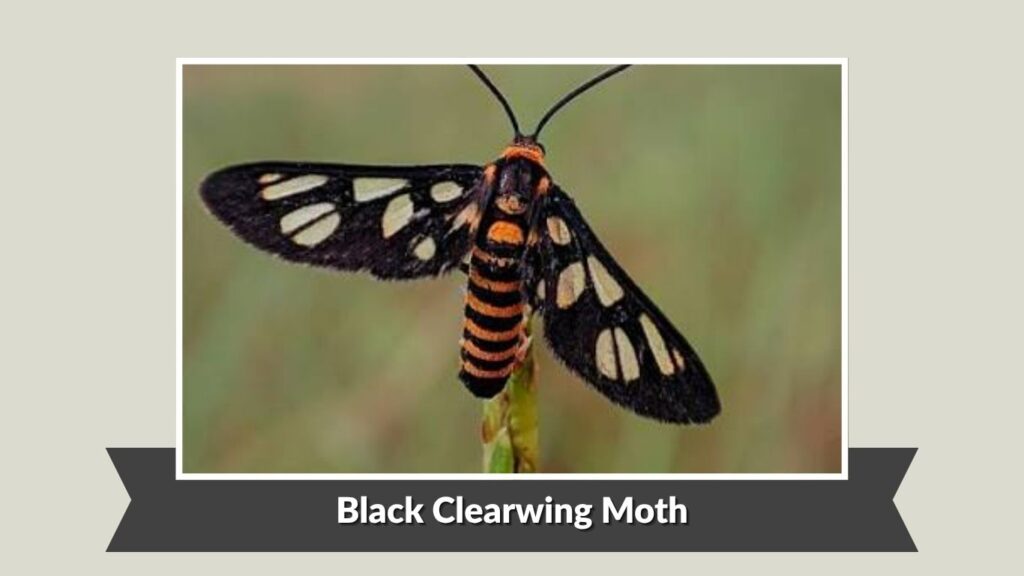
The Black Clearwing Moth is a black flying insect that looks like a wasp because of its narrow abdomen, transparent wing patches, and contrasting body markings. Several species in the genus Amata closely imitate wasps, making them difficult to identify at first glance. These insects belong to the Erebidae family and are harmless moths rather than stinging wasps.
Identification
Black Clearwing Moths have several distinctive characteristics that help distinguish them from actual wasps.
- Size: Many species have wingspans of approximately 20–40 mm (0.8–1.6 inches).
- Body Color: Predominantly black with yellow, orange, or pale abdominal bands.
- Wings: Dark wings featuring distinctive transparent patches.
- Body Shape: Slender, elongated body with a wasp-like appearance.
- Antennae: Dark antennae that may be slightly thickened or comb-like.
- Legs: Relatively slender legs, often dark or partially colored.
- Stinger: No stinger, making these moths harmless to humans.
Habitat and Distribution
Black Clearwing Moths in the genus Amata occur across various regions of Asia, Africa, Australia, and Europe, depending on the species.
They commonly inhabit grasslands, woodland edges, gardens, tropical vegetation, and areas containing flowering plants.
Adults are frequently observed resting on leaves or visiting flowers during daylight hours.
Behavior and Diet
Unlike actual wasps, Black Clearwing Moths do not hunt insects or construct nests.
Adults commonly feed on flower nectar and may contribute to pollination.
Their transparent wing patches and contrasting abdominal bands create a convincing resemblance to stinging wasps. This protective resemblance is known as Batesian mimicry.
The caterpillars feed on vegetation, although preferred host plants differ among species.
Lifespan and Life Cycle
Black Clearwing Moths undergo complete metamorphosis through egg, caterpillar, pupa, and adult stages.
Females deposit eggs on suitable host plants. After hatching, caterpillars feed on vegetation and grow through several developmental stages.
Mature caterpillars eventually pupate before emerging as adult moths.
Development time varies depending on species, climate, food availability, and seasonal conditions.
15. Blue Orchard Mason Bee (Osmia lignaria)
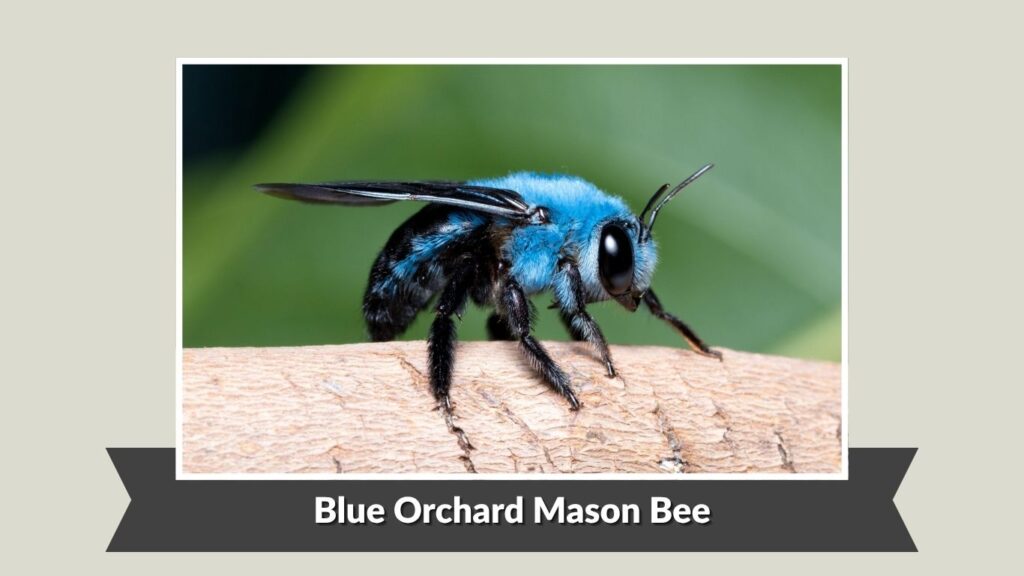
The Blue Orchard Mason Bee is a small black flying bug that looks like a wasp because of its compact body, metallic blue-black coloration, and quick flight. This solitary bee belongs to the Megachilidae family and is native to North America. Unlike social wasps, it does not establish large defensive colonies. Instead, it is an important pollinator of spring-flowering fruit trees.
Identification
The Blue Orchard Mason Bee has several distinctive physical features that help distinguish it from black wasps.
- Size: Adults generally measure approximately 9–14 mm (0.35–0.55 inches) long.
- Body Color: Metallic blue-black with occasional greenish reflections.
- Wings: Transparent to slightly smoky wings.
- Body Shape: Compact, robust body without a narrow wasp-like waist.
- Head: Relatively broad head with strong mandibles.
- Antennae: Short, dark, segmented antennae.
- Pollen-Carrying Structure: Females carry pollen in specialized hairs underneath the abdomen.
- Stinger: Females can sting but rarely do so unless trapped or handled.
Habitat and Distribution
Blue Orchard Mason Bees occur throughout substantial parts of North America, particularly in regions containing suitable flowering trees and nesting cavities.
They commonly inhabit orchards, gardens, woodland edges, and areas containing spring-blooming flowers.
Unlike carpenter bees, these mason bees generally do not excavate tunnels in solid wood. Instead, they occupy existing cavities, hollow stems, and artificial nesting tubes.
Behavior and Diet
Blue Orchard Mason Bees primarily feed on flower nectar and pollen. They are particularly valuable for pollinating apple, cherry, pear, and other fruit trees.
Females construct individual nesting chambers inside narrow cavities, using mud to separate each chamber.
They provision these chambers with pollen and nectar before depositing eggs.
Although females possess stingers, these solitary bees are usually gentle and rarely sting humans.
Lifespan and Life Cycle
Blue Orchard Mason Bees undergo complete metamorphosis through egg, larva, pupa, and adult stages.
Females lay eggs inside mud-partitioned nesting chambers containing pollen provisions.
The larvae consume the stored food before developing into pupae and eventually adults.
New adults typically remain inside their protective cocoons during winter and emerge the following spring.
FAQs
1. What Is a Black Flying Bug That Looks Like a Wasp?
A black flying bug that looks like a wasp could be a Black Soldier Fly, Black Mydas Fly, Black Robber Fly, or Black Carpenter Bee. These insects often have dark bodies, smoky wings, and elongated shapes that resemble wasps. However, their behavior, antennae, wing structure, and body characteristics help distinguish them.
2. What Is a Big Black Flying Bug That Looks Like a Wasp?
Large black wasp-like insects include Black Mydas Flies, Black Horse Flies, Black Robber Flies, and Black Carpenter Bees. Some measure more than an inch long and have dark wings and powerful flight. Black Horse Fly females can bite, while Black Mydas Flies do not sting or bite humans.
3. What Is a Small Black Wasp-Like Insect in the House?
A small black wasp-like insect inside a house might be a Black Soldier Fly, hoverfly, or solitary bee that entered through an open window or door. Identification depends on its size, wing structure, antennae, and body markings. Occasional indoor sightings do not necessarily indicate an infestation.
4. Are Black Flying Bugs That Look Like Wasps Dangerous?
Most black wasp-like flying insects are not dangerous to humans. Black Soldier Flies, hoverflies, and clearwing moths cannot sting. However, female horse flies can deliver painful bites, robber flies may bite when handled, and female carpenter bees can sting if provoked. Avoid handling unidentified insects directly.
5. How Can You Tell a Black Wasp From a Black Wasp-Like Insect?
Examine the insect’s wings, antennae, waist, and body structure. True wasps have two pairs of wings, although these may be difficult to distinguish, and many possess narrow waists. Flies have only one functional pair of wings, while beetles have hardened wing covers. Moths usually have scaled wings, and bees generally have hairier bodies adapted for carrying pollen.
