

Every summer, June bugs appear in droves, buzzing noisily around porch lights and gardens. Because of their size, shape, and color, they’re often confused with other beetles and flying insects — from Japanese beetles to cockroaches and cicadas. While they share similarities, each species has distinct features. Understanding these differences helps in proper identification and control.
June Bug vs Japanese Beetle

Appearance and Identification
June bugs are typically brown or dark reddish in color with an oval, robust body. They range from ½ to 1 inch long and have a matte or slightly glossy shell. Japanese beetles, by contrast, are smaller — about ⅜ inch — and display a striking metallic green body with shiny copper wings.
June bugs are active at night, flying clumsily toward lights, whereas Japanese beetles are daytime feeders, most visible during sunny mornings on flowers and fruit plants.
Feeding and Plant Damage
While both species feed on plants, their damage patterns differ. June bugs chew on leaves and feed on grass roots, damaging lawns from below. Japanese beetles skeletonize leaves by eating the tissue between veins, leaving a lace-like pattern.
Japanese beetles also feed in groups, stripping flowers, shrubs, and fruit trees rapidly. June bugs, on the other hand, are solitary feeders that rarely cause severe visible defoliation.
Larvae and Grub Comparison
Both insects have white, C-shaped grubs that live underground. June bug larvae are larger and feed on grass and crop roots for nearly a year. Japanese beetle grubs are smaller, spending about 10 months in soil before emerging as adults.
| Feature | June Bug | Japanese Beetle |
| Color | Brown or greenish | Metallic green & copper |
| Size | ½ – 1 inch | ⅜ inch |
| Active Time | Night | Day |
| Feeding Area | Roots & leaves | Flowers & foliage |
| Larval Stage | 10–11 months | 9–10 months |
| Group Feeding | Rare | Common |
The easiest way to tell them apart is by time of day — Japanese beetles fly under sunlight, June bugs after dark.
May Beetle vs June Bug

Are They the Same?
The terms May beetle and June bug often refer to the same insects — members of the Phyllophaga genus. The name depends on the region and local climate. In warmer areas, adults emerge in May, while cooler regions see them in June, giving rise to the dual naming.
Color and Timing
May beetles and June bugs are both brown, sturdy, and oval-bodied, but timing marks the difference. May beetles appear slightly earlier and complete their life cycle a bit faster. Both are nocturnal, attracted to artificial lights, and lay eggs in soft soil.
Their larvae, known as white grubs, are responsible for the majority of lawn damage, consuming grass roots and leaving yellow patches behind.
Brown vs Green June Bugs
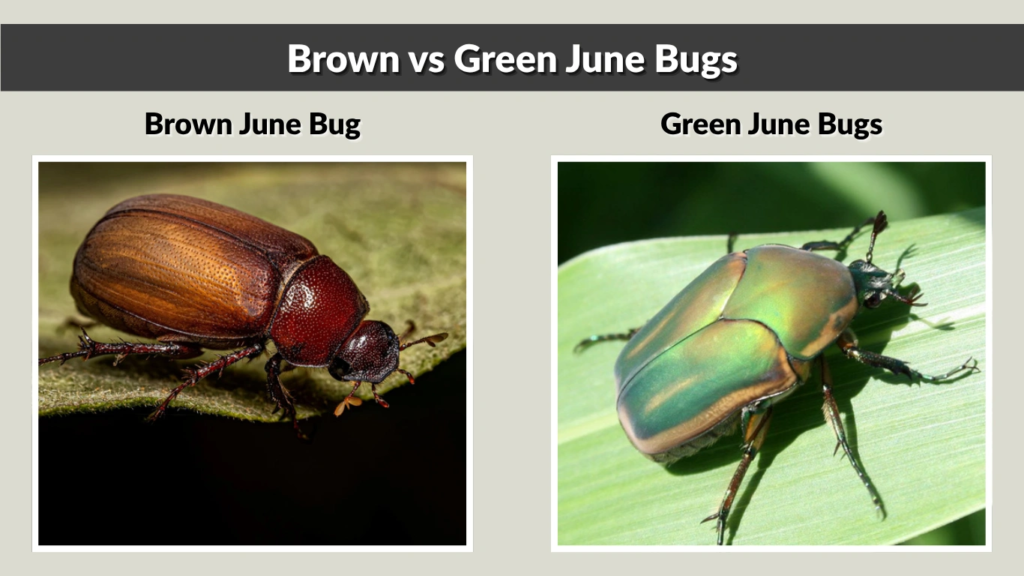
Color and Habitat
Not all June bugs are brown. The green June beetle (Cotinis nitida) is a bright, metallic-green version often mistaken for Japanese beetles. Green June bugs are larger and active during the day, buzzing around fruit trees and compost piles. Brown June bugs (Phyllophaga spp.) prefer nighttime activity and dwell in grassy or agricultural areas.
Behavioral Differences
Green June bugs fly smoothly and noisily, while brown June bugs are slower, bumping into lights and windows. Green June bugs feed mainly on ripe fruits, sap, and decaying matter, whereas brown ones chew on leaves and grass.
| Feature | Brown June Bug | Green June Bug |
| Color | Dull brown / reddish | Metallic green |
| Active Time | Night | Day |
| Flight | Clumsy | Smooth and loud |
| Diet | Roots & leaves | Fruits & sap |
| Habitat | Grasslands & soil | Orchards & compost areas |
Recognizing these differences prevents confusion with Japanese beetles or fig beetles, which share similar coloration.
June Bug vs Cockroach
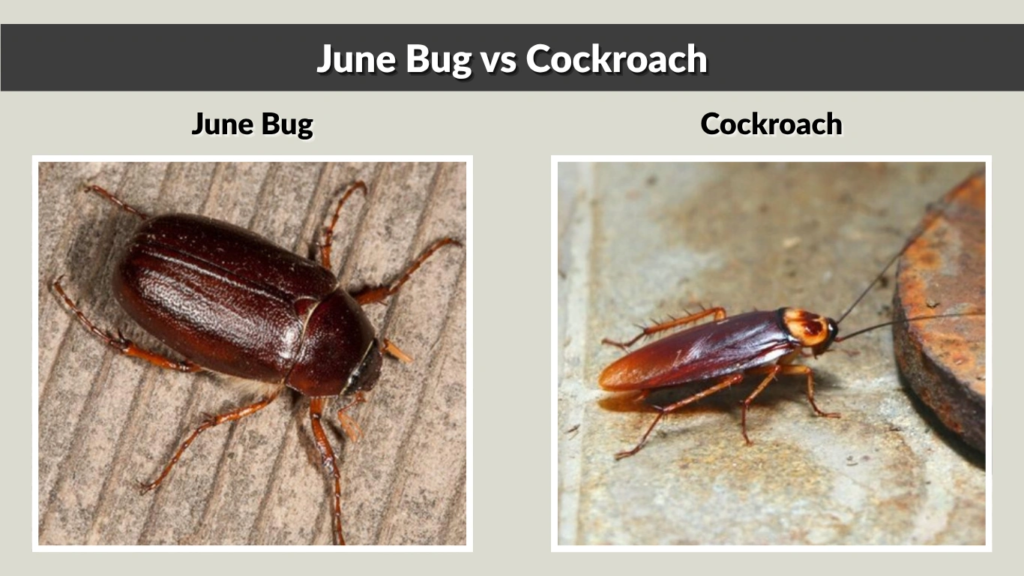
Appearance and Structure
June bugs and cockroaches look alike at a glance — both are brown and winged — but their bodies differ. June bugs are round and compact with hard wing covers, while cockroaches have flat, flexible bodies built for hiding.
Cockroaches have long antennae and move quickly on foot. June bugs have shorter antennae and slower, lumbering movement. Cockroaches avoid light, whereas June bugs are strongly drawn to it.
Behavior and Habitat
June bugs live outdoors and surface mostly at night in summer. They’re harmless to humans and don’t infest homes. Cockroaches, however, thrive indoors, hiding in kitchens, drains, and dark corners.
If a brown insect flies toward a light and bumps into you, it’s a June bug — not a roach. The main visual clue is the thick, rounded shell and the lack of scurrying movement typical of roaches.
June Bug vs Cicada
Sound and Behavior
Cicadas are well known for their loud, rhythmic buzzing, while June bugs create only a dull droning sound during flight. Cicadas use special vibrating organs called tymbals to produce their chorus, especially during hot afternoons. June bugs lack such organs; the buzzing comes from their wings.
Cicadas are active during the day, and their calls mark summer’s peak. June bugs are night flyers, silent except for their clumsy collisions with surfaces.
Appearance
Cicadas are larger, measuring 1–2 inches long, with transparent, veined wings held roof-like over the body. June bugs are smaller, with opaque brown shells that cover their flight wings.
| Feature | June Bug | Cicada |
| Size | ½ – 1 inch | 1 – 2 inches |
| Sound | Buzzing flight | Loud mating call |
| Active Time | Night | Day |
| Wings | Hard shell cover | Clear membranous |
| Lifespan | 1 year | 13–17 years (certain species) |
While cicadas emerge in massive broods once every few years, June bugs appear annually — a dependable sign of early summer.
June Bug vs Other Beetles

Fig Beetle and Figeater Beetle
The fig beetle (Cotinis mutabilis), also called the figeater beetle, is often mistaken for a June bug due to its shiny green body. However, fig beetles are larger and more iridescent, with metallic green or gold coloration and reddish undersides.
While brown June bugs are clumsy nocturnal fliers, fig beetles are strong daytime flyers. They are also less destructive, preferring overripe fruit and nectar to living plants. If you see a large green beetle buzzing loudly around figs or fruit trees during daylight, it’s likely a fig beetle, not a June bug.
Chafer and Scarab Beetles
Both June bugs and chafer beetles belong to the Scarabaeidae family, making them close relatives. Chafer beetles are typically smaller and more golden in color, with softer shells. They are active in early summer and are serious lawn pests in their larval stage.
Scarab beetles, on the other hand, represent a broader family that includes dung beetles, June bugs, and Japanese beetles. The main difference is ecological: while scarabs recycle organic matter, June bugs are more plant-oriented, feeding on roots and leaves.
Christmas and Grapevine Beetles
The Christmas beetle, native to Australia, resembles a large, glossy June bug but emerges in December during their summer. The grapevine beetle (Pelidnota punctata) is another look-alike with a yellow-tan shell dotted with black spots. It’s harmless to most plants and primarily feeds on grapevine leaves.
Though they share similar shapes, these beetles are more regional variants than true relatives of the North American June bug.
June Bug vs Household Insects

June Bug vs Stink Bug
At a glance, stink bugs and June bugs may look similar in color, but their body shapes are entirely different. Stink bugs are shield-shaped, flat, and release a foul odor when threatened. June bugs are oval, rounded, and have no smell.
Behaviorally, stink bugs feed on plant sap and fruit juices, leaving discolored patches on produce. June bugs chew on leaves but don’t pierce plant surfaces. Stink bugs often invade homes seeking warmth, while June bugs rarely enter unless attracted by bright lights.
June Bug vs Ladybug and Firefly
Ladybugs and fireflies (lightning bugs) are smaller, softer-bodied, and beneficial to ecosystems. Ladybugs are brightly colored with black spots, feeding on aphids. Fireflies emit bioluminescent light during summer evenings.
June bugs lack both bright color and light-producing ability. They are larger, heavier, and make a distinct droning sound during flight. This simple observation — size, color, and light — easily distinguishes June bugs from ladybugs and fireflies.
June Bug vs Palmetto and Water Bug
The palmetto bug, a large southern cockroach species, is often mistaken for a flying June bug. However, palmetto bugs are flatter, faster, and prefer indoor or damp environments. June bugs are slower and live outdoors.
Water bugs, in contrast, are aquatic predators that bite and feed on other insects. June bugs neither swim nor bite — they are harmless to people and pets.
So if you find a brown insect near your porch light rather than your sink or bathroom, it’s most likely a June bug.
Sound, Flight, and Behavior
Why June Bugs Fly Clumsily
June bugs’ flight often appears chaotic because of their body structure. Their large, heavy shells and small wings make controlled flight difficult. Combined with poor night vision, this results in frequent midair collisions.
They’re also strongly attracted to light, a behavior called positive phototaxis. Artificial lighting confuses their navigation, causing them to spiral or crash repeatedly into windows and bulbs.
Noise Differences
Unlike cicadas, June bugs cannot produce deliberate sounds. The faint buzzing you hear comes from their wing vibrations. Cicadas use special organs called tymbals to create their famous, high-pitched calls.
This difference explains why June bugs are often heard only when flying close, while cicadas fill entire neighborhoods with their droning chorus.
Seasonal Timing
June bugs typically appear from May through early July, depending on the region. Japanese beetles and cicadas emerge slightly later, in mid to late summer. Because of this timing overlap, many people mistake one for the other.
If the insect appears early in summer, brown in color, and attracted to lights — it’s a June bug. If it’s green and metallic on roses by day, that’s a Japanese beetle. If it screams from trees in August, it’s a cicada.
FAQs
Are June bugs and Japanese beetles the same?
No. While both belong to the scarab family, Japanese beetles are smaller, metallic green, and active during the day. June bugs are larger, brown, and nocturnal. Their larvae also differ, with Japanese beetle grubs feeding closer to the soil surface.
Do June bugs make loud sounds like cicadas?
No. June bugs can only produce a faint droning sound with their wings. Cicadas, on the other hand, have specialized organs that create loud, rhythmic calls used to attract mates.
Are May beetles and June bugs different insects?
They’re actually the same genus — Phyllophaga. The difference lies mainly in timing. In warmer climates, they appear in May, while in cooler areas, they emerge in June.
Can June bugs infest homes like cockroaches?
No. June bugs live outdoors and are drawn to light, not food waste. They may accidentally enter homes through open windows but cannot reproduce indoors or cause infestations.
How can I tell a June bug from other beetles?
Look for size, behavior, and timing. June bugs are larger, brown, and active at night. They fly clumsily toward lights and appear in early summer. Other beetles, like Japanese or fig beetles, are metallic and usually active during daylight.
