

Bees are among the most important creatures on our planet, playing a vital role in pollination, biodiversity, and agriculture. With over 20,000 known species worldwide, bees come in many shapes, sizes, and behaviors, far beyond the familiar honeybee. Each type of bee has unique characteristics, nesting habits, and ecological importance.
In this guide, we’ll explore 25 different types of bees—from the common honeybee and bumblebee to fascinating specialists like orchid bees and squash bees. For each, you’ll find details on identification, habitat, behaviors, importance, diet, and fun facts to help you better understand and appreciate these remarkable insects.
1. Honeybee

Honeybees (Apis mellifera) are one of the most well-known and economically important insects in the world. They are famous for their role in pollination and for producing honey and beeswax. Social in nature, honeybees live in large colonies with a complex caste system.
Identification
- Medium-sized bee, about 12–15 mm long
- Golden-yellow color with black bands
- Hairy body to help collect pollen
- Slender, elongated shape compared to bumblebees
- Transparent wings that overlap when resting
Habitat
Honeybees are found worldwide but thrive in warm and temperate climates. They live in man-made hives, hollow trees, or rock crevices. Beekeepers maintain colonies in managed wooden hives for honey and pollination services.
Behaviors
Honeybees are eusocial insects, meaning they live in highly organized colonies with a queen, workers, and drones. They communicate using the famous “waggle dance,” which tells other bees the direction and distance of nectar sources. Honeybees are also defensive of their hives and will sting when threatened.
Reason (Importance)
Honeybees are vital for agriculture and ecosystems. About one-third of human food depends on pollination, and honeybees are the most important managed pollinators. They contribute billions of dollars to the global economy through pollination services.
Diet & Facts
Honeybees feed primarily on nectar and pollen. Nectar is converted into honey, which is stored as a food source for the colony. Pollen provides proteins and other nutrients.
Fun facts:
- A single bee produces about 1/12 of a teaspoon of honey in its lifetime.
- The queen bee can lay up to 2,000 eggs per day.
- Honey is the only insect-produced food eaten by humans on a large scale.
2. Bumblebee

Bumblebees (Genus Bombus) are large, fuzzy pollinators known for their buzzing sound and critical role in agriculture. They are less aggressive than honeybees and thrive in cooler climates.
Identification
- Large, round, and fuzzy body
- Black and yellow banded coloration
- Broad wings compared to body size
- Hair-covered legs for pollen collection
- Slow, loud buzzing flight
Habitat
Bumblebees prefer temperate regions and are commonly found in meadows, gardens, and farmland. They often nest underground in abandoned rodent burrows, grassy tussocks, or in compost heaps.
Behaviors
Bumblebees live in smaller colonies than honeybees, usually between 50–500 individuals. They are capable of “buzz pollination,” vibrating flowers to release pollen, which is vital for crops like tomatoes and blueberries. They are also more tolerant of cold weather, allowing them to forage earlier and later in the day.
Reason (Importance)
Bumblebees are essential for pollination, especially in crops that honeybees cannot pollinate effectively. Their ability to work in cooler climates makes them invaluable in northern agricultural regions.
Diet & Facts
Bumblebees feed on nectar for energy and collect pollen to feed larvae.
Fun facts:
- Bumblebees can regulate their body temperature by shivering their flight muscles.
- Unlike honeybees, they do not store large amounts of honey.
- Only queens survive the winter to start new colonies.
3. Carpenter Bee
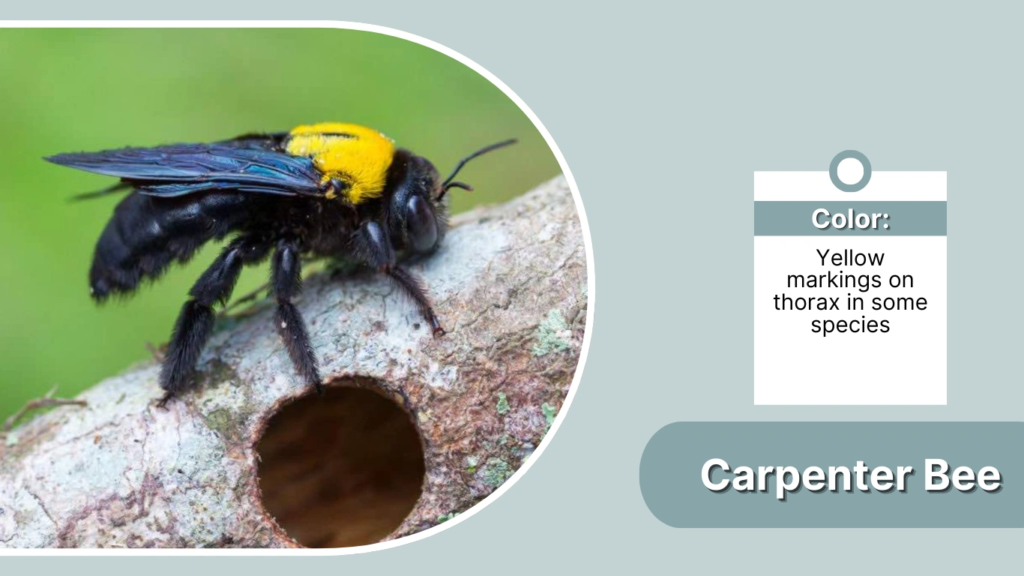
Carpenter bees (Genus Xylocopa) are solitary bees known for nesting in wood rather than living in large colonies. They are strong pollinators but often mistaken for bumblebees due to their size and appearance.
Identification
- Large, robust body resembling bumblebees
- Shiny, hairless black abdomen (unlike fuzzy bumblebees)
- Yellow markings on thorax in some species
- Strong mandibles for boring into wood
- Wings with a metallic sheen
Habitat
Carpenter bees are found worldwide in temperate and tropical regions. They prefer dry wood such as eaves, decks, fences, and tree trunks for nesting, often drilling tunnels to lay eggs.
Behaviors
They are solitary, with females boring tunnels into wood to create brood chambers. Males are territorial and may hover near nests but cannot sting. Carpenter bees are important pollinators, though they sometimes “rob nectar” by cutting holes in flowers instead of pollinating.
Reason (Importance)
Carpenter bees are important pollinators for many wild plants and crops. However, their nesting habits can cause structural damage to wooden buildings, making them both beneficial and a nuisance.
Diet & Facts
Carpenter bees consume nectar and pollen.
Fun facts:
- Only females can sting, and they rarely do unless provoked.
- Tunnels made in wood can be reused for generations.
- Males often “guard” a territory but are harmless.
4. Leafcutter Bee

Leafcutter bees (Genus Megachile) are solitary bees recognized for cutting circular pieces of leaves or petals to construct their nests. They are efficient pollinators and often used in agriculture.
Identification
- Medium-sized bees, about the size of honeybees
- Dark-colored with light bands on the abdomen
- Strong jaws for cutting leaves
- Hairy underside of the abdomen for carrying pollen (not legs)
- Fast and darting flight pattern
Habitat
Leafcutter bees live in temperate and tropical regions, often nesting in soil, rotting wood, or hollow plant stems. They line their nests with neatly cut leaf or petal pieces, forming chambers for their larvae.
Behaviors
Solitary in nature, females build and provision their own nests. They cut precise circles from leaves or petals and use them to create brood cells. These bees are non-aggressive and excellent pollinators of crops like alfalfa.
Reason (Importance)
They are vital for pollinating many wildflowers and crops. Farmers often encourage leafcutter bees because they are far more effective than honeybees in pollinating certain plants.
Diet & Facts
Leafcutter bees feed on nectar and collect pollen for their young.
Fun facts:
- They can carry pollen equivalent to their own body weight.
- They do not eat the leaves they cut.
- Farmers use them commercially to pollinate alfalfa fields.
5. Mason Bee

Mason bees (Genus Osmia) are solitary bees that use mud, clay, or resin to construct their nests. They are gentle and highly efficient pollinators, often used in gardens and orchards.
Identification
- Small to medium-sized, similar to honeybees
- Metallic blue, green, or black coloration
- Compact and robust body
- Pollen carried on abdominal hairs
- Lack the “striped” appearance of honeybees and bumblebees
Habitat
Mason bees prefer temperate regions and commonly nest in cracks, hollow reeds, drilled wooden blocks, or natural cavities. They use mud or clay to partition and seal their nest chambers.
Behaviors
They are solitary, with each female building her own nest. Mason bees are active in early spring, making them especially important for fruit tree pollination. They are very gentle and rarely sting.
Reason (Importance)
Mason bees are considered “super pollinators,” up to 100 times more effective than honeybees at pollinating fruit trees like apples, cherries, and plums.
Diet & Facts
Mason bees feed on nectar and collect pollen for their larvae.
Fun facts:
- A single mason bee can pollinate as much as 100 honeybees.
- They only live for a few weeks as adults in the spring.
- They are popular in backyard gardens due to their efficiency and gentle nature.
6. Sweat Bee

Sweat bees (Family Halictidae) are small, often metallic-colored bees that are attracted to human sweat for its salt content. They are one of the most diverse groups of bees worldwide.
Identification
- Small size (3–10 mm long)
- Metallic green, blue, or bronze coloration in many species
- Slender body with short tongues
- Less hairy than honeybees
- Often mistaken for flies due to size and sheen
Habitat
Sweat bees live in a wide range of environments, from forests to gardens and grasslands. Many species nest in the ground, while some use rotting wood or stems.
Behaviors
Most sweat bees are solitary, though some form small communal nests. They are generally non-aggressive but may land on people to lick sweat, sometimes causing a mild sting if disturbed.
Reason (Importance)
Sweat bees are crucial pollinators of wildflowers and crops. Their diversity makes them significant contributors to global pollination.
Diet & Facts
They feed on nectar and collect pollen for offspring.
Fun facts:
- Sweat bees are among the most common bees in the world.
- They are highly diverse, with over 3,000 known species.
- Their attraction to sweat provides them with essential salts.
7. Long-horned Bee

Long-horned bees (Tribe Eucerini) are named for the exceptionally long antennae found in males. They are solitary bees and important pollinators of wildflowers.
Identification
- Medium to large size (up to 20 mm)
- Males have very long antennae, often longer than their bodies
- Fuzzy thorax, with banded abdomen
- Strong, fast flyers
- Similar in appearance to honeybees but with distinct antennae
Habitat
They inhabit meadows, grasslands, and gardens, often nesting in the ground. They are most active in late summer when wildflowers are abundant.
Behaviors
Long-horned bees are solitary, with females digging burrows in the ground for nesting. Males often gather in groups on flowers at night, forming “sleeping clusters.”
Reason (Importance)
They play an important role in pollinating late-blooming wildflowers and crops such as sunflowers, making them significant for biodiversity and agriculture.
Diet & Facts
Long-horned bees feed on nectar and gather pollen for larvae.
Fun facts:
- Males’ long antennae help them locate females.
- Some species specialize in pollinating particular plants.
- They are among the most striking bees due to their antennae clusters.
8. Mining Bee

Mining bees (Genus Andrena) are solitary ground-nesting bees commonly found in spring. They are harmless to humans and essential pollinators for many plants.
Identification
- Small to medium size (8–17 mm)
- Brown or black with pale hairs
- Slender body, less robust than bumblebees
- Females have noticeable pollen-collecting hairs on hind legs
- Often mistaken for small honeybees
Habitat
Mining bees prefer sandy or loose soil where females dig burrows to lay eggs. They are often found in gardens, lawns, meadows, and woodland edges, creating small volcano-like soil mounds at nest entrances.
Behaviors
Each female makes her own nest, though many mining bees nest close together in colonies. They are active mainly in spring and are non-aggressive, rarely stinging.
Reason (Importance)
Mining bees are vital for early spring pollination, especially of fruit trees like apples and cherries, which bloom when honeybee activity is still low.
Diet & Facts
They feed on nectar and collect pollen for their larvae.
Fun facts:
- Over 1,500 species of mining bees exist worldwide.
- They are among the first bees seen each year.
- Their burrows are shallow and usually not harmful to lawns.
9. Squash Bee

Squash bees (Genera Peponapis and Xenoglossa) are specialist pollinators that primarily visit squash, pumpkins, and gourds. They are solitary and highly efficient for these crops.
Identification
- Similar in size to honeybees
- Fuzzy thorax with striped abdomen
- Females carry pollen on leg hairs
- Wings slightly darker than honeybees
- Active very early in the morning
Habitat
Squash bees nest in the ground, usually near squash or pumpkin fields. They prefer loose, sandy soil and are commonly found in North and Central America.
Behaviors
These bees are solitary, with each female building her own nest. They begin foraging at dawn, often before honeybees are active, and specialize in pollinating squash blossoms.
Reason (Importance)
Squash bees are the most effective pollinators of squash, pumpkins, and gourds, often outperforming honeybees. Farmers rely on them for crop success.
Diet & Facts
They feed almost exclusively on pollen and nectar from squash-family plants.
Fun facts:
- Males often sleep inside squash blossoms overnight.
- Squash bees can pollinate a field of pumpkins more efficiently than honeybees.
- They are active only during the flowering season of squash plants.
10. Cuckoo Bee

Cuckoo bees (Nomadinae subfamily and related groups) are parasitic bees that lay their eggs in the nests of other bee species, similar to how cuckoo birds behave. They do not build nests or collect pollen.
Identification
- Small to medium-sized, often slender
- Brightly colored or metallic (red, blue, or black)
- Sparse body hair compared to other bees
- Resemble wasps in appearance
- Females lack pollen-collecting hairs
Habitat
Cuckoo bees live wherever their host bees are found. They occupy diverse environments, from meadows and gardens to woodlands and sandy soils, depending on the host species.
Behaviors
Instead of making nests, females invade the nests of other bees, laying eggs inside. The cuckoo bee larva often kills the host’s offspring and consumes the food provisions. They are solitary and do not form colonies.
Reason (Importance)
Though parasitic, cuckoo bees play a role in maintaining ecological balance by controlling populations of their host species. They also showcase fascinating evolutionary strategies.
Diet & Facts
They feed on nectar as adults but rely on host-provided pollen for larvae.
Fun facts:
- Cuckoo bees are sometimes mistaken for wasps due to their sleek look.
- They make up about 20% of all bee species.
- Their parasitism reduces competition among bee populations.
11. Orchid Bee

Orchid bees (Tribe Euglossini) are brightly colored tropical bees famous for their unique relationship with orchids. Males collect fragrances from orchids, which they use to attract mates.
Identification
- Medium-sized, metallic green, blue, or purple body
- Shiny and hairless appearance
- Long tongue, sometimes longer than body
- Strong, fast fliers
- Males carry special structures on their legs for fragrance storage
Habitat
Orchid bees are found mainly in Central and South America, inhabiting tropical forests rich in orchids. They are key pollinators in these ecosystems.
Behaviors
Males collect and mix floral fragrances from orchids, which are later used in mating displays. Females build solitary nests in cavities, using resin and mud. Orchid bees are strong fliers and can travel long distances to forage.
Reason (Importance)
They are critical pollinators of orchids and many tropical plants, maintaining rainforest biodiversity. Without them, many orchid species could not reproduce.
Diet & Facts
They consume nectar for energy and gather pollen for larvae.
Fun facts:
- Some orchid bee species can fly up to 45 km in a single trip.
- Orchids have evolved specialized shapes that only orchid bees can pollinate.
- Males’ fragrance-collecting behavior is unique among bees.
12. Blue Banded Bee

Blue banded bees (Amegilla cingulata) are striking bees native to Australia, recognized by their beautiful blue stripes. They are excellent pollinators, especially for crops requiring buzz pollination.
Identification
- Medium-sized, about 10–12 mm long
- Metallic blue bands across the abdomen
- Brown thorax with fine hairs
- Large, transparent wings
- Males often rest clinging to twigs at night
Habitat
They are commonly found in Australia and parts of Southeast Asia, inhabiting gardens, farms, and open woodlands. They nest in soil, soft mortar, or mud-brick walls.
Behaviors
Blue banded bees are solitary and do not form colonies. They specialize in buzz pollination, vibrating flowers to release pollen, which benefits crops like tomatoes, eggplants, and chilies. Males are known for their roosting clusters on plant stems at night.
Reason (Importance)
They are among the most efficient native pollinators in Australia, making them vital for both wild plants and agriculture. They are increasingly studied as alternatives to honeybees in greenhouse farming.
Diet & Facts
They feed on nectar and gather pollen for their young.
Fun facts:
- Their buzz pollination makes them better than honeybees for certain crops.
- Males form unique sleeping clusters at night.
- They are fast fliers, darting quickly between flowers.
13. Alkali Bee
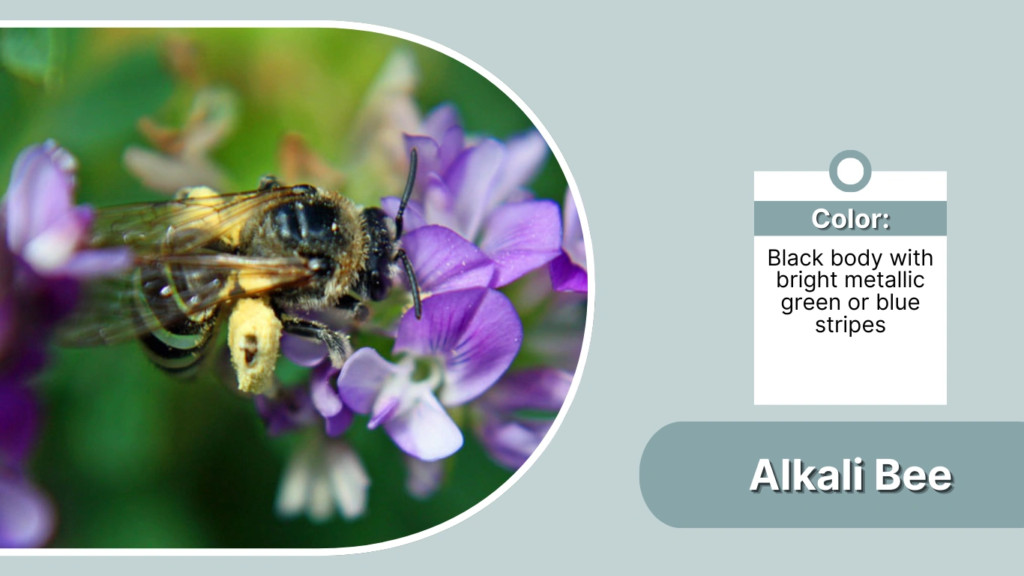
Alkali bees (Nomia melanderi) are ground-nesting bees native to western North America. They are famous for their role in pollinating alfalfa, a crucial crop for livestock feed.
Identification
- Medium-sized, about 8–10 mm long
- Black body with bright metallic green or blue stripes
- Narrow and sleek appearance
- Clear wings with dark veins
- Less hairy than honeybees
Habitat
They prefer alkaline soils, nesting in large underground aggregations. They thrive in arid regions and are often found near irrigated alfalfa fields. Farmers sometimes maintain special “bee beds” to support their populations.
Behaviors
Alkali bees are solitary, with females digging tunnels in the soil to lay eggs. They are highly efficient alfalfa pollinators, working during hot daytime hours when honeybees are less active.
Reason (Importance)
They are essential for alfalfa pollination, which supports the livestock industry worldwide. Their efficiency makes them economically significant in agriculture.
Diet & Facts
They feed on nectar and collect pollen, especially from alfalfa flowers.
Fun facts:
- One alkali bee can pollinate thousands of alfalfa flowers per day.
- They can nest in dense aggregations, with thousands of tunnels close together.
- Unlike honeybees, they rarely sting and are gentle around humans.
14. Wool Carder Bee

Wool carder bees (Anthidium manicatum) are solitary bees named for their habit of scraping plant fibers, or “wool,” to build their nests. They are known for their territorial males and distinctive nesting behavior.
Identification
- Medium-sized, about 11–14 mm long
- Black body with bright yellow markings
- Males are larger than females and more territorial
- Females carry pollen on hairs on the underside of the abdomen
- Quick, darting flight pattern
Habitat
They are widespread in Europe, North America, and other temperate regions. Wool carder bees nest in cavities such as hollow stems, cracks, and crevices, lining them with plant hairs collected from fuzzy-leaved plants like lamb’s ear.
Behaviors
Males are highly territorial and aggressively guard flower patches, chasing away rivals and even larger insects. Females collect wool-like plant fibers to build soft nest cells for their eggs.
Reason (Importance)
Wool carder bees are effective pollinators for many garden flowers and crops. Their unique nesting behavior also contributes to plant–pollinator interactions.
Diet & Facts
They feed on nectar, while larvae are provisioned with pollen and nectar.
Fun facts:
- Males patrol flowers like “guards,” attacking intruders mid-air.
- The collected plant hairs make nests soft and well-insulated.
- They are among the few bee species where males play a strong territorial role.
15. Resin Bee
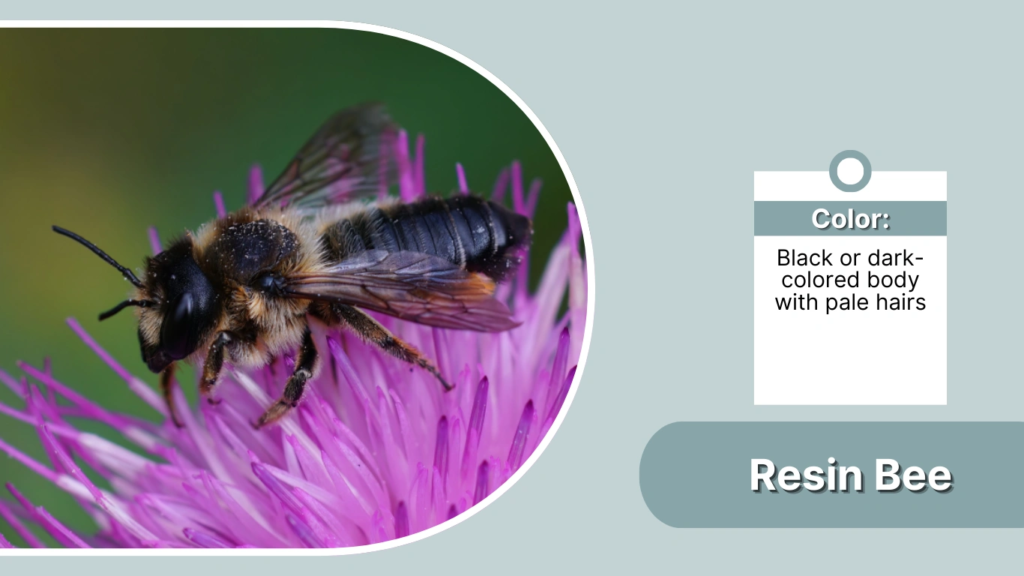
Resin bees (Genus Megachile and related groups) are solitary bees that use plant resin to construct and seal their nests. They are closely related to leafcutter bees but use resin instead of leaf pieces.
Identification
- Small to medium size, 6–14 mm long
- Black or dark-colored body with pale hairs
- Strong mandibles for collecting resin
- Females carry pollen on abdominal hairs
- Smooth, shiny exoskeleton compared to fuzzier bees
Habitat
Resin bees are found in many parts of the world, often nesting in pre-existing holes in wood, hollow stems, or man-made bee hotels. They seal and partition their brood cells using sticky plant resin.
Behaviors
Solitary in nature, each female constructs her own nest. They use resin as a waterproof, protective material for brood cells, which helps safeguard larvae from parasites and fungi.
Reason (Importance)
Resin bees are valuable pollinators in both natural ecosystems and gardens. Their resin-sealed nests help demonstrate the diversity of bee nesting strategies.
Diet & Facts
They feed on nectar and collect pollen for their offspring.
Fun facts:
- Resin is used to line, partition, and close nest entrances.
- They are frequent visitors to bee hotels.
- Their nesting material makes them resistant to pests compared to other cavity-nesting bees.
16. Yellow-Faced Bee
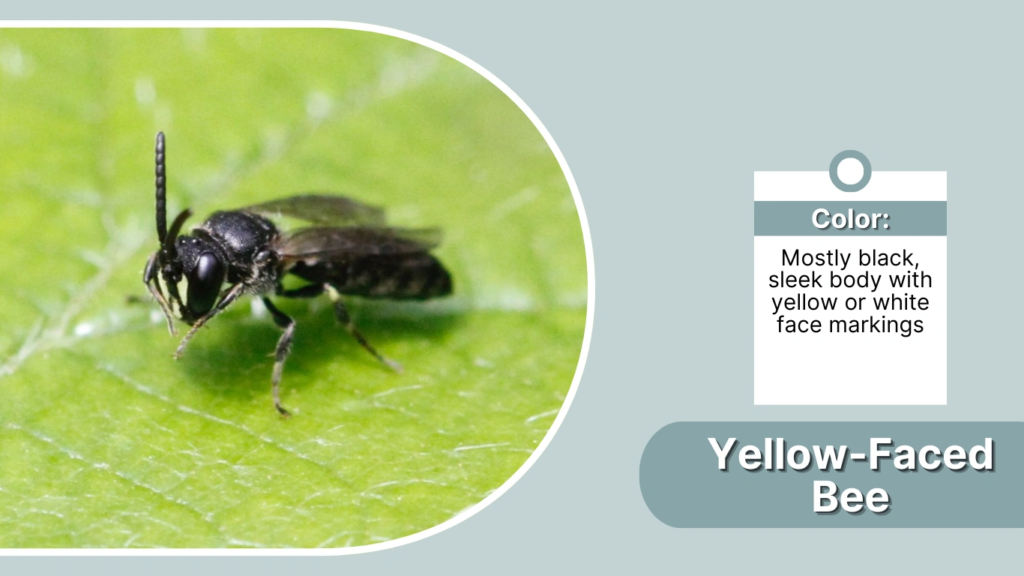
Yellow-faced bees (Genus Hylaeus) are small, wasp-like bees with distinctive yellow or white markings on their faces. Unlike many other bees, they do not carry visible pollen.
Identification
- Small size, usually 4–8 mm long
- Mostly black, sleek body with yellow or white face markings
- Few body hairs compared to other bees
- Slender, wasp-like appearance
- Lack external pollen baskets
Habitat
They are widespread across the world, with many species native to Hawaii, Australia, and North America. They nest in hollow stems, crevices, or small cavities, often sealing them with a cellophane-like substance.
Behaviors
Yellow-faced bees are solitary. Instead of carrying pollen on their bodies, they swallow it mixed with nectar and regurgitate it to feed their larvae. This makes them unique among bees.
Reason (Importance)
They play a crucial role in pollinating native plants, especially in Hawaii, where they are considered endangered. They help maintain fragile island ecosystems.
Diet & Facts
They feed on nectar and transport pollen internally for their young.
Fun facts:
- Some Hawaiian species are federally protected due to habitat loss.
- Their nests are lined with a clear, waterproof secretion, like plastic.
- Their wasp-like look helps deter predators.
17. Digger Bee

Digger bees (Family Anthophoridae and related groups) are solitary ground-nesting bees known for their strong burrowing abilities. They resemble honeybees but are typically larger and hairier.
Identification
- Medium to large size, up to 18 mm
- Hairy thorax with striped abdomen
- Long tongue for deep flowers
- Strong legs for digging
- Often mistaken for honeybees or bumblebees
Habitat
Digger bees prefer dry, sandy soils where they dig deep tunnels, sometimes up to a meter long. They are often found in deserts, meadows, or open fields.
Behaviors
They are solitary, but many females nest in large aggregations, creating “bee cities” of burrow entrances. Males hover near flowers or nest entrances to seek mates.
Reason (Importance)
Digger bees are important pollinators, particularly in arid ecosystems where few other pollinators thrive. Their burrowing also helps aerate soil.
Diet & Facts
They feed on nectar and collect pollen for their offspring.
Fun facts:
- Some species can dig burrows over 1 meter deep.
- They are among the first pollinators to appear in desert regions after rain.
- Males often patrol flowers in groups, waiting for emerging females.
18. Sand Bee
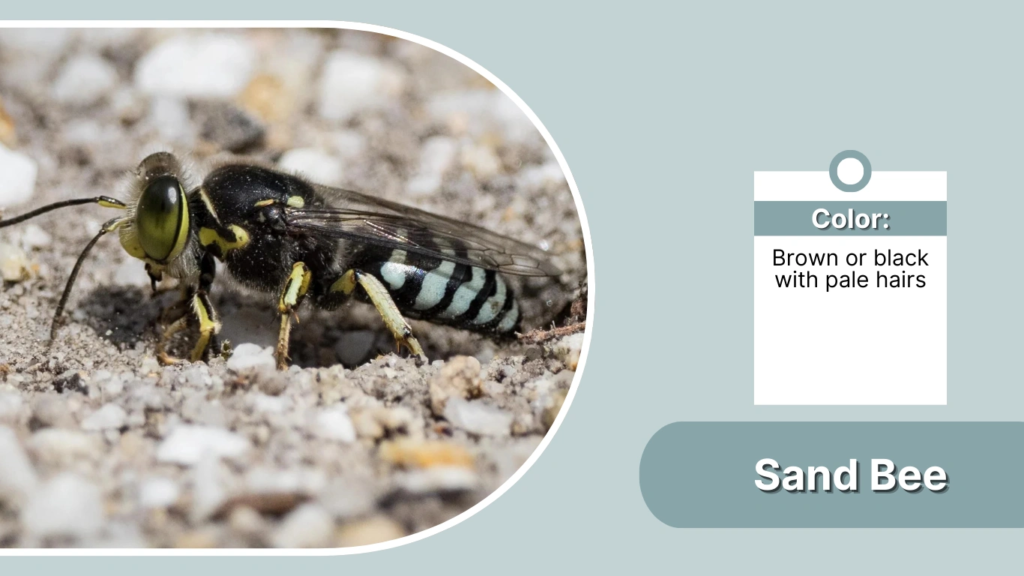
Sand bees (Genus Andrena, closely related to mining bees) are solitary ground-nesting bees that prefer sandy soils. They are among the earliest spring pollinators.
Identification
- Small to medium size, about 7–15 mm
- Brown or black with pale hairs
- Slender body shape
- Females have dense pollen-collecting hairs on hind legs
- Often confused with small honeybees
Habitat
They are commonly found in sandy areas such as dunes, heaths, and light soils in gardens or meadows. Females dig burrows in sandbanks or open soil, leaving small volcano-like mounds at entrances.
Behaviors
Sand bees are solitary, but many nest close together, forming loose colonies. They are very gentle and rarely sting. Their activity peaks in early spring when many fruit trees bloom.
Reason (Importance)
They are crucial pollinators for early-blooming plants and fruit trees, helping ecosystems and agriculture during the start of the growing season.
Diet & Facts
They feed on nectar and collect pollen for their larvae.
Fun facts:
- Some species specialize in pollinating certain plants.
- They are often the first bees seen after winter.
- Burrows can extend 30–60 cm into sandy soil.
19. Ashy Mining Bee
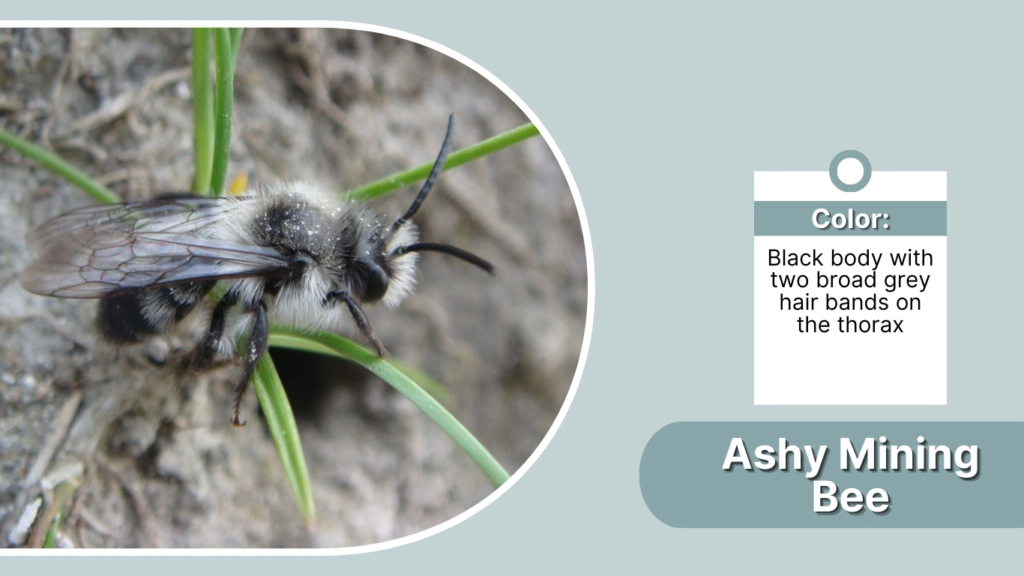
Ashy mining bees (Andrena cineraria) are solitary bees known for their distinctive black-and-grey appearance. They are common in Europe and valued as gentle pollinators.
Identification
- Medium size, about 10–14 mm
- Black body with two broad grey hair bands on the thorax
- Sparse hairs on abdomen, giving a smooth look
- Females have strong digging legs
- Easy to identify due to their ashy coloration
Habitat
They are widespread across Europe, nesting in open, sandy soils, lawns, and field edges. They prefer sunny areas with sparse vegetation for digging burrows.
Behaviors
Each female constructs her own nest in the ground, though many may nest in the same area. They are solitary, non-aggressive, and very active in spring.
Reason (Importance)
Ashy mining bees are important pollinators for orchards, gardens, and wild plants. They often appear when apple and cherry blossoms are blooming.
Diet & Facts
They feed on nectar and pollen, especially from fruit trees and dandelions.
Fun facts:
- They are completely harmless and rarely sting.
- Nests are often clustered but individually built.
- They are active for only a few weeks each spring.
20. Red Mason Bee

Red mason bees (Osmia bicornis) are solitary cavity-nesting bees named for their reddish-brown body and habit of using mud to build their nests. They are gentle and very effective pollinators.
Identification
- Medium size, about 8–12 mm
- Reddish-brown hairy body
- Females have small “horns” on their heads
- Dark wings with visible veins
- Compact and robust appearance
Habitat
They are found across Europe and parts of Asia, nesting in hollow stems, cracks, walls, and bee hotels. They use mud to partition brood cells and seal nest entrances.
Behaviors
Red mason bees are solitary but often nest in groups where cavities are abundant. They are highly active in spring and among the best pollinators of fruit trees. They are non-aggressive and rarely sting.
Reason (Importance)
They are “super pollinators,” especially for orchards, as a single female can pollinate thousands of blossoms during her short lifespan.
Diet & Facts
They feed on nectar and collect pollen for larvae.
Fun facts:
- Females determine the sex of offspring (fertilized eggs become females).
- A single mason bee can pollinate as much as 100 honeybees.
- They are popular in bee hotels for gardens.
21. Tawny Mining Bee
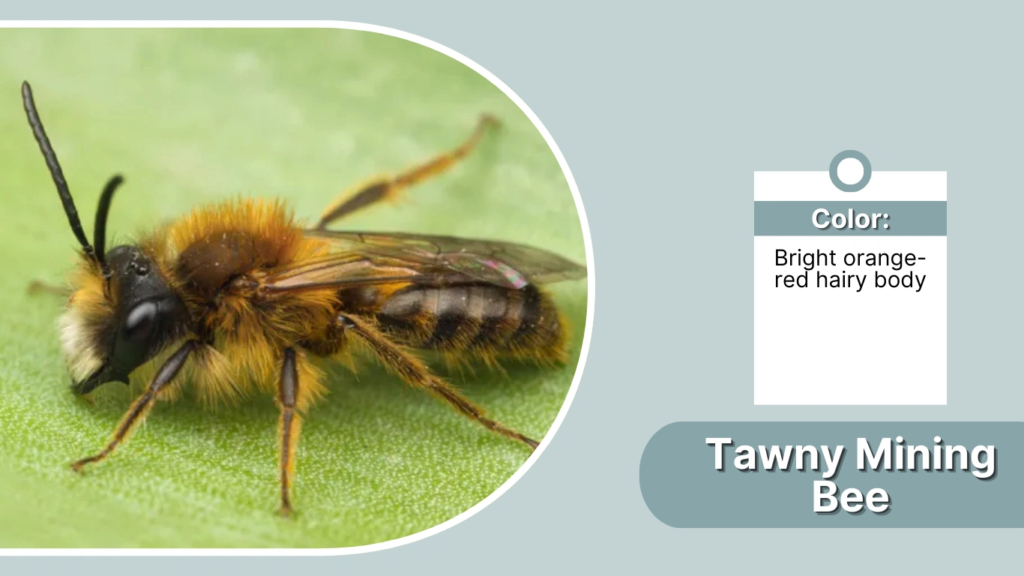
Tawny mining bees (Andrena fulva) are striking, orange-furred solitary bees common in gardens and grasslands in Europe. They are easily spotted in spring due to their vivid coloring.
Identification
- Medium size, about 10–12 mm
- Bright orange-red hairy body
- Black face and legs
- Slender shape compared to bumblebees
- Females larger and hairier than males
Habitat
They nest in lawns, grassy banks, and sandy soils, digging burrows that create small soil mounds at entrances. They prefer sunny, open areas with access to spring flowers.
Behaviors
Each female digs her own burrow, though many nest close together. They are solitary and active only in spring, especially around April and May. They are harmless and rarely sting.
Reason (Importance)
Tawny mining bees are vital spring pollinators, helping fruit trees, dandelions, and wildflowers. Their early activity supports ecosystems at the start of the growing season.
Diet & Facts
They feed on nectar and collect pollen, especially from fruit blossoms and dandelions.
Fun facts:
- Their bright orange color makes them easy to identify.
- Nests may look like ant hills due to soil mounds.
- They are among the first bees to appear after winter.
22. Metallic Green Sweat Bee

Metallic green sweat bees (Agapostemon spp.) are small, brilliantly colored bees often mistaken for flies due to their shiny, metallic appearance. They are part of the sweat bee family and are common across the Americas.
Identification
- Small to medium size, 7–12 mm
- Shiny metallic green or blue body
- Some species have striped yellow-and-black abdomens (females are fully metallic green)
- Slender, wasp-like form
- Sparse hair compared to honeybees
Habitat
They are found in gardens, meadows, and fields across North and South America. They usually nest in the ground, preferring loose or sandy soils. Some species form small communal nests.
Behaviors
They are generally solitary, though some species nest in small groups. Attracted to sweat for salts, they occasionally land on humans. They are gentle and rarely sting unless pressed.
Reason (Importance)
They are excellent pollinators of wildflowers and crops, contributing significantly to biodiversity and agriculture despite their small size.
Diet & Facts
They feed on nectar and collect pollen for larvae.
Fun facts:
- Their metallic coloration makes them among the most eye-catching bees.
- They are active through much of the summer.
- They are more abundant in warmer climates.
23. Valley Carpenter Bee
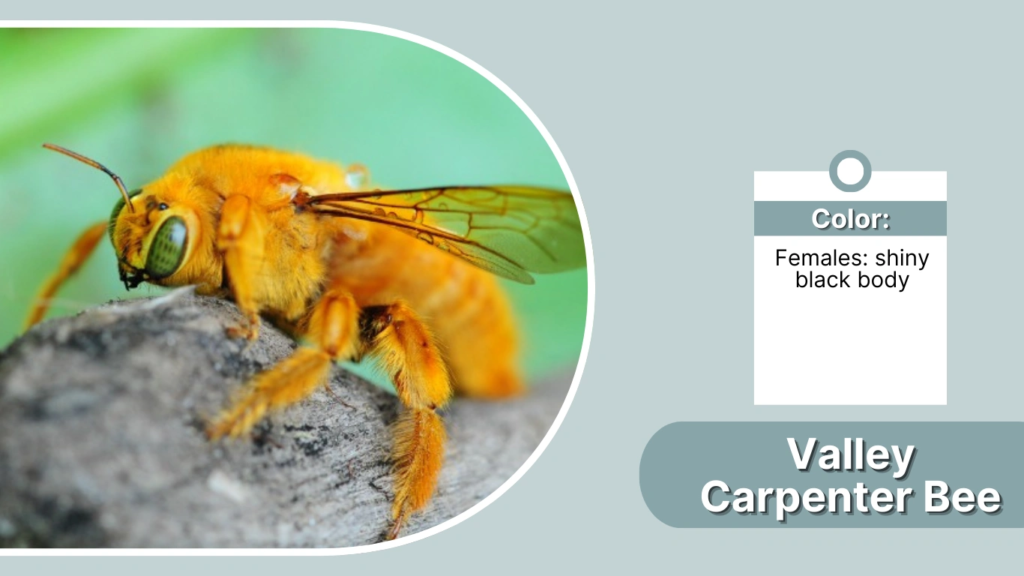
Valley carpenter bees (Xylocopa sonorina, formerly X. varipuncta) are large carpenter bees native to western North America, particularly the U.S. Southwest and Hawaii. They are known for their sexual dimorphism in color.
Identification
- Very large size, up to 25 mm
- Females: shiny black body
- Males: golden brown, fuzzy body (nicknamed “teddy bear bees”)
- Hairless abdomen (unlike bumblebees)
- Strong, buzzing flight
Habitat
They prefer warm climates and nest in dead wood, fence posts, and wooden structures by boring tunnels with their strong mandibles. They are often found in deserts, gardens, and orchards.
Behaviors
Valley carpenter bees are solitary, with females excavating tunnels to create brood chambers. Males are territorial, patrolling areas near flowers. Despite their intimidating size, they are generally gentle.
Reason (Importance)
They are important pollinators for many native plants and crops in arid regions. Their buzz pollination benefits flowers that honeybees cannot efficiently pollinate.
Diet & Facts
They feed on nectar and collect pollen.
Fun facts:
- Males cannot sting, while females rarely do.
- They are the largest native bee in the U.S. Southwest.
- Males’ golden color makes them easily distinguishable from females.
24. Rusty-Patched Bumblebee
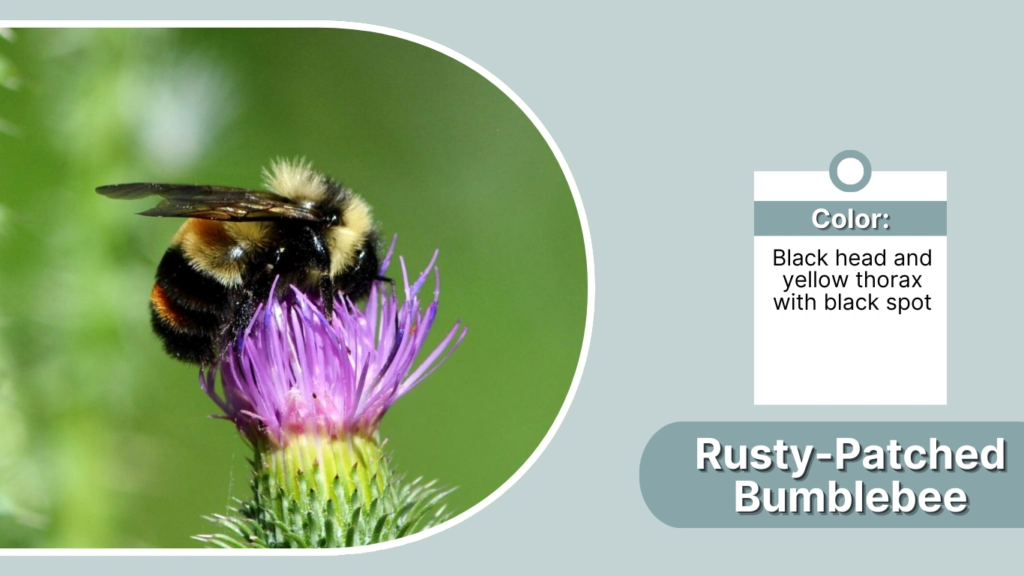
The rusty-patched bumblebee (Bombus affinis) is a critically endangered species native to North America. Once widespread, its population has declined sharply in recent decades.
Identification
- Medium-sized bumblebee, 15–20 mm
- Black head and yellow thorax with black spot
- Abdomen with yellow bands and distinctive rusty-red patch on the second segment (in workers and males)
- Fuzzy, rounded body typical of bumblebees
- Transparent wings with dark veins
Habitat
Historically found in the grasslands and prairies of the upper Midwest and northeastern U.S., as well as southern Canada. Today, its range is fragmented and limited to small, isolated populations.
Behaviors
They live in colonies, often nesting underground in abandoned rodent burrows or grassy areas. Workers forage over a wide variety of plants, and colonies are annual, dying out in winter except for new queens.
Reason (Importance)
The rusty-patched bumblebee is a vital pollinator of wildflowers and crops, including tomatoes, clover, and blueberries. Its decline poses risks to ecosystems and agriculture.
Diet & Facts
They feed on nectar and collect pollen for the colony.
Fun facts:
- Listed as endangered in the U.S. in 2017.
- One of the first bees to emerge in spring and last to forage in fall.
- Decline is due to habitat loss, pesticides, disease, and climate change.
25. Western Honeybee
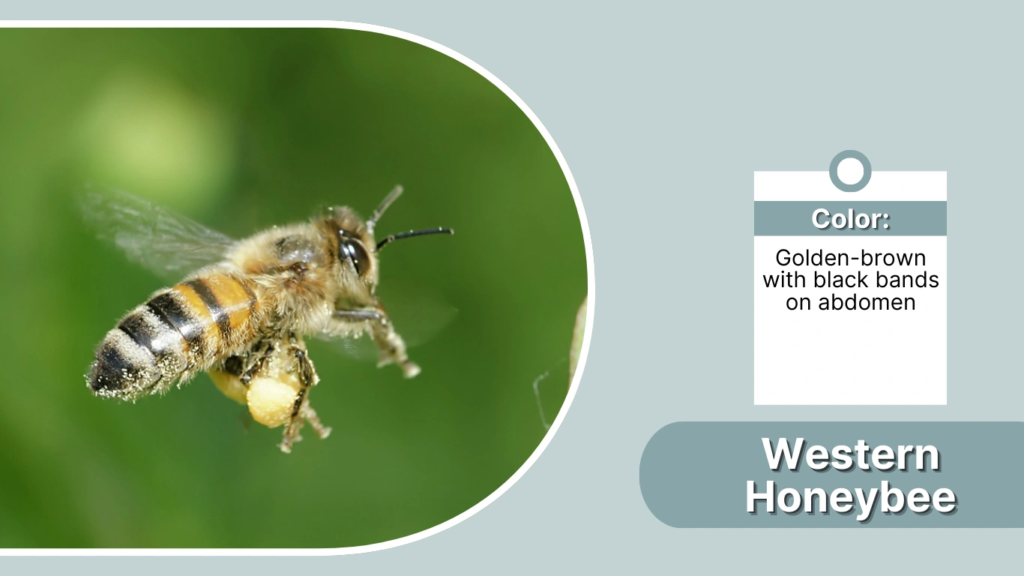
The western honeybee (Apis mellifera) is the most widely managed bee species in the world, domesticated for honey production and pollination services.
Identification
- Medium-sized, 12–15 mm long
- Golden-brown with black bands on abdomen
- Hairy body adapted for pollen collection
- Slender form compared to bumblebees
- Wings overlap when at rest
Habitat
Native to Europe, Africa, and parts of Asia, but introduced worldwide. They thrive in diverse habitats, from forests and meadows to agricultural lands, and are kept in artificial hives by beekeepers.
Behaviors
Highly social, living in colonies of tens of thousands with a caste system: queen, workers, and drones. They communicate using the waggle dance to share foraging locations. Colonies survive winters by storing honey.
Reason (Importance)
The western honeybee is the world’s most important managed pollinator, supporting crops worth billions annually. It also produces honey, beeswax, and royal jelly.
Diet & Facts
They feed on nectar and pollen, converting nectar into honey for long-term storage.
Fun facts:
- A colony can contain up to 60,000 bees.
- The queen may lay up to 2,000 eggs daily.
- Honey never spoils; edible samples have been found in ancient tombs.
