
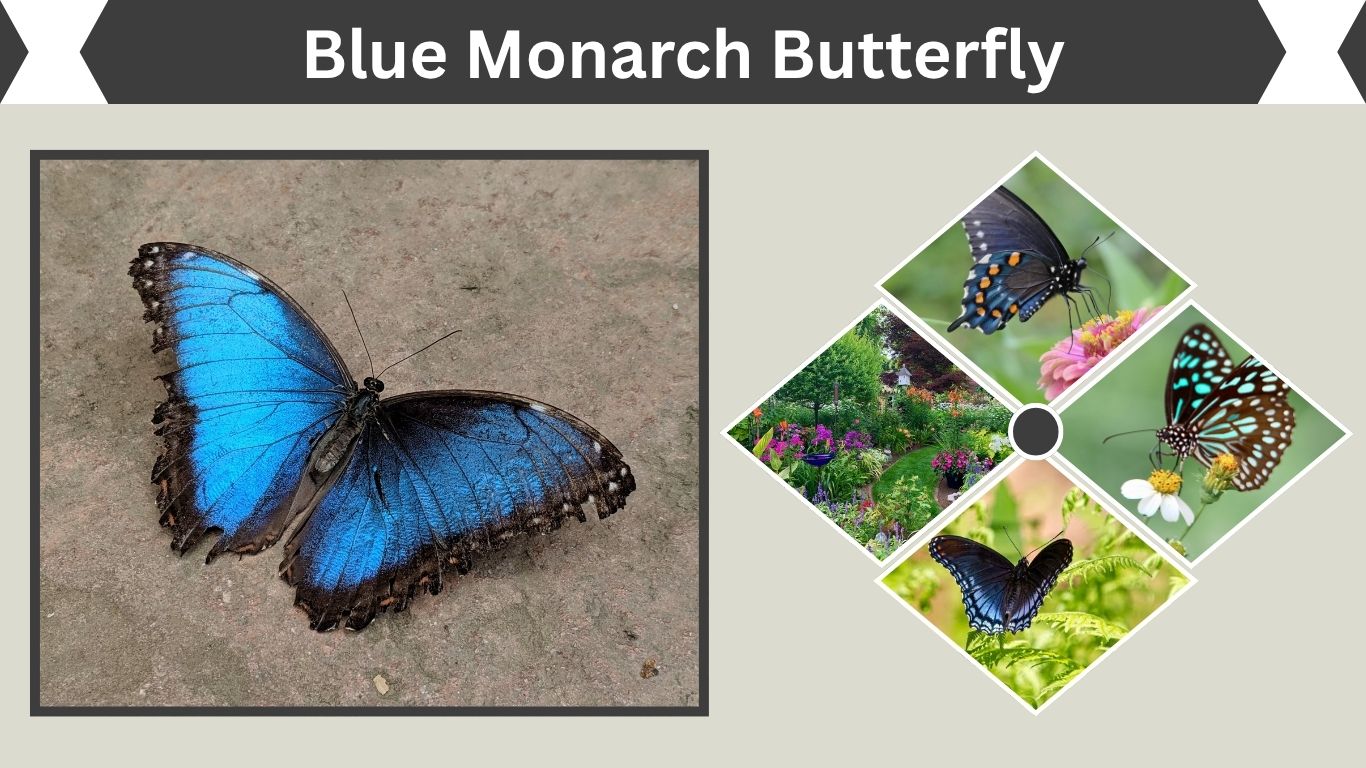
A blue monarch butterfly is usually an artistic creation, digitally altered image, or another butterfly mistakenly identified as a monarch. True monarch butterflies are orange, black, and white rather than blue. However, several real butterflies have brilliant blue wings, dark monarch-like patterns, or similar size and shape. Blue morphos, blue tiger butterflies, pipevine swallowtails, and red-spotted purples are among the insects commonly confused with a “real blue monarch.” The phrase is also widely used for tattoos, drawings, jewelry, costumes, and spiritual symbolism.
Are Blue Monarch Butterflies Real?
There is no naturally occurring blue color form of the monarch butterfly recognized as a separate species or normal variation. The monarch, Danaus plexippus, has deep orange wings divided by black veins, broad black borders, and white spots. The underside is paler orange, while males have a black scent-scale patch on each hindwing.
Images labeled as blue monarch butterflies usually show:
- A monarch photograph recolored with editing software
- Artwork based on the monarch’s wing pattern
- A blue morpho incorrectly labeled as a monarch
- A blue tiger butterfly
- A dark swallowtail with blue iridescence
- A decorative tattoo, costume, or digital illustration
A genuine monarch may sometimes look slightly different because of lighting, faded wing scales, camera settings, or shadow. Nevertheless, it will not naturally develop large bright-blue or purple wing panels.
What Colors Are Real Monarch Butterflies?
Adult monarchs are primarily orange, black, and white. Their orange wing panels are crossed by thick black veins, and the black margins contain two rows of small white spots.
Male and female monarchs differ slightly:
| Feature | Male monarch | Female monarch |
|---|---|---|
| Main wing color | Usually brighter orange | Often darker orange-brown |
| Black veins | Thinner | Thicker |
| Hindwing scent patches | Present | Absent |
| Blue coloration | Absent | Absent |
A photograph may make orange wings appear reddish, golden, pale, or brown. Strong filters can also turn orange into blue or purple, creating a convincing but biologically inaccurate image.
What Is the Butterfly Commonly Called a Blue Monarch?
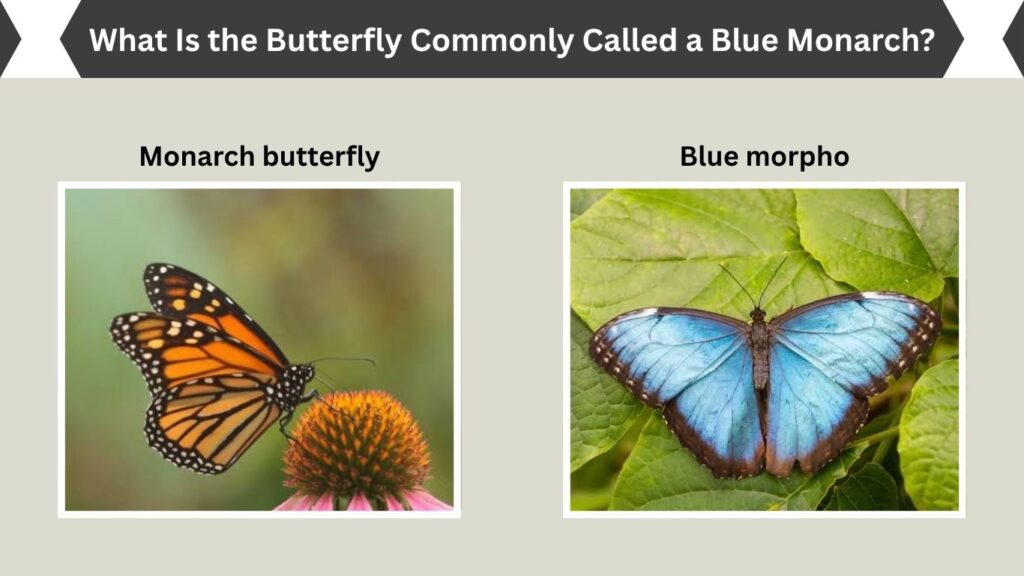
The butterfly most often imagined when people search for a blue monarch is the blue morpho. Blue morphos have large wings with intense iridescent blue upper surfaces and dark borders. They are native to tropical regions of Mexico, Central America, and South America rather than the monarch’s familiar open-field and milkweed habitats.
Their blue appearance comes largely from microscopic structures in the wing scales that reflect light. The color may seem to flash, brighten, or disappear as the butterfly changes its wing angle.
Despite the superficial similarities, blue morphos and monarchs differ considerably:
| Feature | Monarch butterfly | Blue morpho |
|---|---|---|
| Typical color | Orange, black, and white | Iridescent blue with dark edges |
| Main range | North, Central, and parts of South America | Tropical Central and South America |
| Wing pattern | Strong black veins | Broad blue panels |
| Larval host | Milkweed | Various tropical host plants |
| Famous behavior | Long-distance migration | Flashing blue forest flight |
Therefore, a blue morpho is not a blue version of the monarch.
Blue Tiger Butterfly
The blue tiger, Tirumala limniace, is another real species that may be called a blue monarch online. It has black or dark brown wings covered with pale blue spots and elongated blue streaks. Its body is also dark with numerous white markings.
Blue tigers belong to the same broader butterfly subfamily as monarchs, which helps explain their somewhat similar body shape and slow, gliding flight. However, their spotted blue-and-black pattern is very different from the monarch’s orange panels and branching black veins.
Blue tiger butterflies occur in parts of South and Southeast Asia and nearby regions. A butterfly seen in North America is therefore unlikely to be a blue tiger unless it is inside a butterfly exhibit or collection.
Black and Blue Butterflies Mistaken for Monarchs
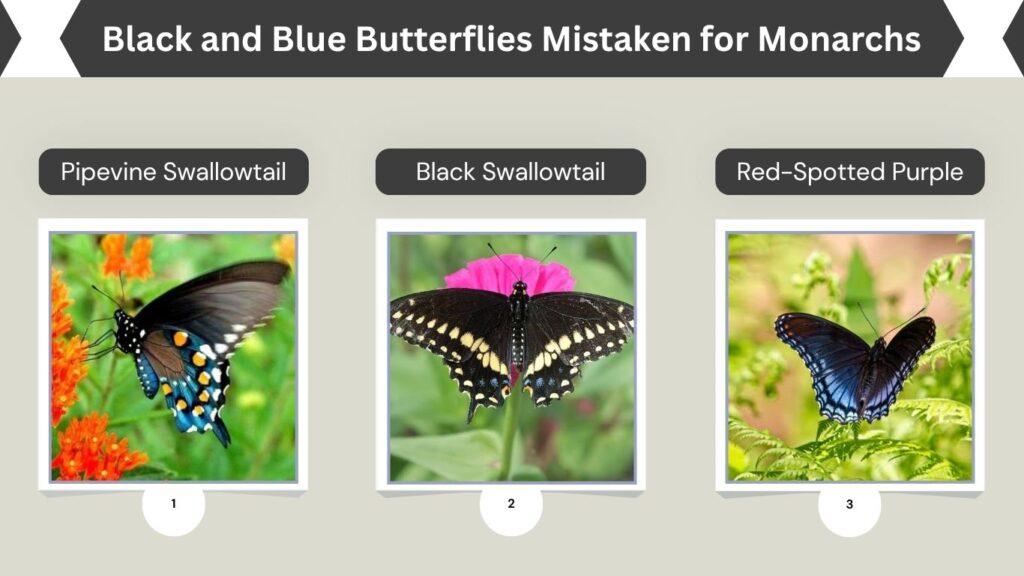
Several North American butterflies have dark wings with blue areas. These species are more likely than monarchs to explain a black-and-blue butterfly seen outdoors.
Pipevine Swallowtail
The pipevine swallowtail has dark upper wings, and its hindwings may show intense blue or blue-green iridescence. Orange spots appear along the underside of the hindwings.
It differs from a monarch because it has:
- Tail-like extensions on the hindwings
- Mostly black wings
- Blue or blue-green iridescence
- Orange spots rather than broad orange panels
- A swallowtail-shaped wing outline
A black-and-blue butterfly with obvious tails is almost certainly not a monarch.
Black Swallowtail
Female black swallowtails often have a row or band of blue scales across the hindwings. Their wings are mostly black, with yellow spots and orange-centered markings near the lower edges.
They are commonly found in gardens where their caterpillars feed on parsley, dill, fennel, and related plants. Monarch caterpillars, by contrast, depend on milkweed.
Red-Spotted Purple
The red-spotted purple is a tailless dark butterfly with blue or blue-green iridescence and orange-red spots beneath its wings. Its shape can appear somewhat monarch-like from a distance, but its colors and markings are distinctly different.
Regional butterfly records identify the red-spotted purple as one of the prominent dark, iridescent species occurring across parts of North America.
Blue and Purple Monarch Butterflies
Purple monarch butterflies do not occur as a normal natural color form either. Blue-and-purple monarch images generally result from:
- Digital recoloring
- Fantasy artwork
- Tattoo designs
- Colored lighting
- Iridescent look-alike species
- Decorative products
Blue morphos can sometimes appear violet or purple because structural coloration changes with light and viewing angle. Their wings may shift between turquoise, deep blue, and blue-purple, which may lead viewers to call them purple monarchs.
Blue and Orange Monarch Butterfly
A true monarch combines orange with black and white, not blue. A butterfly displaying both blue and orange is more likely to be a swallowtail, red-spotted purple, or another iridescent species.
For example, pipevine swallowtails may show blue-green hindwings and orange spots, while black swallowtails combine dark wings, blue scales, and orange-centered markings.
When identifying an unknown butterfly, pay attention to wing shape, tails, spots, flight behavior, location, and host plants rather than relying on color alone.
Does a Blue Monarch Butterfly Have a Caterpillar?
Because a true blue monarch does not exist, there is no separate blue monarch caterpillar.
Real monarch caterpillars are striped with black, white, and yellow and have pairs of black filaments near the front and rear of the body. They feed on milkweed before forming a green chrysalis with gold markings.
A caterpillar associated with a blue morpho, blue tiger, or swallowtail will look different and use different host plants. Butterfly color in adulthood does not necessarily predict the caterpillar’s color.
Where Would a “Blue Monarch” Live?
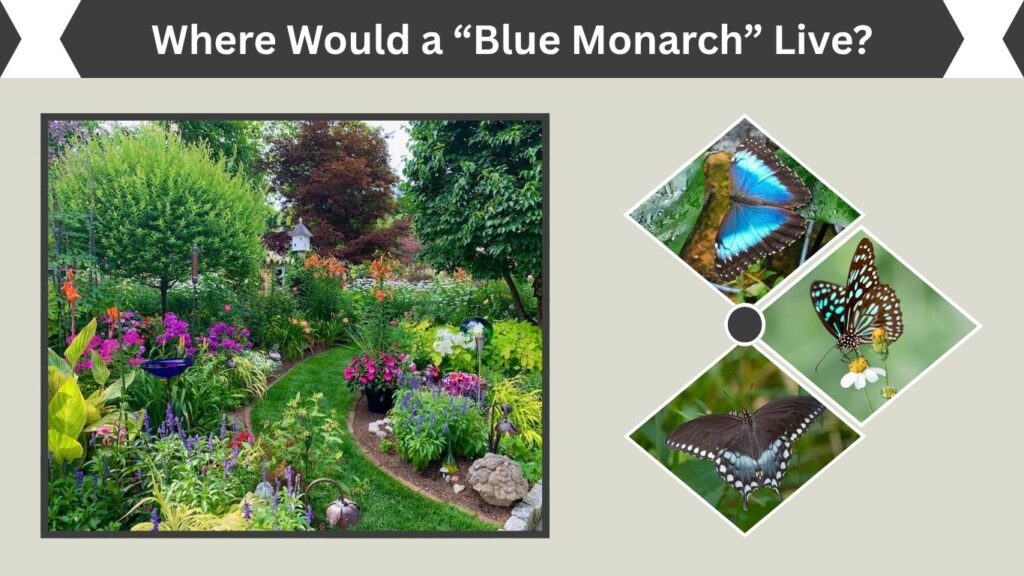
A genuine monarch may occur across much of North America and other parts of the world, but it will retain its orange-and-black coloring. A blue butterfly’s likely habitat depends on its actual species.
Blue Morpho Habitat
Blue morphos inhabit tropical forests from Mexico through Central America and into South America. They are strongly associated with humid forest environments.
Blue Tiger Habitat
Blue tiger butterflies occur in warm Asian regions and use forests, woodland edges, gardens, and migration gathering sites.
Blue-Black Swallowtail Habitat
Pipevine and black swallowtails may occur in gardens, fields, woodland edges, and areas containing their larval host plants. Their exact range depends on the species.
A location is therefore one of the best clues for rejecting an incorrect “blue monarch” identification.
Why Do Blue Butterflies Look So Bright?
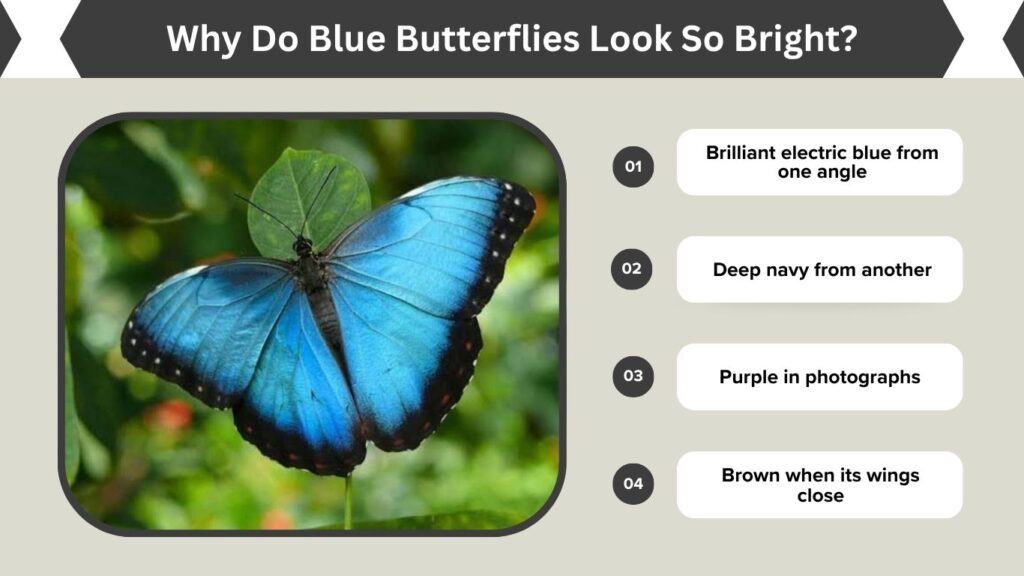
Many blue butterflies obtain their color through microscopic wing structures rather than blue pigment alone. These structures interact with light, reflecting certain wavelengths and producing brilliant iridescence.
This structural coloration explains why a blue morpho may look:
- Brilliant electric blue from one angle
- Deep navy from another
- Purple in photographs
- Brown when its wings close
- Almost invisible in shade
The effect is very different from the monarch’s comparatively stable orange pigmentation.
Blue Monarch Butterfly Meaning
The meaning of a blue monarch butterfly comes from art, culture, dreams, and personal interpretation rather than zoology. Since blue monarchs are not a natural biological form, their symbolism combines the traditional meaning of butterflies with associations linked to the color blue.
Common interpretations include:
- Transformation
- Emotional healing
- Peace and calm
- Freedom
- Hope
- Spiritual growth
- Communication
- Intuition
- Rare beauty
- A new stage of life
These meanings are subjective. Seeing a blue butterfly in a dream or choosing one for a tattoo does not carry a universally established message.
Black and Blue Monarch Butterfly Meaning
A black-and-blue monarch design often represents transformation after hardship. Black may symbolize mystery, grief, strength, or endings, while blue may suggest peace, loyalty, healing, or spiritual awareness.
Together, the colors are commonly used to express:
- Recovery after loss
- Inner strength
- Emotional change
- Freedom from the past
- Balance between sorrow and hope
- Personal reinvention
These symbolic ideas are popular in tattoos and memorial artwork but should not be presented as scientific facts.
Blue Monarch Butterfly Tattoo Ideas
Blue monarch tattoos usually preserve the monarch’s familiar black vein pattern while replacing orange with blue, teal, or purple.
Popular designs include:
- Realistic blue-and-black monarch
- Watercolor blue monarch
- Small minimalist butterfly
- Blue monarch with flowers
- Half monarch and half geometric pattern
- Blue monarch memorial tattoo
- Three-dimensional monarch design
- Butterfly with stars or a moon
- Blue and purple gradient wings
- Black monarch with blue highlights
A biologically inspired design can use monarch-shaped wings while clearly remaining artistic rather than claiming to represent a natural color variation.
Blue Monarch Drawings, Costumes, and Artwork
The phrase “blue monarch butterfly” is also commonly used for fantasy illustrations, clipart, paintings, costume wings, wallpaper, jewelry, and fabric patterns.
Artists often recolor monarch wings because the thick black veins create an attractive framework for blue, purple, or turquoise panels. These designs can look realistic even though the color pattern does not occur naturally.
Educational illustrations should label such images as stylized or fictional to prevent species-identification confusion.
FAQs
Are blue monarch butterflies real?
No naturally blue form of the monarch butterfly is recognized. Real monarchs have orange wings with black veins, black borders, and white spots. Images of blue monarchs usually depict edited photographs, art, or a different butterfly species.
What butterfly looks like a blue monarch?
The blue morpho is the most famous large blue butterfly, while blue tiger butterflies have a dark monarch-like shape with pale blue markings. Pipevine swallowtails and red-spotted purples are other possible black-and-blue look-alikes.
Are blue monarch butterflies rare?
They are not rare because they do not exist as a natural monarch color form. A real blue butterfly may be rare or common depending on its actual species and location. Identification requires more than color alone.
Can monarch butterflies be blue or purple?
Normal monarch butterflies cannot be blue or purple. Lighting and digital editing may alter their appearance, while blue morphos and other iridescent species can shift between blue and violet depending on the viewing angle.
What does a blue monarch butterfly symbolize?
In art and tattoos, a blue monarch commonly symbolizes transformation, peace, hope, emotional healing, spiritual development, or freedom. The interpretation is personal and cultural rather than a scientifically defined meaning.
