

When people think of wasps, they often imagine aggressive yellowjackets or hornets buzzing around picnics. However, the world of wasps is much broader and more fascinating. Among them, parasitic wasps stand out as one of the most diverse and ecologically significant groups. Instead of building paper nests and stinging humans, these wasps have evolved to lay their eggs inside or on other insects, turning them into living hosts for their young.
Though small and often overlooked, parasitic wasps play a crucial role in regulating insect populations. They are natural enemies of caterpillars, beetles, aphids, and other pests, making them valuable allies in both agriculture and ecosystems. Far from being a nuisance, they are one of nature’s most effective biological control agents.
Scientific Classification and Name
- Order: Hymenoptera (the same order as ants, bees, and other wasps)
- Suborder: Apocrita
- Superfamilies/Families: Includes Ichneumonoidea (Ichneumonidae, Braconidae), Chalcidoidea (Chalcid wasps), Cynipoidea (Gall wasps), and many others.
- Common Term: Parasitic wasps, sometimes called parasitoid wasps.
With over 100,000 described species worldwide, and likely many more undiscovered, parasitic wasps form one of the largest and most diverse insect groups.
Physical Appearance and Identification
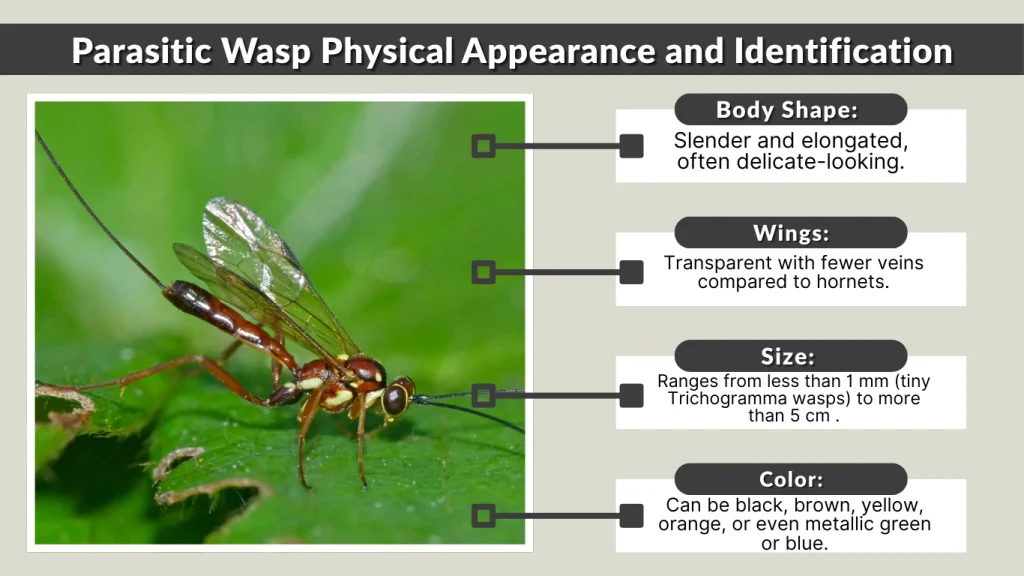
Parasitic wasps vary greatly in size, shape, and color, depending on the family and species. However, they share some general characteristics that distinguish them from social wasps.
General Features
- Body Shape: Slender and elongated, often delicate-looking.
- Antennae: Long, segmented antennae used to sense chemical signals from hosts.
- Wings: Transparent with fewer veins compared to hornets or yellowjackets.
- Ovipositor: The most distinctive feature — a long, needle-like structure used for laying eggs into or onto hosts. In some species, it can be longer than the wasp’s body.
Variations Among Types
- Size: Ranges from less than 1 mm (tiny Trichogramma wasps) to more than 5 cm (giant Ichneumon wasps).
- Color: Can be black, brown, yellow, orange, or even metallic green or blue.
- Resemblance: Some species mimic ants or flies, helping them avoid predators.
Though their appearance may seem intimidating, parasitic wasps are harmless to humans and rarely noticed unless specifically sought out.
Types of Parasitic Wasps

The term “parasitic wasp” covers thousands of species across multiple families. A few important groups include:
Ichneumon Wasps
- Belong to the family Ichneumonidae, one of the largest families in the animal kingdom.
- Often large, with extremely long ovipositors.
- Target caterpillars, beetle larvae, and sawflies.
- Many species are active in forests and gardens, helping control pests naturally.
Braconid Wasps
- Smaller than ichneumons but just as effective.
- Family Braconidae includes thousands of species.
- Commonly parasitize caterpillars, aphids, and beetle grubs.
- Widely used in agriculture as biological control agents against crop pests.
Chalcid Wasps
- Family Chalcidoidea, one of the tiniest wasps (often less than 2 mm).
- Brilliant metallic colors (blue, green, gold).
- Specialize in parasitizing insect eggs and larvae.
- Used commercially in greenhouses to control whiteflies, leaf miners, and aphids.
Trichogramma Wasps
- Belong to Trichogrammatidae family.
- Extremely tiny, often smaller than a grain of sand.
- Lay eggs inside pest eggs (like moth eggs in corn, sugarcane, or rice fields).
- Among the most widely released wasps for pest control worldwide.
Habitat and Distribution
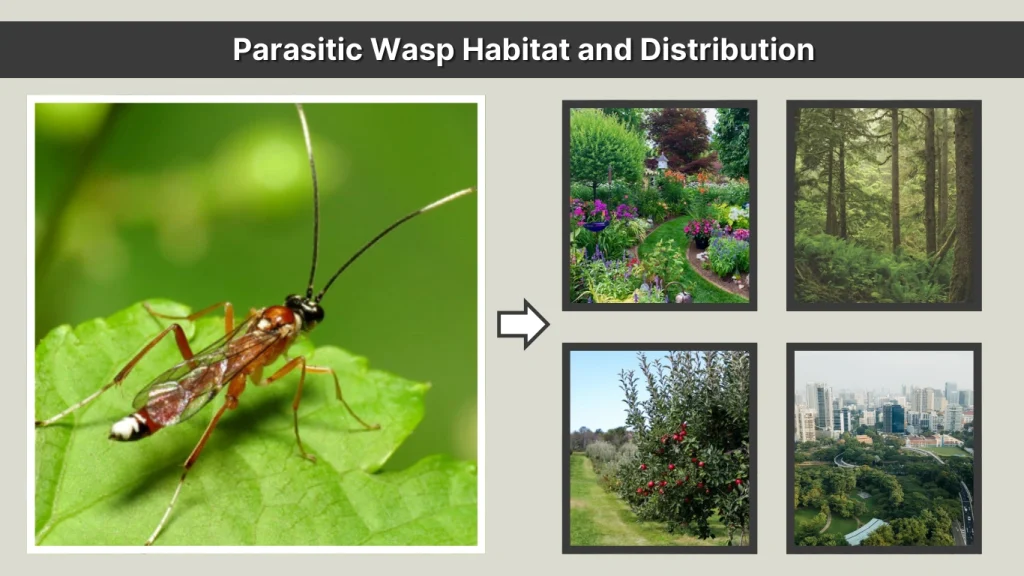
Parasitic wasps are found worldwide, from tropical rainforests to deserts, grasslands, and urban backyards. Their distribution depends largely on the presence of hosts, since they cannot survive without them.
Common Habitats
- Gardens: Preying on caterpillars, aphids, and beetles.
- Forests: Controlling populations of leaf-eating larvae.
- Farms and Orchards: Naturally regulating crop pests.
- Urban Environments: Often unnoticed but present in flower beds, shrubs, and trees.
Because of their ecological importance, many species are intentionally introduced or conserved in agricultural systems as part of integrated pest management (IPM).
Life Cycle of a Parasitic Wasp

The life cycle of a parasitic wasp is one of the most fascinating and sometimes gruesome examples of insect survival. It involves turning another insect into a living incubator.
Egg Stage
The female wasp uses her ovipositor to deposit eggs inside or on the surface of a host. Hosts can be caterpillars, beetles, flies, aphids, or even spiders. Depending on the species:
- Some inject a single egg into a host.
- Others lay dozens of eggs, leading to multiple larvae developing inside one victim.
Larval Stage
Once the eggs hatch, the larvae feed on the host’s tissues. Many parasitic wasps follow a very strategic feeding process:
- They begin by consuming non-vital organs to keep the host alive as long as possible.
- As they grow, they eventually consume the host completely, killing it.
Some species manipulate host behavior, effectively creating “zombie insects”. For example, certain wasps make their host defend the wasp’s pupae before dying.
Pupal Stage
After feeding on the host, parasitic wasp larvae eventually pupate. This can happen:
- Inside the Host: The larvae remain within the host’s body, forming pupal cases. The host dies shortly after or during this process.
- Outside the Host: Some larvae exit the host and spin cocoons nearby, often leaving behind the hollowed-out body.
- Attached Cocoons: In species like braconid wasps, multiple white cocoons can often be seen clustered on a caterpillar’s back.
The pupal stage lasts from a few days to several weeks, depending on the species and climate.
Adult Stage
When the transformation is complete, adult wasps emerge. Their main priorities are finding nectar for energy and locating new hosts for egg-laying.
- Lifespan: Adults live for a few days to a couple of weeks.
- Feeding: Adults feed on nectar, honeydew, and sometimes fluids from their hosts.
- Reproduction: Females devote most of their time to seeking suitable hosts, guided by chemical cues and vibrations.
This cycle repeats, with each generation controlling more pest populations in its environment.
Sting and Interaction with Humans
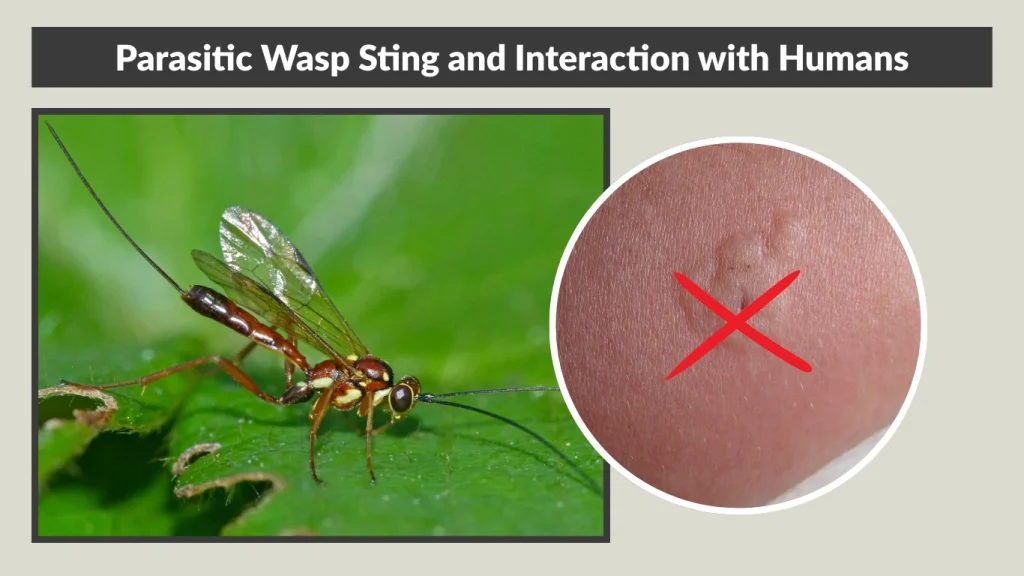
One of the most important questions about parasitic wasps is whether they sting humans.
- Most Species: Do not sting humans. Their ovipositors are specialized for laying eggs, not defense.
- Larger Species (Ichneumon Wasps): May look intimidating due to their long ovipositors, but they are completely harmless.
- Rare Exceptions: A few species may deliver a mild defensive sting, but it is extremely rare and not dangerous.
In summary, parasitic wasps are harmless to humans and pets but deadly efficient against insect pests.
Behavior and Host-Parasite Interaction
Parasitic wasps have evolved remarkable strategies to ensure survival of their young:
- Host Manipulation: Some alter the host’s behavior, turning them into bodyguards that protect wasp pupae until death.
- Chemical Warfare: They inject venom or symbiotic viruses (polydnaviruses) into the host to suppress its immune system.
- Selective Feeding: Larvae consume non-essential organs first, keeping the host alive until the last stages.
These behaviors make parasitic wasps one of the most complex and fascinating insect groups studied by entomologists.
Ecological Importance
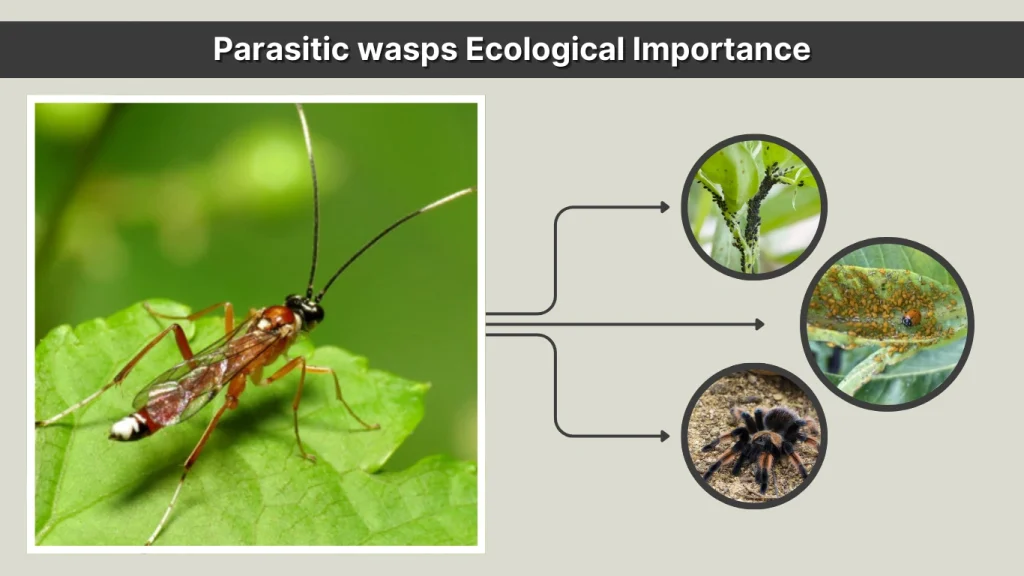
Parasitic wasps are among the most important natural regulators of insect populations.
- Pest Control: They keep populations of caterpillars, beetles, aphids, and flies in check.
- Balance in Ecosystems: Prevent outbreaks of herbivorous insects that could damage plants.
- Food Web Role: Serve as prey for birds, spiders, and other predators, linking multiple levels of the ecosystem.
Without parasitic wasps, pest populations would rise uncontrollably, threatening crops and forests alike.
Parasitic Wasps in Agriculture
Because of their effectiveness, parasitic wasps are widely used in integrated pest management (IPM).
- Trichogramma Wasps: Released to control moth pests in corn, rice, and sugarcane.
- Braconid Wasps: Used in greenhouses against aphids and whiteflies.
- Chalcid Wasps: Target stored-product pests and fruit flies.
These wasps reduce the need for chemical pesticides, making farming more sustainable and eco-friendly.
Are Parasitic Wasps Dangerous?
- To Humans: No. They are solitary, non-aggressive, and harmless.
- To Pests: Extremely effective. Many pests fall victim to their parasitism, keeping populations naturally controlled.
- To Gardens: Beneficial, as they protect plants without damaging them.
For this reason, gardeners often encourage parasitic wasps by planting nectar-rich flowers to sustain adults.
Conservation of Parasitic Wasps
Though abundant, parasitic wasps face threats:
- Habitat Loss: Urbanization reduces host availability.
- Pesticide Use: Chemicals kill both wasps and their host insects, disrupting natural balance.
- Climate Change: Alters host distributions and seasonal cycles.
Conservation Strategies
- Planting wildflowers and nectar sources in gardens.
- Reducing pesticide use.
- Supporting biodiversity in farms and natural landscapes.
FAQs
What is a parasitic wasp?
A parasitic wasp is an insect that lays its eggs in or on another insect (the host). The larvae then develop by feeding on the host, eventually killing it. They belong to several families within the order Hymenoptera.
Do parasitic wasps sting humans?
Most parasitic wasps do not sting humans. Their ovipositors are designed for egg-laying, not defense. Larger wasps like ichneumons may appear threatening, but they are harmless and rarely interact with people.
What do parasitic wasps eat?
Adult parasitic wasps feed on nectar, honeydew, and occasionally host fluids. The larvae, however, feed directly on the tissues of their host insect, consuming it gradually until it dies.
How do parasitic wasps control pests?
By laying eggs inside or on pests such as caterpillars, aphids, and beetles, parasitic wasps ensure their larvae destroy the host. This natural process reduces pest populations and provides biological control for crops and gardens.
Are parasitic wasps beneficial for gardens?
Yes, parasitic wasps are highly beneficial. They target destructive insects like tomato hornworms, aphids, and beetle larvae, protecting garden plants without harming people or pets.
